What is PPS-1 special power of attorney in tax matters?
PPS-1 (Pełnomocnictwo szczególne) is the official form for a special power of attorney in Polish tax matters, under art. 138e of the Tax Ordinance. It lets a person you choose — a relative, an accountant, an advocate, a legal adviser or a tax adviser — act for you in one named tax matter, or within a scope you describe, before the tax authority handling it: tax proceedings, a refund request, a tax audit, a local-tax assessment or a tax-ruling application.
It differs from its sister forms. UPL-1 and UPL-1P only let someone sign your tax returns (electronic and paper returns respectively); PPS-1 covers acting in a case, not signing returns. The general power of attorney for all tax matters is PPO-1, filed electronically to the Central Register of General Powers of Attorney. PPS-1 is a paper form delivered to the authority dealing with your case, and stamp duty applies unless an exemption does.
FileIt guides you through each part in plain English, pre-fills your name from your People records, checks NIP and PESEL check digits, strikes out 'NIP' or 'PESEL' as the form asks, checks your description fits item 71, and prints everything in capitals onto the Ministry's own PDF, saved in your vault. You print, sign and deliver it yourself — FileIt never sends anything to any tax authority.
- Who fills it
- The principal (mocodawca), or the attorney or further attorney filing the power of attorney they received
- Given to
- The tax authority handling the matter (organ podatkowy właściwy w sprawie)
- When
- Before the attorney acts in the matter — it takes effect from the day the authority is notified
- Signatures
- Signed by hand by the principal, or by up to three representatives of a company per copy
- Stamp duty
- Payable unless not due or exempt; proof of payment attached (the form doesn't print the amount)
- Edition
- PPS-1(3)
Who needs to fill out PPS-1 special power of attorney in tax matters?
- Individuals who want a family member or adviser to deal with a particular tax case for them, such as a refund of overpaid tax or questions from the tax office.
- Companies and other organisations appointing a tax adviser, advocate or legal adviser to represent them in specific tax proceedings or a tax audit.
- Heirs and legal successors who want someone to handle a tax matter concerning an estate or a predecessor's taxes.
- Anyone applying for an individual or general tax ruling who wants a representative to deal with the application.
- Non-residents without a Polish NIP or PESEL, who can identify themselves on PPS-1 with a passport or a foreign identification number.
- Professional attorneys who file a power of attorney they received, or appoint a further attorney where the principal allowed it.
When to use PPS-1 special power of attorney in tax matters
- When a tax office, customs and tax office or municipal tax authority is dealing with a case and you want someone else to act in it for you.
- Before a tax audit or tax proceedings begin, so that your representative can take part, give explanations and receive letters.
- When you want to limit what your representative can do to one case or one set of actions — a general power of attorney (PPO-1) cannot be limited.
- When you already have more than one attorney in the same matter and need to name one of them as the attorney for service (who receives the letters).
- When your attorney needs to appoint a further attorney (substitution) — this can be reported on the same form.
- To change, revoke or terminate a special power of attorney later, the Ministry publishes a separate notice form, OPS-1.
What you need before you start
- The exact name of the tax authority handling the matter, e.g. NACZELNIK URZĘDU SKARBOWEGO W GDAŃSKU, or the mayor (burmistrz) for local taxes.
- Your NIP or PESEL — or, for a non-resident without one, a passport or other identity document.
- Your address, including province (województwo), county (powiat) and municipality (gmina) for a Polish address.
- The attorney's name, NIP or PESEL, and address for service in Poland or electronic address.
- For a professional attorney: their professional list entry number and electronic address.
- A clear description of the matter: proceedings, tax, period and any case reference.
- Proof of stamp duty payment, or the legal basis for no duty or the exemption.
What’s on PPS-1 special power of attorney in tax matters
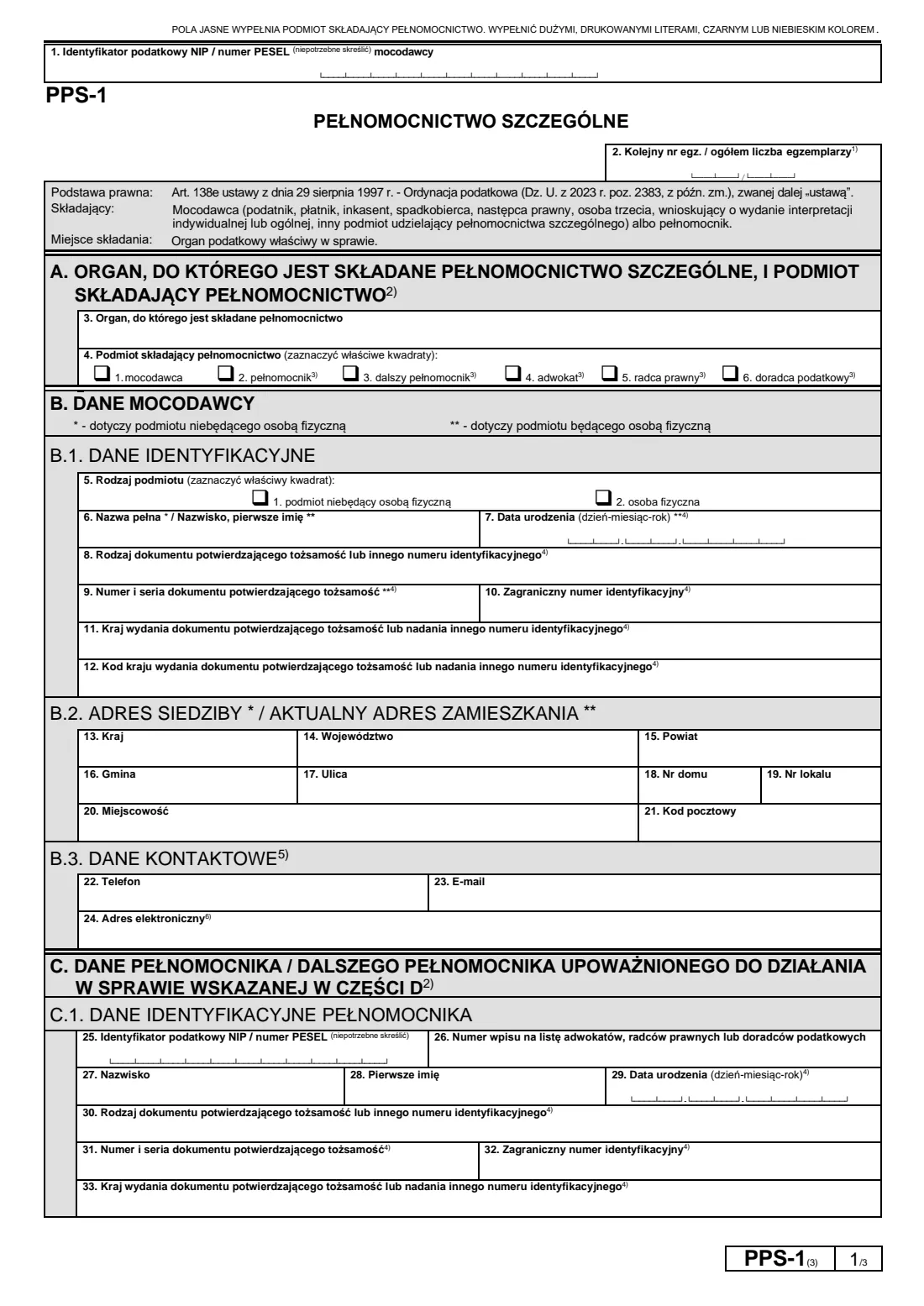
The 2026 edition has 3 pages. FileIt asks for it in 12 parts:
- A. Where it goes and who files it (Organ, do którego jest składane pełnomocnictwo szczególne, i podmiot składający)Principal (mocodawca)
- B.1 The principal — who grants the power of attorney (Dane mocodawcy)Principal (mocodawca)
- B.2 Principal's registered office or current home address (Adres siedziby / aktualny adres zamieszkania)Principal (mocodawca)
- B.3 Principal's contact details (Dane kontaktowe)Principal (mocodawca)
- C.1 The attorney — who will act in the matter (Dane identyfikacyjne pełnomocnika)Principal (mocodawca)
- C.2 Attorney's address for service in Poland (Adres pełnomocnika do doręczeń w kraju)Principal (mocodawca)
- C.3 Attorney's contact details (Dane kontaktowe pełnomocnika)Principal (mocodawca)
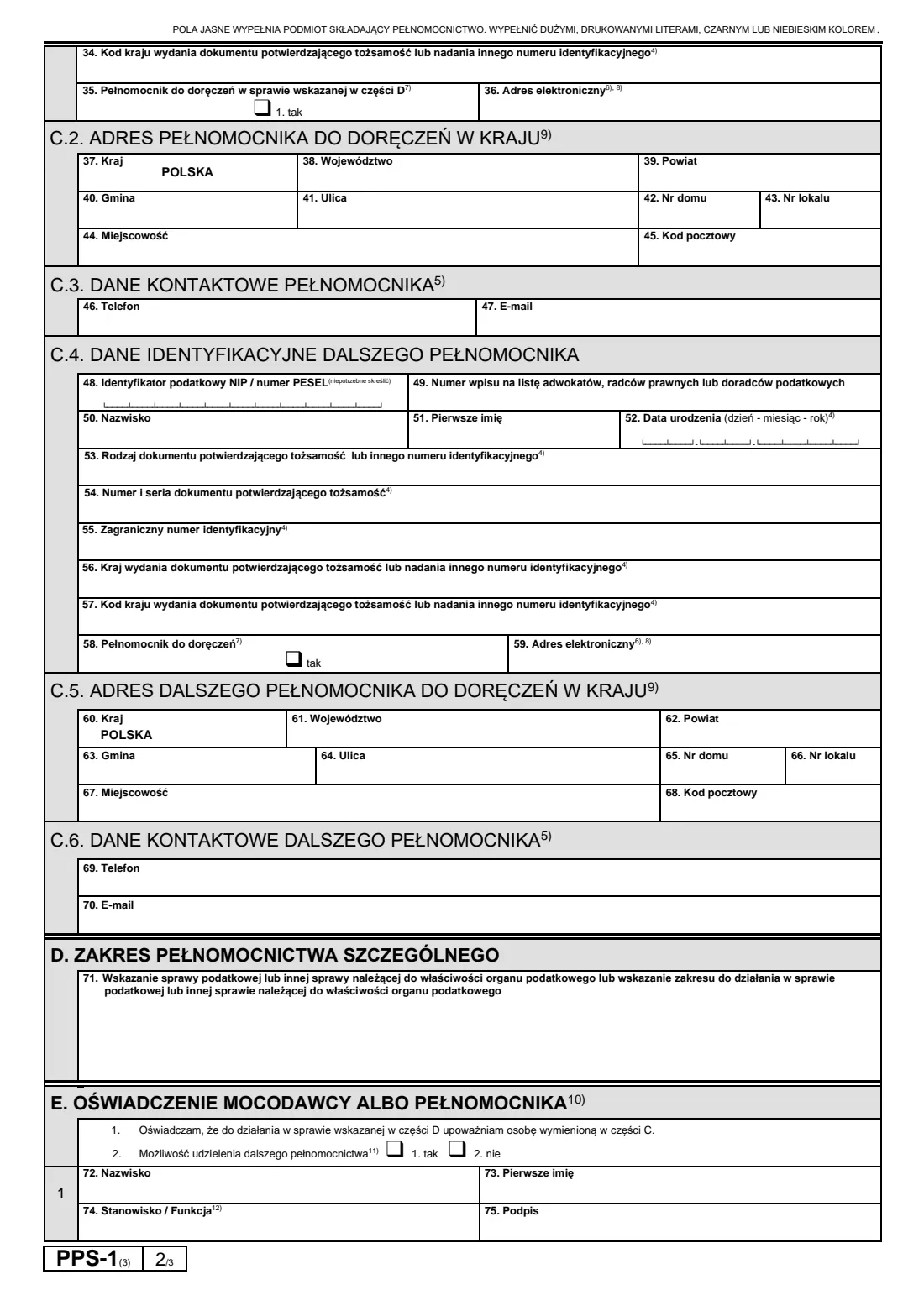
- C.4–C.6 A further attorney (Dalszy pełnomocnik)Principal (mocodawca)
- D. The matter the power of attorney covers (Zakres pełnomocnictwa szczególnego)Principal (mocodawca)
- E. Statement and who signs (Oświadczenie mocodawcy albo pełnomocnika)Principal (mocodawca)
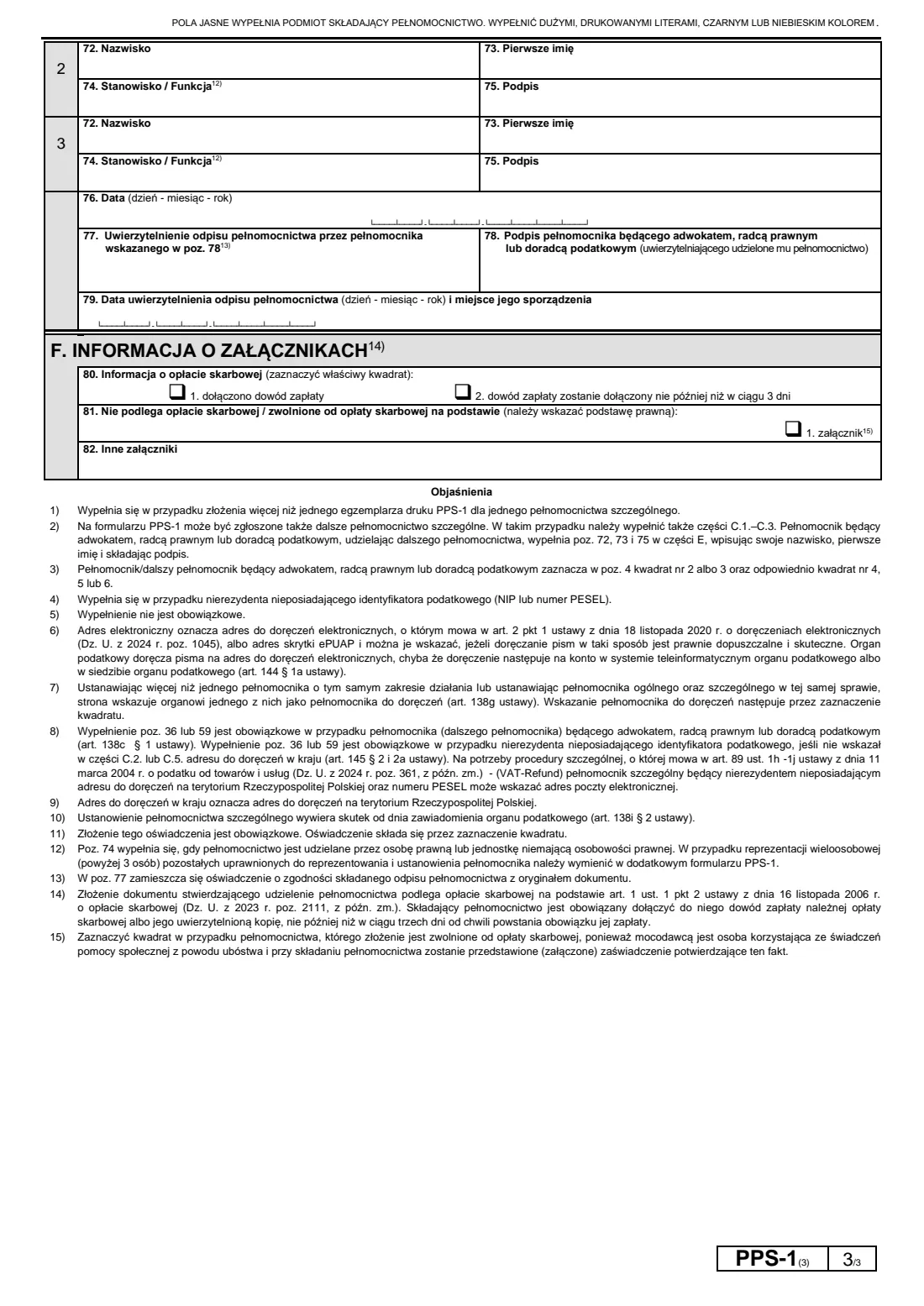
- Certified copy by a professional attorney (items 77–79)Professional attorney
- F. Stamp duty and attachments (Informacja o załącznikach)Principal (mocodawca)
How to fill out PPS-1 special power of attorney in tax matters, step by step
1 Items 1–2: Principal's NIP / PESEL and copy number
Item 1 at the top of every PPS-1 carries the principal's tax identifier. A company gives its NIP; a person gives the PESEL, or the NIP if they run a business or are registered for VAT. The form asks you to strike out whichever of 'NIP' and 'PESEL' you are not using, and FileIt does this for you from the length of the number.
Item 2 is only filled in when one power of attorney needs more than one PPS-1 — for example when more than three people must sign for a company. It records this copy's number and the total number of copies.
2 A. The authority and who files the form
Item 3 names the tax authority the power of attorney is filed with: the authority handling the matter. Item 4 says who is filing it — the principal, the attorney, or a further attorney. A professional attorney ticks box 2 or 3 and also box 4, 5 or 6 to say whether they are an advocate, a legal adviser or a tax adviser (footnote 3).
3 B.1 Principal's identification
Item 5 says whether the principal is a natural person or an organisation, and item 6 gives the organisation's full name or the person's surname and first name. Items 7–12 are only for a non-resident with no Polish NIP or PESEL (footnote 4): date of birth, identity document type, number and series, any foreign identification number, and the issuing country and its code.
4 B.2 and B.3 Principal's address and contact details
B.2 is a company's registered office or a person's current home address, with the Polish administrative units — province, county and municipality. B.3 (phone, email, electronic address) is optional (footnote 5); the electronic address means an e-delivery address or ePUAP box (footnote 6).
5 C.1–C.3 The attorney
Part C identifies the person who will act: NIP or PESEL and name, plus the professional list entry number for an advocate, legal adviser or tax adviser (item 26). A non-resident without a Polish identifier gives identity document details instead (items 29–34).
Item 35 marks the attorney for service — the one who receives letters when there is more than one attorney in the same matter (footnote 7). Item 36, the electronic address, is compulsory for professional attorneys and for a non-resident with no Polish address for service (footnote 8). C.2 is the address for service in Poland (country pre-printed as POLSKA); C.3 contact details are optional.
6 C.4–C.6 A further attorney (optional)
A PPS-1 can also report a further special power of attorney — someone the attorney appoints in turn (footnote 2). C.4–C.6 then describe the further attorney the same way as C.1–C.3. FileIt shows these parts only when you switch them on.
7 D. Scope of the special power of attorney
Item 71 is the heart of the form: name the tax matter (or other matter within the tax authority's competence), or describe the scope of acting in it. Be specific — the kind of proceedings, the tax, the period and a case reference number if you have one. A special power of attorney covers only what is written here.
FileIt checks that your text fits the five printed lines of item 71 and tells you if it needs shortening.
8 E. Statement and signatures
Statement 1 is printed: you authorise the person in part C to act in the matter in part D. Statement 2 — whether the attorney may appoint a further attorney — must be answered (footnote 11).
Items 72–75 list who signs: a person signs for themselves; an organisation lists up to three representatives with their positions, and any more go on an additional PPS-1 (footnote 12). Item 76 is the date.
9 Items 77–79: Certified copy by a professional attorney
When an advocate, legal adviser or tax adviser files a copy of the power of attorney granted to them, they can certify the copy themselves. Item 77 holds their statement that the copy matches the original (footnote 13), item 78 their signature, and item 79 the date and place of the certification. Most people leave this part empty.
10 F. Stamp duty and attachments
Footnote 14 says filing a document granting a power of attorney is subject to stamp duty under art. 1(1)(2) of the Stamp Duty Act of 16 November 2006, and proof of payment must be attached no later than three days after the obligation arises. Item 80 records whether the proof is attached or will follow within three days.
If no duty is due or an exemption applies, item 81 gives the legal basis; its box 1 is for a principal receiving social assistance due to poverty, with the certificate attached (footnote 15). Item 82 lists other attachments. The form does not print the amount.
Common mistakes to avoid
- Using PPS-1 to let someone sign your tax returns — that needs UPL-1 (electronic returns) or UPL-1P (paper returns).
- Describing the matter too vaguely in item 71. A special power of attorney only covers what it names, so give the proceedings, tax, period and any reference number.
- Sending the form to the wrong office. PPS-1 goes to the authority handling the matter, which for local taxes may be the mayor or municipality rather than the tax office.
- Forgetting stamp duty. Attach proof of payment, or give the legal basis if no duty is due, as part F asks.
- Leaving statement 2 in part E unanswered — the form says it is compulsory — or reporting a further attorney while answering 'no'.
- Ticking 'attorney for service' for more than one attorney in the same matter; only one person can receive the letters.
After you fill it out
Print the PDF and have the principal — or each person representing a company — sign by hand. Pay any stamp duty due and attach the proof and the other attachments listed in part F.
Deliver the form to the tax authority handling the matter, in person or by post. It takes effect from the day that authority is notified (footnote 10). To change or revoke it later, the Ministry publishes a separate notice, OPS-1. Keep the signed copy and proof of payment in your FileIt vault with the case documents.
Fill out PPS-1 special power of attorney in tax matters online with FileIt
- Pick the person. Choose someone from People and FileIt fills in their name, date of birth, address and other details it already knows.
- Answer plain-language questions. One part of the form at a time, with the official help text beside each question — 99 fields in all. Your answers save as you go.
- Check the live preview. Watch your answers land on the real Ministerstwo Finansów — Ministry of Finance of Poland (MF) form, and let FileIt do any worksheet arithmetic.
- Generate the official PDF. FileIt prints your answers into the agency’s own PDF and files it in that person’s folder in your vault.
FileIt fills the form — it never files or submits anything for you. Deliver the finished form to whoever asked for it, the way the form’s instructions say.
Start PPS-1 special power of attorney in tax matters now — it’s freePPS-1 special power of attorney in tax matters: frequently asked questions
What is the difference between PPS-1 and UPL-1 or UPL-1P?
UPL-1 and UPL-1P only authorise someone to sign tax returns — UPL-1 for returns filed electronically, UPL-1P for paper returns. PPS-1 authorises someone to act for you in a particular tax matter, such as tax proceedings, an audit or a refund request, but not to sign returns. Many people need both kinds, for different purposes.
What is the difference between PPS-1 and PPO-1?
PPO-1 is the general power of attorney (pełnomocnictwo ogólne): it covers all tax matters before all tax authorities and cannot be limited. According to the Ministry of Finance, PPO-1 is filed electronically through e-Urząd Skarbowy to the Central Register of General Powers of Attorney, and paper is accepted only when the Ministry's systems fail. PPS-1 is the special power of attorney for one matter or a stated scope, filed with the authority handling that matter.
Where do I file PPS-1?
With the tax authority handling the matter, as printed at the top of the form ('Organ podatkowy właściwy w sprawie'). That may be your tax office, a customs and tax office, or — for local taxes such as property tax — the mayor or head of the municipality. Name it in item 3.
Do I have to pay stamp duty for PPS-1?
The form says filing a document granting a power of attorney is subject to stamp duty under the Stamp Duty Act, and that proof of payment must be attached no later than three days after the obligation arises. If the filing is not subject to duty or is exempt, you give the legal basis in item 81. The form does not print the amount, so check the current rate with the authority before you pay.
When does a special power of attorney start to work?
Footnote 10 of the form says it takes effect from the day the tax authority is notified — that is, when the authority receives it.
Can a non-resident without a PESEL or NIP use PPS-1?
Yes. Both the principal and the attorney can be identified by an identity document or a foreign identification number instead (footnote 4). A non-resident attorney without a Polish address for service must then give an electronic address (footnote 8).
Can I fill in PPS-1 online with FileIt?
Yes. FileIt guides you through the form, pre-fills details from your People records, checks identifiers and addresses, and prints your answers onto the Ministry's official PDF, which is saved in your vault. Filling forms is free on every FileIt account. You then print, sign and deliver the form yourself; FileIt does not submit it.
Official sources
- Blank form (PDF), published by Ministerstwo Finansów — Ministry of Finance of Poland (MF): https://www.podatki.gov.pl/media/21inego4/pps-1-03-12.pdf
- Official instructions and guidance: https://www.podatki.gov.pl/pelnomocnictwa/formularze/
- Edition shown on this page: PPS-1(3) (checked 2026-09-26).
FileIt is not affiliated with or endorsed by Ministerstwo Finansów — Ministry of Finance of Poland (MF) or any government. This page explains the form in general terms and is not legal, tax or immigration advice. Always read the official instructions, and check that you are using the edition the recipient accepts. Page last reviewed 2026-09-26.