What is DT-1 transport vehicle tax return?
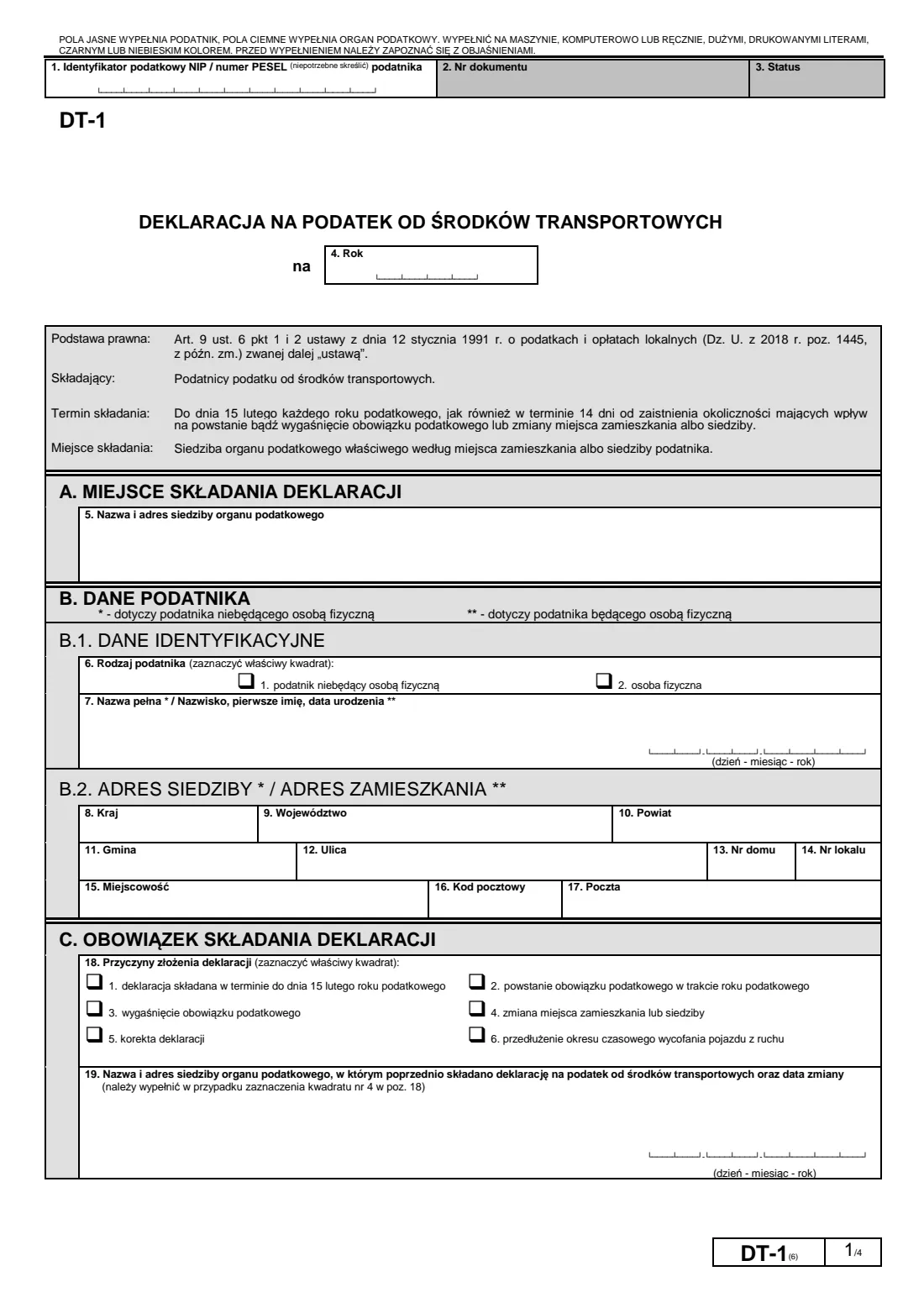
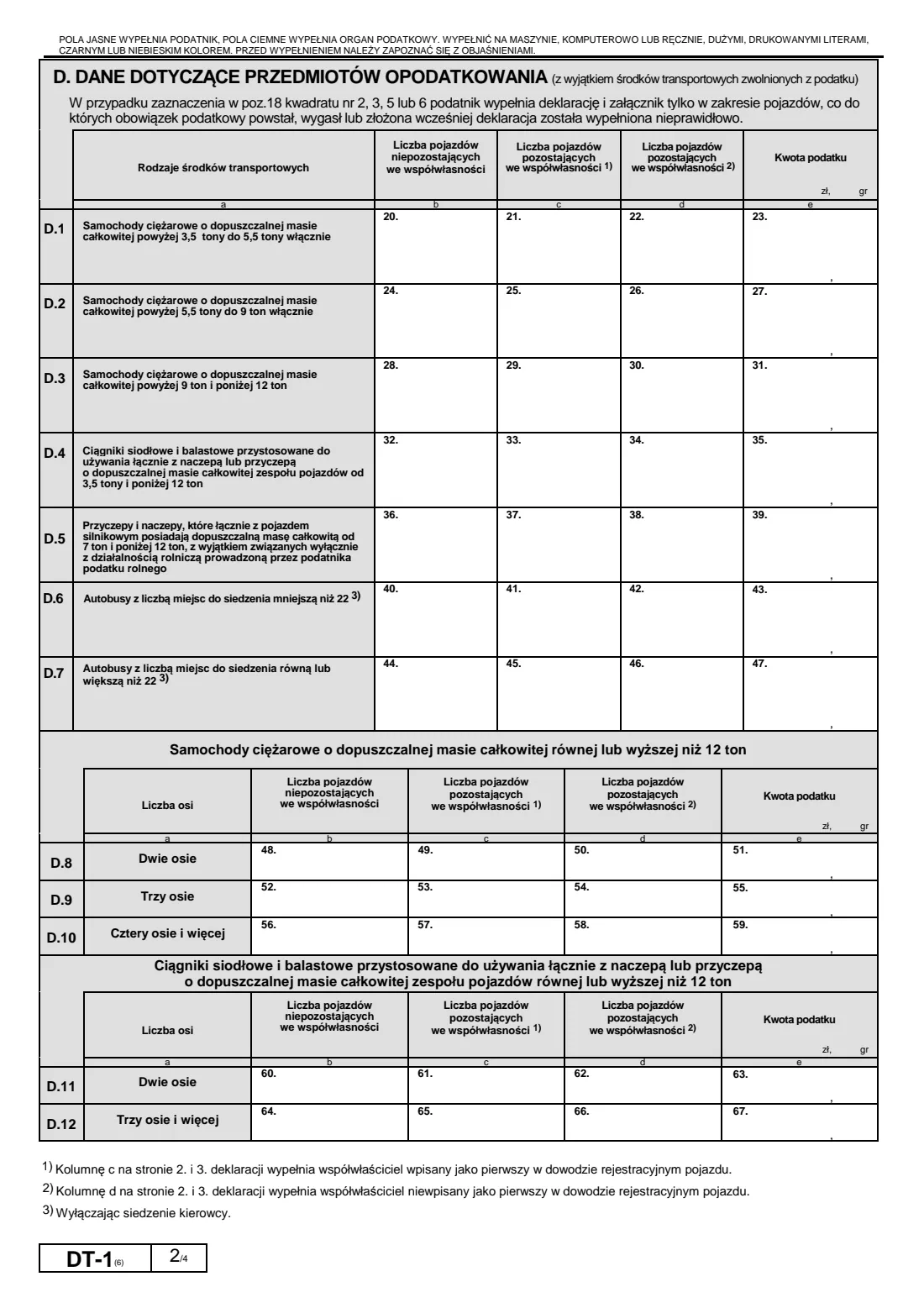
DT-1 is the return for the Polish local tax on transport vehicles (podatek od środków transportowych). Owners - private individuals and companies - file it with the municipality where they live or have their seat. It covers trucks with a permissible gross weight over 3.5 tonnes, tractor units, trailers and semi-trailers that with their towing vehicle weigh 7 tonnes or more (except those used only for the owner's farm), and buses.
The form asks for the number of vehicles of each kind, split by sole ownership and co-ownership, and the tax for each row at the municipality's rates. It then needs the total and the two instalments. Each vehicle is described on the separate annex DT-1/A, three vehicles to an annex.
FileIt explains each row in plain English, checks your PESEL or NIP, adds up the total, works out the instalments rounded to whole złoty, and checks you attach enough annexes. It prints everything into the official form, which is saved in your vault. You sign and file it yourself.
- Who fills it
- Owners of trucks over 3.5 t, tractor units, heavy trailers and buses
- Given to
- The municipality where you live or have your seat (wójt, burmistrz or prezydent miasta)
- When
- By 15 February each year, and within 14 days of a change (printed on the form)
- Annex
- DT-1/A, one per three vehicles - a separate form
- Edition
- DT-1(6), the Ministry of Finance model
- Pages
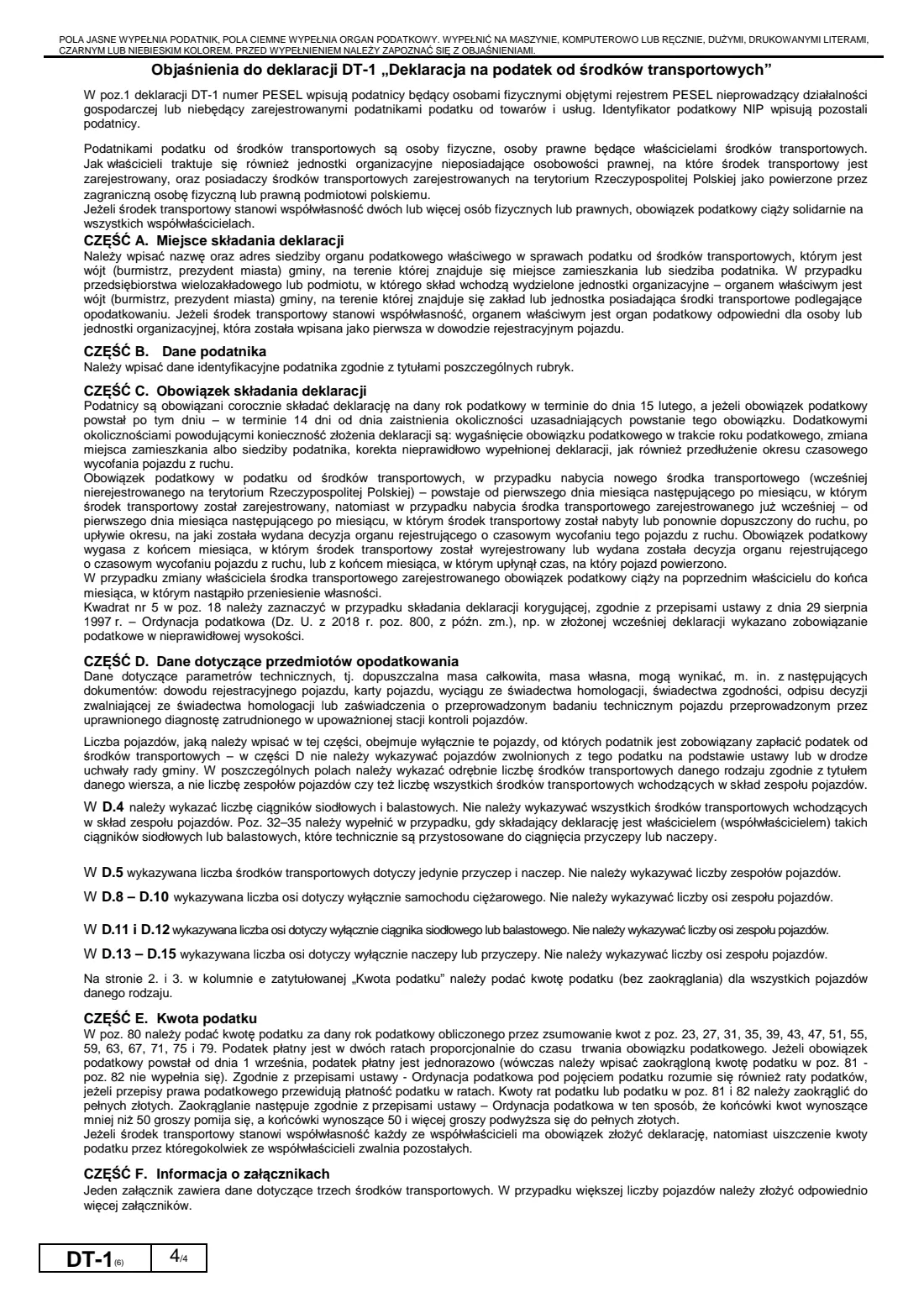
- 4 (page 4 is explanations)
Who needs to fill out DT-1 transport vehicle tax return?
- Haulage firms and self-employed drivers owning trucks over 3.5 tonnes or tractor units.
- Owners of heavy trailers and semi-trailers.
- Bus operators, including small private owners.
- Co-owners of such vehicles - each files a return, though payment by one releases the others, as page 4 explains.
When to use DT-1 transport vehicle tax return
- Every year by 15 February for the vehicles you own.
- Within 14 days of buying or registering a vehicle, or putting one back on the road after a temporary withdrawal.
- Within 14 days of selling, deregistering or temporarily withdrawing a vehicle, or of moving home or seat.
- To correct a return filed with a mistake.
What you need before you start
- Your PESEL number (private individuals) or NIP (companies and businesses) and your address or seat.
- Each vehicle's registration certificate (dowód rejestracyjny), for its permissible gross weight, axles and seats.
- Your municipality's tax rates for the year (its rada gminy resolution), to work out each row's tax.
- The DT-1/A annexes describing each vehicle, filled in separately.
What’s on DT-1 transport vehicle tax return
The 2019 edition has 4 pages. FileIt asks for it in 7 parts, and it is signed by Taxpayer:
- Identifier and tax yearTaxpayer
- A. Where you file (Miejsce składania deklaracji)Taxpayer
- B. Taxpayer (Dane podatnika)Taxpayer
- C. Why you file (Obowiązek składania deklaracji)Taxpayer
- D. The vehicles taxed (Dane dotyczące przedmiotów opodatkowania)Taxpayer
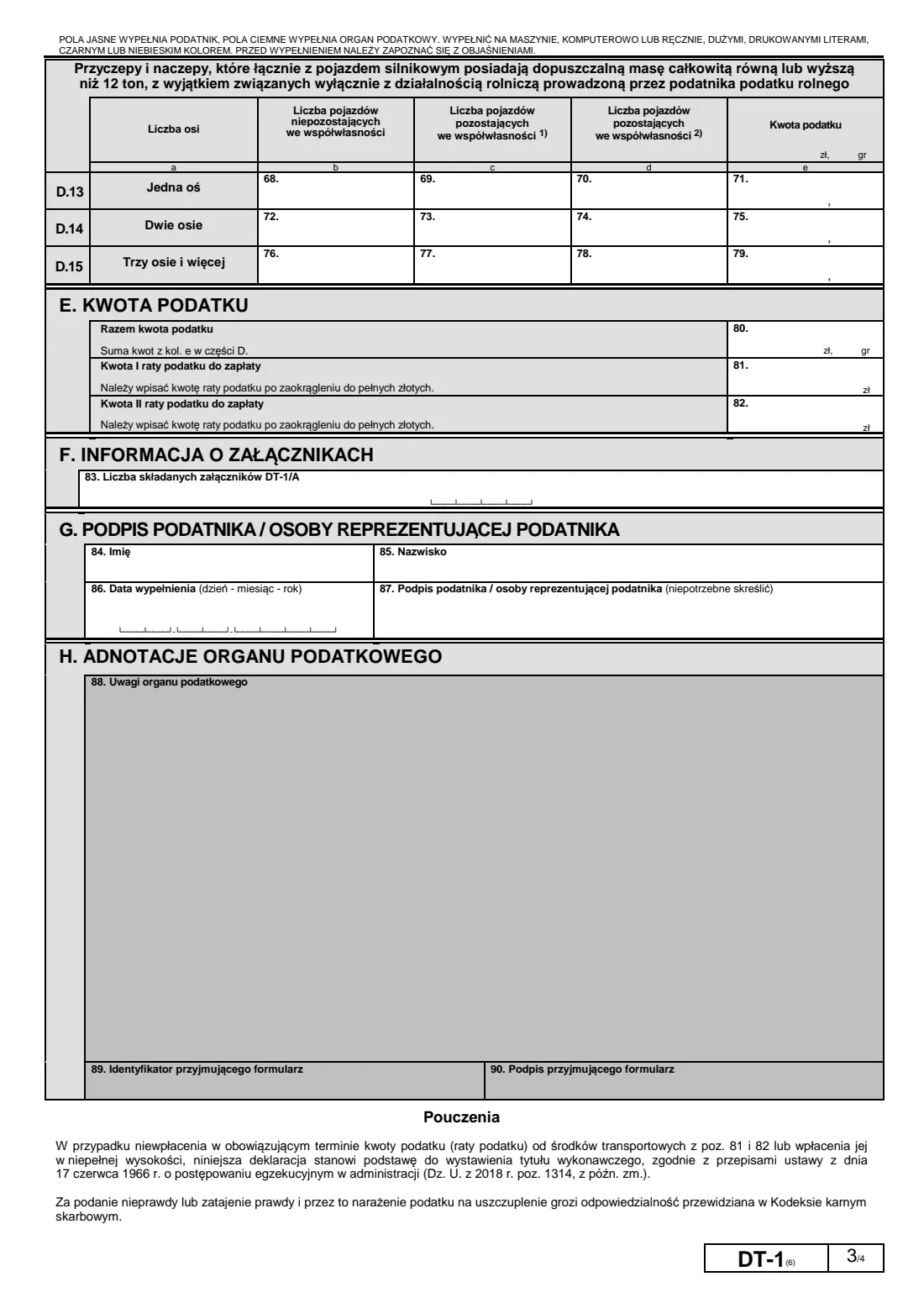
- E. Tax amount (Kwota podatku)Taxpayer
- F-G. Annexes and signature (Informacja o załącznikach, podpis)Taxpayer
How to fill out DT-1 transport vehicle tax return, step by step
1 Identifier, year and authority
Your PESEL or NIP (the other word is struck through for you), the tax year, and the name and address of your municipality's tax authority.
2 Taxpayer and address (Part B)
Whether you are a company or a natural person; the company's full name, or your surname, first name and date of birth; and the address of your seat or home.
3 Why you file (Part C)
The yearly return, an obligation that started or ended during the year, a change of address, a correction, or an extended temporary withdrawal. After a change of address, give the previous authority and the date.
4 Vehicles (Part D)
For each kind of vehicle you pay tax on: how many you own alone (b), how many you co-own as the co-owner entered first in the registration certificate (c) or not (d), and the tax for the row (e), unrounded.
5 Tax amount (Part E)
FileIt adds column e into the total. For a whole-year obligation it splits it into two instalments rounded to whole złoty; from 1 September the tax is paid in one go. For part of a year, enter the instalments yourself.
6 Annexes and signature (Parts F-G)
The number of DT-1/A annexes, the name of the person signing, the date, and the signature. FileIt strikes through 'podatnika' or 'osoby reprezentującej podatnika' as applies.
Common mistakes to avoid
- Listing vehicles that are exempt by law or by the municipality's resolution - the form says not to.
- Counting a whole combination of vehicles instead of each vehicle in its own row.
- Using the combination's axles instead of the truck's, tractor's or trailer's own.
- Rounding the row amounts - only the instalments are rounded to whole złoty.
- Not attaching enough DT-1/A annexes (three vehicles each).
- Missing the 14-day deadline after buying or selling a vehicle.
After you fill it out
Print and sign the return and file it with your municipality together with the DT-1/A annexes. FileIt never sends it for you.
Pay the instalments shown in items 81 and 82. The form warns that if you don't pay on time, the return itself is the basis for enforcement.
A copy stays in your FileIt vault under the person or company you filled it for.
Fill out DT-1 transport vehicle tax return online with FileIt
- Pick the person. Choose someone from People and FileIt fills in their name, date of birth, address and other details it already knows.
- Answer plain-language questions. One part of the form at a time, with the official help text beside each question — 125 fields in all. Your answers save as you go.
- Check the live preview. Watch your answers land on the real Ministerstwo Finansów (form model on podatki.gov.pl) - filed with the municipality (wójt, burmistrz, prezydent miasta) form, and let FileIt do any worksheet arithmetic.
- Generate the official PDF. FileIt prints your answers into the agency’s own PDF and files it in that person’s folder in your vault. Sign it, or send it for e-signature.
FileIt fills the form — it never files or submits anything for you. Deliver the finished form to whoever asked for it, the way the form’s instructions say.
Start DT-1 transport vehicle tax return now — it’s freeDT-1 transport vehicle tax return: frequently asked questions
Do I pay this tax on a car or a small van?
No. DT-1 covers trucks with a permissible gross weight over 3.5 tonnes, tractor units, heavy trailers and semi-trailers, and buses - not cars or vans up to 3.5 tonnes.
Where do the tax rates come from?
Each municipality sets its own rates by resolution of the rada gminy, within limits set by law. FileIt doesn't know your municipality's rates, so you enter each row's tax.
How are the instalments worked out?
Page 4 says the tax is paid in two instalments in proportion to how long the obligation lasts, or in one payment if it arose from 1 September. Each instalment is rounded to whole złoty: under 50 groszy down, 50 and over up.
What is DT-1/A?
The annex that describes each vehicle one by one. Page 4 says one annex covers three vehicles. It's a separate form on podatki.gov.pl that FileIt doesn't fill.
I co-own a truck - who files?
Page 4 says each co-owner must file a return, but payment by any one of them releases the others. The co-owner entered first in the registration certificate uses column c, the others column d.
Can a company use FileIt for DT-1?
Yes. Choose 'not a natural person', give the company's NIP and full name, and have the person representing it sign.
Official sources
- Blank form (PDF), published by Ministerstwo Finansów (form model on podatki.gov.pl) - filed with the municipality (wójt, burmistrz, prezydent miasta): https://www.podatki.gov.pl/media/lr1hrpqg/dt-1-06-04.pdf
- Official instructions and guidance: https://www.podatki.gov.pl/podatki-lokalne/formularze/
- Edition shown on this page: DT-1(6) (checked 2026-10-25).
FileIt is not affiliated with or endorsed by Ministerstwo Finansów (form model on podatki.gov.pl) - filed with the municipality (wójt, burmistrz, prezydent miasta) or any government. This page explains the form in general terms and is not legal, tax or immigration advice. Always read the official instructions, and check that you are using the edition the recipient accepts. Page last reviewed 2026-10-25.