What is Form TR1 (transfer of whole of registered title)?
When a registered house, flat or piece of land in England or Wales changes hands as a whole, the change of ownership is made by a transfer deed. Form TR1 is that deed for the whole of one or more registered titles: a sale, a gift to a family member, adding or removing someone's name, or moving a property between joint owners.
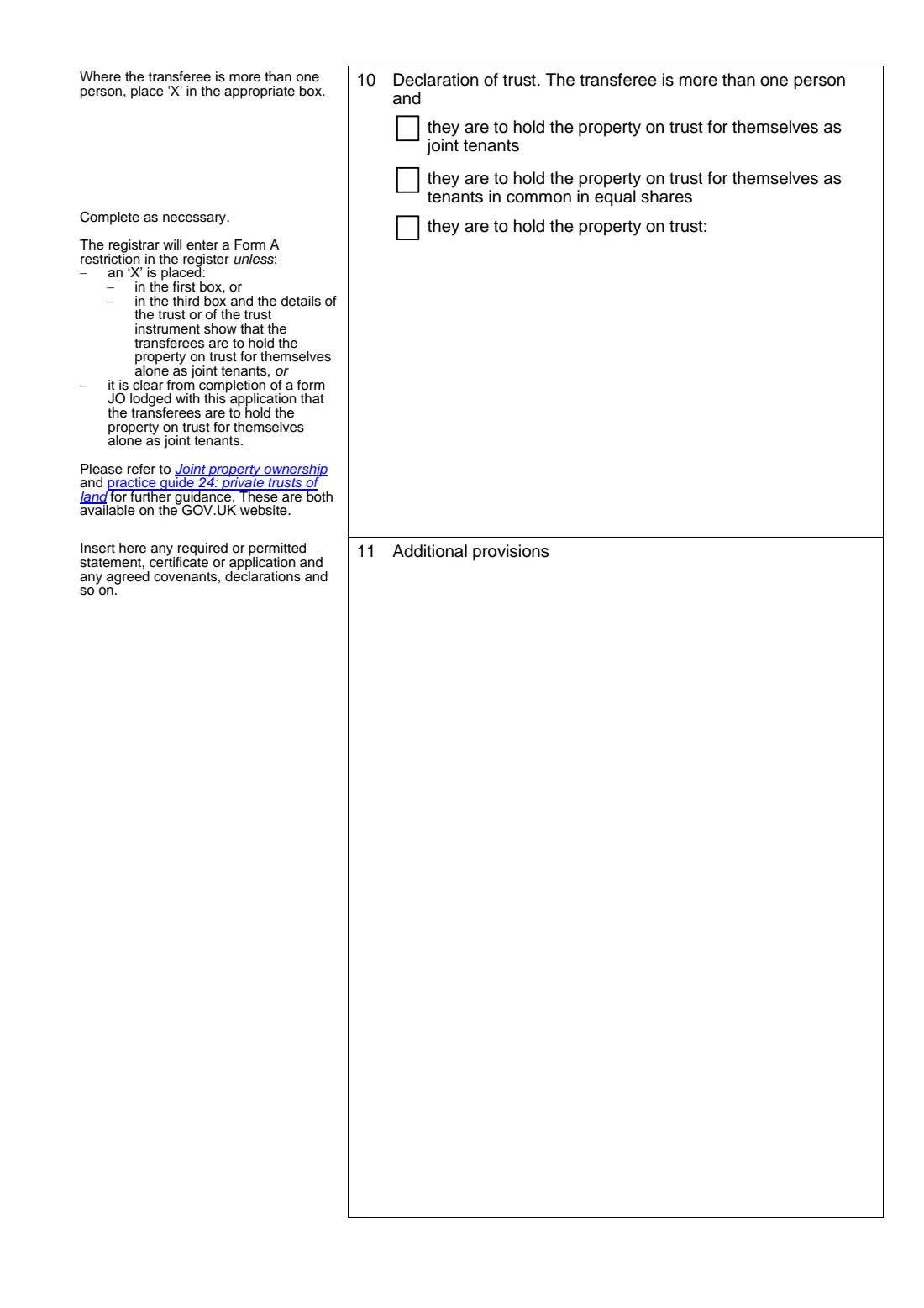
The TR1 names the property and its title numbers, the transferor (the current owner) and the transferee (the new owner), what was paid, and whether the transferor gives full or limited title guarantee. When two or more people take the property, panel 10 records whether they hold it as joint tenants or as tenants in common. That choice matters for what happens to each share on death.
FileIt walks you through each panel, writes the price in words and figures, and prints execution blocks for everyone who must sign onto HM Land Registry's own TR1 PDF. You then sign it as a deed in front of a witness and send it with an application form AP1. FileIt doesn't file anything for you.
- Who fills it
- The transferor and transferee, or their conveyancer
- Sent to
- HM Land Registry, with form AP1 and the fee
- Covers
- The whole of one or more registered titles in England and Wales
- Length
- 4 pages, 12 panels
- Edition
- (ref: LR/HO) 08/23
- Signatures
- Signed as a deed by each transferor, each in front of a witness
Who needs to fill out Form TR1 (transfer of whole of registered title)?
- Owners selling or giving away the whole of a registered property.
- Couples putting a home into joint names, or one partner transferring their share to the other.
- Parents transferring a property to a child.
- Companies and LLPs transferring a registered property they own.
When to use Form TR1 (transfer of whole of registered title)
- For the whole of a registered title. For part of a title use TR5 or TP1 instead.
- When the land is already registered at HM Land Registry.
- At completion: the deed is dated on the day of completion, after it has been signed and witnessed.
What you need before you start
- The title number(s) and the property's address or description.
- The full names of all the transferors and transferees, and company or overseas entity numbers where they apply.
- The transferee's address(es) for service: up to three, one of which must be a postal address.
- What is being paid, or confirmation that the transfer is not for money.
- Whether full or limited title guarantee is given.
- For joint transferees: whether they hold as joint tenants, as tenants in common in equal shares, or on other terms.
- A witness for each signature.
What’s on Form TR1 (transfer of whole of registered title)
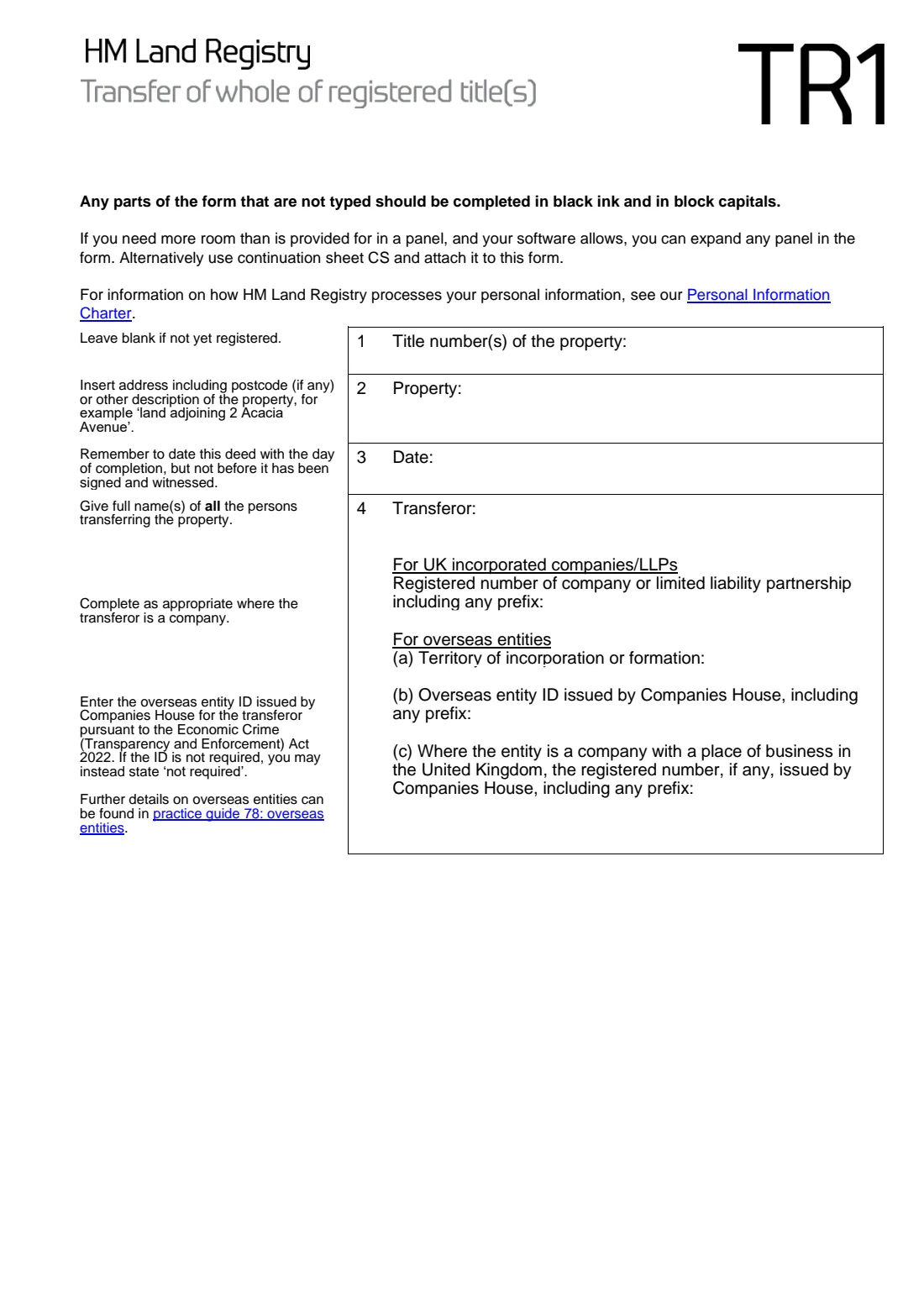
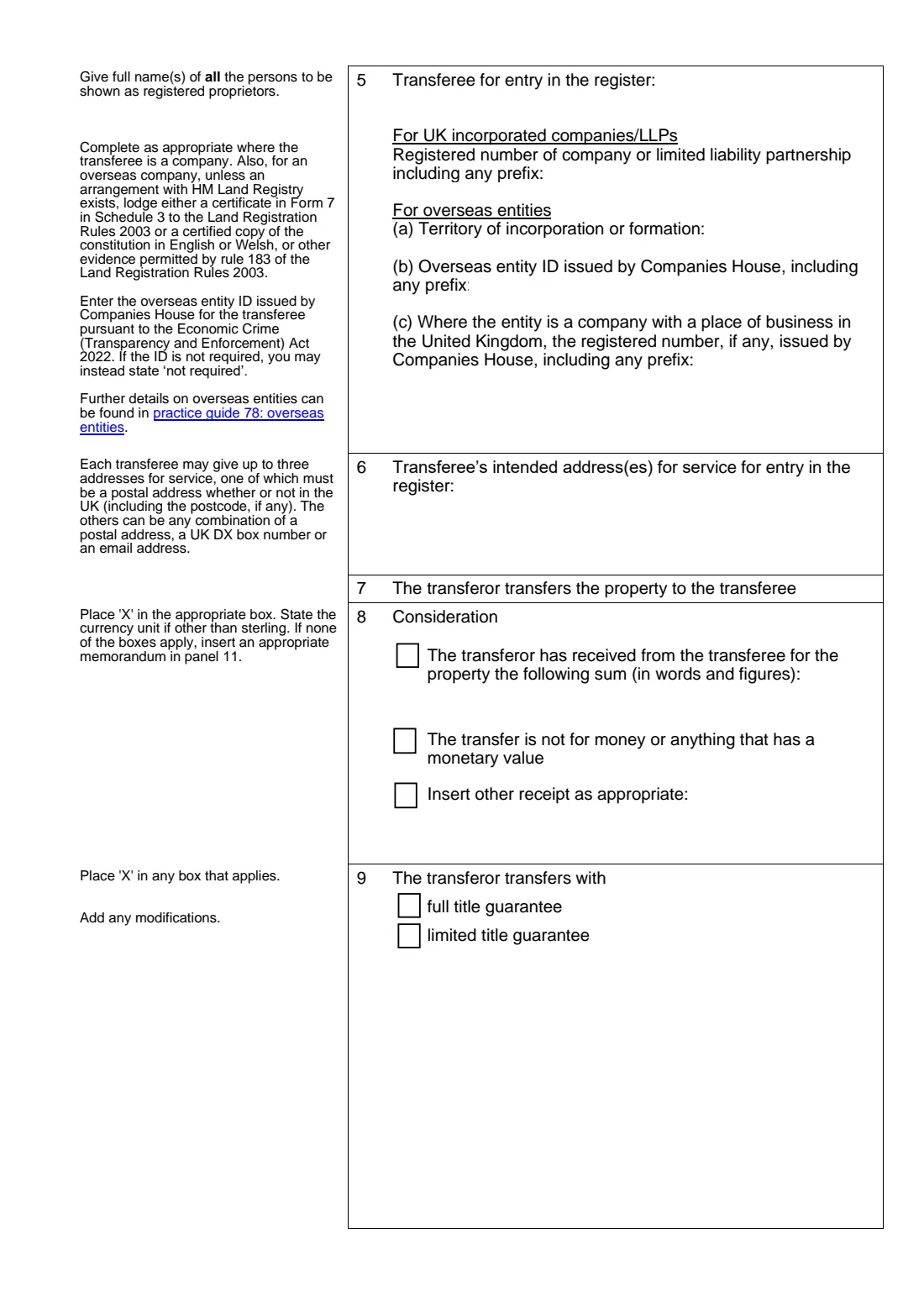
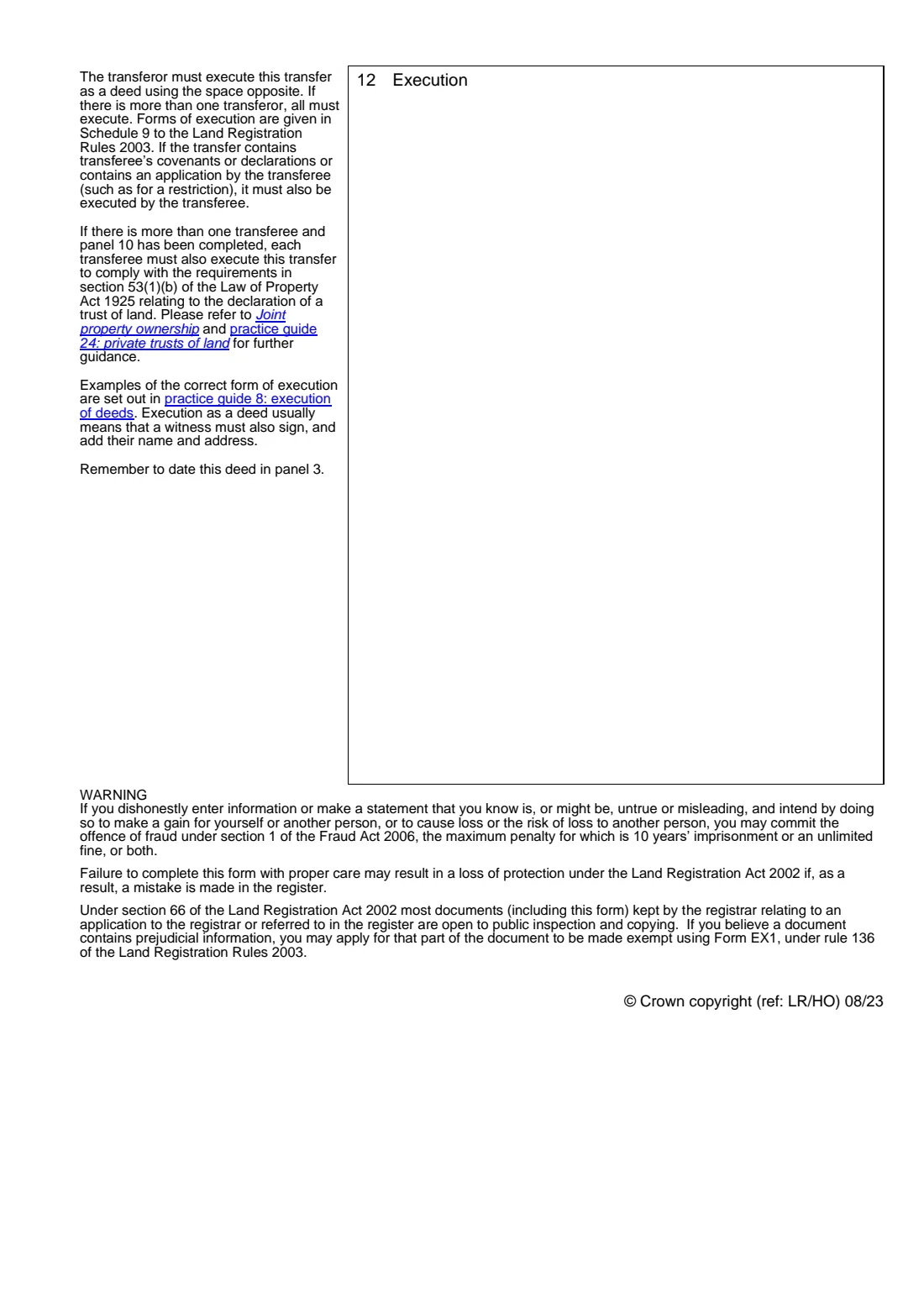
The 2023 edition has 4 pages. FileIt asks for it in 8 parts:
- Panels 1 to 3: the property and the dateTransferor
- Panel 4: the transferor (seller or giver)Transferor
- Panels 5 and 6: the transferee (buyer or recipient)Transferee
- Panels 7 and 8: considerationTransferor
- Panel 9: title guaranteeTransferor
- Panel 10: declaration of trustTransferee
- Panel 11: additional provisionsTransferor
- Panel 12: executionTransferor
How to fill out Form TR1 (transfer of whole of registered title), step by step
1 Panels 1 to 3: Property and date
The title numbers, the address or description, and the date of the transfer, which you can leave for completion.
2 Panel 4: Transferor
Everyone transferring the property, with company or overseas entity details if a company is selling.
3 Panels 5 and 6: Transferee
Everyone to be registered as the new owner, and the addresses for service HM Land Registry will hold for them.
4 Panels 7 and 8: Consideration
Tick the sum received, written in words and figures, or 'not for money', or another receipt. If none of these fits, add a memorandum in panel 11.
5 Panel 9: Title guarantee
Full or limited title guarantee, with any modifications.
6 Panels 10 and 11: Trust and provisions
For joint buyers, how they hold the property. Then any extra provisions, such as an indemnity covenant.
7 Panel 12: Execution
FileIt prints a 'Signed as a deed' block for each transferor, and for each transferee if they must sign. Each signature is witnessed.
Common mistakes to avoid
- Using TR1 for part of a title. That's TR5 or TP1.
- Dating the deed before everyone has signed and been witnessed.
- Not having a witness present for each signature, or a witness who doesn't add their name and address.
- Joint buyers not completing panel 10, or not signing when it is completed.
- Giving a price in figures only. The form asks for words and figures.
- Forgetting to send it with an AP1 and the right fee, or sending it outside the 30-day priority period of an official search.
After you fill it out
Print the TR1. Each transferor signs in front of a witness, and so does each transferee if they must sign. Date it on completion.
Send it to HM Land Registry with form AP1, the registration fee and any other documents, such as evidence of identity.
Stamp Duty Land Tax (or Land Transaction Tax in Wales) may be due on a purchase. Deal with that before applying to register.
Keep a copy of the signed TR1 with the property's papers in FileIt.
Fill out Form TR1 (transfer of whole of registered title) online with FileIt
- Pick the person. Choose someone from People and FileIt fills in their name, date of birth, address and other details it already knows.
- Answer plain-language questions. One part of the form at a time, with the official help text beside each question — 30 fields in all. Your answers save as you go.
- Check the live preview. Watch your answers land on the real HM Land Registry form, and let FileIt do any worksheet arithmetic.
- Generate the official PDF. FileIt prints your answers into the agency’s own PDF and files it in that person’s folder in your vault.
FileIt fills the form — it never files or submits anything for you. Deliver the finished form to whoever asked for it, the way the form’s instructions say.
Start Form TR1 (transfer of whole of registered title) now — it’s freeForm TR1 (transfer of whole of registered title): frequently asked questions
What's the difference between joint tenants and tenants in common?
Joint tenants own the whole property together, and when one dies it passes to the survivor. Tenants in common each own a share that can pass under their will. GOV.UK's 'Joint property ownership' guide and practice guide 24 explain both.
Do I need a solicitor to use a TR1?
No, you can complete it yourself, though many people use a conveyancer for a sale or when a mortgage is involved. HM Land Registry can't give legal advice.
Who has to sign the TR1?
Every transferor signs it as a deed in front of a witness. The transferees must also sign if it contains their covenants, declarations or applications, or if panel 10 is completed for two or more of them.
Can the TR1 be used for a gift?
Yes. Tick 'The transfer is not for money or anything that has a monetary value' in panel 8.
What do I send with it?
An application form AP1, the fee and any supporting documents. Practice guide 8 shows the correct forms of execution.
Official sources
- Blank form (PDF), published by HM Land Registry: https://assets.publishing.service.gov.uk/media/65afbf6870218e000cb41f89/TR1__2023-08-29_ct.pdf
- Official instructions and guidance: https://www.gov.uk/government/publications/registered-titles-whole-transfer-tr1
- Edition shown on this page: Form TR1, (ref: LR/HO) 08/23 (checked 2026-10-19).
FileIt is not affiliated with or endorsed by HM Land Registry or any government. This page explains the form in general terms and is not legal, tax or immigration advice. Always read the official instructions, and check that you are using the edition the recipient accepts. Page last reviewed 2026-10-19.