What is Form AP1?
Every registered property in England and Wales has a register kept by HM Land Registry. When something about the title changes, such as a new owner after a death, a joint owner who has died, a new mortgage, or a change of name after marriage, the register is updated by sending an application to change the register. Form AP1 is that application.
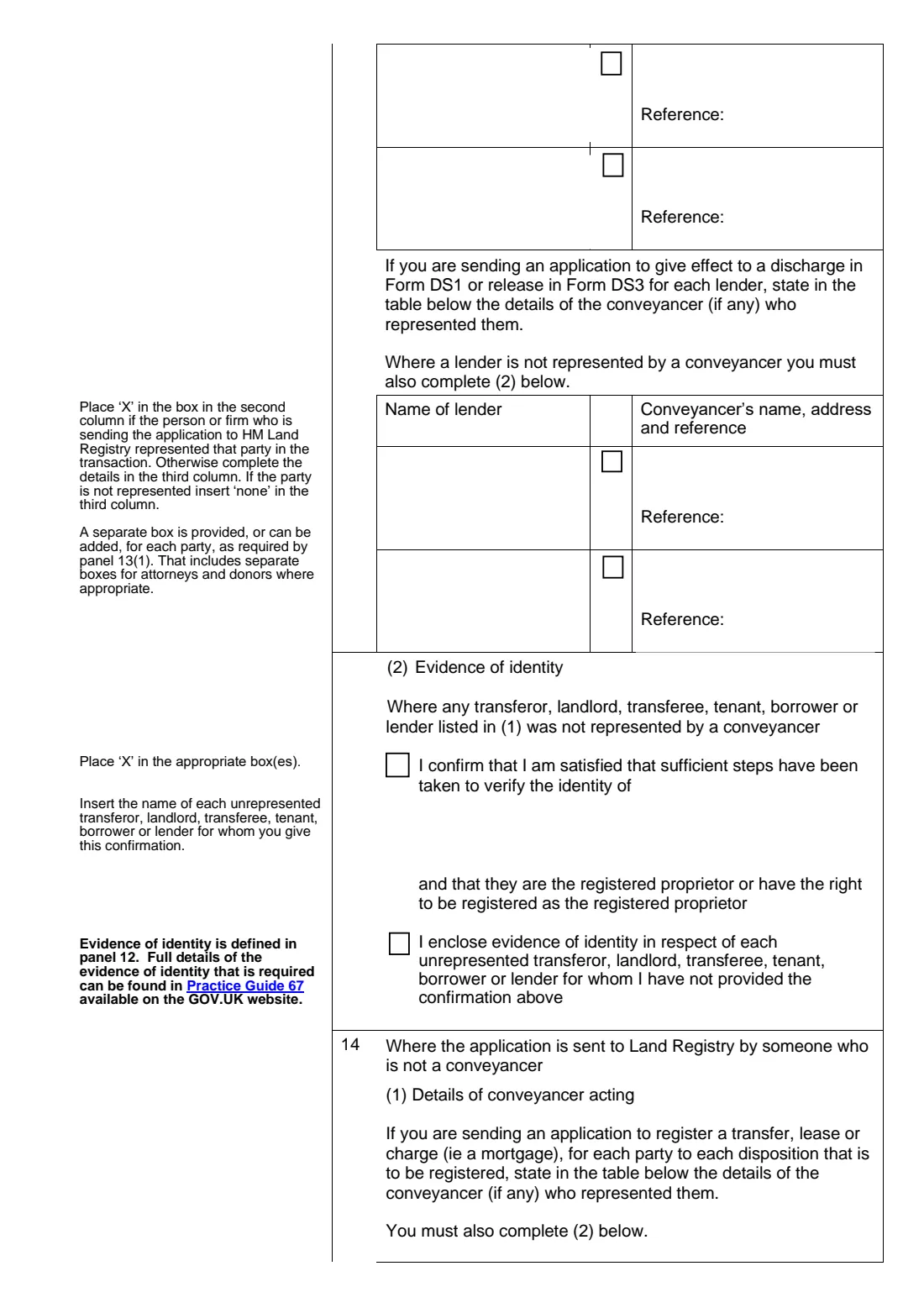
The AP1 doesn't make the change itself: it's the cover form for the documents that do, such as an assent (AS1), a transfer or a death certificate. It lists the title, each application with its fee, the documents you're sending, who is applying and who is sending it, and the addresses for service to go on the register. If the application registers a transfer, lease or charge, or a discharge, it also covers how the parties' identities were checked.
FileIt asks each panel in plain English, adds up the fees, shows panel 13 or 14 depending on whether a conveyancer is sending it, and prints your answers onto HM Land Registry's own AP1 PDF. You print it, sign and date panel 15, and send it with your documents. FileIt never submits anything.
- Who fills it
- The applicant, or a conveyancer such as a solicitor acting for them
- Sent to
- HM Land Registry, with the documents and the fee
- Payment
- Private individuals pay by postal order or cheque. Direct debit needs an agreement with HM Land Registry
- Identity panels
- Panels 12 to 14, for transfers, leases, charges and DS1 / DS3 discharges
- Signatures
- The conveyancer, or every applicant if there's no conveyancer
- Edition
- AP1 (10/24)
Who needs to fill out Form AP1?
- Beneficiaries and executors registering an assent (form AS1) after an owner has died.
- A surviving joint owner removing the name of a joint owner who has died.
- Owners recording a change of name, for example after marriage or civil partnership.
- Anyone registering a transfer, lease or charge, or a discharge of a mortgage, on an existing registered title.
- Conveyancers lodging any of these for a client.
When to use Form AP1
- To change the register of a title that's already registered. A first registration uses form FR1 instead.
- With the document that makes the change, such as an AS1, TR1, DS1 or a death certificate.
- Once for a set of related applications: panel 4 lists them in priority order.
What you need before you start
- The title number(s), the local authority and the property's postcode.
- Each application you're making, with the price paid or value and the fee. HM Land Registry's fees guides give the fee for each.
- The documents you're lodging. HM Land Registry only needs certified copies of deeds or documents you send with its forms.
- The applicant's full name, and company details if a company is applying.
- Contact details for whoever sends it, and the addresses for service for the new proprietors.
- For a transfer, lease or charge: the details of each party's conveyancer, or evidence of identity for anyone unrepresented.
What’s on Form AP1
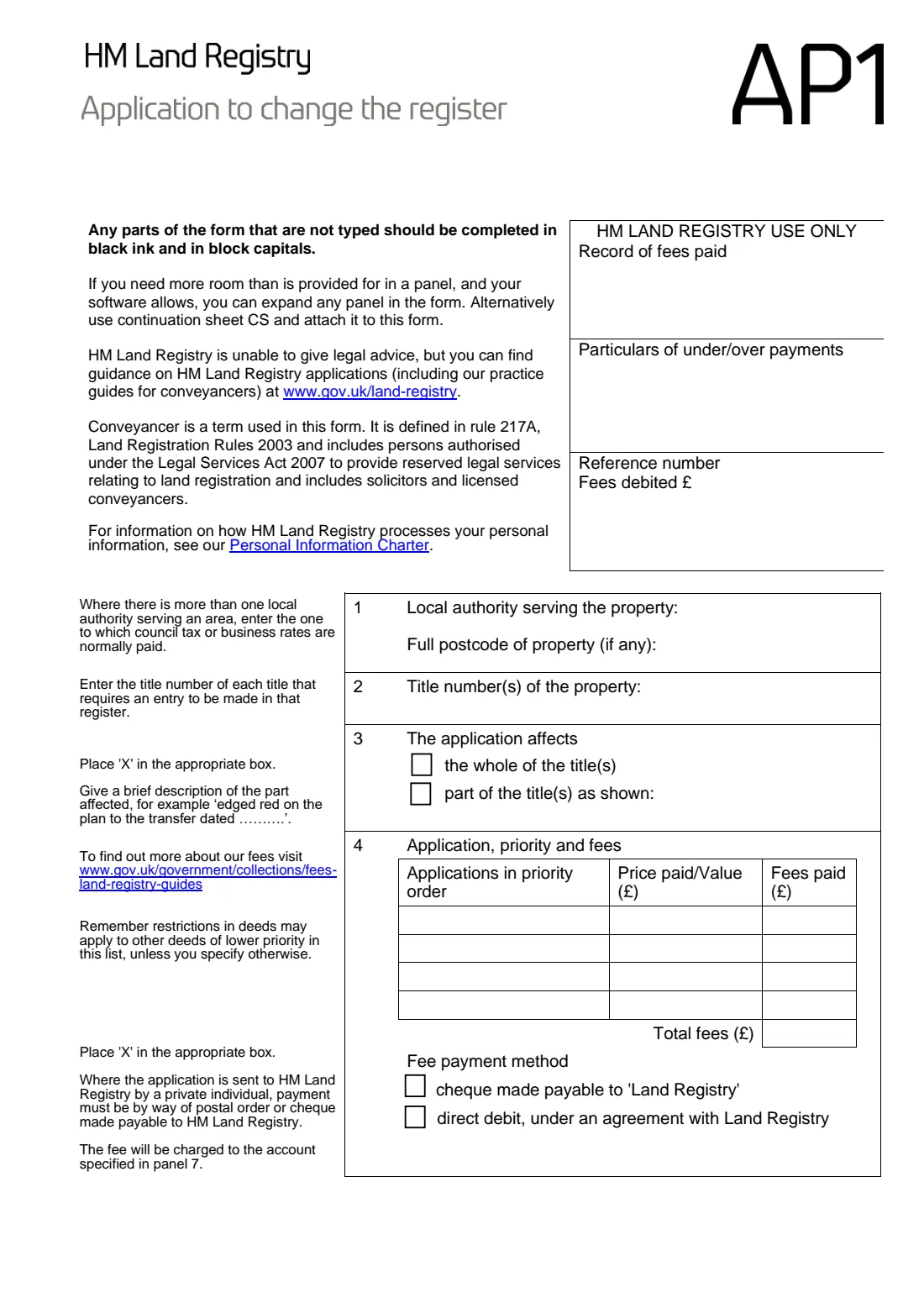
The 2024 edition has 7 pages. FileIt asks for it in 13 parts:
- Panels 1 to 3: the propertyApplicant
- Panel 4: applications, priority and feesApplicant
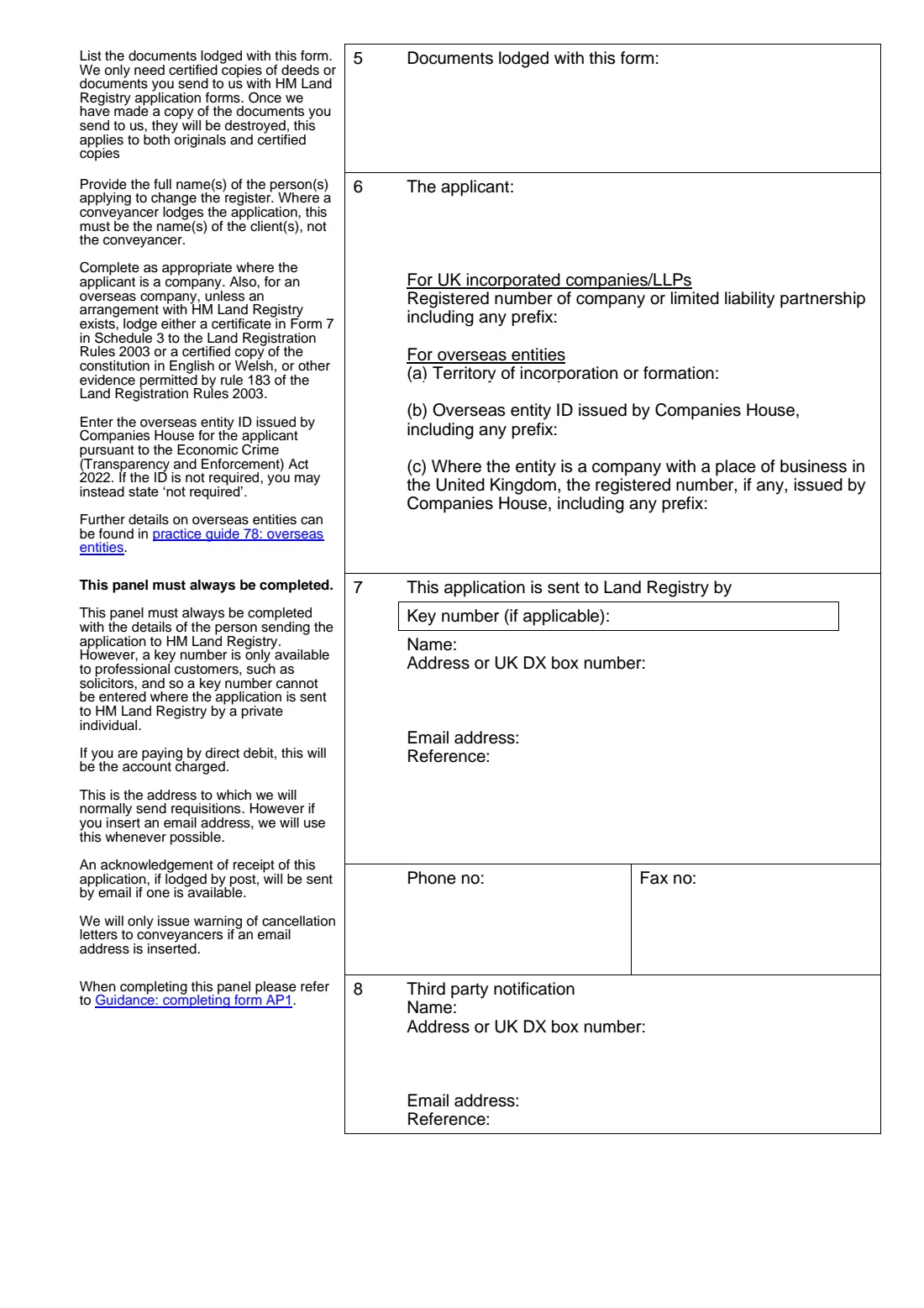
- Panel 5: documents lodged with this formApplicant
- Panel 6: the applicantApplicant
- Panel 7: who is sending the applicationApplicant
- Panel 8: third party notificationApplicant
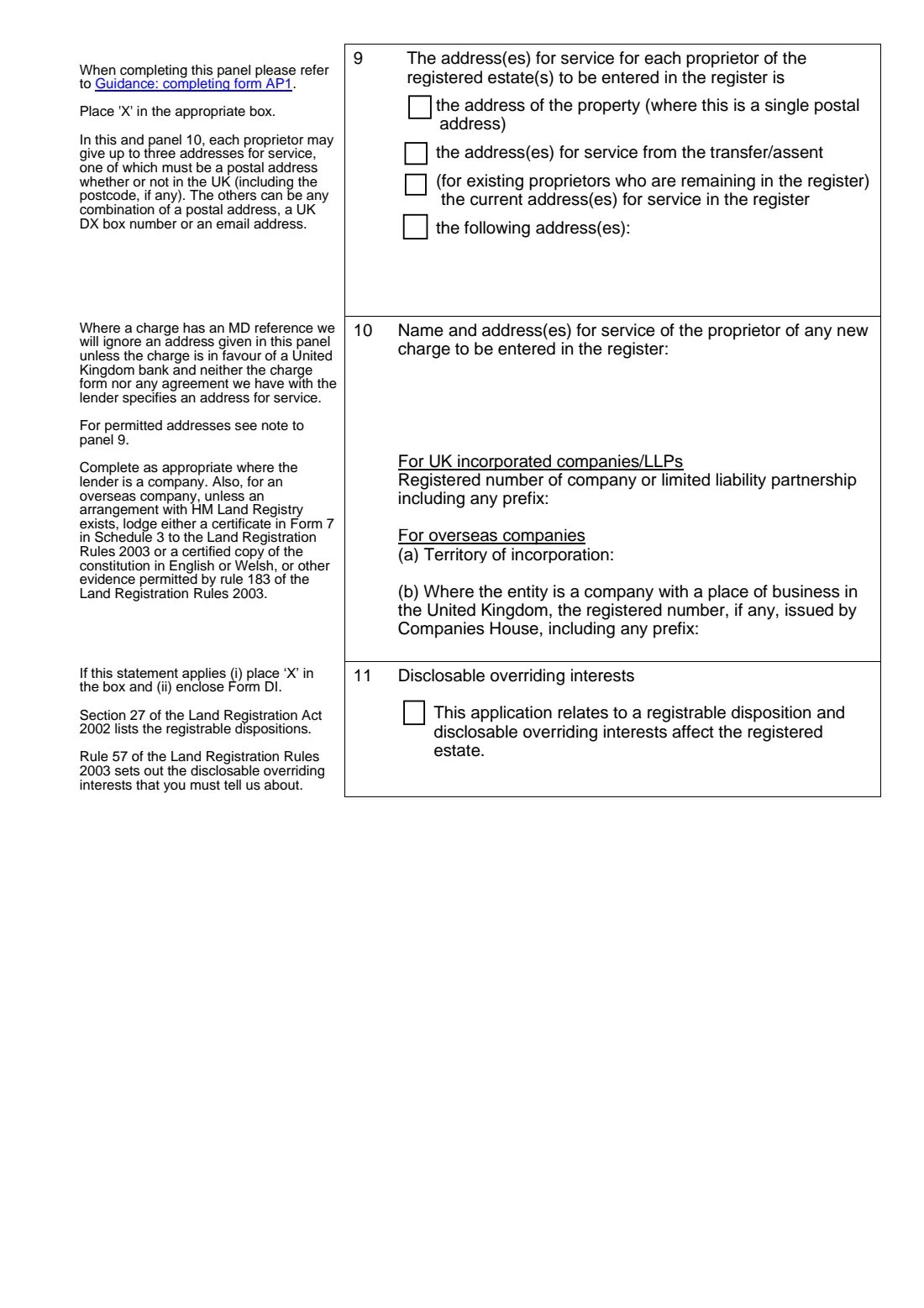
- Panel 9: address(es) for serviceApplicant
- Panel 10: proprietor of a new chargeApplicant
- Panel 11: disclosable overriding interestsApplicant
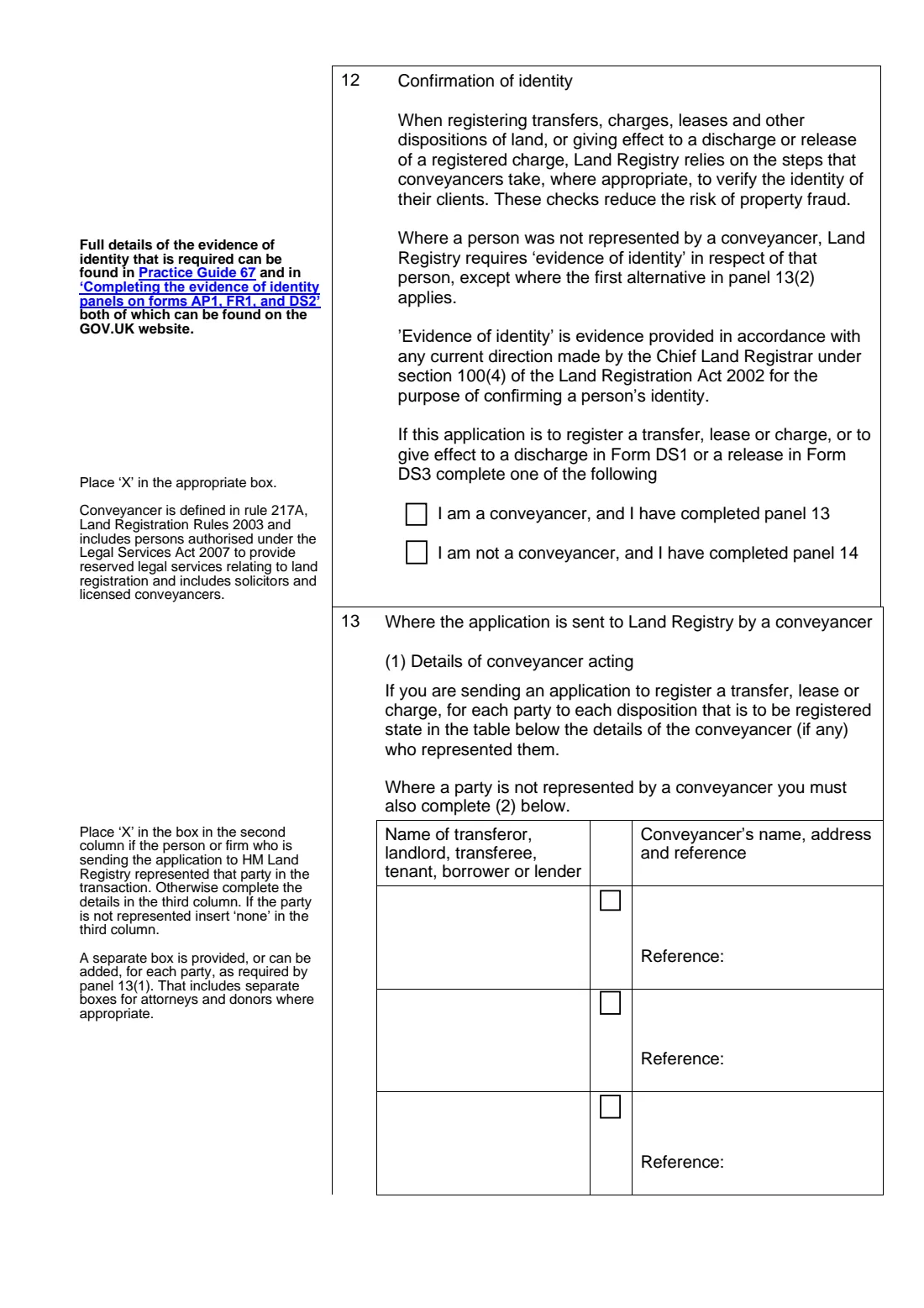
- Panel 12: confirmation of identityApplicant
- Panel 13: sent by a conveyancerApplicant
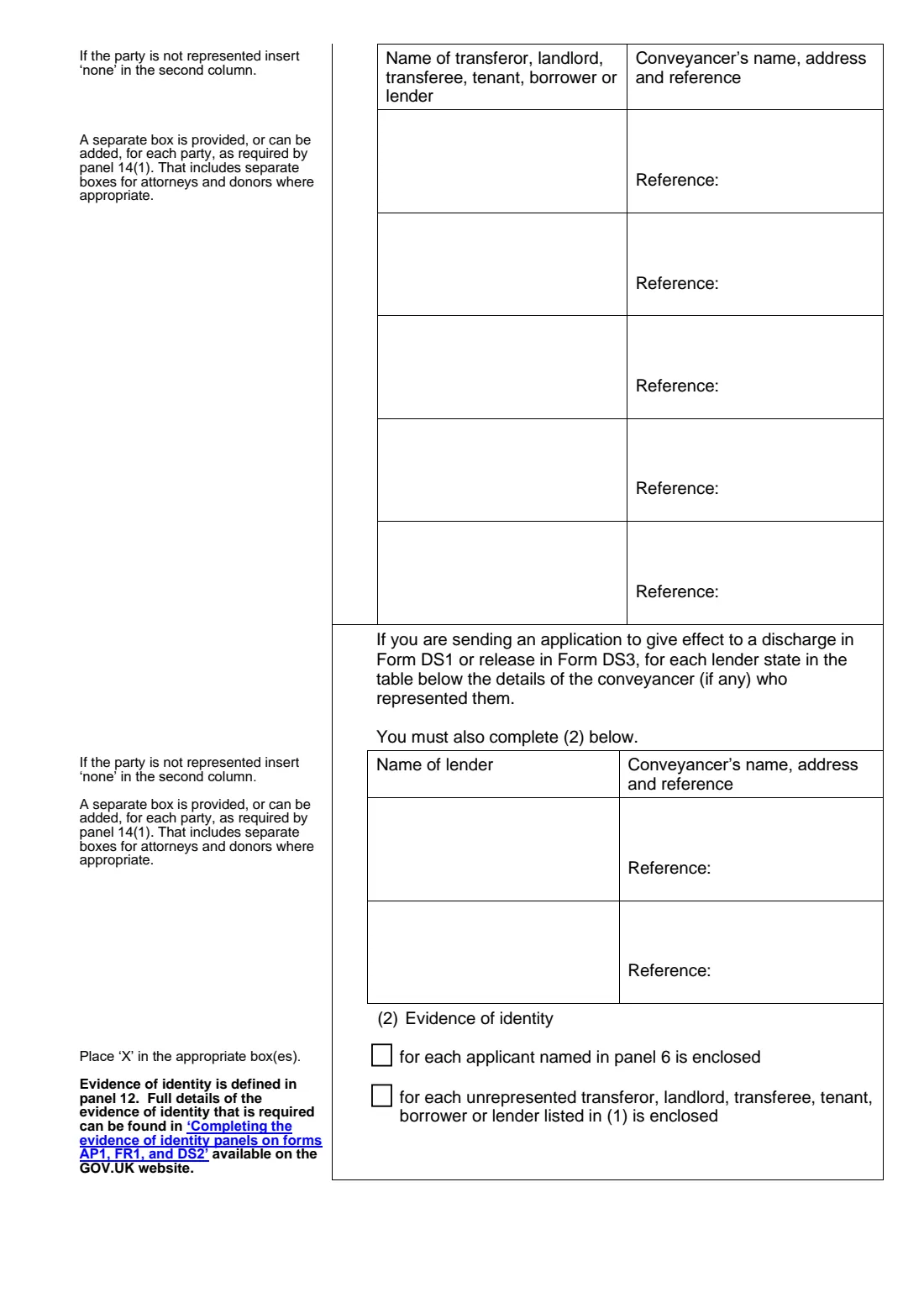
- Panel 14: not sent by a conveyancerApplicant
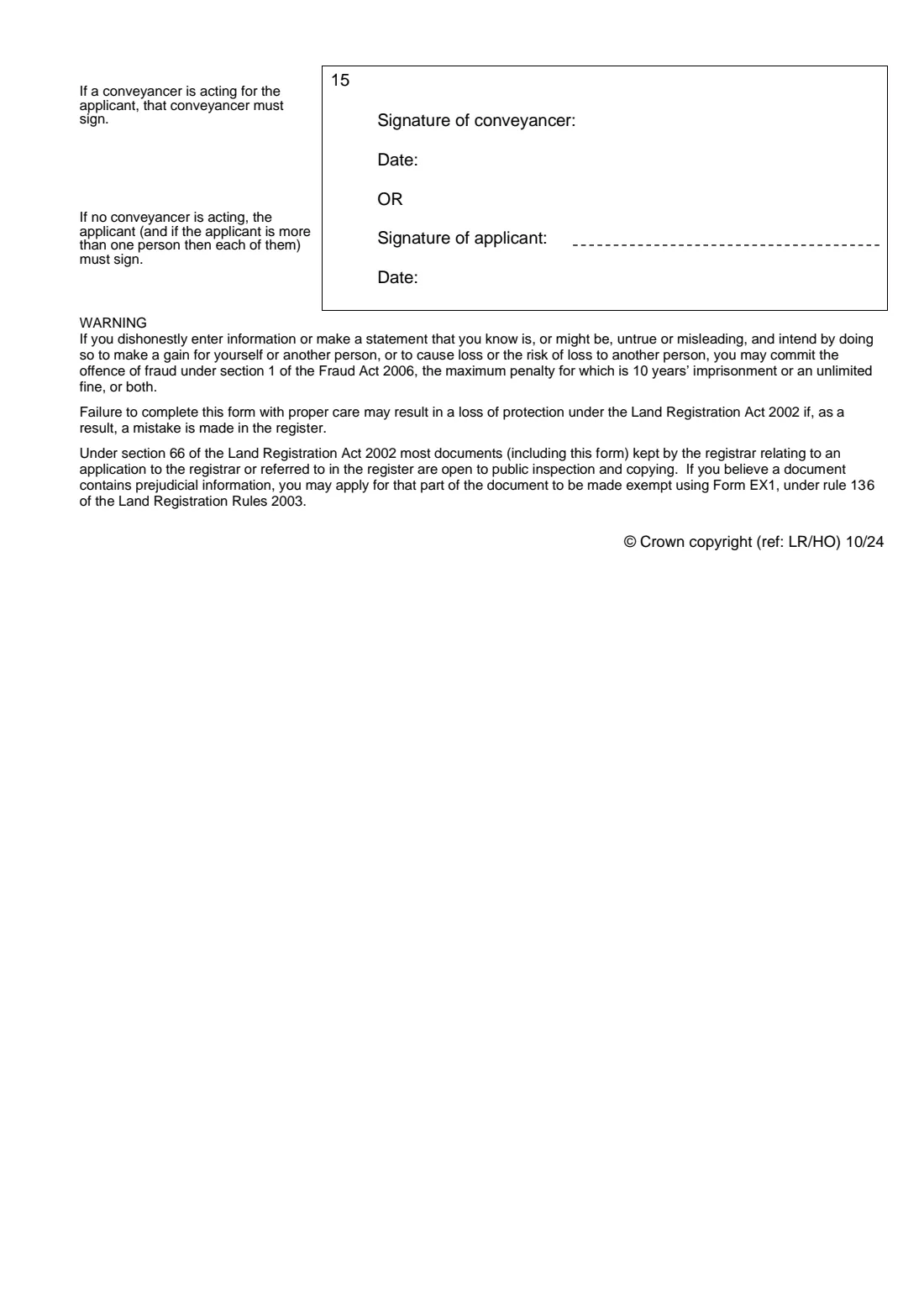
- Panel 15: signature and dateApplicant
How to fill out Form AP1, step by step
1 Panels 1 to 4: the property, applications and fees
The local authority, postcode and title numbers, whether the application affects the whole title or part of it, then each application in priority order with its value and fee. FileIt adds up the total. Choose cheque or direct debit (under an agreement), or leave both empty if you're paying another way, such as by postal order.
2 Panels 5 to 8: documents, applicant and sender
List the documents you're sending, then the applicant: the client's name, not the conveyancer's. Panel 7 is whoever sends the application and must always be completed. HM Land Registry sends requisitions there, or to the email address when one is given. Panel 8 is for a third party to be notified, if any.
3 Panels 9 to 11: addresses and interests
Say where the addresses for service come from: the property itself, the transfer or assent, the existing register, or addresses you list. Panel 10 is for the lender of any new charge. Tick panel 11 if disclosable overriding interests affect the property, and enclose form DI.
4 Panels 12 to 14: identity
Only when you're registering a transfer, lease or charge, or giving effect to a DS1 or DS3. A conveyancer completes panel 13 and anyone else panel 14, listing each party and their conveyancer (or 'none'), then confirming or enclosing evidence of identity. Practice guide 67 explains the evidence.
5 Panel 15: signature
If a conveyancer is acting, they sign. Otherwise the applicant signs, and every applicant if there's more than one. Add the date.
Common mistakes to avoid
- Putting the conveyancer's name in panel 6 instead of the client's.
- Leaving panel 7 empty: it must always be completed.
- Ticking direct debit as a private individual without an agreement with HM Land Registry.
- Not listing every document you're sending, or sending originals you need back.
- Skipping the identity panels for a transfer, lease or charge, or not enclosing evidence of identity for someone unrepresented.
After you fill it out
Print the form, sign and date panel 15 (every applicant, if there's no conveyancer).
Send it to HM Land Registry with the documents listed in panel 5 and the fee, following GOV.UK's 'Guidance: completing form AP1'. FileIt doesn't send anything for you.
HM Land Registry acknowledges postal applications by email if one is given, and writes if it needs more information. Keep the AP1, your documents and the updated register in FileIt.
Fill out Form AP1 online with FileIt
- Pick the person. Choose someone from People and FileIt fills in their name, date of birth, address and other details it already knows.
- Answer plain-language questions. One part of the form at a time, with the official help text beside each question — 109 fields in all. Your answers save as you go.
- Check the live preview. Watch your answers land on the real HM Land Registry form, and let FileIt do any worksheet arithmetic.
- Generate the official PDF. FileIt prints your answers into the agency’s own PDF and files it in that person’s folder in your vault.
FileIt fills the form — it never files or submits anything for you. Deliver the finished form to whoever asked for it, the way the form’s instructions say.
Start Form AP1 now — it’s freeForm AP1: frequently asked questions
What is form AP1 used for?
To apply to HM Land Registry to change the register of an existing registered title, for example to register an assent, a transfer, a death of a joint owner or a change of name.
Can I fill in an AP1 myself without a solicitor?
Yes. The form has panels for applications not sent by a conveyancer (panel 14), and the side notes explain how private individuals pay. HM Land Registry can't give legal advice, so a conveyancer is worth asking if the change is complicated.
How do I pay the fee?
The form's side note says a private individual sending the application must pay by postal order or cheque made payable to HM Land Registry. Direct debit is for customers with an agreement, charged to the account in panel 7.
Do I need to send original documents?
HM Land Registry says it only needs certified copies of deeds or documents you send with its forms, and it destroys what you send once it's copied.
What are panels 12 to 14 for?
They record how the identity of each party was checked, when the application registers a transfer, lease or charge or gives effect to a DS1 or DS3. A conveyancer completes panel 13 and anyone else panel 14.
Official sources
- Blank form (PDF), published by HM Land Registry: https://assets.publishing.service.gov.uk/media/66fe37eb080bdf716392ed17/AP1__2024-10-07_.pdf
- Official instructions and guidance: https://www.gov.uk/government/publications/change-the-register-ap1/guidance-completing-form-ap1
- Edition shown on this page: AP1 (10/24) (checked 2026-10-19).
FileIt is not affiliated with or endorsed by HM Land Registry or any government. This page explains the form in general terms and is not legal, tax or immigration advice. Always read the official instructions, and check that you are using the edition the recipient accepts. Page last reviewed 2026-10-19.