What is N9C Admission (unspecified amount)?
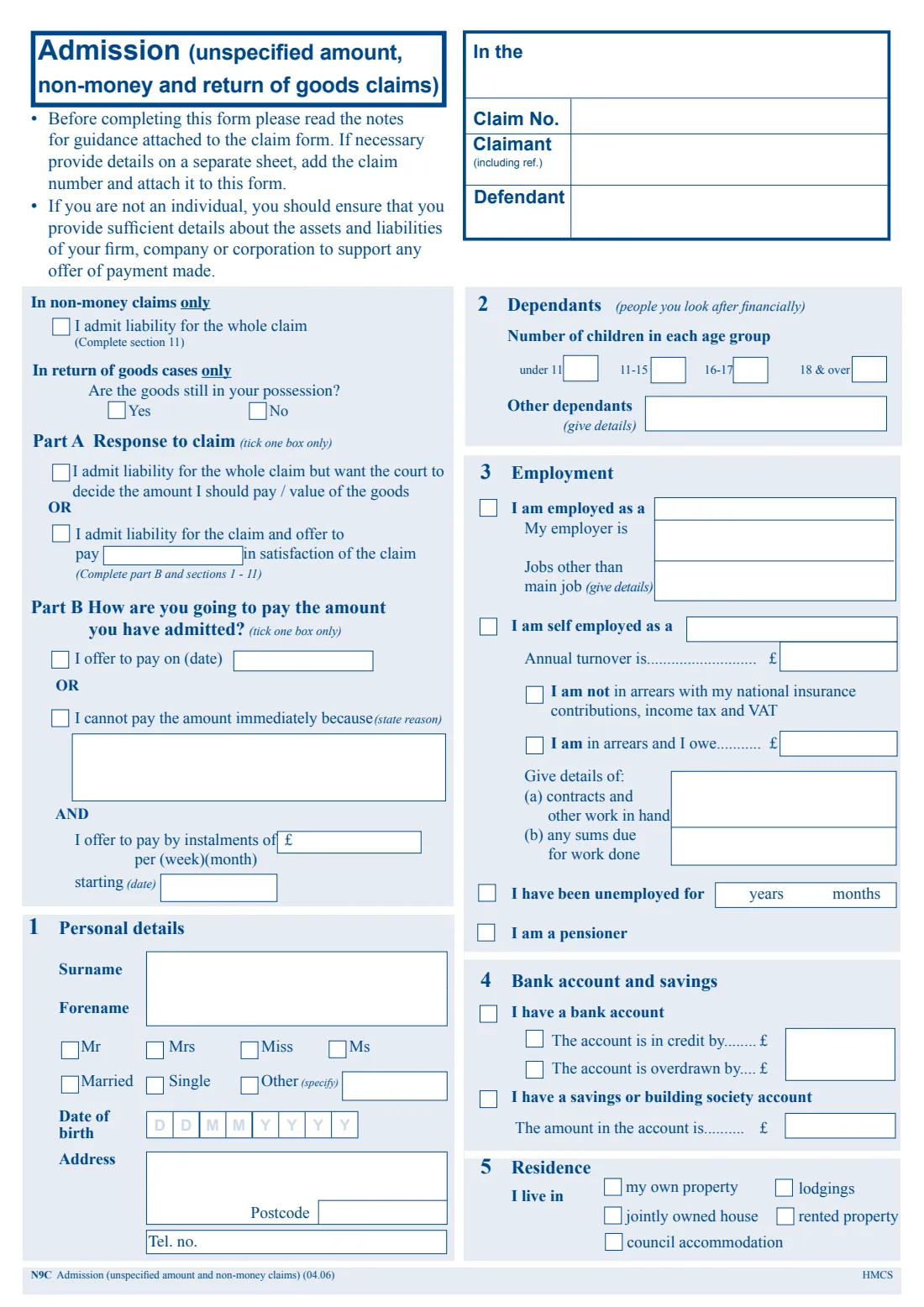
Form N9C is the admission form in the County Court response pack for claims that aren't for a fixed sum: claims for an unspecified amount of money, for the return of goods, and other non-money claims in England and Wales. It's how a defendant accepts liability and, where money is involved, offers what they can pay and how.
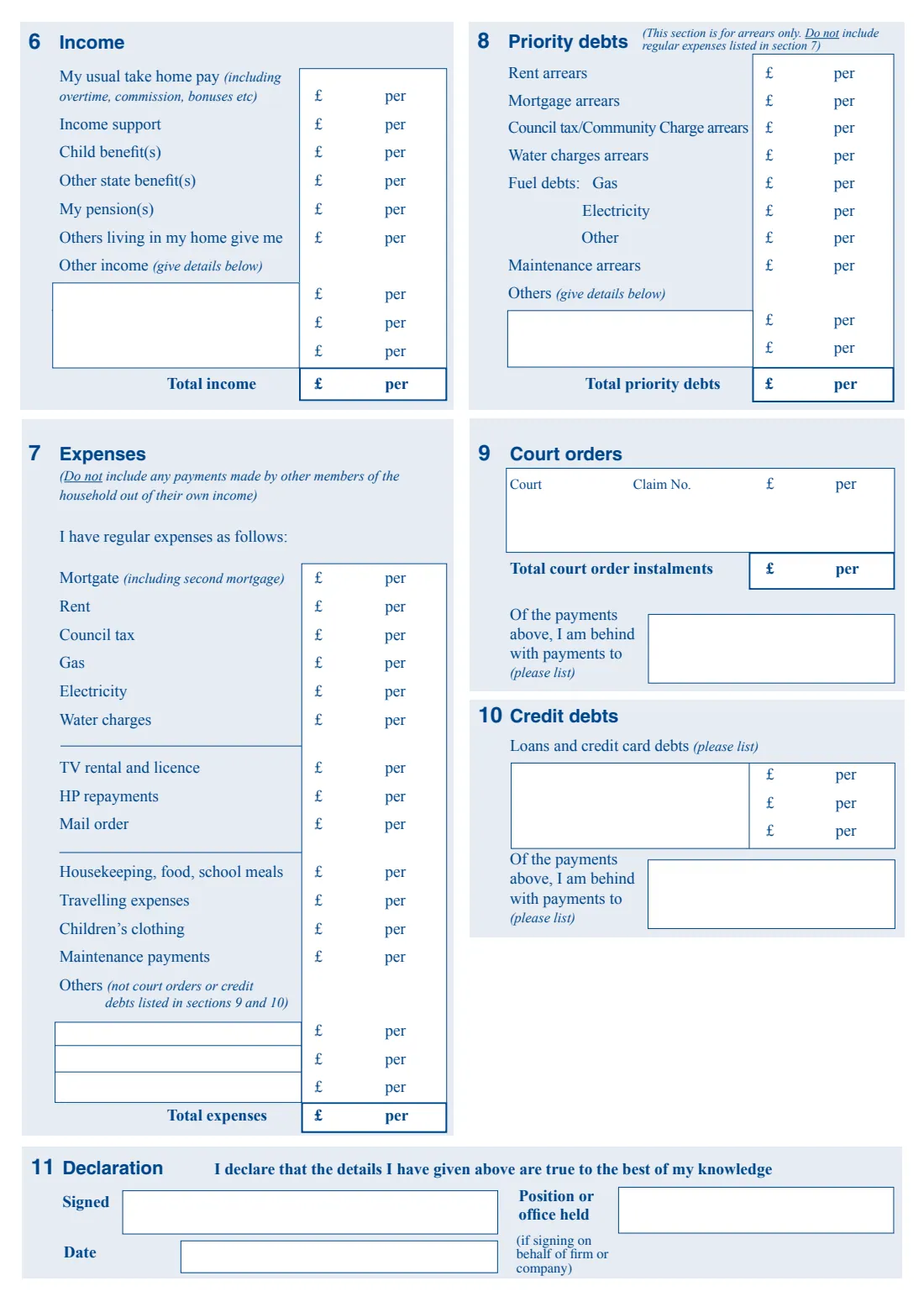
For a non-money claim you can simply admit liability for the whole claim and sign. Otherwise you choose whether the court should decide the amount (or the value of the goods), or make your own offer, payable on a date or by instalments. The second half is a statement of means: dependants, work, bank accounts and savings, home, income, expenses, priority debts, court orders and credit debts.
FileIt shows only the parts that apply to your answers, adds up your income, expenses, priority debts and court orders (converting to a monthly figure when the lines use different periods), strikes out week or month for the instalments, and prints it all into HMCTS's own N9C PDF (04.06 edition). You sign the declaration and send it back as the notes with your claim form explain.
- Who fills it
- A defendant admitting a claim, or someone signing for a firm or company
- Claim types
- Unspecified amount, return of goods, and non-money claims
- Includes
- A statement of means (sections 1 to 10)
- Courts
- County Court, England and Wales
- Signature
- Declaration that the details are true to the best of your knowledge
- Edition
- N9C (04.06)
Who needs to fill out N9C Admission (unspecified amount)?
- A defendant who accepts liability for a claim where the claimant hasn't put a fixed figure on what's owed.
- A defendant in a return of goods case, whether or not they still have the goods.
- A defendant admitting a non-money claim.
- Someone who wants to offer instalments and needs to show the court what they can afford.
- A firm or company admitting a claim, which should give enough detail of its assets and liabilities to support its offer.
When to use N9C Admission (unspecified amount)
- When you receive a claim form for an unspecified amount, goods or a non-money remedy and decide to admit it.
- Within the time set out in the notes for guidance that came with the claim form.
- Together with a defence form if you admit only part of the claim, as the response pack explains.
What you need before you start
- The claim form, for the court, claim number and parties' names.
- Your personal details, address, phone number and date of birth.
- The number and ages of your children and anyone else you support.
- Details of your job, self-employment, unemployment or pension.
- Bank and savings balances.
- Your regular income and expenses, each with how often it's paid.
- Any arrears (rent, mortgage, council tax, utilities, maintenance), court orders and loans or credit cards.
What’s on N9C Admission (unspecified amount)
The 2006 edition has 2 pages. FileIt asks for it in 13 parts, and it is signed by Defendant:
- The claimDefendant
- Your admission (Part A and Part B)Defendant
- 1. Personal detailsDefendant
- 2. Dependants (people you look after financially)Defendant
- 3. EmploymentDefendant
- 4. Bank account and savingsDefendant
- 5. ResidenceDefendant
- 6. IncomeDefendant
- 7. ExpensesDefendant
- 8. Priority debtsDefendant
- 9. Court ordersDefendant
- 10. Credit debtsDefendant
- 11. DeclarationDefendant
How to fill out N9C Admission (unspecified amount), step by step
1 The claim and your admission
Say what the claim is for. For a non-money claim, admit liability for the whole claim. For goods, say whether you still have them. For money or goods, choose whether the court decides the amount or you offer a figure.
2 How you'll pay (Part B)
If you make an offer, say whether you'll pay on a date, or explain why you can't pay immediately and offer instalments per week or per month, with a start date.
3 Sections 1 to 5: about you
Personal details, dependants, employment (employed, self-employed, unemployed or retired), bank account and savings, and whether you own, rent, lodge or live in council accommodation.
4 Sections 6 to 10: money in and out
List income and regular expenses, then priority debts (arrears only), court orders and credit debts, and say which payments you're behind with. FileIt works out each total for you.
5 Section 11: declaration
You declare the details are true to the best of your knowledge. Give your position if you sign for a firm or company.
Common mistakes to avoid
- Putting regular bills in the priority debts section. The form says that section is for arrears only.
- Listing court orders or credit debts as everyday expenses as well, so they're counted twice.
- Including money other people in your household pay out of their own income.
- Forgetting to say how often each amount is paid, which makes the totals meaningless.
- Offering more than your figures show you can afford.
After you fill it out
Check every figure and total in the filled PDF before you sign.
Sign the declaration by hand or with FileIt's eSignature, and send the form as the notes with your claim form explain. FileIt never sends it for you.
If you admitted only part of the claim, send your defence form with it.
Keep copies of the form, payslips and statements in your FileIt vault.
Fill out N9C Admission (unspecified amount) online with FileIt
- Pick the person. Choose someone from People and FileIt fills in their name, date of birth, address and other details it already knows.
- Answer plain-language questions. One part of the form at a time, with the official help text beside each question — 164 fields in all. Your answers save as you go.
- Check the live preview. Watch your answers land on the real HM Courts & Tribunals Service form, and let FileIt do any worksheet arithmetic.
- Generate the official PDF. FileIt prints your answers into the agency’s own PDF and files it in that person’s folder in your vault. Sign it, or send it for e-signature.
FileIt fills the form — it never files or submits anything for you. Deliver the finished form to whoever asked for it, the way the form’s instructions say.
Start N9C Admission (unspecified amount) now — it’s freeN9C Admission (unspecified amount): frequently asked questions
What's the difference between N9A and N9C?
N9A is for admitting a claim for a specified (fixed) amount of money. N9C is for claims for an unspecified amount, the return of goods, and non-money claims.
Do I have to fill in the statement of means?
For a non-money claim the form says to complete section 11 only. If you make an offer of payment, it asks you to complete Part B and sections 1 to 11.
Can I ask the court to decide what I pay?
Yes. Part A lets you admit liability for the whole claim but ask the court to decide the amount you should pay, or the value of the goods.
How does FileIt work out the totals?
It adds the lines in each section. If they all use the same period, the total is in that period; if they differ, each line is converted to a monthly figure first.
What if I need more space?
The form says to give details on a separate sheet with the claim number and attach it.
Does FileIt send the form to court?
No. FileIt prepares the official N9C PDF with your answers. You sign it and send it yourself.
Official sources
- Blank form (PDF), published by HM Courts & Tribunals Service: https://assets.publishing.service.gov.uk/media/6470741e80dffe001323eddb/N9C_0406.pdf
- Official instructions and guidance: https://www.gov.uk/government/publications/form-n9c-admission-unspecified-amount-and-non-money-claims
- Edition shown on this page: N9C Admission (unspecified amount and non-money claims) (04.06) (checked 2026-10-19).
FileIt is not affiliated with or endorsed by HM Courts & Tribunals Service or any government. This page explains the form in general terms and is not legal, tax or immigration advice. Always read the official instructions, and check that you are using the edition the recipient accepts. Page last reviewed 2026-10-19.