What is IHT430 Reduced rate of IHT?
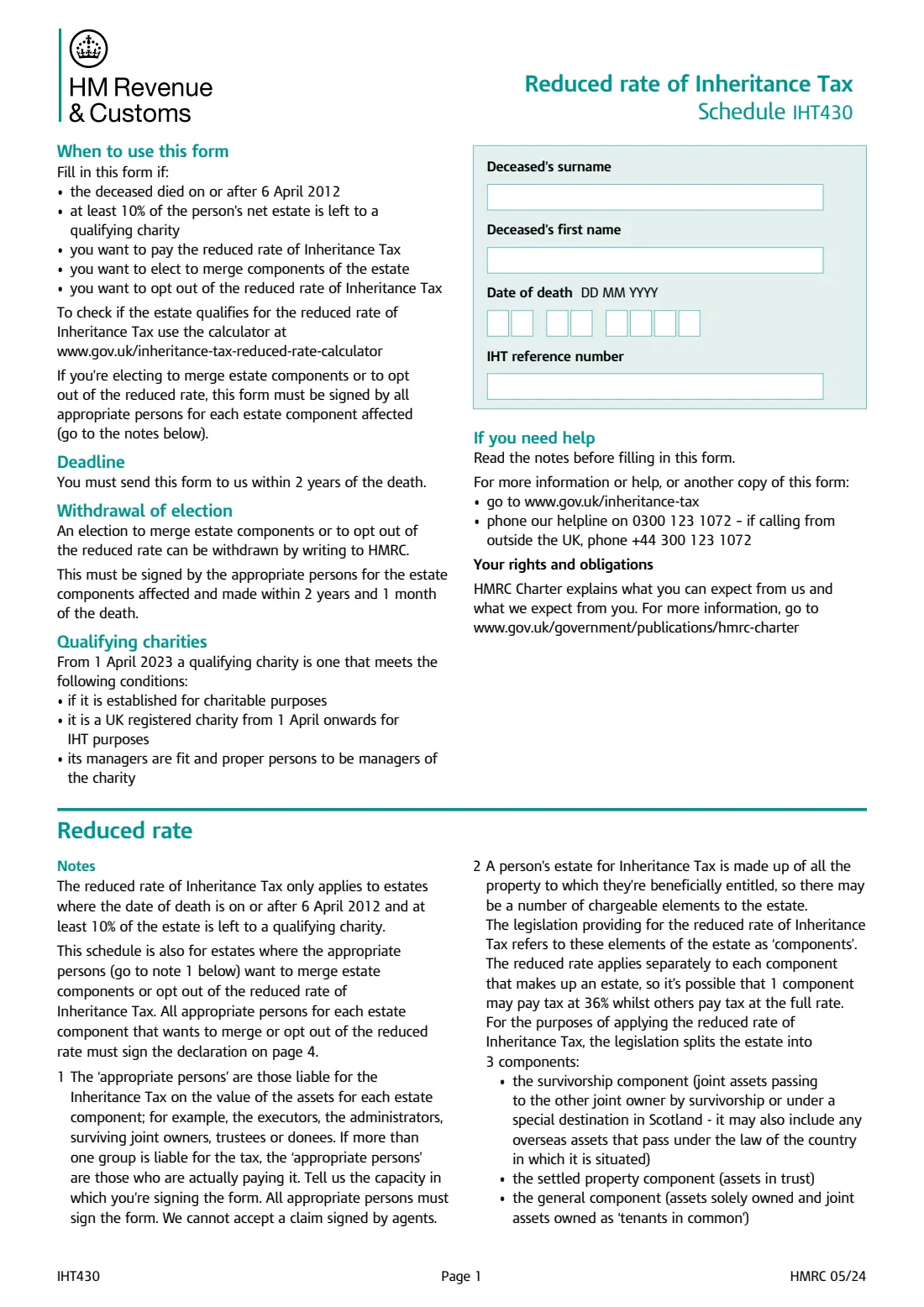
Where someone died on or after 6 April 2012 and left at least 10% of their net estate to a qualifying charity, Inheritance Tax on that part of the estate can be paid at a reduced rate of 36% instead of 40%. Executors claim it on schedule IHT430, sent with form IHT400. The same schedule is used to elect to merge components of the estate, or to opt out of the reduced rate.
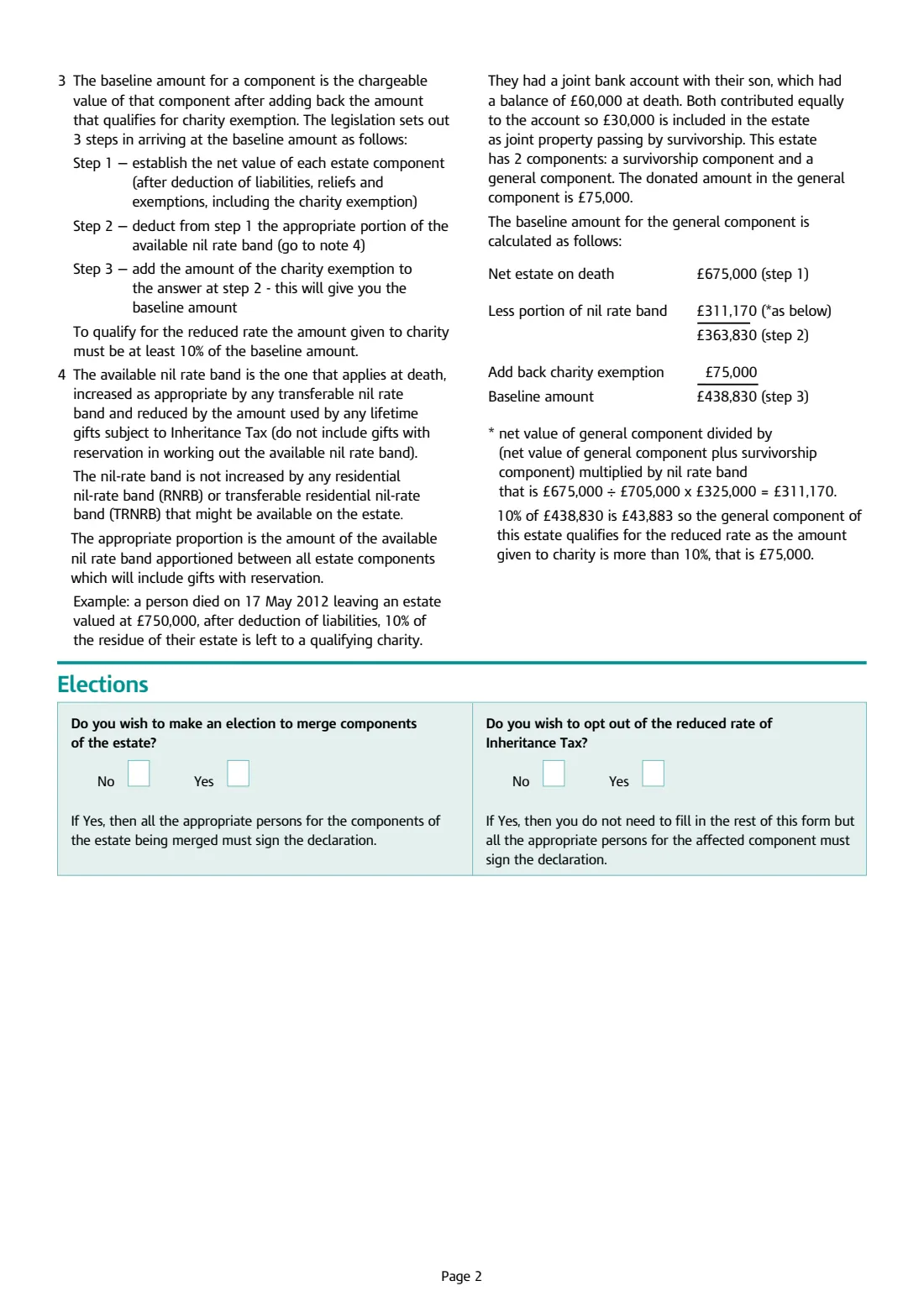
The reduced rate is tested separately for each component of the estate: the general component (assets owned outright and as tenants in common), the survivorship component (joint assets passing to the other owner) and the settled property component (assets in trust). A component qualifies when the gift to charity is at least 10% of its baseline amount: its net value, less its share of the available nil rate band, with the charity exemption added back. The form works through the values, deductions and exemptions for each component and then the tax at 36% or 40%.
FileIt works out the net value of each component, and can apply the 10% test and fill in the reduced rate calculation as the form's notes describe (it matches HMRC's own worked example), or you can enter the figures from HMRC's reduced rate calculator. It prints everything into HMRC's own IHT430 PDF (HMRC 05/24 edition). You check it and send it with the IHT400 yourself.
- Who fills it
- The executor or administrator of the estate
- Reduced rate
- 36% instead of 40%, for components leaving at least 10% of the baseline amount to charity
- Deaths
- On or after 6 April 2012
- Deadline
- The form says send it to HMRC within 2 years of the death
- Signatures
- Only to merge components or opt out: all the appropriate persons sign; HMRC can't accept a claim signed by agents
- Edition
- HMRC 05/24, 4 pages
- Helpline
- 0300 123 1072 (+44 300 123 1072 from outside the UK)
Who needs to fill out IHT430 Reduced rate of IHT?
- Executors of an estate where the will leaves at least 10% of the net estate to charity.
- Executors who want to merge estate components so that more of the estate qualifies for the reduced rate.
- Appropriate persons (executors, surviving joint owners, trustees or donees) who want to opt out of the reduced rate.
- Probate practitioners preparing the IHT400 schedules.
When to use IHT430 Reduced rate of IHT
- When completing form IHT400 for an estate with a charitable gift, where the death was on or after 6 April 2012.
- Within 2 years of the death, as the form says.
- An election to merge or to opt out can be withdrawn in writing to HMRC, signed by the appropriate persons, within 2 years and 1 month of the death.
What you need before you start
- The deceased's surname, first names, date of death and IHT reference number.
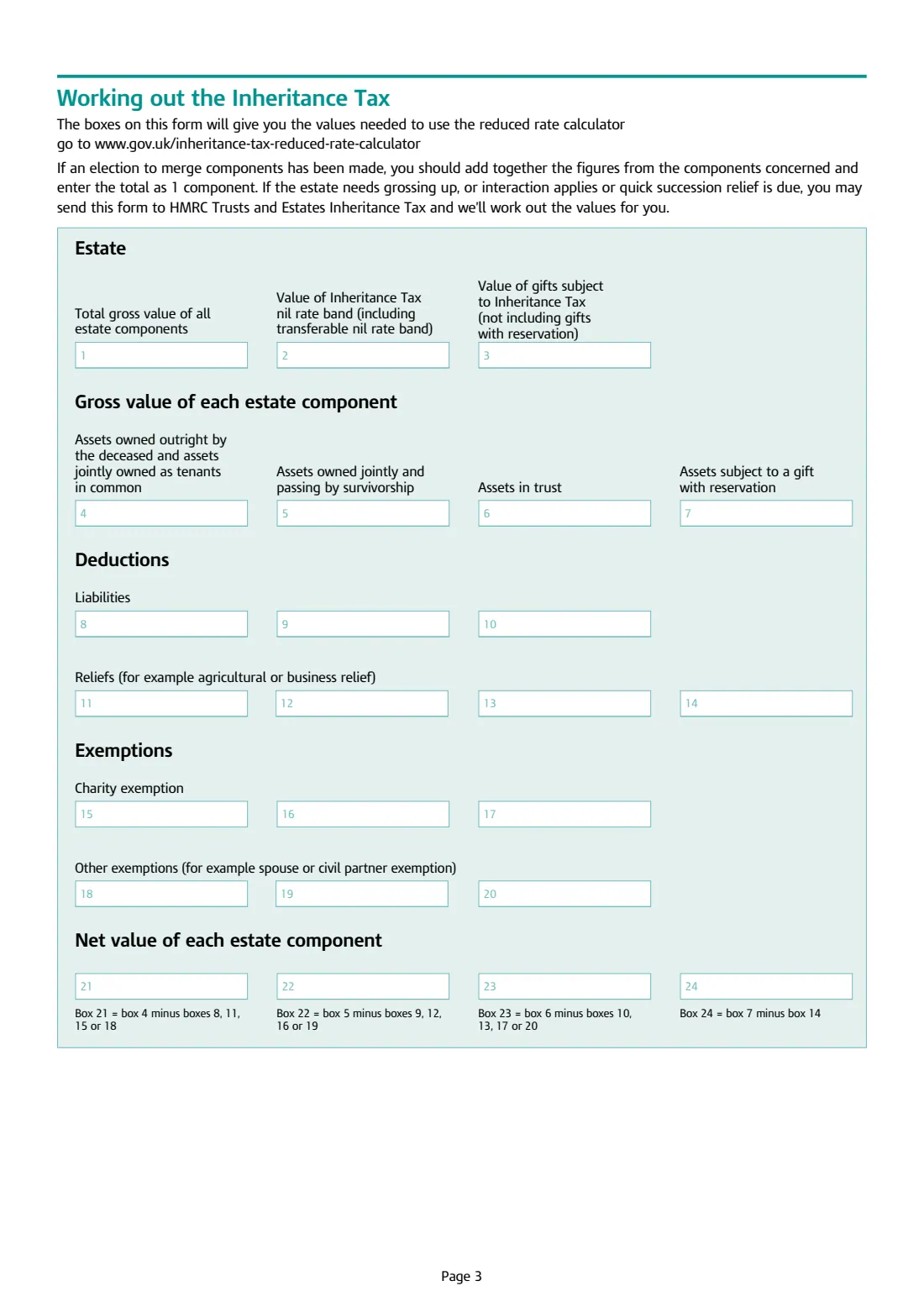
- The nil rate band, including any transferable nil rate band, and the value of lifetime gifts subject to Inheritance Tax.
- The gross value of each component: assets owned outright or as tenants in common, joint assets passing by survivorship, assets in trust and gifts with reservation.
- The liabilities, reliefs (such as agricultural or business relief), charity exemption and other exemptions for each component.
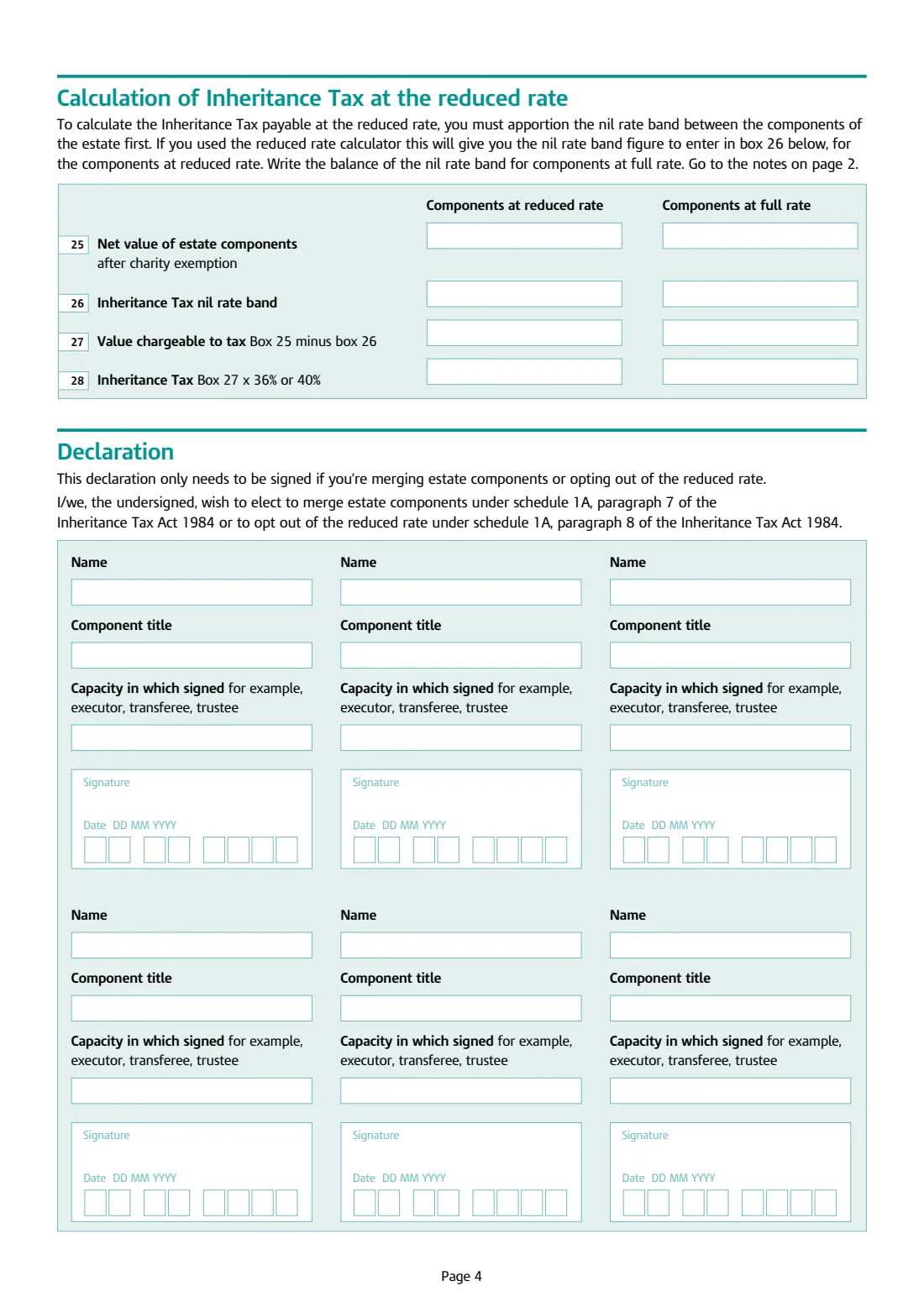
- If merging or opting out, the names, component and capacity of every appropriate person who must sign.
What’s on IHT430 Reduced rate of IHT
The 2024 edition has 4 pages. FileIt asks for it in 11 parts, and it is signed by Appropriate person 1 and Appropriate person 2 and Appropriate person 3 and Appropriate person 4 and Appropriate person 5 and Appropriate person 6:
- The person who has diedExecutor
- ElectionsExecutor
- Working out the Inheritance Tax: the estateExecutor
- Deductions and exemptionsExecutor
- Calculation of Inheritance Tax at the reduced rateExecutor
- Declaration: appropriate person 1Appropriate person 1
- Declaration: appropriate person 2Appropriate person 2
- Declaration: appropriate person 3Appropriate person 3
- Declaration: appropriate person 4Appropriate person 4
- Declaration: appropriate person 5Appropriate person 5
- Declaration: appropriate person 6Appropriate person 6
How to fill out IHT430 Reduced rate of IHT, step by step
1 Page 1: the deceased
The deceased's surname, first names, date of death and IHT reference number. The reduced rate only applies where the death was on or after 6 April 2012.
2 Page 2: elections
Say whether you want to merge components of the estate and whether you want to opt out of the reduced rate. If you opt out, you don't need to fill in the rest of the form, but the appropriate persons for the affected component must sign the declaration.
3 Page 3: working out the tax
Box 1 is the total gross value of all components, box 2 the nil rate band and box 3 lifetime gifts subject to tax. Boxes 4 to 7 are the gross value of each component, boxes 8 to 20 the liabilities, reliefs, charity exemption and other exemptions, and boxes 21 to 24 the net value of each component.
4 Page 4: the reduced rate calculation and declaration
Boxes 25 to 28 split the components between the reduced rate and the full rate: net value, the share of the nil rate band, the value chargeable and the tax at 36% or 40%. If the estate needs grossing up, interaction applies or quick succession relief is due, the form says you may leave HMRC to work out the values. The declaration is signed only when merging components or opting out.
Common mistakes to avoid
- Testing 10% against the whole estate instead of each component's baseline amount.
- Forgetting that the available nil rate band is reduced by lifetime gifts and shared between all the components, including gifts with reservation.
- Adding the residence nil rate band to box 2: the notes say the nil rate band here is not increased by the RNRB or transferable RNRB.
- Leaving out an appropriate person from the declaration when merging or opting out; all of them must sign, and agents can't.
- Sending the form more than 2 years after the death.
After you fill it out
Check the figures, ideally against HMRC's reduced rate calculator at www.gov.uk/inheritance-tax-reduced-rate-calculator.
If merging components or opting out, have every appropriate person sign the declaration, by hand or with FileIt's eSignature.
Send the schedule with the IHT400 within 2 years of the death. FileIt doesn't send anything for you.
Fill out IHT430 Reduced rate of IHT online with FileIt
- Pick the person. Choose someone from People and FileIt fills in their name, date of birth, address and other details it already knows.
- Answer plain-language questions. One part of the form at a time, with the official help text beside each question — 67 fields in all. Your answers save as you go.
- Check the live preview. Watch your answers land on the real HM Revenue & Customs form, and let FileIt do any worksheet arithmetic.
- Generate the official PDF. FileIt prints your answers into the agency’s own PDF and files it in that person’s folder in your vault. Sign it, or send it for e-signature.
FileIt fills the form — it never files or submits anything for you. Deliver the finished form to whoever asked for it, the way the form’s instructions say.
Start IHT430 Reduced rate of IHT now — it’s freeIHT430 Reduced rate of IHT: frequently asked questions
How much do you need to leave to charity to get the 36% rate?
At least 10% of the baseline amount of the component: its net value after all deductions and exemptions, less its share of the available nil rate band, with the charity exemption added back.
What is the baseline amount in HMRC's example?
An estate of £750,000 left 10% of the residue (£75,000) to charity and had a £30,000 share of a joint account. The general component's net value is £675,000, its share of the nil rate band is £675,000 ÷ £705,000 x £325,000 = £311,170, and the baseline is £363,830 + £75,000 = £438,830. 10% of that is £43,883, so the £75,000 gift qualifies.
Why would anyone merge components or opt out?
Merging lets components be tested as one, so a charitable gift in one component can bring the merged total up to the 10% threshold. Opting out keeps the full rate for a component. Either way, all the appropriate persons for the components affected must sign the declaration.
Is the reduced rate applied to the residence nil rate band?
The form's notes say the nil rate band used here is not increased by the residence nil rate band or transferable residence nil rate band.
Does FileIt send IHT430 to HMRC?
No. FileIt fills in the official IHT430 PDF. You send it with the IHT400 yourself.
Official sources
- Blank form (PDF), published by HM Revenue & Customs: https://assets.publishing.service.gov.uk/media/668b94b97541f54efe51baec/IHT430-05-24_fillable.pdf
- Official instructions and guidance: https://www.gov.uk/government/publications/inheritance-tax-reduced-rate-of-inheritance-tax-iht430
- Edition shown on this page: IHT430 HMRC 05/24 (checked 2026-10-25).
FileIt is not affiliated with or endorsed by HM Revenue & Customs or any government. This page explains the form in general terms and is not legal, tax or immigration advice. Always read the official instructions, and check that you are using the edition the recipient accepts. Page last reviewed 2026-10-25.