What is IHT419 Debts owed by the deceased?
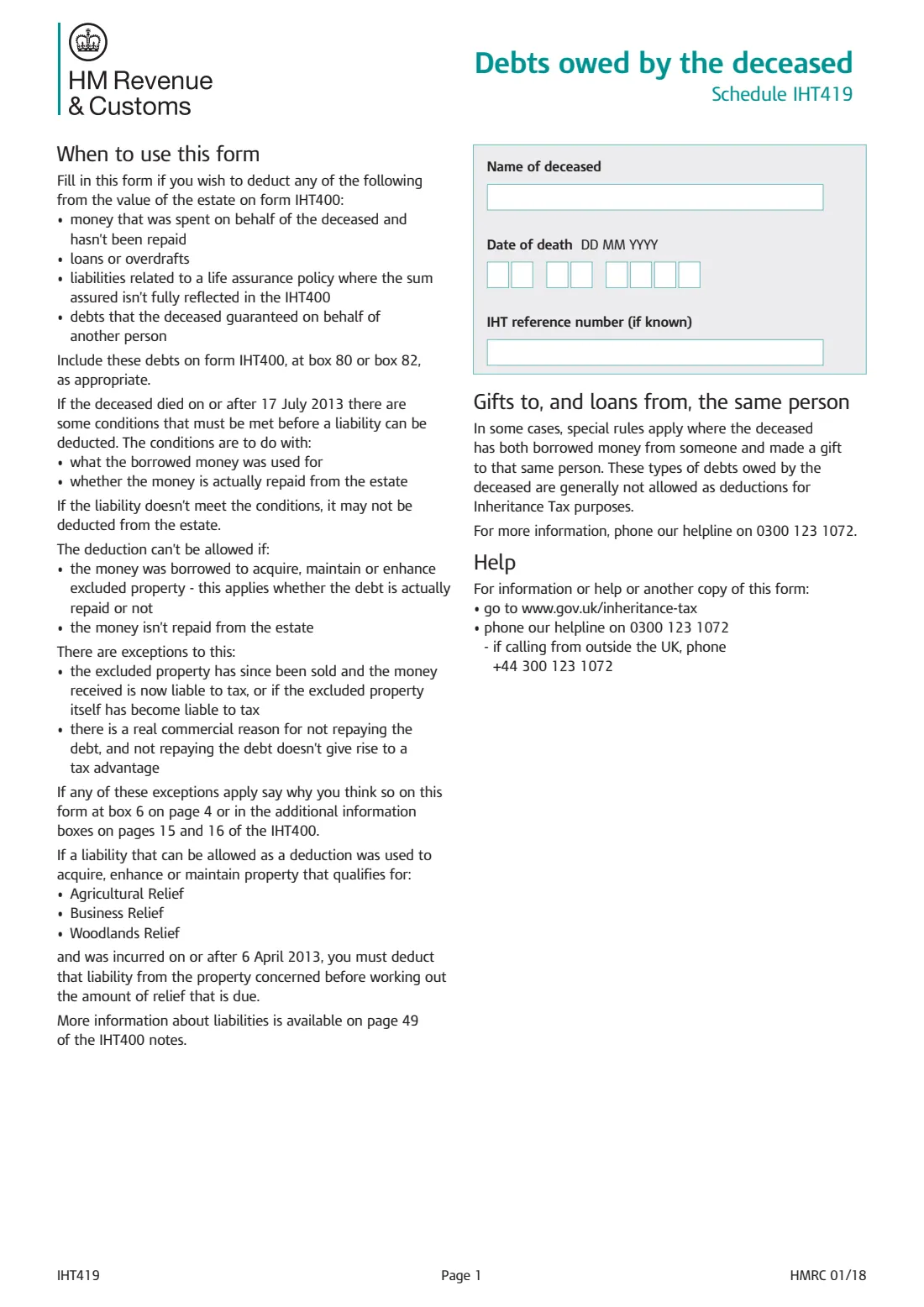
Some debts can be deducted from an estate's value for Inheritance Tax, but HMRC wants to know more about the less straightforward ones. Schedule IHT419 is where an executor gives the details: money someone spent on the deceased's behalf and wasn't repaid, loans and overdrafts (including from friends and relatives), liabilities tied to a life assurance policy or investment bond, debts the deceased guaranteed for someone else, and loans from a person the deceased had also made a gift to.
Each of the five questions is a Yes or No, with a table to fill in for a Yes. A sixth box takes any other information, such as why an exception applies. Since 17 July 2013, a liability can generally only be deducted if conditions about what the money was used for, and whether it's actually repaid from the estate, are met. The debts themselves go on IHT400 at box 80 or box 82.
FileIt asks each question in turn, shows the table only when you answer Yes, and checks every row you start has its name and amount. It prints your answers into HMRC's official IHT419 PDF, with the landscape pages laid out as they appear on screen. You check the schedule and send it with the IHT400 yourself.
- Who fills it
- The executor or administrator of the estate
- Sent with
- Form IHT400 (the Inheritance Tax account)
- Debts go in
- IHT400 box 80 or box 82, as appropriate
- Evidence
- Copies of written loan evidence and policy documents
- Edition
- HMRC 01/18
- Helpline
- 0300 123 1072 (+44 300 123 1072 from outside the UK)
Who needs to fill out IHT419 Debts owed by the deceased?
- Executors deducting a loan from a friend or relative, or a bank loan or overdraft, from the estate.
- Families where someone paid the deceased's bills and is now being repaid from the estate.
- Estates with a guarantee the deceased gave for another person's borrowing.
- Probate practitioners preparing IHT400 schedules.
When to use IHT419 Debts owed by the deceased
- When completing form IHT400 and deducting any of the debts the schedule covers.
- Once you have the loan agreements, statements, policy documents and other written evidence.
- Use it for the kinds of debt it lists; the IHT400 notes explain where other debts are entered.
What you need before you start
- The deceased's name, date of death and IHT reference, if you have one.
- Who spent money on the deceased's behalf, what on, how much, and why it wasn't repaid.
- Each lender's name, the date, purpose, original amount and the amount outstanding at death.
- Policy documents and any trust or loan documents for a policy-related liability.
- Details of any debts the deceased guaranteed, and whether the guarantee was called on.
- Any gifts made after 18 March 1986 to someone who later lent the deceased money.
What’s on IHT419 Debts owed by the deceased
The 2018 edition has 4 pages. FileIt asks for it in 7 parts:
- The person who has diedExecutor
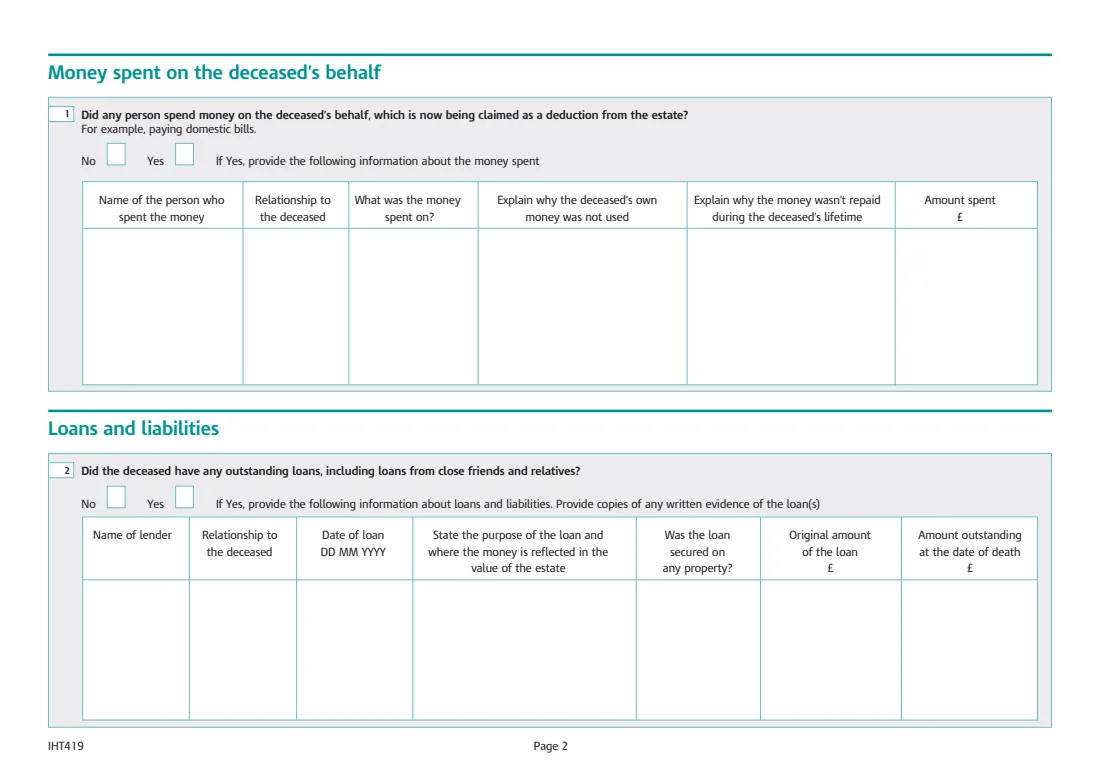
- 1. Money spent on the deceased's behalfExecutor
- 2. Loans and liabilitiesExecutor
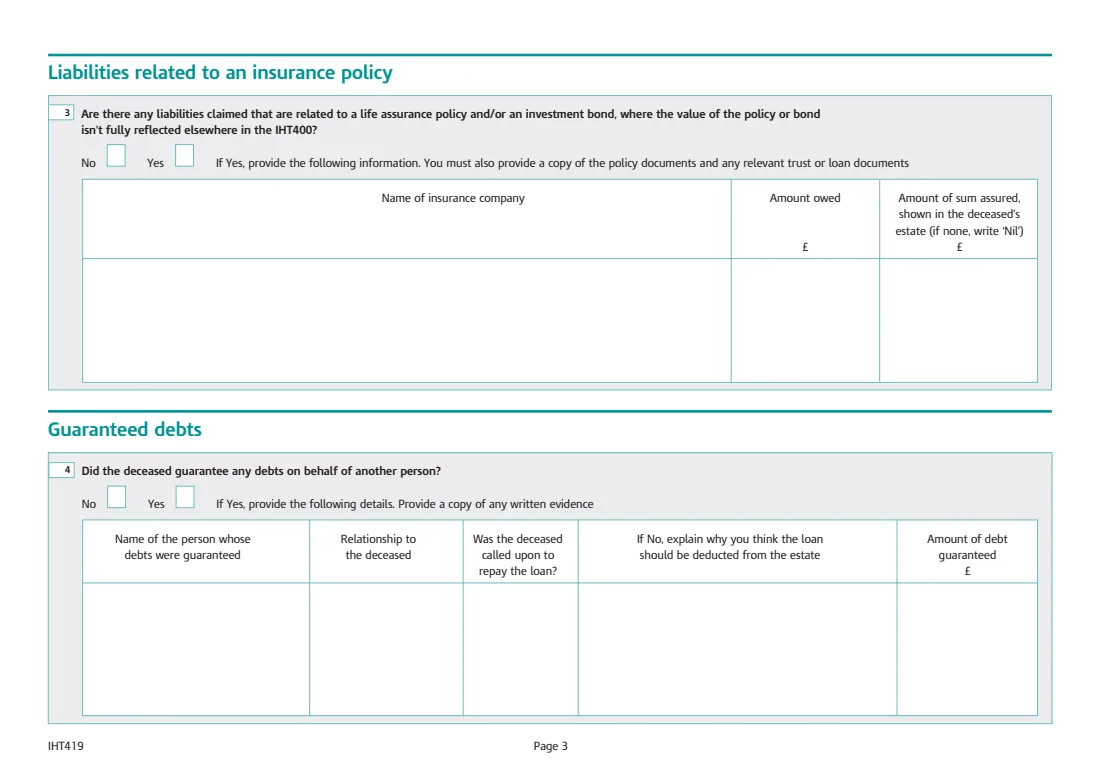
- 3. Liabilities related to an insurance policyExecutor
- 4. Guaranteed debtsExecutor
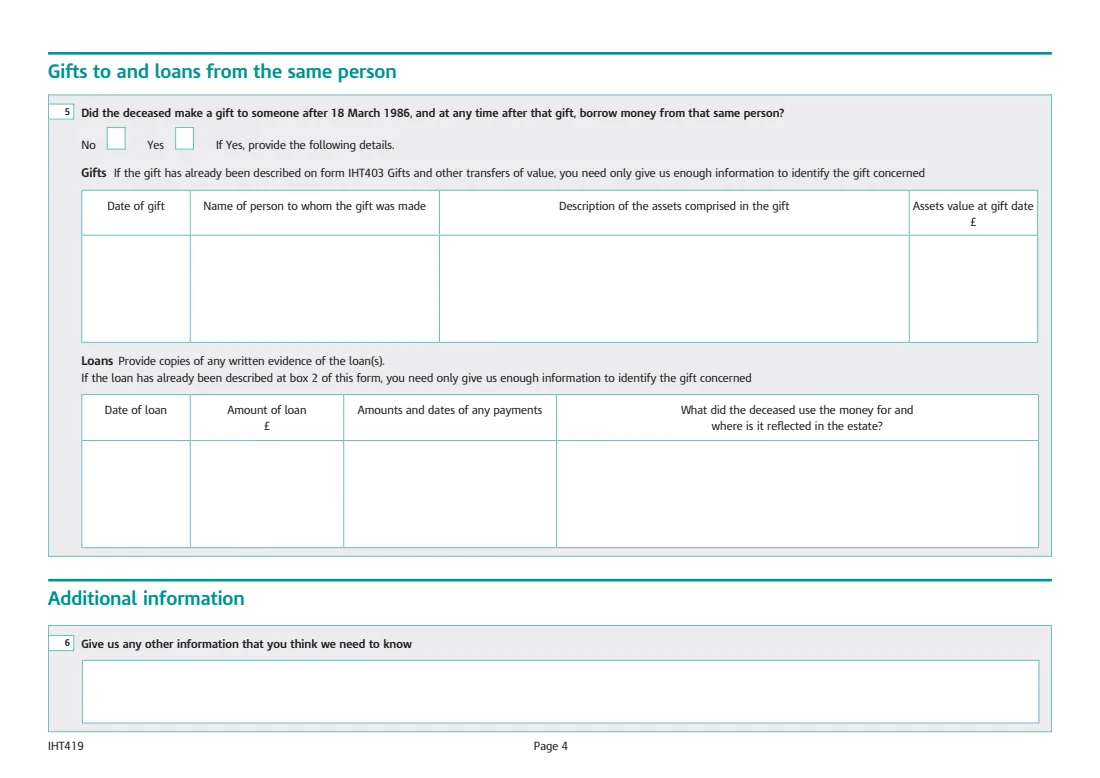
- 5. Gifts to and loans from the same personExecutor
- 6. Additional informationExecutor
How to fill out IHT419 Debts owed by the deceased, step by step
1 The person who has died
Name, date of death and IHT reference number. FileIt can pre-fill the name from the person's record in your vault.
2 1. Money spent on the deceased's behalf
Who spent it, their relationship, what it paid for, why the deceased's own money wasn't used, why it wasn't repaid in their lifetime, and the amount. Up to 3 people.
3 2. Loans and liabilities
Each lender, their relationship, the date and purpose of the loan, where the money is reflected in the estate, whether it was secured on property, the original amount and what was outstanding. Up to 3 loans.
4 3 and 4. Policies and guarantees
Liabilities linked to a life policy or investment bond (company, amount owed and sum assured, or Nil), and debts the deceased guaranteed, with whether they were called upon to repay and, if not, why the debt should still be deducted.
5 5. Gifts to and loans from the same person
Gifts made after 18 March 1986 to someone the deceased later borrowed from: the gift's date, recipient, assets and value, and the loan's date, amount, repayments and use.
6 6. Additional information
Anything else HMRC needs, such as why an exception applies to a liability that wasn't repaid or was used for excluded property.
Common mistakes to avoid
- Deducting a loan that won't actually be repaid from the estate, without explaining why.
- Leaving out the copies of written evidence for loans and policies.
- Answering Yes to a question but leaving its table empty.
- Forgetting that loans used to buy, maintain or improve excluded property generally can't be deducted.
- Not mentioning gifts to someone who later lent the deceased money.
After you fill it out
Check the figures, then include the debts on form IHT400 at box 80 or box 82.
Send IHT419 with the IHT400 and the copies of evidence it asks for. FileIt doesn't send anything to HMRC.
Keep a copy with the loan papers in the deceased's FileIt folder.
Fill out IHT419 Debts owed by the deceased online with FileIt
- Pick the person. Choose someone from People and FileIt fills in their name, date of birth, address and other details it already knows.
- Answer plain-language questions. One part of the form at a time, with the official help text beside each question — 92 fields in all. Your answers save as you go.
- Check the live preview. Watch your answers land on the real HM Revenue & Customs form, and let FileIt do any worksheet arithmetic.
- Generate the official PDF. FileIt prints your answers into the agency’s own PDF and files it in that person’s folder in your vault.
FileIt fills the form — it never files or submits anything for you. Deliver the finished form to whoever asked for it, the way the form’s instructions say.
Start IHT419 Debts owed by the deceased now — it’s freeIHT419 Debts owed by the deceased: frequently asked questions
Which debts need IHT419?
Money spent on the deceased's behalf, loans and overdrafts, liabilities related to a life assurance policy that isn't fully reflected in the IHT400, debts the deceased guaranteed, and loans from someone the deceased also made a gift to.
Can every debt be deducted?
Not always. For deaths on or after 17 July 2013 there are conditions about what the borrowed money was used for and whether it's repaid from the estate. The form and page 49 of the IHT400 notes explain the exceptions.
What if there are more debts than rows?
Use the additional information box on page 4, or the additional information pages of the IHT400, for anything that doesn't fit.
Where do the amounts go on IHT400?
The form says to include these debts on form IHT400 at box 80 or box 82, as appropriate.
Does FileIt decide whether a debt is deductible?
No. FileIt records your answers on the official schedule and checks the tables are complete. Whether a liability can be deducted is for you and HMRC, using the IHT400 notes.
Official sources
- Blank form (PDF), published by HM Revenue & Customs: https://assets.publishing.service.gov.uk/media/5af189f9ed915d586f32aa35/IHT419_012018_online-v2.pdf
- Official instructions and guidance: https://www.gov.uk/government/publications/inheritance-tax-debts-owed-by-the-deceased-iht419
- Edition shown on this page: HMRC 01/18 (checked 2026-10-19).
FileIt is not affiliated with or endorsed by HM Revenue & Customs or any government. This page explains the form in general terms and is not legal, tax or immigration advice. Always read the official instructions, and check that you are using the edition the recipient accepts. Page last reviewed 2026-10-19.