What is IHT412 unlisted shares?
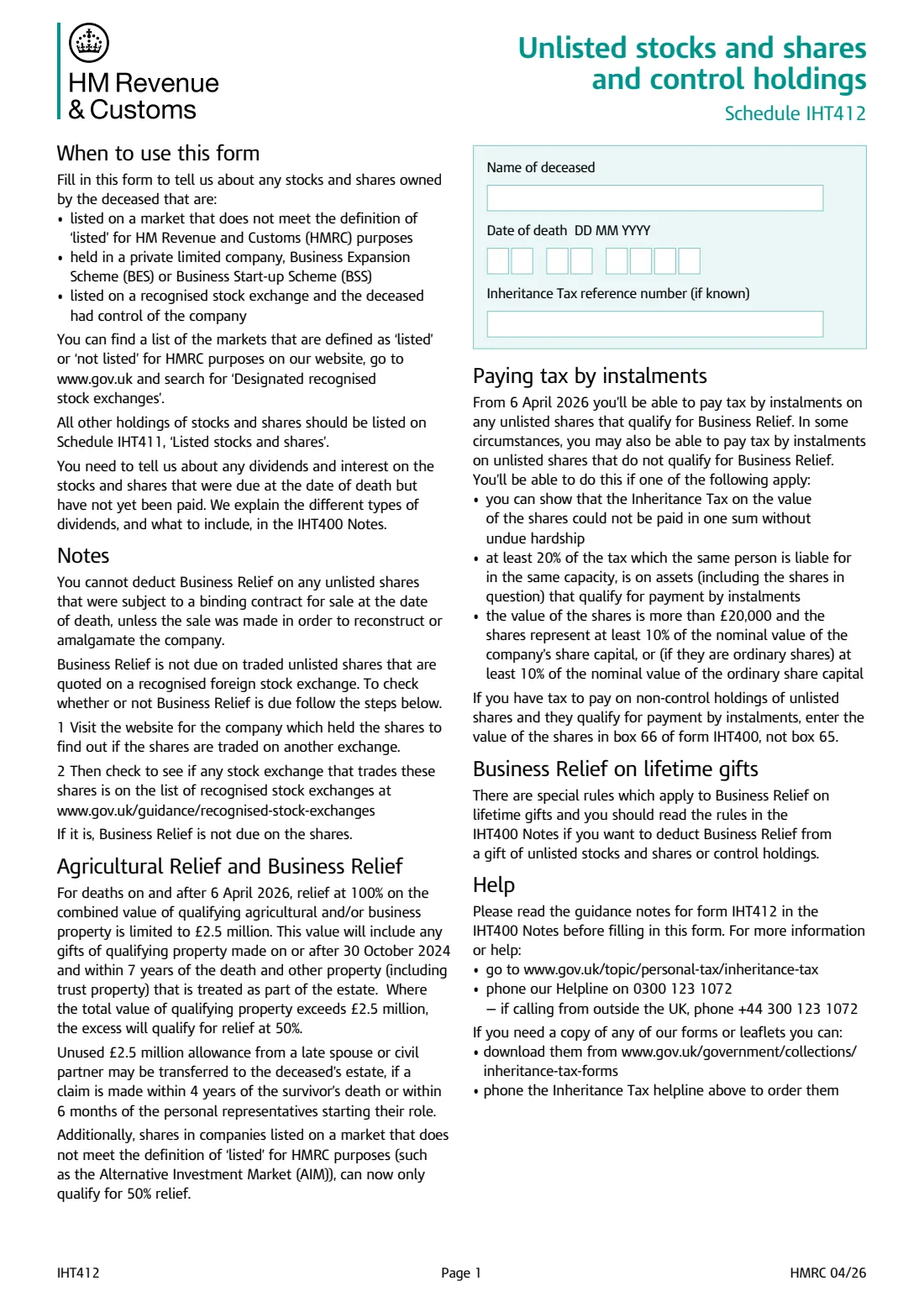
Schedule IHT412 lists the deceased's stocks and shares that don't go on IHT411: shares on markets HMRC doesn't treat as 'listed' (such as AIM), shares in private limited companies, Business Expansion Scheme and Business Start-up Scheme shares, and listed shares where the deceased had control of the company.
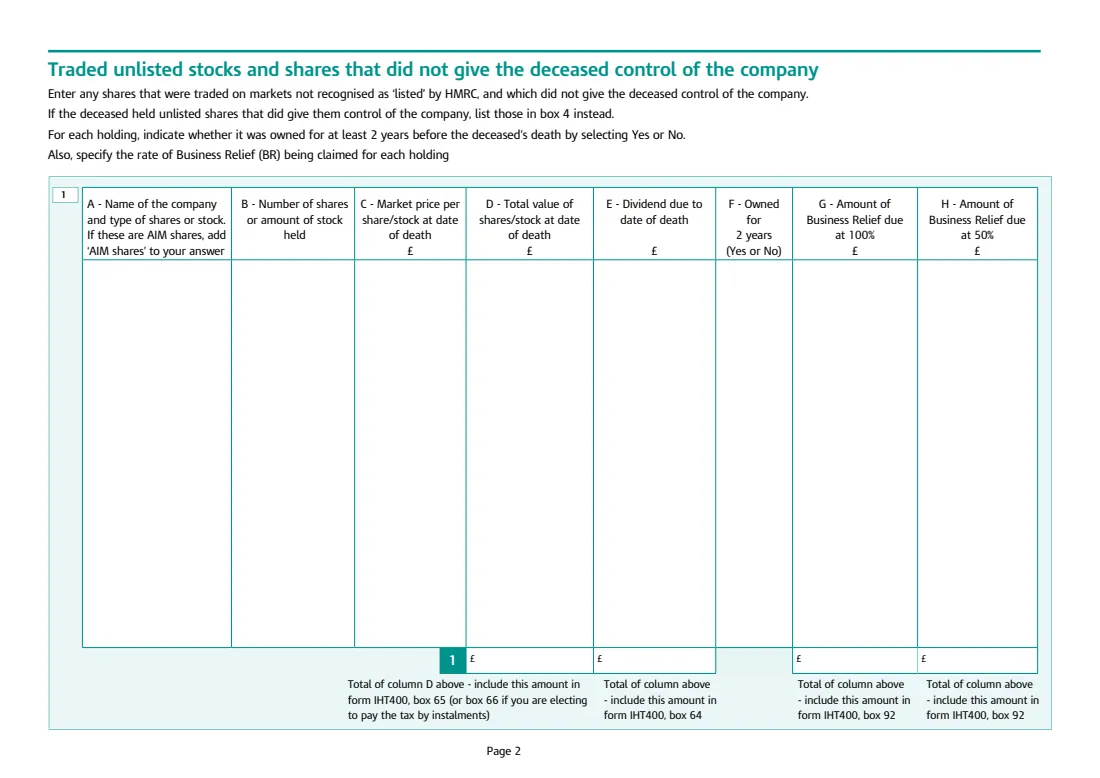
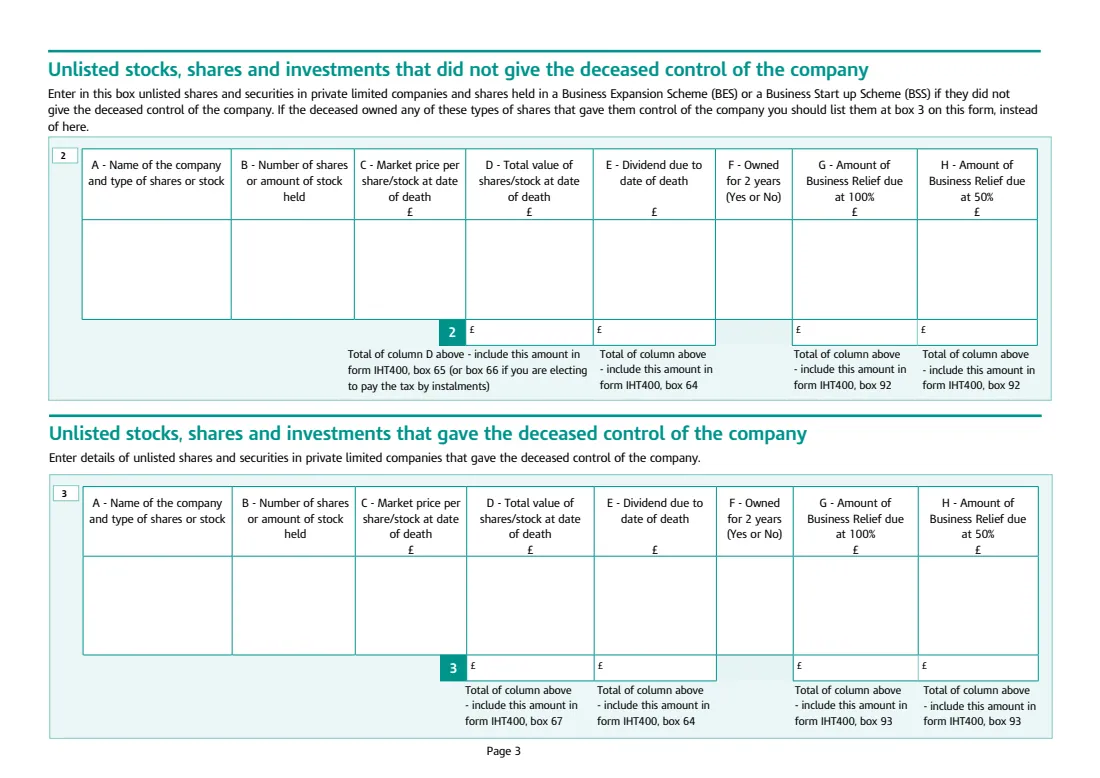
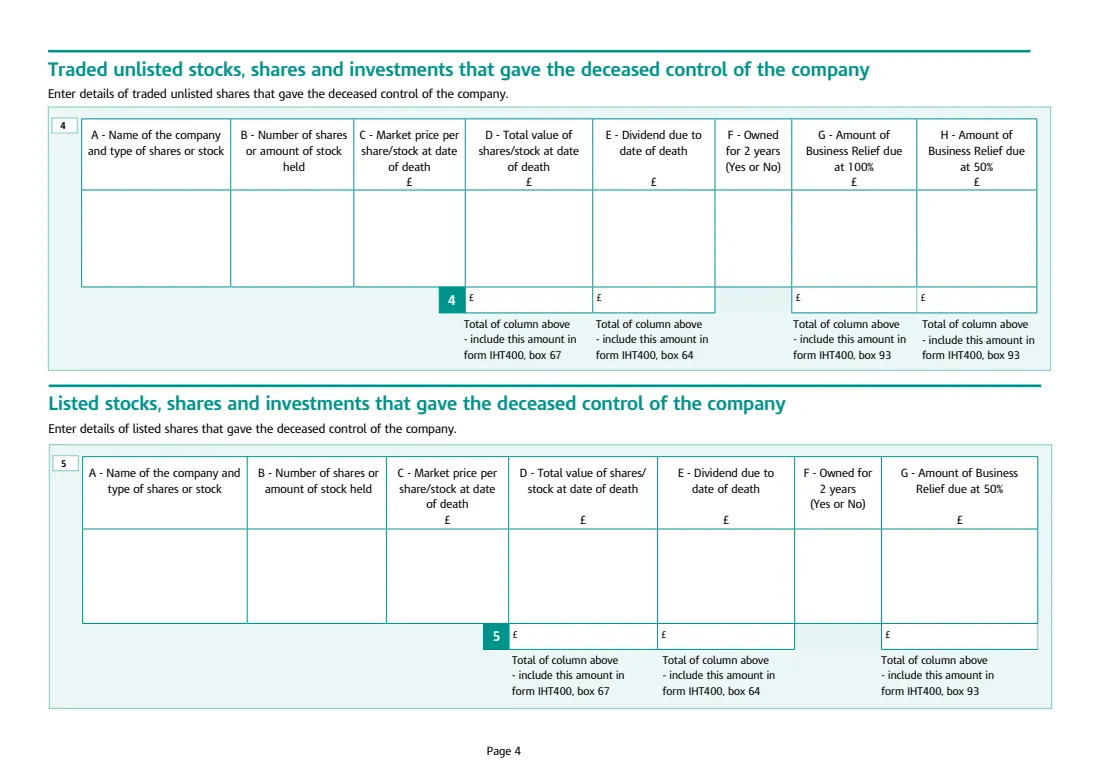
There are five tables, depending on whether the shares are traded or not, unlisted or listed, and whether they gave the deceased control. For each holding you give the number of shares, the price and value at the date of death, any dividend due, whether it was owned for 2 years and the Business Relief at 100% and 50%. The column totals go to IHT400 boxes 64, 65 or 66, 67, 92 and 93.
For deaths on and after 6 April 2026, 100% relief on the combined value of qualifying agricultural and business property is limited to £2.5 million, with the excess at 50%, and shares on markets that aren't 'listed' for HMRC, such as AIM, only qualify for 50% relief. FileIt checks the relief against each holding's value, adds up every column and prints HMRC's official IHT412 PDF for you to send with IHT400.
- Who fills it
- The executor or administrator preparing form IHT400
- Part of
- Form IHT400, the Inheritance Tax account
- Totals go to
- IHT400 boxes 64, 65 (or 66), 67, 92 and 93
- Tables
- 5: box 1 has 7 rows, boxes 2 to 5 have 2 each
- Edition
- HMRC 04/26
- Helpline
- Inheritance Tax helpline 0300 123 1072
Who needs to fill out IHT412 unlisted shares?
- Executors whose estate includes AIM shares or shares on another market HMRC doesn't treat as 'listed'.
- Estates with shares in a family or private limited company, or BES or BSS shares.
- Estates where the deceased had a controlling holding in a company, listed or not.
- Not for ordinary listed shares, unit trusts or gilts: those go on IHT411.
When to use IHT412 unlisted shares
- When you're completing the full IHT400 account and the deceased held unlisted shares or a control holding.
- Once you have valuations at the date of death for each holding.
- When you're claiming Business Relief on shares, or electing to pay the tax on unlisted shares by instalments.
What you need before you start
- The deceased's name, date of death and Inheritance Tax reference, if known.
- For each holding: the company, the type and number of shares, and the price and total value at the date of death.
- Any dividend that was due at the date of death but not yet paid.
- Whether each holding was owned for at least 2 years before the death.
- The Business Relief you're claiming on each holding at 100% and at 50%.
What’s on IHT412 unlisted shares
The 2026 edition has 4 pages. FileIt asks for it in 6 parts:
- The person who has diedExecutor or administrator
- 1. Traded unlisted stocks and shares that did not give the deceased control of the companyExecutor or administrator
- 2. Unlisted stocks, shares and investments that did not give the deceased control of the companyExecutor or administrator
- 3. Unlisted stocks, shares and investments that gave the deceased control of the companyExecutor or administrator
- 4. Traded unlisted stocks, shares and investments that gave the deceased control of the companyExecutor or administrator
- 5. Listed stocks, shares and investments that gave the deceased control of the companyExecutor or administrator
How to fill out IHT412 unlisted shares, step by step
1 About the deceased
Name, date of death and Inheritance Tax reference. FileIt can pre-fill the name from your vault.
2 Box 1: traded unlisted, no control
Shares on markets that aren't 'listed' for HMRC, such as AIM, that didn't give control. Add 'AIM shares' to the name of AIM shares. Totals go to IHT400 boxes 65 (or 66), 64 and 92.
3 Box 2: unlisted, no control
Private company, BES and BSS shares that didn't give control. Totals go to IHT400 boxes 65 (or 66), 64 and 92.
4 Boxes 3 and 4: control holdings
Unlisted (box 3) and traded unlisted (box 4) shares that gave the deceased control of the company. Totals go to IHT400 boxes 67, 64 and 93.
5 Box 5: listed control holdings
Listed shares that gave the deceased control, with Business Relief at 50%. Totals go to IHT400 boxes 67, 64 and 93.
Common mistakes to avoid
- Putting ordinary listed shares here instead of on IHT411.
- Listing a control holding in box 1 or 2 instead of box 3 or 4.
- Claiming 100% relief on AIM shares for a death on or after 6 April 2026: they only qualify for 50%.
- Claiming Business Relief on shares under a binding contract for sale at the date of death, unless the sale was to reconstruct or amalgamate the company.
- Claiming Business Relief on traded unlisted shares that are quoted on a recognised foreign stock exchange.
After you fill it out
Check the preview against the valuations and download the PDF.
Copy each table's totals to the IHT400 boxes printed under it, and send IHT412 with the IHT400 account. FileIt doesn't send anything to HMRC.
Keep the share valuations and the schedule in the deceased's FileIt folder.
Fill out IHT412 unlisted shares online with FileIt
- Pick the person. Choose someone from People and FileIt fills in their name, date of birth, address and other details it already knows.
- Answer plain-language questions. One part of the form at a time, with the official help text beside each question — 140 fields in all. Your answers save as you go.
- Check the live preview. Watch your answers land on the real HMRC form, and let FileIt do any worksheet arithmetic.
- Generate the official PDF. FileIt prints your answers into the agency’s own PDF and files it in that person’s folder in your vault.
FileIt fills the form — it never files or submits anything for you. Deliver the finished form to whoever asked for it, the way the form’s instructions say.
Start IHT412 unlisted shares now — it’s freeIHT412 unlisted shares: frequently asked questions
Are AIM shares 'listed' for Inheritance Tax?
No. AIM is a market that doesn't meet HMRC's definition of 'listed', so AIM shares go on IHT412, in box 1 or box 4. For deaths on and after 6 April 2026 they can only qualify for 50% Business Relief.
What changed on 6 April 2026?
For deaths on and after that date, 100% relief on the combined value of qualifying agricultural and business property is limited to £2.5 million, including qualifying gifts made on or after 30 October 2024 and within 7 years of the death. The excess qualifies for 50% relief. Unused allowance from a late spouse or civil partner can be transferred if it's claimed in time.
Can the tax on unlisted shares be paid by instalments?
The form says that from 6 April 2026 you can pay by instalments on unlisted shares that qualify for Business Relief, and in some circumstances on others. For non-control holdings that qualify, enter the value in IHT400 box 66 instead of box 65.
Why does the form ask about 2 years?
For each holding, column F says whether it was owned for at least 2 years before the death. The IHT400 Notes explain how that affects Business Relief.
Who signs IHT412?
Nobody signs the schedule itself. The declaration on IHT400 covers all the schedules sent with it.
Official sources
- Blank form (PDF), published by HMRC: https://assets.publishing.service.gov.uk/media/69ce22eeb5210036050bc6cc/IHT412_0426.pdf
- Official instructions and guidance: https://www.gov.uk/government/publications/inheritance-tax-unlisted-stocks-and-shares-and-control-holdings-iht412
- Edition shown on this page: HMRC 04/26 (checked 2026-10-25).
FileIt is not affiliated with or endorsed by HMRC or any government. This page explains the form in general terms and is not legal, tax or immigration advice. Always read the official instructions, and check that you are using the edition the recipient accepts. Page last reviewed 2026-10-25.