
What is Form COP4?
If someone can no longer make some decisions for themselves and didn't set up a lasting power of attorney, the Court of Protection can appoint a deputy to make them. Anyone applying to be that deputy, often a family member, sends the court a COP4 declaration with the application. It's the court's way of checking you're suitable and that you understand the role.
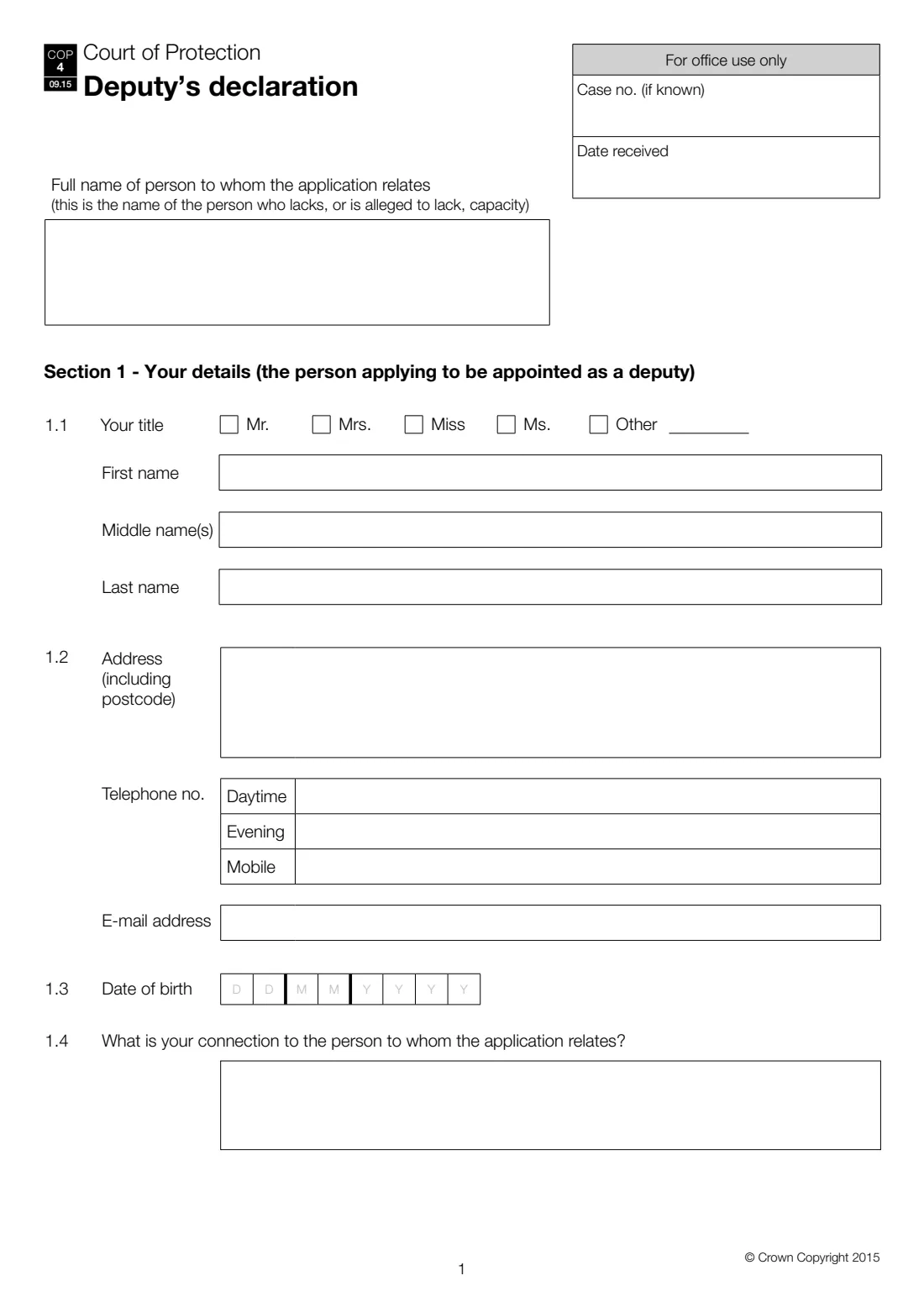
The form asks about you and the person, your work and personal circumstances, your financial history if you'll manage their property and affairs, and a set of undertakings, such as acting in their best interests and keeping their money separate from yours. It ends with a personal statement about why you want to be their deputy, and a statement of truth.
FileIt asks each question in plain English, only shows the financial section and the extra property and affairs undertakings when they apply, and prints your answers onto the court's own COP4 PDF. It also checks that every 'Yes' has its details and every 'No' undertaking has a comment, as the form asks. You print it, sign it and send it with your application. FileIt never submits anything.
- Who fills it
- Each person applying to be appointed as a deputy
- Sent with
- The deputyship application to the Court of Protection
- Sections
- 6: your details, circumstances, finances, undertakings, personal statement, statement of truth
- Finances section
- Only for a property and affairs deputy
- Signatures
- The person applying to be deputy signs the statement of truth
- Edition
- COP 4 (09.15)
Who needs to fill out Form COP4?
- A son, daughter, partner or other relative applying to be a property and financial affairs deputy for someone who lacks capacity.
- Someone applying to be a personal welfare (health and welfare) deputy.
- Each person, where two or more people are applying to be deputies together.
- A professional, such as a solicitor or accountant, applying to act as deputy.
When to use Form COP4
- When you apply to the Court of Protection to be appointed as someone's deputy.
- When the court asks a proposed deputy for a declaration.
- Again if you're proposed as a replacement deputy.
What you need before you start
- The person's full name, address and date of birth, and how you're connected to them.
- Your own details: name, address, phone numbers, email and date of birth.
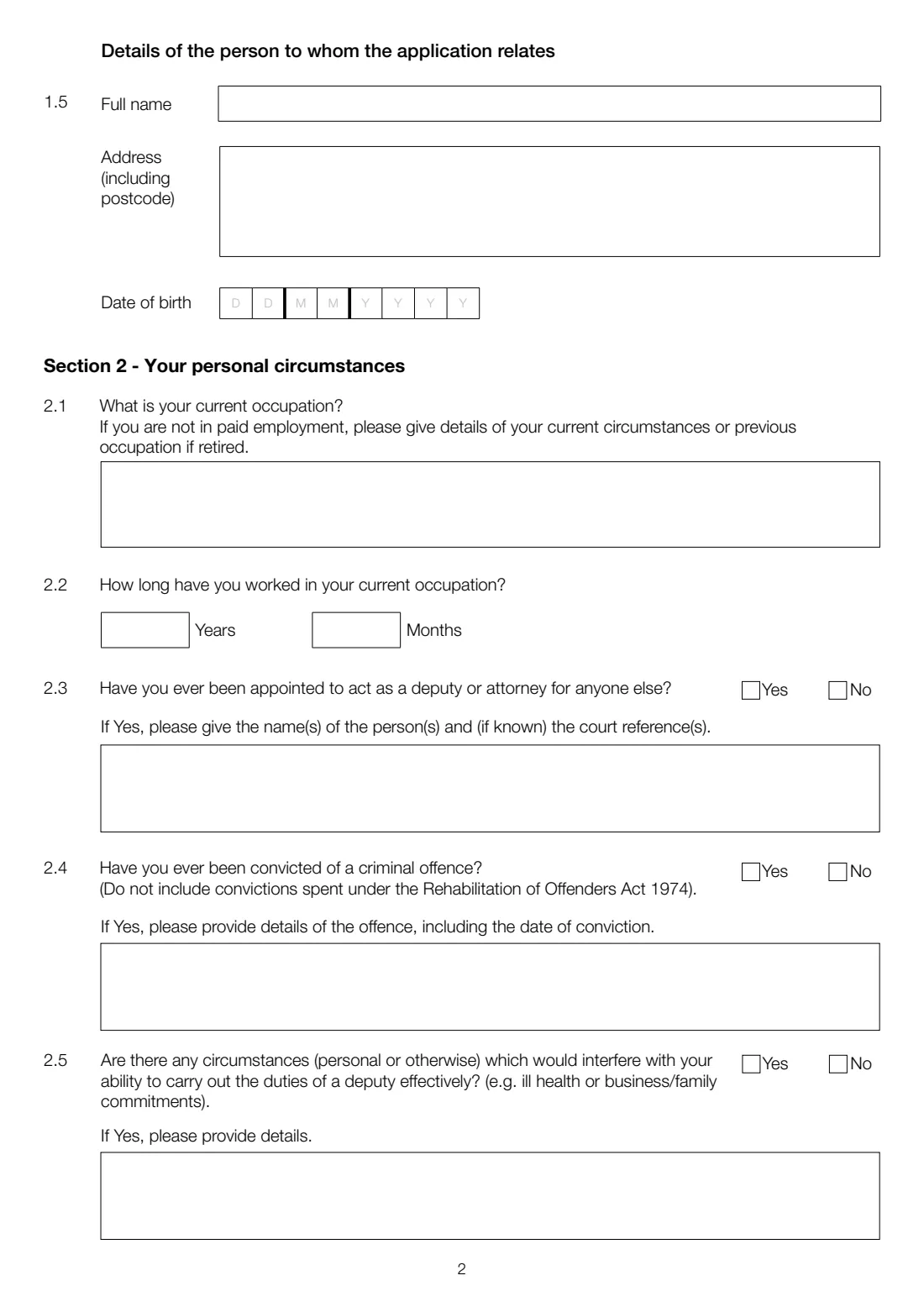
- Your occupation and how long you've done it, and any past appointments as a deputy or attorney.
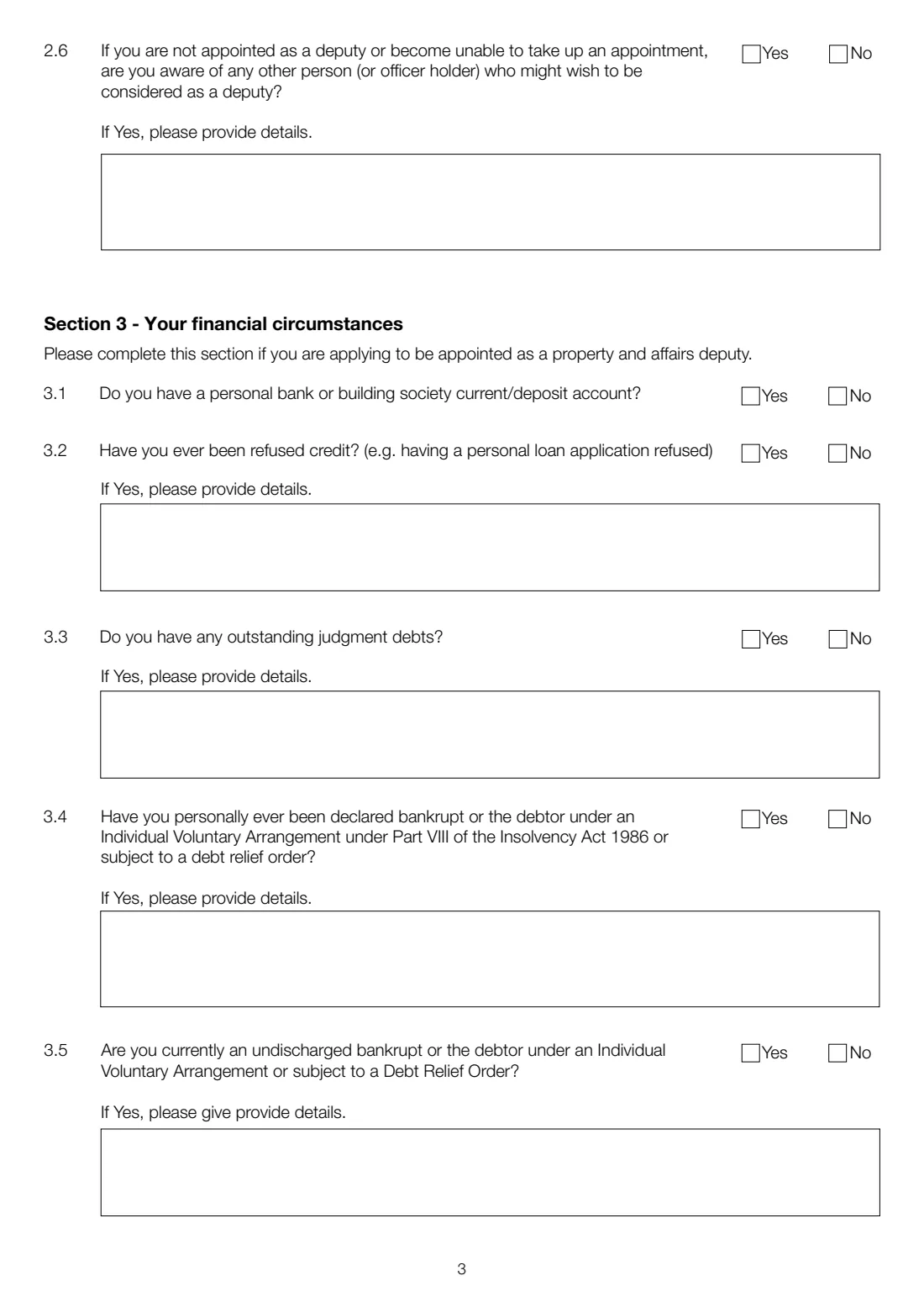
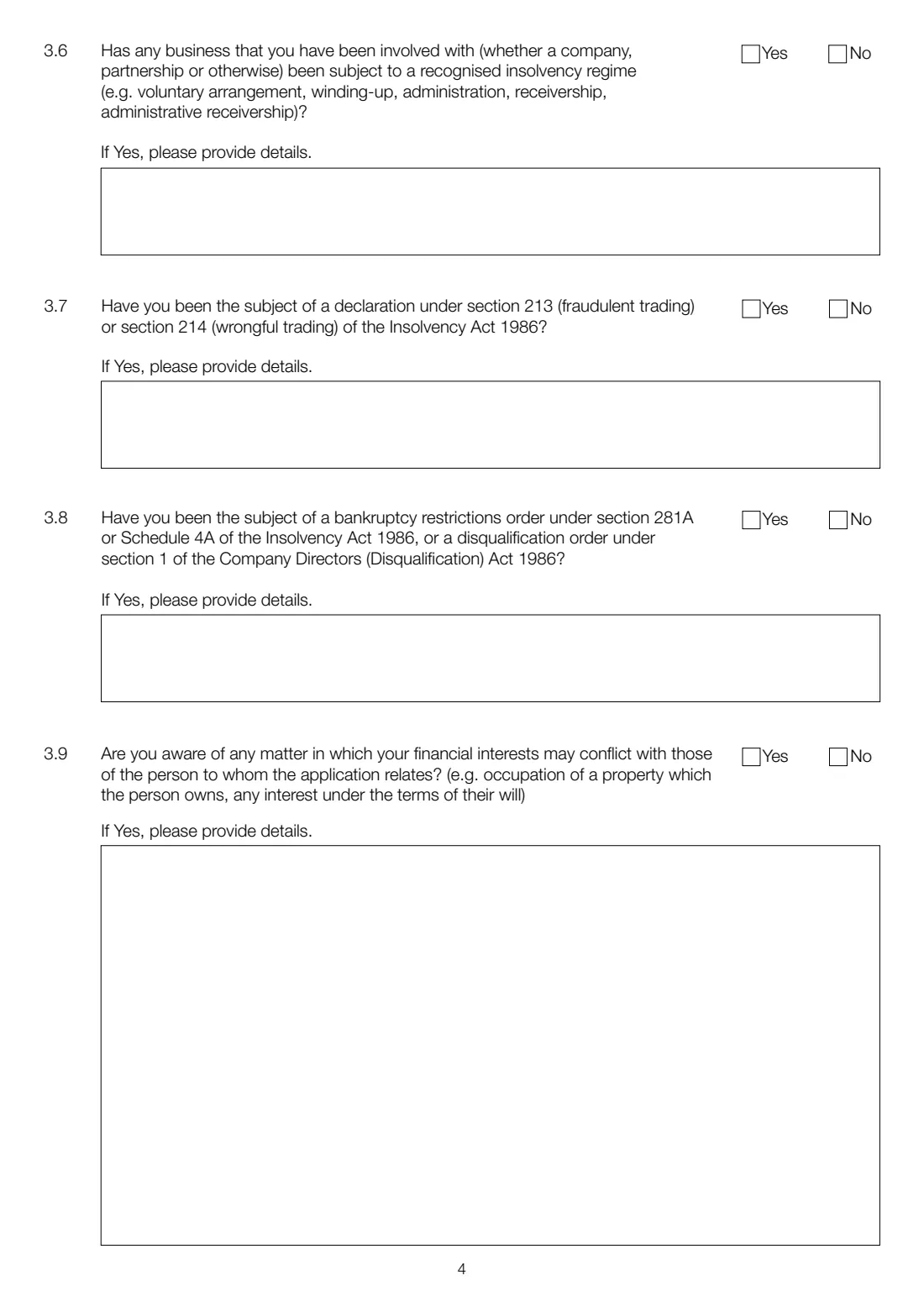
- For property and affairs: honest answers about credit refusals, judgment debts, bankruptcy, insolvency and any conflict between your finances and theirs.
- Some time to read the 17 undertakings, and a few sentences on why you want to be their deputy.
What’s on Form COP4
The 2015 edition has 8 pages. FileIt asks for it in 8 parts, and it is signed by Applicant (proposed deputy):
- The person the application is aboutApplicant (proposed deputy)
- Section 1: Your detailsApplicant (proposed deputy)
- Section 2: Your personal circumstancesApplicant (proposed deputy)
- Section 3: Your financial circumstancesApplicant (proposed deputy)
- Section 4: Your undertakings to the personApplicant (proposed deputy)
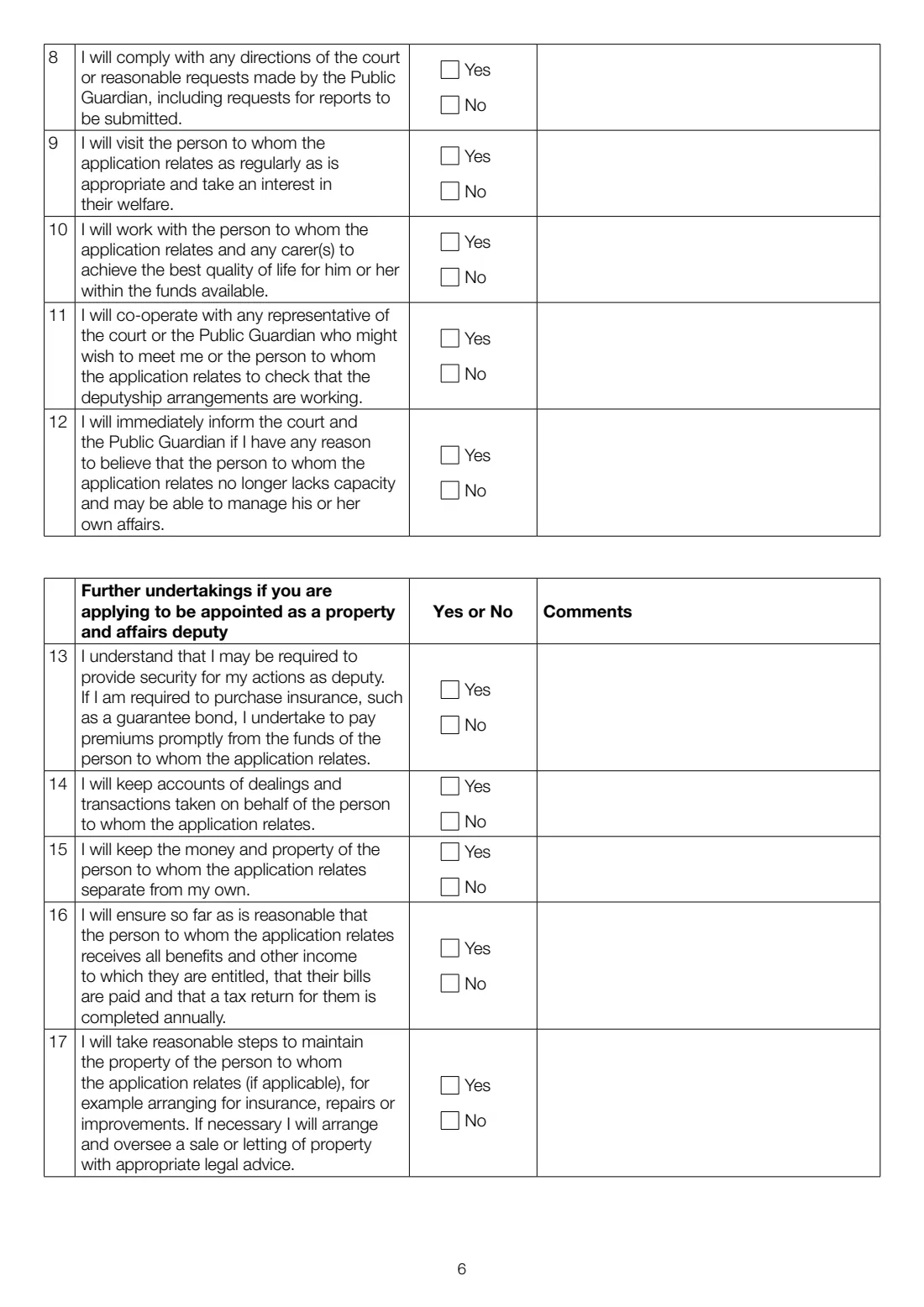
- Further undertakings for a property and affairs deputyApplicant (proposed deputy)
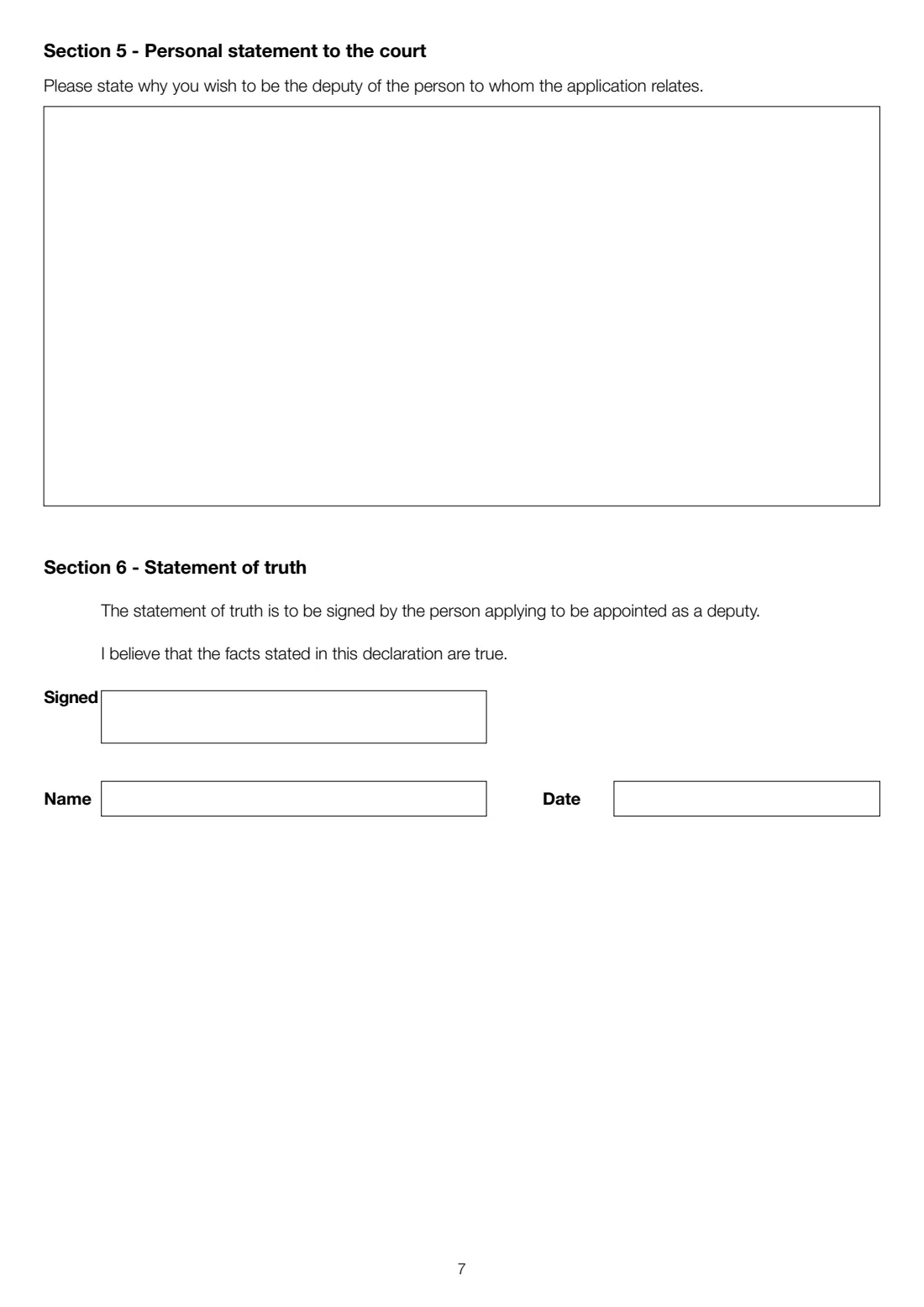
- Section 5: Personal statement to the courtApplicant (proposed deputy)
- Section 6: Statement of truthApplicant (proposed deputy)
How to fill out Form COP4, step by step
1 Section 1: your details
Your title, names, address, phone numbers, email and date of birth, then your connection to the person. Section 1.5 is the person's own name, address and date of birth.
2 Section 2: your personal circumstances
Your occupation (or circumstances if you're not working, or your former job if retired) and how long you've done it. Then whether you've been a deputy or attorney before, any unspent criminal convictions, anything that would get in the way of the role, such as ill health, and anyone else who might be considered if you're not appointed. Give details for each 'Yes'.
3 Section 3: your financial circumstances
Only for a property and affairs deputy. It asks whether you have a personal bank account, and about refused credit, judgment debts, bankruptcy, individual voluntary arrangements, debt relief orders, insolvent businesses, fraudulent or wrongful trading, disqualification orders and conflicts of interest.
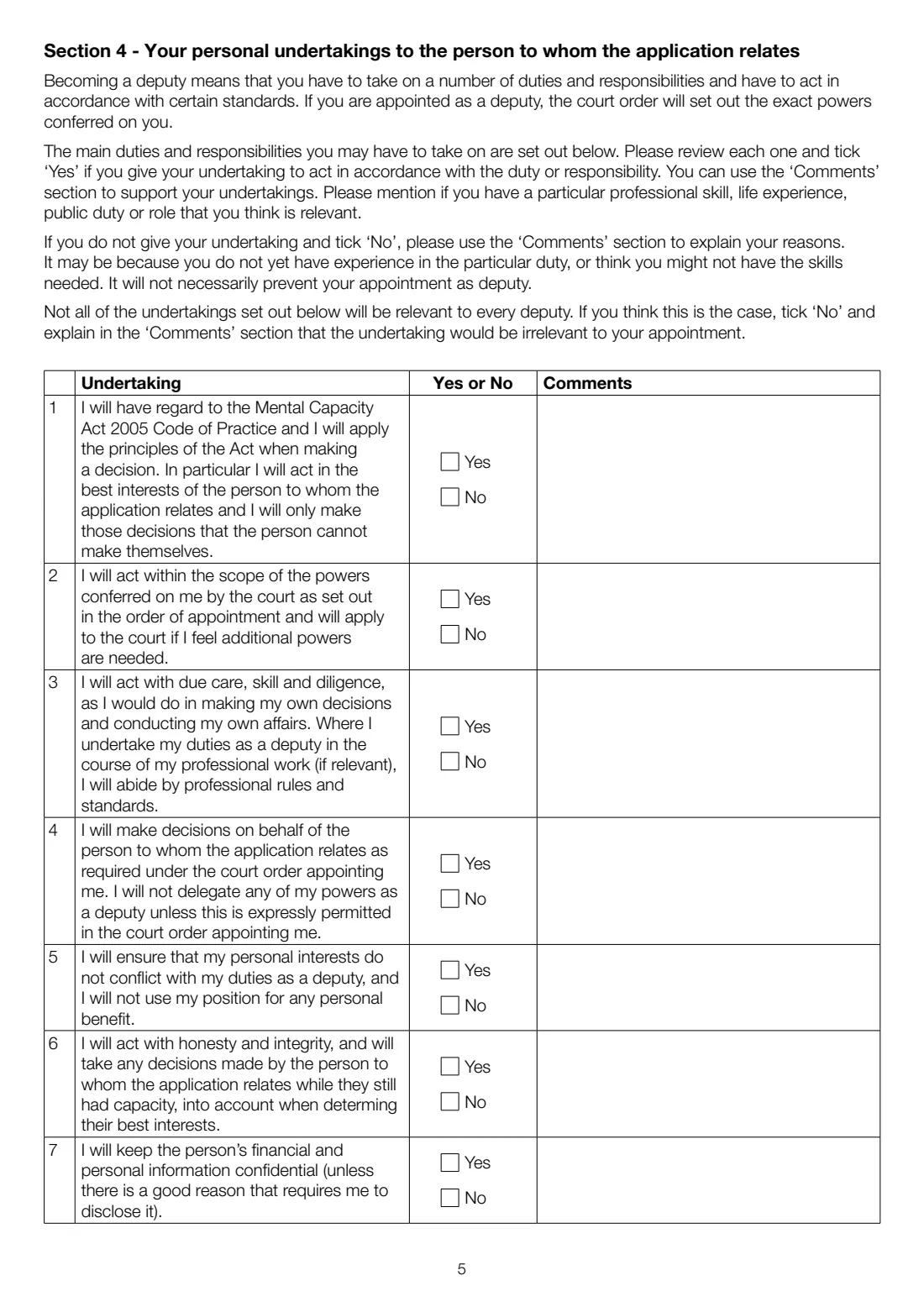
4 Section 4: your undertakings
Tick Yes for each duty you undertake, such as applying the Mental Capacity Act's principles, keeping the person's information confidential and visiting them. Undertakings 13 to 17 are only for property and affairs, such as keeping accounts and their money separate from yours. You can add comments, and a No needs a comment explaining why. The form says a No won't necessarily stop you being appointed.
5 Sections 5 and 6
Your personal statement explains why you want to be the person's deputy. Then you sign the statement of truth, with your name and the date.
Common mistakes to avoid
- Leaving the details box empty after answering Yes.
- Ticking No on an undertaking without saying why in the comments.
- Skipping section 3 when you're applying to manage property and affairs.
- Leaving out a past deputyship or attorney role, or a conviction that isn't spent.
- A personal statement that doesn't explain your relationship with the person and why you're suited to the role.
After you fill it out
Print the declaration, check it, and sign and date the statement of truth.
Send it with the rest of your deputyship application to the Court of Protection, following GOV.UK's guidance on applying to become a deputy. FileIt doesn't send anything for you.
If you're appointed, the court order sets out your exact powers. Keep a copy of the declaration and the order in FileIt.
Fill out Form COP4 online with FileIt
- Pick the person. Choose someone from People and FileIt fills in their name, date of birth, address and other details it already knows.
- Answer plain-language questions. One part of the form at a time, with the official help text beside each question — 80 fields in all. Your answers save as you go.
- Check the live preview. Watch your answers land on the real Court of Protection (HM Courts & Tribunals Service) form, and let FileIt do any worksheet arithmetic.
- Generate the official PDF. FileIt prints your answers into the agency’s own PDF and files it in that person’s folder in your vault. Sign it, or send it for e-signature.
FileIt fills the form — it never files or submits anything for you. Deliver the finished form to whoever asked for it, the way the form’s instructions say.
Start Form COP4 now — it’s freeForm COP4: frequently asked questions
What is a COP4 form?
It's the deputy's declaration: the form a proposed deputy completes so the Court of Protection can check their suitability and get their undertakings to act in the person's best interests.
Do I need to fill in section 3?
Only if you're applying to be a property and affairs deputy. A personal welfare deputy skips it, along with undertakings 13 to 17.
What if I can't give one of the undertakings?
Tick No and explain in the comments, for example that you don't yet have the experience, or that it isn't relevant to your appointment. The form says this won't necessarily prevent your appointment.
Will a bankruptcy stop me being a deputy?
The form asks about it so the court can decide. Answer honestly and give the details. The court looks at the whole picture.
Does each joint deputy need a COP4?
Yes. Each person applying to be appointed fills in their own declaration.
Official sources
- Blank form (PDF), published by Court of Protection (HM Courts & Tribunals Service): https://assets.publishing.service.gov.uk/media/602a5ad7d3bf7f031fb13844/cop4-eng.pdf
- Official instructions and guidance: https://www.gov.uk/government/publications/apply-to-become-someones-deputy-make-a-declaration-form-cop4
- Edition shown on this page: COP 4 (09.15) (checked 2026-10-19).
FileIt is not affiliated with or endorsed by Court of Protection (HM Courts & Tribunals Service) or any government. This page explains the form in general terms and is not legal, tax or immigration advice. Always read the official instructions, and check that you are using the edition the recipient accepts. Page last reviewed 2026-10-19.