What is Form TD1NL?
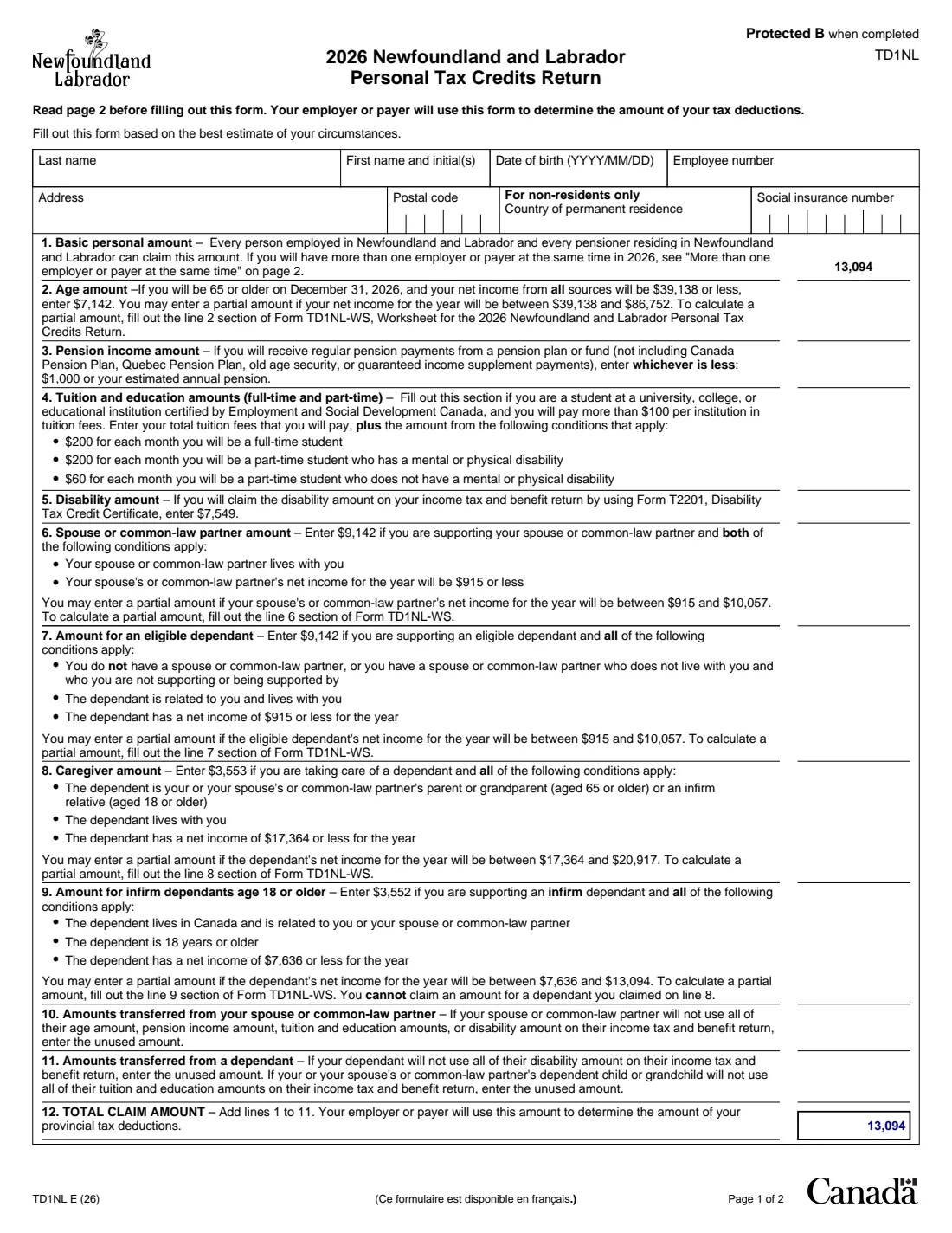
Form TD1NL, the 2026 Newfoundland and Labrador Personal Tax Credits Return, is the Canada Revenue Agency (CRA) form that goes to your employer or payer alongside the federal TD1. It covers the Newfoundland and Labrador non-refundable credits — the provincial basic personal amount, age amount, pension income amount, tuition and education amounts, disability amount, spouse and dependant amounts, a caregiver amount, an amount for infirm dependants and transfers — so the right amount of provincial tax comes off each payment.
If you don't fill out a TD1NL, the form says your employer or payer will deduct tax after allowing the basic personal amount only. People who are 65 or older, pensioners, students and anyone supporting family members often qualify for more.
FileIt asks the TD1NL questions in plain language and prints your answers into the CRA's own fillable PDF (edition TD1NL E (26)). It can pre-fill names and dates of birth from People records in your vault, and it calculates the age amount, pension income amount, the tuition and education amount from your fees and months of study, the disability amount, the spouse and eligible dependant amounts and the line 12 total. The PDF is filed in the person's vault folder, with optional e-signature. You give it to your employer or payer yourself — FileIt never files or sends it. Filling forms is free on every plan.
- Who fills it
- People employed in Newfoundland and Labrador and pensioners living there
- Given to
- Your employer or payer, together with the federal TD1 — not the CRA
- When
- With a new employer or payer, or when your 2026 claim changes
- Signatures
- You sign and date the Certification on page 2
- Edition
- TD1NL E (26)
- Basic personal amount
- $13,094 on the 2026 edition
Who needs to fill out Form TD1NL?
- Every person employed in Newfoundland and Labrador, and every pensioner residing there, who starts with a new employer or payer.
- People who will be 65 or older on December 31, 2026.
- Full-time and part-time students who will pay more than $100 per institution in tuition fees.
- Students with a mental or physical disability studying part time, who get the higher monthly education amount.
- People supporting a spouse, common-law partner or eligible dependant with low income.
- Caregivers of a parent, grandparent or infirm relative, and people supporting an infirm adult dependant.
- Anyone who wants to change the claim they gave their employer earlier.
When to use Form TD1NL
- When you start a new job or begin receiving a pension, employment insurance benefits or other remuneration from a new payer.
- When you want to change the amounts you previously claimed, for example because your number of eligible dependants has changed.
- When you start or finish a college or university program during the year.
- When you turn 65, or your spouse's or dependant's income changes a lot.
- When your employer asks for updated TD1 forms for a new year.
What you need before you start
- Your social insurance number, full name, date of birth and address with postal code.
- Your employee number, if you have one.
- Your estimated 2026 net income from all sources, if you will be 65 or older by year end.
- Your expected annual pension from a pension plan or fund.
- Your 2026 tuition fees and the number of months you will be a full-time or part-time student.
- Whether you will claim the disability amount with Form T2201.
- The estimated 2026 net income of the spouse, partner or relatives you support.
- Your completed federal TD1.
What’s on Form TD1NL
The 2026 edition has 2 pages. FileIt asks for it in 4 parts, and it is signed by Employee:
- Your detailsEmployee
- Lines 1–12: Your Newfoundland and Labrador claim amountsEmployee
- Other choices (page 2)Employee
- CertificationEmployee
How to fill out Form TD1NL, step by step
1 Identification
Give your last name, first name and initial(s), date of birth (YYYY/MM/DD), employee number, address, postal code and social insurance number. Non-residents add their country of permanent residence.
Use the same details as on your federal TD1.
2 Line 1 – Basic personal amount
Every person employed in Newfoundland and Labrador and every pensioner residing there can claim this amount, printed as $13,094 on the 2026 edition. If you will have more than one employer or payer at the same time in 2026, read page 2 first.
3 Line 2 – Age amount
If you will be 65 or older on December 31, 2026, and your net income will be $39,138 or less, enter $7,142. Between $39,138 and $86,752 you may enter a partial amount (line 2 section of Form TD1NL-WS). FileIt works it out from your estimated net income.
4 Line 3 – Pension income amount
Enter whichever is less: $1,000 or your estimated annual pension from a pension plan or fund. Canada Pension Plan, Quebec Pension Plan, old age security and guaranteed income supplement payments are excluded.
5 Line 4 – Tuition and education amounts
If you are a student at a university, college or certified institution and will pay more than $100 per institution in tuition, enter your total tuition fees plus a monthly amount: $200 for each month as a full-time student, $200 for each month as a part-time student with a mental or physical disability, and $60 for each month as a part-time student without one.
This monthly education amount is what sets the TD1NL apart from the TD1NB. FileIt asks for your fees and months and adds them up.
6 Line 5 – Disability amount
If you will claim the disability amount using Form T2201, Disability Tax Credit Certificate, enter $7,549 (2026 edition).
7 Line 6 – Spouse or common-law partner amount
Enter $9,142 if you support your spouse or common-law partner who lives with you and whose net income will be $915 or less. Between $915 and $10,057 a partial amount applies (line 6 section of Form TD1NL-WS). FileIt calculates it.
8 Line 7 – Amount for an eligible dependant
The maximum is also $9,142, for an eligible dependant who is related to you and lives with you, with net income of $915 or less, when you have no spouse or partner (or one you live apart from and neither support nor are supported by). A partial amount applies between $915 and $10,057. You can't claim both line 6 and line 7.
9 Line 8 – Caregiver amount
Enter $3,553 if you take care of your (or your spouse's or partner's) parent or grandparent aged 65 or older, or an infirm relative aged 18 or older, who lives with you and whose net income will be $17,364 or less. Between $17,364 and $20,917 a partial amount applies (line 8 section of Form TD1NL-WS). You enter this line yourself because it is worked out per dependant.
10 Line 9 – Amount for infirm dependants age 18 or older
Enter $3,552 if you support an infirm dependant aged 18 or older who lives in Canada, is related to you or your spouse or partner, and has net income of $7,636 or less. The form describes a partial amount for net income between $7,636 and $13,094, calculated on the line 9 section of Form TD1NL-WS — use the worksheet for the exact figure. You can't claim someone here whom you claimed on line 8.
11 Lines 10 and 11 – Amounts transferred
Line 10 takes the unused part of your spouse's or partner's age amount, pension income amount, tuition and education amounts or disability amount. Line 11 takes the unused part of a dependant's disability amount, and the unused tuition and education amounts of your (or your spouse's or partner's) dependent child or grandchild.
12 Line 12 – Total claim amount
Add lines 1 to 11. Your employer or payer uses this to determine your provincial tax deductions. FileIt totals the calculated and entered amounts.
13 Page 2 – More than one employer, total income and other requests
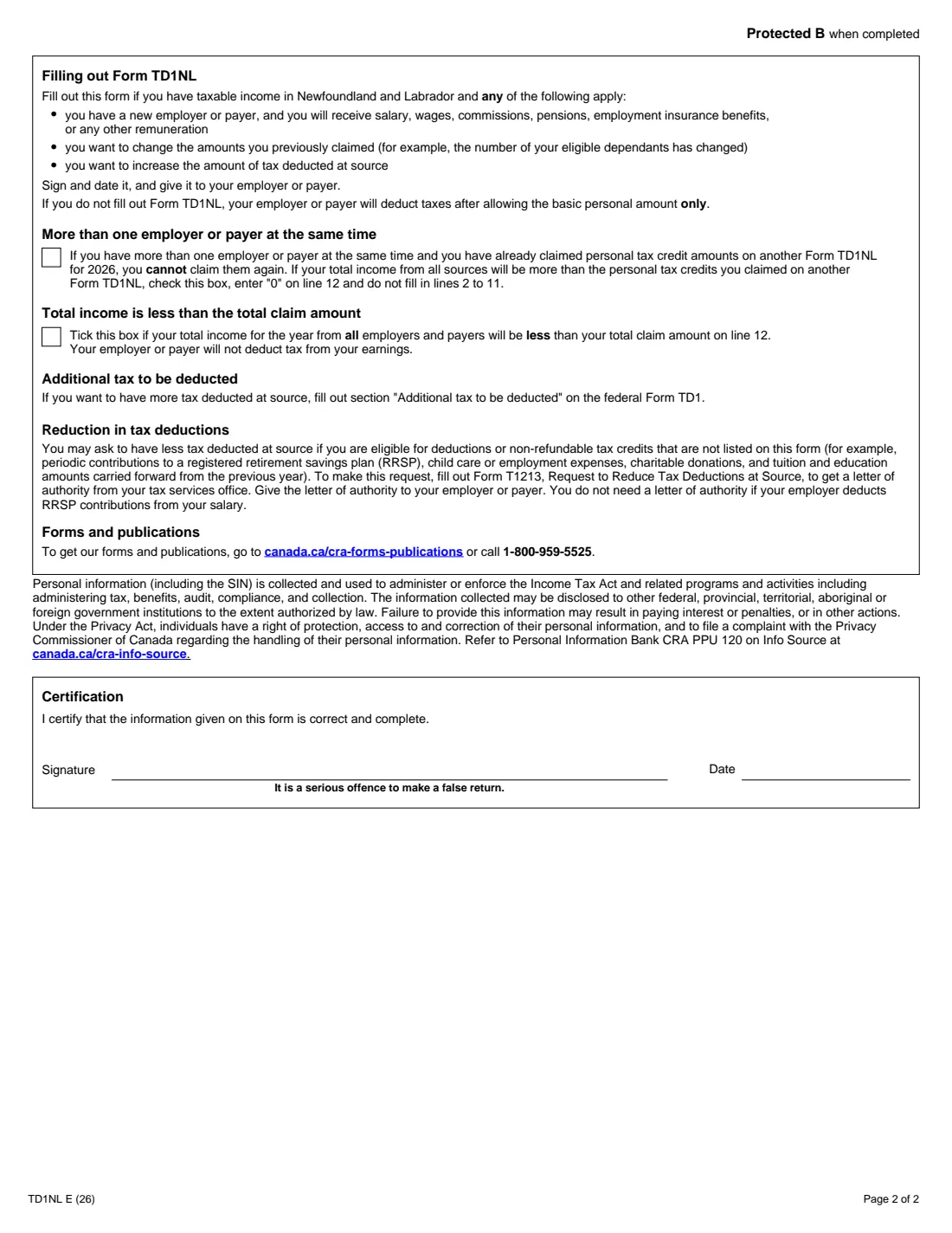
With more than one employer or payer at the same time, and credits already claimed on another 2026 TD1NL, tick the box, enter 0 on line 12 and leave lines 2 to 11 blank. If your total income will be less than line 12, tick the "Total income is less than the total claim amount" box so no tax is deducted.
Extra tax is requested on the federal TD1. Less tax for items not on this form, such as RRSP contributions or charitable donations, needs a letter of authority through Form T1213.
14 Certification
Sign and date page 2 to confirm the information is correct and complete. Making a false return is a serious offence.
Common mistakes to avoid
- Entering only your tuition on line 4 and forgetting the monthly education amount.
- Using the $200 monthly rate for part-time study without a disability — that rate is $60.
- Claiming the full $9,142 spouse or dependant amount when their net income will be more than $915.
- Claiming the same person on line 8 and line 9.
- Claiming your credits again on a second, simultaneous job.
- Handing the TD1NL to the CRA instead of your employer or payer.
- Forgetting to file a new TD1NL when your studies, age or family situation changes.
After you fill it out
Look over the PDF, then sign and date the Certification on page 2, by FileIt's e-signature or by hand. Give it to your employer or payer with your federal TD1. The CRA doesn't receive this form, and FileIt doesn't deliver it for you.
Your copy stays in the person's FileIt vault folder, so you can check your claim later. Complete a new TD1NL whenever your situation changes or your employer asks for a new year's form.
Fill out Form TD1NL online with FileIt
- Pick the person. Choose someone from People and FileIt fills in their name, date of birth, address and other details it already knows.
- Answer plain-language questions. One part of the form at a time, with the official help text beside each question — 37 fields in all. Your answers save as you go.
- Check the live preview. Watch your answers land on the real Canada Revenue Agency (CRA) form, and let FileIt do any worksheet arithmetic.
- Generate the official PDF. FileIt prints your answers into the agency’s own PDF and files it in that person’s folder in your vault. Sign it, or send it for e-signature.
FileIt fills the form — it never files or submits anything for you. Deliver the finished form to whoever asked for it, the way the form’s instructions say.
Start Form TD1NL now — it’s freeForm TD1NL: frequently asked questions
Can I fill out the TD1NL online?
Yes. FileIt guides you through each line, prints your answers into the CRA's official 2026 TD1NL PDF, works out the lines with fixed rules (including the tuition and education amount) and the line 12 total, and saves it to your vault. It is free on every plan.
Where do I send the TD1NL?
Give it to your employer or payer, normally together with your federal TD1. It isn't sent to the CRA, and FileIt never submits it.
What is the Newfoundland and Labrador basic personal amount for 2026?
The 2026 TD1NL prints $13,094 on line 1.
How does the education amount on line 4 work?
On top of your tuition fees, add $200 for each month you will be a full-time student, $200 for each month as a part-time student with a mental or physical disability, or $60 for each month as a part-time student without one. It only applies if you will pay more than $100 per institution in tuition.
What if I don't fill out a TD1NL?
Your employer or payer will deduct taxes after allowing the basic personal amount only, which may be more tax than you need to pay through the year.
Do I need a TD1NL if I live in Newfoundland and Labrador but work elsewhere?
The TD1NL says every person employed in Newfoundland and Labrador and every pensioner residing there can claim line 1. If you're an employee, use the provincial form for the province where you work; pensioners use the one for where they live.
How do I have more tax deducted?
The TD1NL doesn't have that option; use the "Additional tax to be deducted" section of the federal TD1.
Can I sign it electronically?
FileIt offers optional e-signature, or you can print and sign by hand. Ask your employer or payer what they accept.
Official sources
- Blank form (PDF), published by Canada Revenue Agency (CRA): https://www.canada.ca/content/dam/cra-arc/formspubs/pbg/td1nl/td1nl-fill-26e.pdf
- Official instructions and guidance: https://www.canada.ca/en/revenue-agency/services/forms-publications/td1-personal-tax-credits-returns/td1-forms-pay-received-on-january-1-later/td1nl.html
- Edition shown on this page: TD1NL E (26) (checked 2026-09-26).
FileIt is not affiliated with or endorsed by Canada Revenue Agency (CRA) or any government. This page explains the form in general terms and is not legal, tax or immigration advice. Always read the official instructions, and check that you are using the edition the recipient accepts. Page last reviewed 2026-09-26.