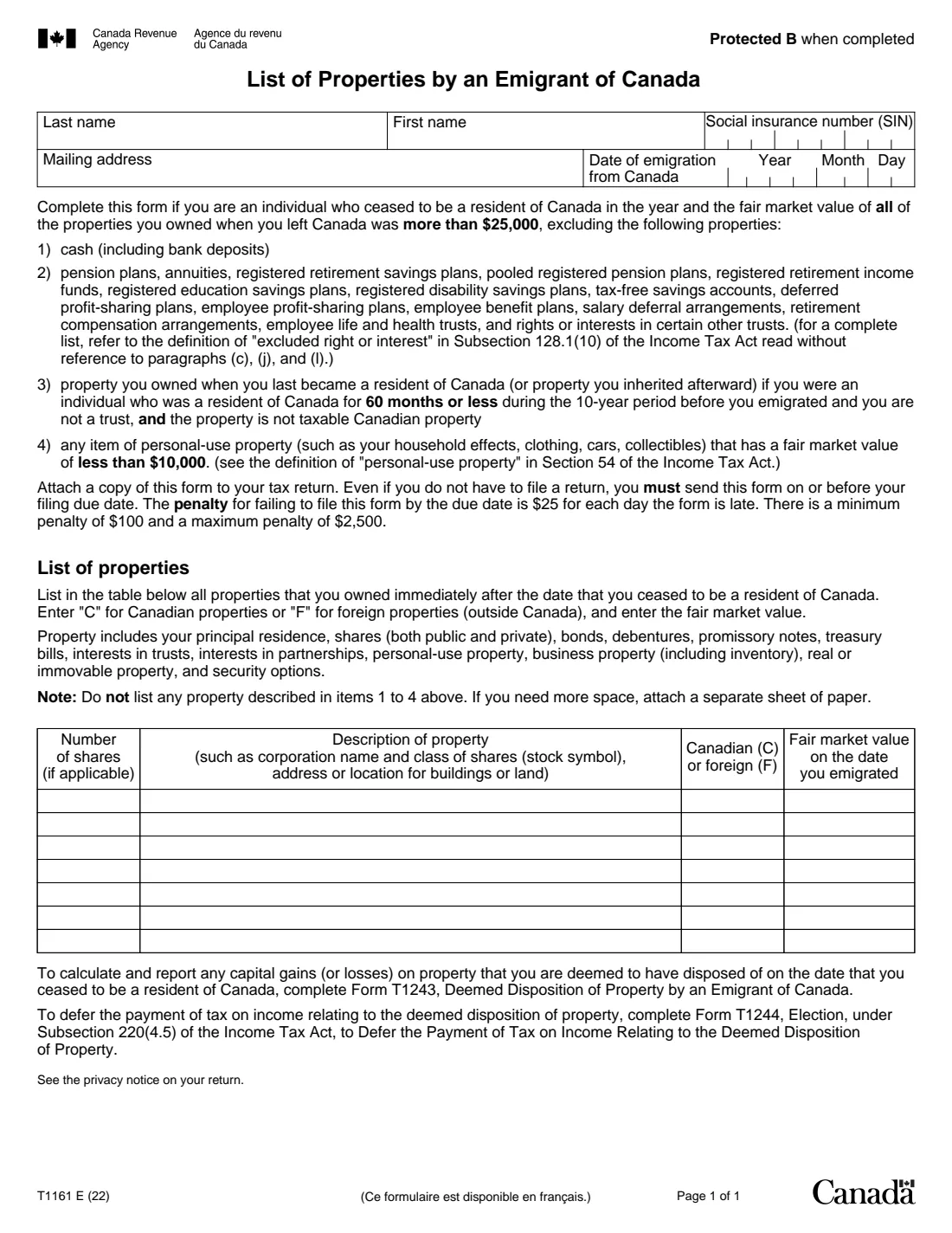
What is Form T1161?
When you leave Canada for good, the CRA wants to know what you owned on the way out. T1161 is a one-page list of those properties, each with whether it is Canadian or foreign and its fair market value on the date you emigrated. You complete it if you ceased to be a resident of Canada in the year and everything you owned when you left was worth more than $25,000.
Some things don't count toward the $25,000 and aren't listed: cash and bank deposits; pension plans, annuities, RRSPs, RRIFs, RESPs, RDSPs, TFSAs and similar registered plans and employee benefit arrangements; property you owned when you last became a resident (or inherited later) if you lived in Canada for 60 months or less in the 10 years before leaving, unless it is taxable Canadian property; and personal-use items such as household effects, clothing and cars worth less than $10,000 each.
FileIt fills in your name, SIN, mailing address and date of emigration, and up to seven properties, on the CRA's own PDF. The deemed disposition itself is worked out on Form T1243, and the election to defer the tax is Form T1244. FileIt never files anything for you.
- Who fills it
- Individuals who ceased to be residents of Canada in the year with listed property over $25,000
- Values
- Fair market value on the date you emigrated
- Rows
- 7 (attach a separate sheet for more)
- File with
- Your income tax return for the year you left, or on its own by the filing due date
- Late-filing penalty
- $25 a day, minimum $100, maximum $2,500 (as printed on the form)
- Edition
- T1161 E (22)
Who needs to fill out Form T1161?
- People moving abroad who stop being residents of Canada for tax purposes this year.
- Emigrants who own a home, shares, bonds, partnership interests, business property or real estate, in Canada or elsewhere.
- Emigrants who don't have to file a return but still owned more than $25,000 of listed property when they left.
When to use Form T1161
- For the year you ceased to be a resident of Canada, together with your departure-year tax return.
- By your filing due date even if you don't have to file a return, as the form says.
What you need before you start
- Your social insurance number and your mailing address after you left.
- The date you ceased to be a resident of Canada.
- A list of everything you owned right after that date, with the number of shares where it applies.
- The fair market value of each property on the date you emigrated, in Canadian dollars.
What’s on Form T1161
The 2022 edition has 1 page. FileIt asks for it in 2 parts:
- IdentificationEmployee
- List of propertiesEmployee
How to fill out Form T1161, step by step
1 Identification
Enter your last and first name, SIN, mailing address and the date you emigrated from Canada, which prints as year, month and day in the form's boxes.
2 List of properties
For each property, give the number of shares if it is shares, a description (such as the corporation name and class of shares or stock symbol, or the address of a building or land), C for Canadian or F for foreign, and its fair market value on the date you emigrated.
3 What not to list
Leave out cash, pensions and registered plans, property of a short-term resident that the form excludes, and personal-use items worth less than $10,000 each.
Common mistakes to avoid
- Listing RRSPs, TFSAs, pensions or bank deposits. The form says to leave them out.
- Using the purchase price instead of the fair market value on the day you left.
- Not filing because you have no return to file. The form must still be sent by the due date.
- Forgetting foreign property. Both Canadian (C) and foreign (F) properties go on the list.
After you fill it out
Attach a copy of the PDF to your income tax return for the year you left, or send it on its own by your filing due date if you don't have to file.
Work out any capital gains on Form T1243, and use Form T1244 if you want to defer the tax.
Keep a copy in your FileIt vault.
Fill out Form T1161 online with FileIt
- Pick the person. Choose someone from People and FileIt fills in their name, date of birth, address and other details it already knows.
- Answer plain-language questions. One part of the form at a time, with the official help text beside each question — 33 fields in all. Your answers save as you go.
- Check the live preview. Watch your answers land on the real Canada Revenue Agency (CRA) form, and let FileIt do any worksheet arithmetic.
- Generate the official PDF. FileIt prints your answers into the agency’s own PDF and files it in that person’s folder in your vault.
FileIt fills the form — it never files or submits anything for you. Deliver the finished form to whoever asked for it, the way the form’s instructions say.
Start Form T1161 now — it’s freeForm T1161: frequently asked questions
When do I have to file Form T1161?
The form says to complete it if you ceased to be a resident of Canada in the year and the fair market value of all the properties you owned when you left was more than $25,000, not counting the excluded items it lists.
What is the penalty for filing T1161 late?
The form says the penalty is $25 for each day it is late, with a minimum of $100 and a maximum of $2,500.
Do I list my RRSP or TFSA?
No. Pension plans, annuities and registered plans such as RRSPs, RRIFs, RESPs, RDSPs and TFSAs are excluded, as are cash and bank deposits.
Is T1161 the same as the departure tax?
No. T1161 only lists your properties. The deemed disposition and any capital gain are calculated on Form T1243, and T1244 is the election to defer the tax.
Can I fill out T1161 with FileIt?
Yes. FileIt fills the CRA's official PDF with your details and up to seven properties. You attach it to your return or send it yourself.
Official sources
- Blank form (PDF), published by Canada Revenue Agency (CRA): https://www.canada.ca/content/dam/cra-arc/formspubs/pbg/t1161/t1161-fill-22e.pdf
- Official instructions and guidance: https://www.canada.ca/en/revenue-agency/services/forms-publications/forms/t1161.html
- Edition shown on this page: T1161 E (22) (checked 2026-10-25).
FileIt is not affiliated with or endorsed by Canada Revenue Agency (CRA) or any government. This page explains the form in general terms and is not legal, tax or immigration advice. Always read the official instructions, and check that you are using the edition the recipient accepts. Page last reviewed 2026-10-25.