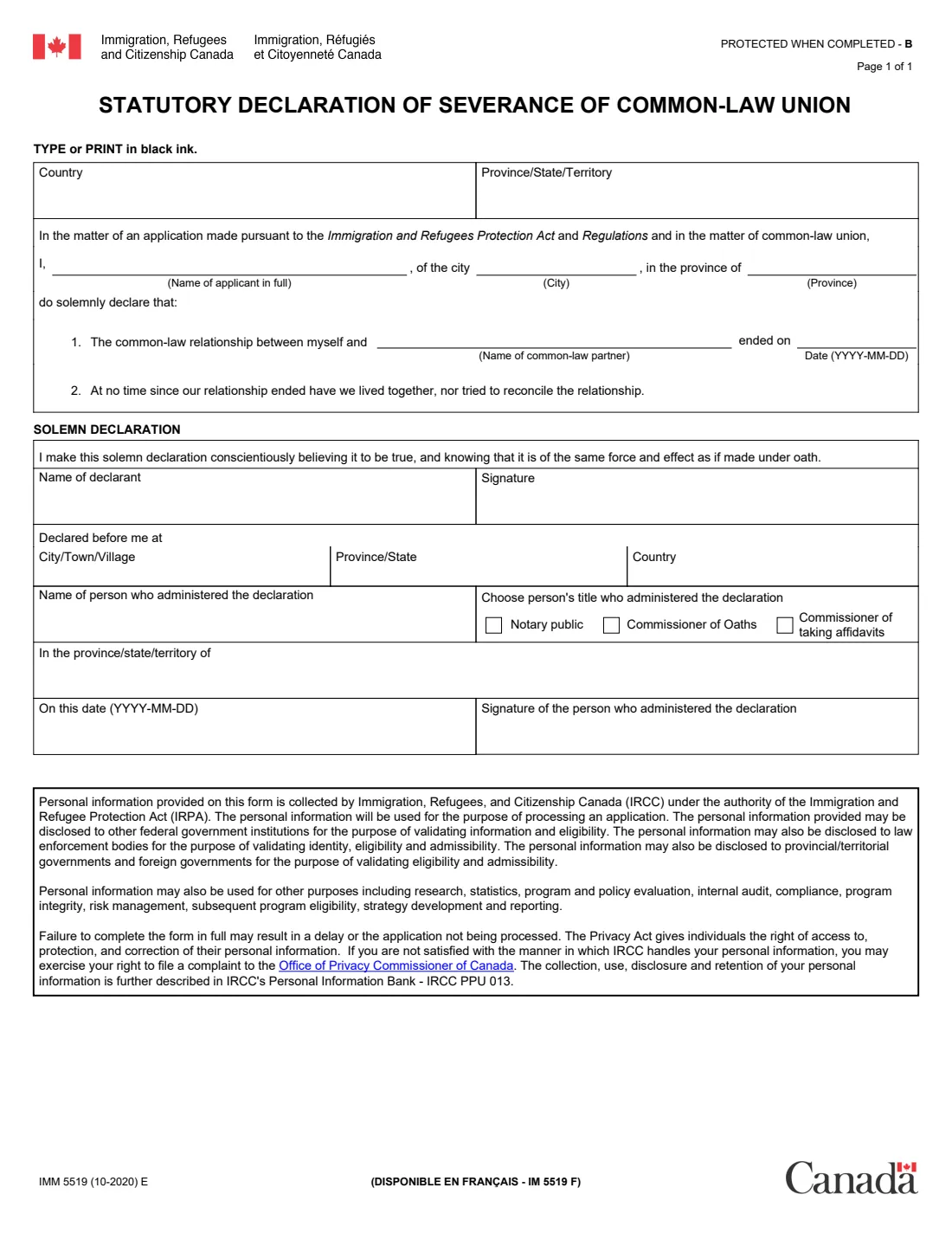
What is IMM 5519 end of common-law union?
IMM 5519 is the declaration IRCC uses when you need to show that a common-law relationship has ended. You name your former partner, give the date the relationship ended, and declare that since then you have not lived together or tried to reconcile.
It is a solemn declaration, which means it carries the same weight as a statement made under oath. You sign it in front of a notary public, a commissioner of oaths or a commissioner for taking affidavits, who completes the bottom of the page and signs too.
FileIt asks for each detail in plain English and prints it into IRCC's own IMM 5519 PDF, with your name repeated in the declarant box. Accented names print correctly. If you already know where and before whom you will swear it, FileIt can print that part too; otherwise the official writes it in. The PDF is saved in your vault, ready to print and take to your appointment. FileIt never sends anything to IRCC.
- Who fills it
- The person whose common-law relationship has ended
- Given to
- IRCC, with the application that asks for it
- Pages
- 1
- Edition
- IMM 5519 (10-2020) E
- Sworn before
- A notary public, commissioner of oaths or commissioner for taking affidavits
- Signatures
- You and the official, both in ink
Who needs to fill out IMM 5519 end of common-law union?
- Applicants who declared a common-law partner to IRCC and are no longer in that relationship.
- People whose immigration application asks them to confirm that an earlier common-law union has ended.
- Sponsors or principal applicants whose family situation has changed since a previous application.
- Anyone IRCC has asked for proof that a common-law relationship is over.
When to use IMM 5519 end of common-law union
- When an IRCC application or document checklist lists IMM 5519.
- When your declared common-law relationship ended and IRCC needs it on record.
- Before an appointment with a notary or commissioner, so the form is ready to sign.
- Not to declare a current common-law union: IRCC uses IMM 5409 for that.
What you need before you start
- The country and province, state or territory where you will make the declaration.
- Your full name, and the city and province where you live.
- Your former partner's full name.
- The date the relationship ended.
- If you know them, the official's name, title and province, and the date and place of the declaration.
- An appointment with a notary public or commissioner, and the identification they ask you to bring.
What’s on IMM 5519 end of common-law union
The 2020 edition has 1 page. FileIt asks for it in 2 parts:
- Your statutory declarationApplicant (declarant)
- Declared before (the official)Official taking the declaration
How to fill out IMM 5519 end of common-law union, step by step
1 Where you make it
The country and province, state or territory printed at the top of the declaration, usually where you will meet the official.
2 You
Your full name, the city you live in and its province. Your name prints again in the Name of declarant box.
3 The relationship
Your former common-law partner's full name and the date the relationship ended. The second statement, that you have not lived together or tried to reconcile since, is printed on the form.
4 Declared before (optional)
The city, province and country where you swear it, the official's name and title, the province they are commissioned in, and the date. Leave it off if the official will write it.
5 Signing
Bring the printed form unsigned. You sign in front of the official, who then signs below.
Common mistakes to avoid
- Signing the declaration before you meet the official.
- Giving a date the relationship ended that doesn't match what you told IRCC elsewhere.
- Using this form to declare a current common-law relationship instead of IMM 5409.
- Leaving the former partner's name incomplete or using a nickname.
- Forgetting the identification the official asks for at the appointment.
After you fill it out
Print the PDF and take it, unsigned, to a notary public or commissioner of oaths.
Sign in front of them; they complete and sign the Declared before me part.
Include it with your IRCC application as the instructions for that application say, and keep the copy FileIt saved in your vault.
Fill out IMM 5519 end of common-law union online with FileIt
- Pick the person. Choose someone from People and FileIt fills in their name, date of birth, address and other details it already knows.
- Answer plain-language questions. One part of the form at a time, with the official help text beside each question — 14 fields in all. Your answers save as you go.
- Check the live preview. Watch your answers land on the real Immigration, Refugees and Citizenship Canada (IRCC) form, and let FileIt do any worksheet arithmetic.
- Generate the official PDF. FileIt prints your answers into the agency’s own PDF and files it in that person’s folder in your vault.
FileIt fills the form — it never files or submits anything for you. Deliver the finished form to whoever asked for it, the way the form’s instructions say.
Start IMM 5519 end of common-law union now — it’s freeIMM 5519 end of common-law union: frequently asked questions
What does IMM 5519 declare?
That your common-law relationship with the person named ended on the date given, and that since then you have not lived together or tried to reconcile.
Who can take the declaration?
The form gives three choices: a notary public, a commissioner of oaths or a commissioner for taking affidavits.
Can I sign it at home?
No. It is a solemn declaration, so you sign it in front of the official who takes it, and they sign it too.
Does my former partner need to sign?
No. Only you, as the declarant, and the official sign this form.
Which form do I use for a current common-law partner?
IRCC's Statutory Declaration of Common-law Union, IMM 5409, is for a relationship that is ongoing.
Can I fill out IMM 5519 with FileIt?
Yes. FileIt prints your answers into IRCC's official PDF and saves it in your vault. You print it, sign it before the official and send it with your application. FileIt never submits it.
Official sources
- Blank form (PDF), published by Immigration, Refugees and Citizenship Canada (IRCC): https://www.canada.ca/content/dam/ircc/documents/pdf/english/kits/forms/imm5519/01-10-2020/imm5519e.pdf
- Official instructions and guidance: https://www.canada.ca/en/immigration-refugees-citizenship/services/application/application-forms-guides/imm5519.html
- Edition shown on this page: IMM 5519 (10-2020) E (checked 2026-10-19).
FileIt is not affiliated with or endorsed by Immigration, Refugees and Citizenship Canada (IRCC) or any government. This page explains the form in general terms and is not legal, tax or immigration advice. Always read the official instructions, and check that you are using the edition the recipient accepts. Page last reviewed 2026-10-19.