What is Form 956 — appoint a migration agent, lawyer or exempt person?
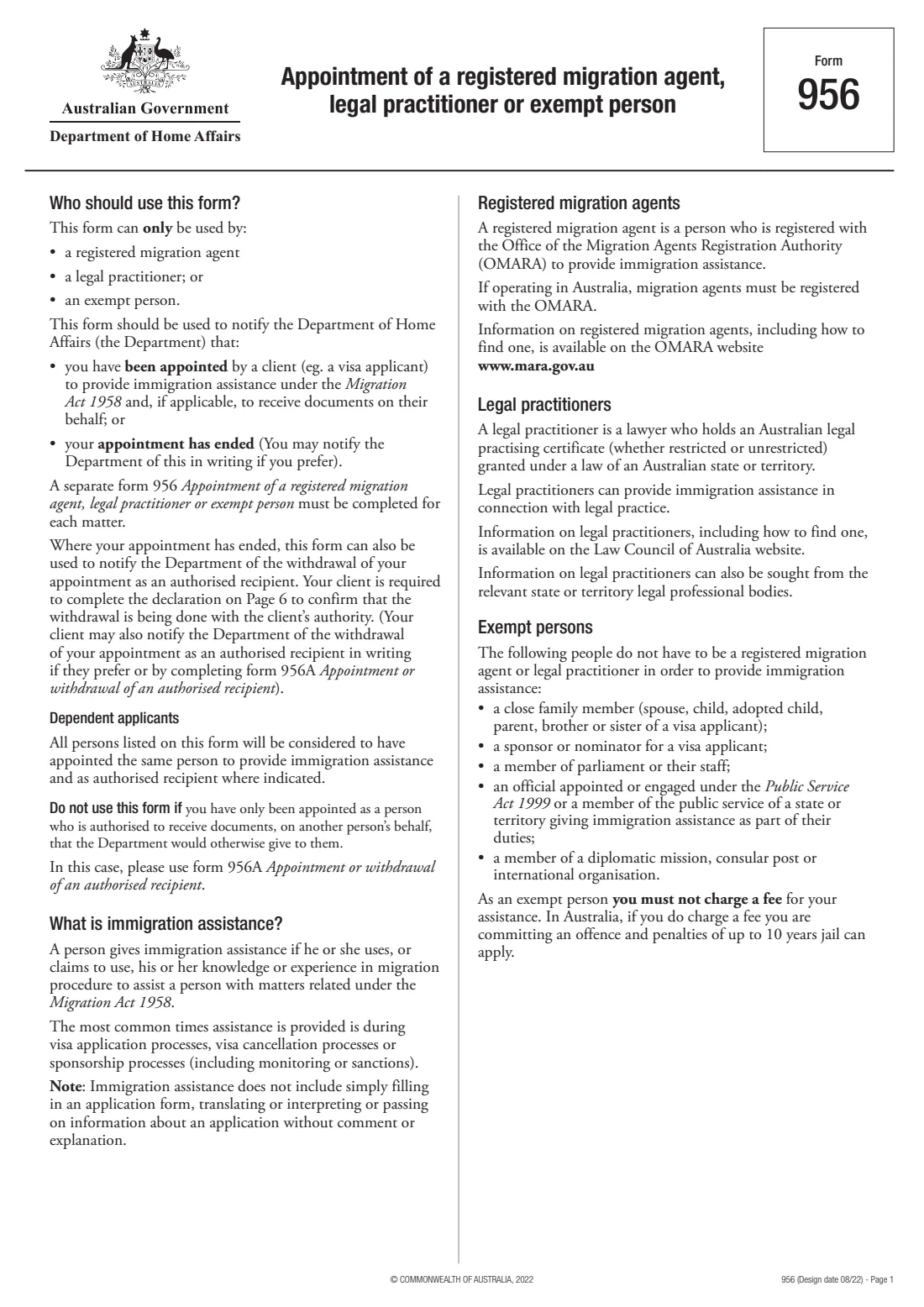
Form 956 is filled in by the person helping with an immigration matter: a registered migration agent, an Australian legal practitioner, or an exempt person such as a close family member, a sponsor or a nominator. It tells the Department of Home Affairs that they've been appointed by a client — a visa applicant, sponsor, nominator, proposer, a visa holder facing cancellation, or someone seeking ministerial intervention — and whether they'll also receive the Department's letters as the client's authorised recipient.
The same form records that an appointment has ended (Part B), including the withdrawal of an authorised recipient appointment. A separate Form 956 is needed for each matter, and everyone listed on it is taken to have appointed the same person. If someone will only receive documents and won't give immigration assistance, Form 956A is the one to use.
FileIt fills the current Form 956 (design date 08/22) in the Department's own PDF. It shows Part A or Part B depending on what you're notifying, places the MARN and LPN digits in their boxes, ticks the matching declarations in Part C for both adviser and client, and saves the result to your FileIt vault.
- Who fills it
- The migration agent, legal practitioner or exempt person
- Who signs
- The adviser (question 23) and the client (question 24)
- Parts
- Part A new appointment, Part B ending appointment, Part C declarations
- One form per
- Matter — for example one visa application
- Exempt persons
- Must not charge a fee for their help
- Edition
- Design date 08/22
Who needs to fill out Form 956 — appoint a migration agent, lawyer or exempt person?
- Registered migration agents taking on a new client or matter.
- Australian legal practitioners giving immigration assistance as part of legal practice.
- Exempt persons helping without a fee — a spouse, parent, child, brother or sister of the applicant, a sponsor or nominator, an MP or their staff, a public servant or a diplomat.
- Any of these advisers telling the Department that their appointment has ended.
When to use Form 956 — appoint a migration agent, lawyer or exempt person
- When you start giving immigration assistance on a visa application, a cancellation, a sponsorship matter or a ministerial intervention request.
- When you'll also act as the client's authorised recipient and receive the Department's documents for them.
- When your appointment ends — Part B, or a letter to the Department if you prefer.
- Not when someone will only receive documents for the client — use Form 956A.
What you need before you start
- The adviser's name, organisation, business and correspondence addresses, phone numbers and email.
- The MARN (7 digits) or LPN (7 digits starting 55), or for an exempt person, their date of birth and the reason they're exempt.
- The client's name, date of birth, organisation (if any), address, phone numbers and Home Affairs Client ID if known.
- The names of any other clients in the same matter, such as dependent applicants.
- The matter: type of application and date lodged, visa subclass and grant date for a cancellation, or details of a specific matter.
- The Request ID (RID) or Transaction Reference Number (TRN), if known.
What’s on Form 956 — appoint a migration agent, lawyer or exempt person
The 2022 edition has 6 pages. FileIt asks for it in 7 parts, and it is signed by Migration agent, legal practitioner or exempt person and Client:
- What you're notifying (question 1)Migration agent, legal practitioner or exempt person
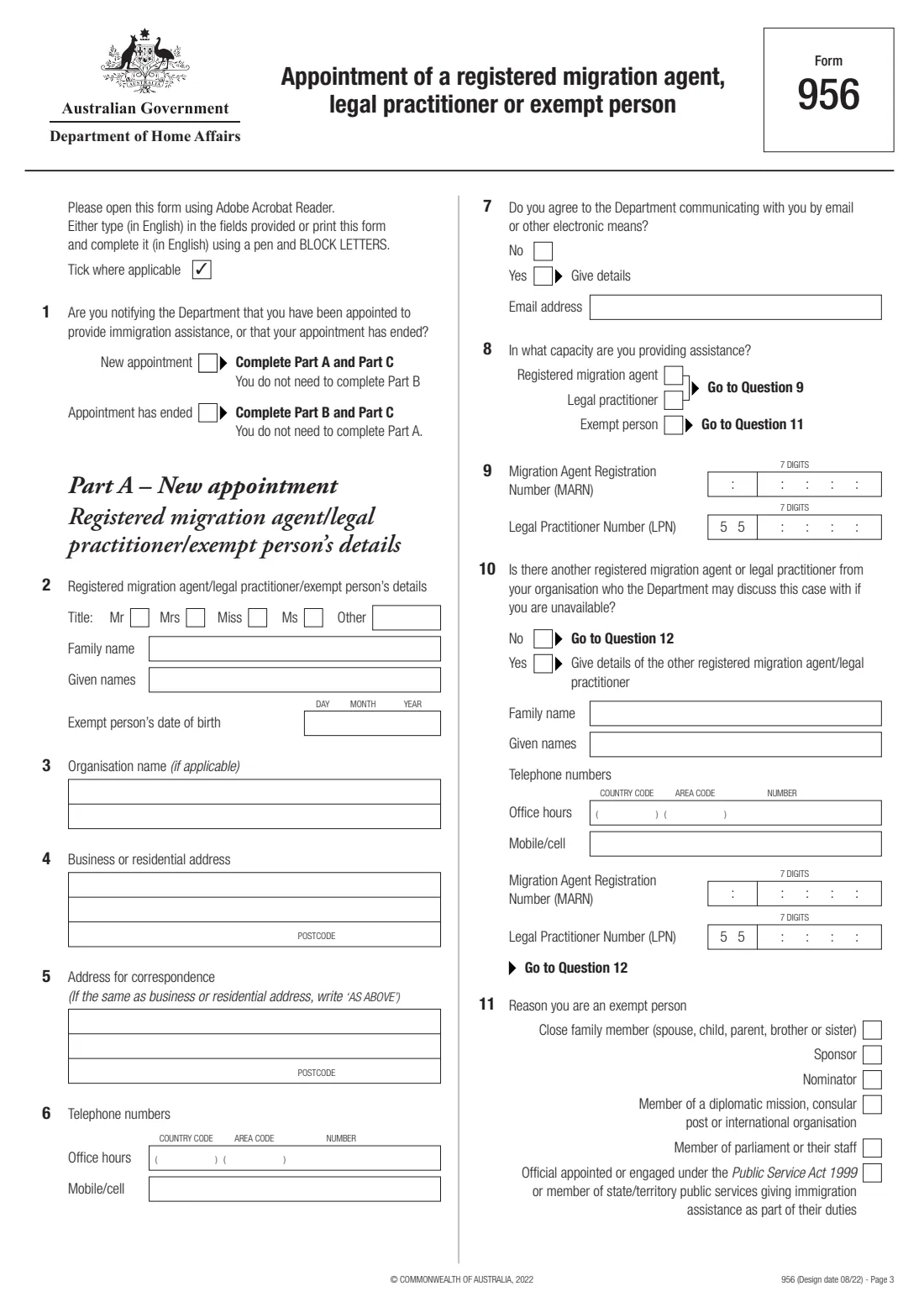
- Part A — Your details as adviser (questions 2–11)Migration agent, legal practitioner or exempt person
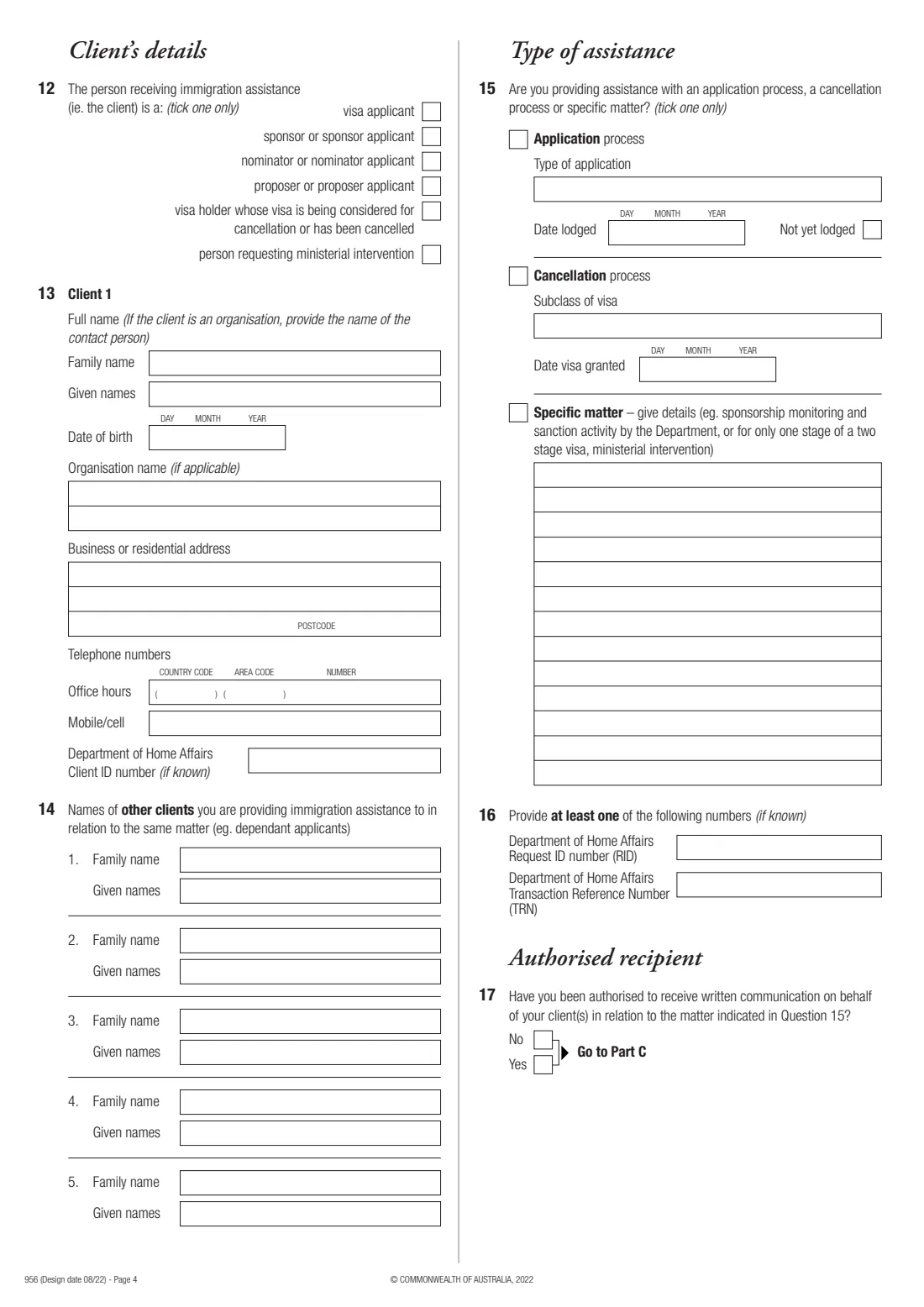
- Part A — Client's details (questions 12–14)Migration agent, legal practitioner or exempt person
- Part A — Other clients in the same matter (question 14)Migration agent, legal practitioner or exempt person
- Part A — Type of assistance and authorised recipient (questions 15–17)Migration agent, legal practitioner or exempt person
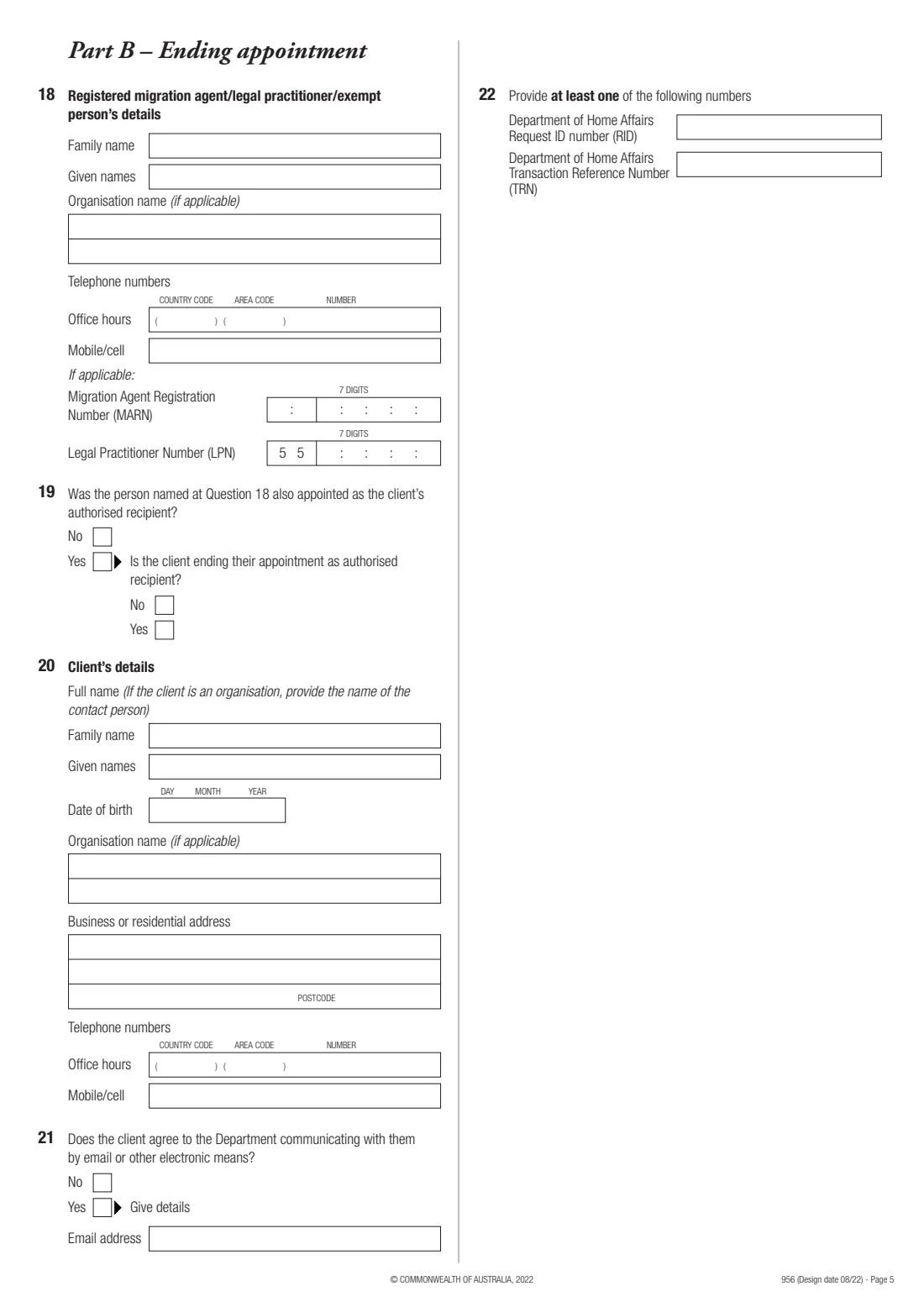
- Part B — Ending appointment (questions 18–22)Migration agent, legal practitioner or exempt person
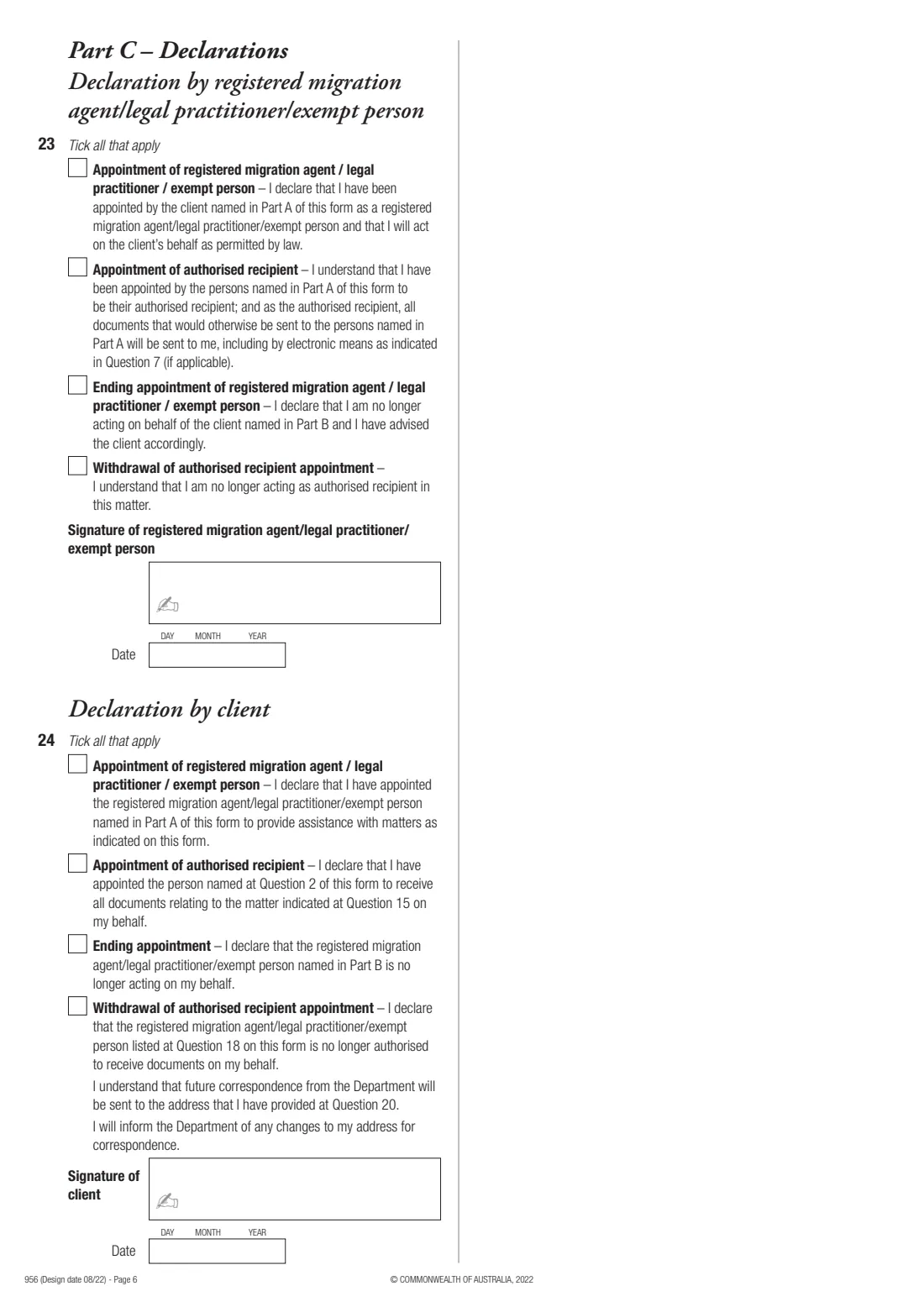
- Part C — Declarations (questions 23–24)Migration agent, legal practitioner or exempt person
How to fill out Form 956 — appoint a migration agent, lawyer or exempt person, step by step
1 Question 1: new or ended
Choose New appointment to complete Parts A and C, or Appointment has ended to complete Parts B and C. FileIt only shows the part that applies.
2 Questions 2–11: the adviser
Your name, organisation, addresses, phones, consent to email, and the capacity you act in — migration agent with MARN, legal practitioner with LPN, or exempt person with date of birth and reason. Agents and lawyers can name a colleague the Department may speak to.
3 Questions 12–14: the client
What kind of client they are, their name, date of birth, organisation, address and phone numbers, their Client ID if known, and up to five other clients in the same matter.
4 Questions 15–17: the matter
Application, cancellation or specific matter, with its details, the RID or TRN, and whether you'll be the client's authorised recipient.
5 Part B: ending an appointment
Your details and registration number, whether you were also the authorised recipient and whether that ends too, the client's current details and email consent, and the RID or TRN.
6 Part C: declarations
FileIt ticks the declarations that match your answers. The adviser signs question 23 and the client signs question 24.
Common mistakes to avoid
- Using one form for several matters — each matter needs its own Form 956.
- Using Form 956 for someone who will only receive documents — that's Form 956A.
- Writing all seven LPN digits into the five boxes — the form already prints the leading 5 5.
- An exempt person charging a fee — the form warns that this is an offence in Australia.
- Forgetting the client's signature on the Part C declaration.
After you fill it out
The adviser and the client sign and date Part C. Print from FileIt and sign by hand, or send the PDF for e-signature to both.
Give the form to the Department with the application or for the matter it relates to. FileIt doesn't lodge it.
Keep a copy in your FileIt vault, and send a new Form 956 (Part B) or a letter when the appointment ends.
Fill out Form 956 — appoint a migration agent, lawyer or exempt person online with FileIt
- Pick the person. Choose someone from People and FileIt fills in their name, date of birth, address and other details it already knows.
- Answer plain-language questions. One part of the form at a time, with the official help text beside each question — 128 fields in all. Your answers save as you go.
- Check the live preview. Watch your answers land on the real Department of Home Affairs form, and let FileIt do any worksheet arithmetic.
- Generate the official PDF. FileIt prints your answers into the agency’s own PDF and files it in that person’s folder in your vault. Sign it, or send it for e-signature.
FileIt fills the form — it never files or submits anything for you. Deliver the finished form to whoever asked for it, the way the form’s instructions say.
Start Form 956 — appoint a migration agent, lawyer or exempt person now — it’s freeForm 956 — appoint a migration agent, lawyer or exempt person: frequently asked questions
Who is an exempt person?
Someone who may give immigration assistance without being a registered migration agent or lawyer: a close family member of the applicant (spouse, child, adopted child, parent, brother or sister), a sponsor or nominator, a member of parliament or their staff, a public servant assisting as part of their duties, or a member of a diplomatic mission, consular post or international organisation. They must not charge a fee.
What's the difference between Form 956 and 956A?
Form 956 appoints someone to give immigration assistance — and optionally to receive documents too. Form 956A only appoints an authorised recipient to receive documents.
Do I need a new form for each visa application?
Yes. The Department asks for a separate Form 956 for each matter.
How do I end an appointment?
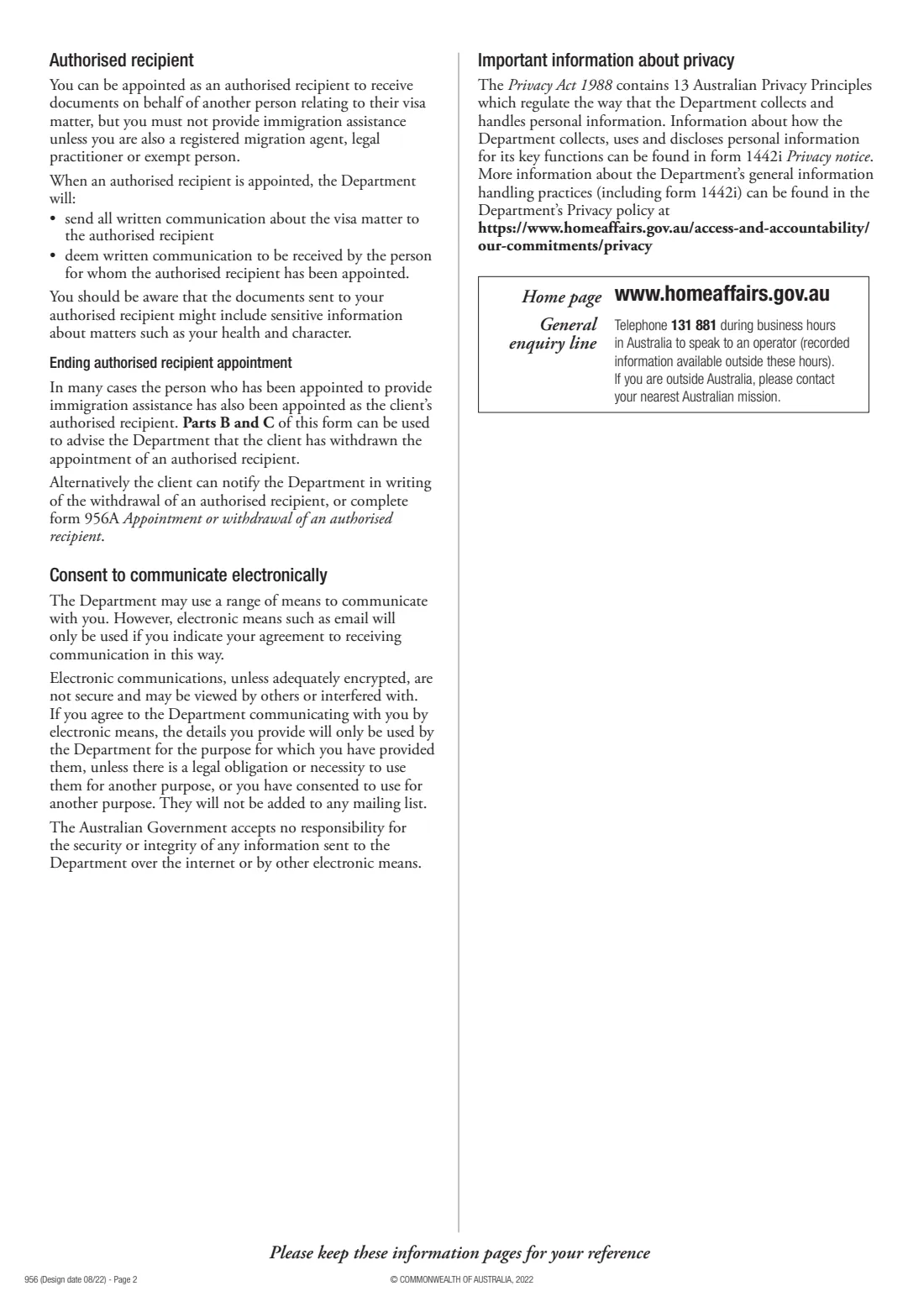
Complete Part B and Part C of Form 956, or tell the Department in writing. The client can also withdraw an authorised recipient appointment themselves, in writing or with Form 956A.
Why does the LPN box only take five digits?
Every Legal Practitioner Number starts with 55, which the form prints for you. FileIt asks for the full 7-digit number and fills in the last five.
Official sources
- Blank form (PDF), published by Department of Home Affairs: https://immi.homeaffairs.gov.au/form-listing/forms/956.pdf
- Official instructions and guidance: https://immi.homeaffairs.gov.au/form-listing/forms/956.pdf
- Edition shown on this page: Design date 08/22 (checked 2026-10-19).
FileIt is not affiliated with or endorsed by Department of Home Affairs or any government. This page explains the form in general terms and is not legal, tax or immigration advice. Always read the official instructions, and check that you are using the edition the recipient accepts. Page last reviewed 2026-10-19.