What is Form 1006 — Bridging visa B (permission to travel)?
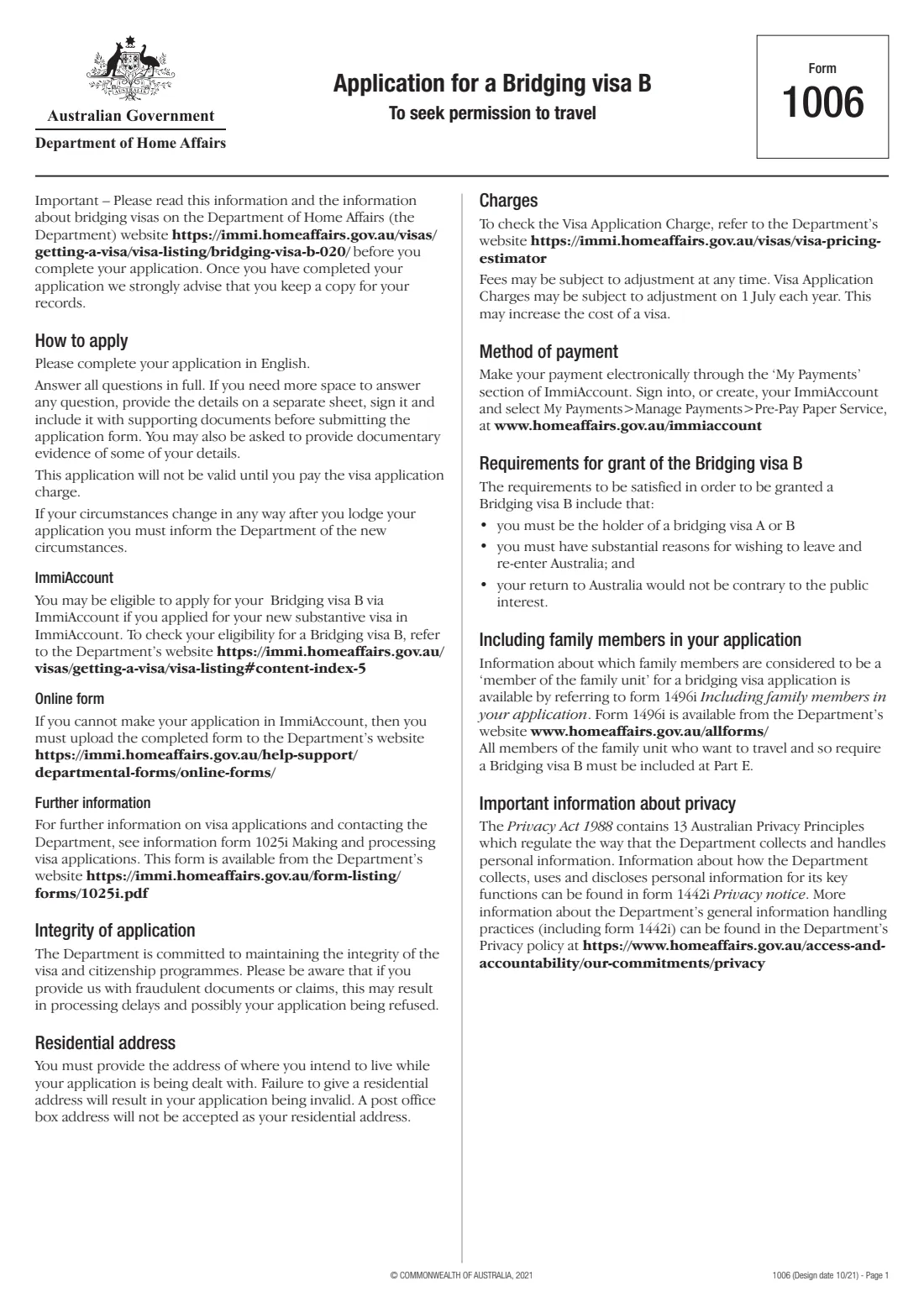
A Bridging visa B (BVB, subclass 020) lets someone who holds a Bridging visa A or B leave Australia and return while their substantive visa application — or judicial review of a refusal — is still being dealt with. Form 1006 is the Department of Home Affairs' paper application for it, used when you can't apply through ImmiAccount. The completed form is uploaded through the Department's online forms page.
You give your personal and passport details, your current visa and grant number, the substantive visa you've applied for, any judicial review details, where you're going, when you'll leave and return and why, and where the Department should write to you while you're away. Family members who are travelling and also need a Bridging visa B are included in Part E. To be granted the visa you must have substantial reasons for leaving and re-entering, and your return must not be contrary to the public interest, which is what the health and character questions are for.
FileIt fills the current Form 1006 (design date 10/21) in the Department's own PDF. Names and addresses with accents print correctly, your reason for travel and any health or character details are wrapped onto the form's ruled lines, and the finished application is kept in your FileIt vault.
- Who uses it
- Bridging visa A or B holders who want to travel and return
- Visa
- Bridging visa B, subclass 020
- Charge
- Yes — paid in ImmiAccount before lodging
- Family members
- Up to 5 more applicants in Part E
- Lodged
- Uploaded through the Department's online forms page
- Edition
- Design date 10/21
Who needs to fill out Form 1006 — Bridging visa B (permission to travel)?
- People on a Bridging visa A or B who need to travel overseas while their substantive visa application is being decided.
- Applicants awaiting the outcome of judicial review of a visa refusal who need to travel.
- Family members travelling with them who also need a Bridging visa B.
- Anyone who can't lodge their Bridging visa B application through ImmiAccount.
When to use Form 1006 — Bridging visa B (permission to travel)
- Before you leave Australia, allowing time for the Department to decide the application.
- When you have substantial reasons for travelling, such as a family emergency or work commitments.
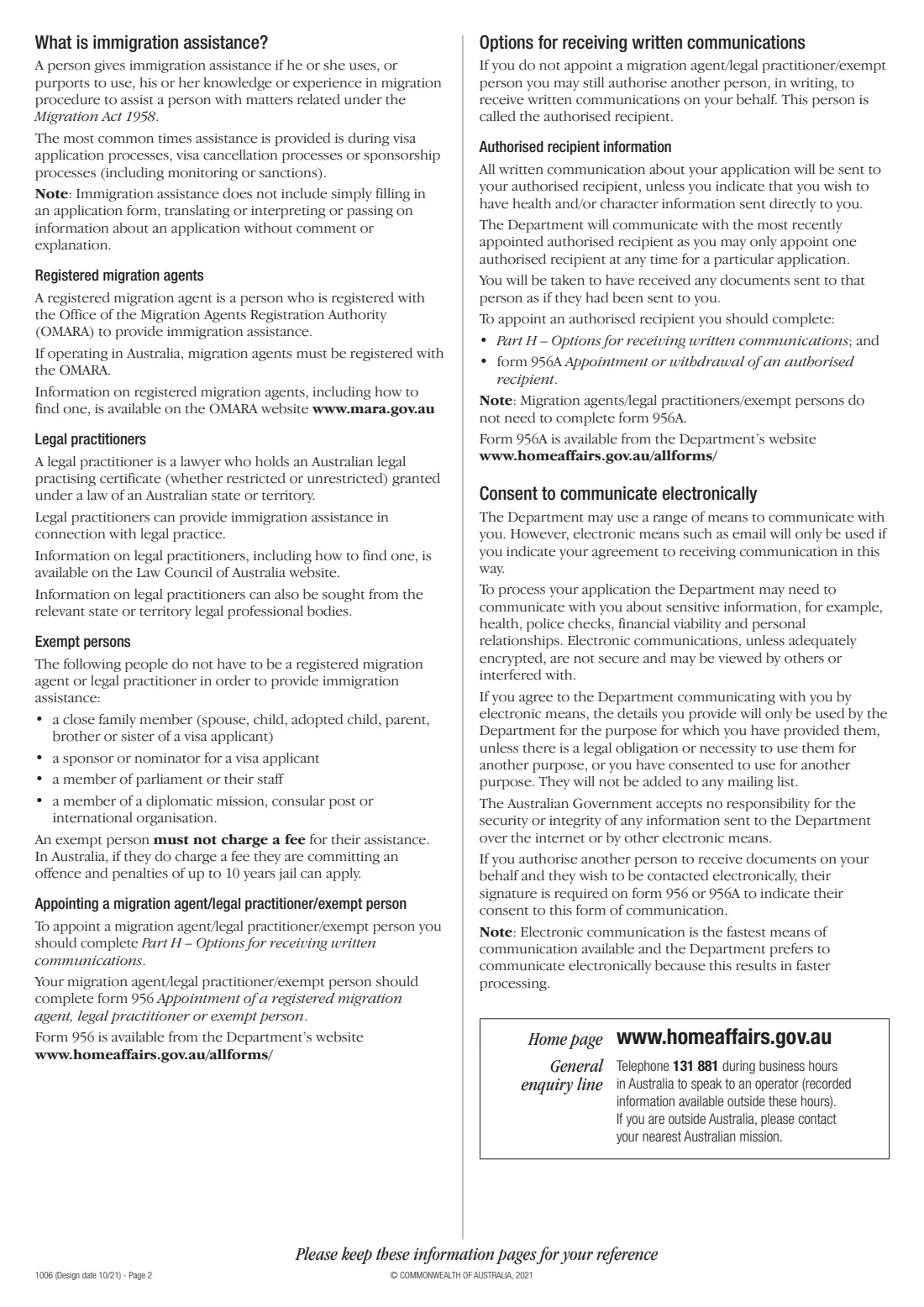
- When you can't apply in ImmiAccount — if your substantive application was made in ImmiAccount you may be able to apply there instead.
What you need before you start
- The receipt number from your last visa application and your substantive visa application's receipt number, TRN or file number.
- Your passport details, the class of visa you hold or last held, and its 13-digit visa grant number.
- Your residential address in Australia (not a PO box), correspondence address, phone numbers and email.
- Your destination, expected departure and return dates, and the reason for travelling — with supporting documents.
- Any overseas address you'll stay at for 14 days or more, and where the Department should write to you while you're away.
- Details and passports of family members travelling with you, and your ImmiAccount payment receipt number.
What’s on Form 1006 — Bridging visa B (permission to travel)
The 2021 edition has 8 pages. FileIt asks for it in 16 parts, and it is signed by Main applicant:
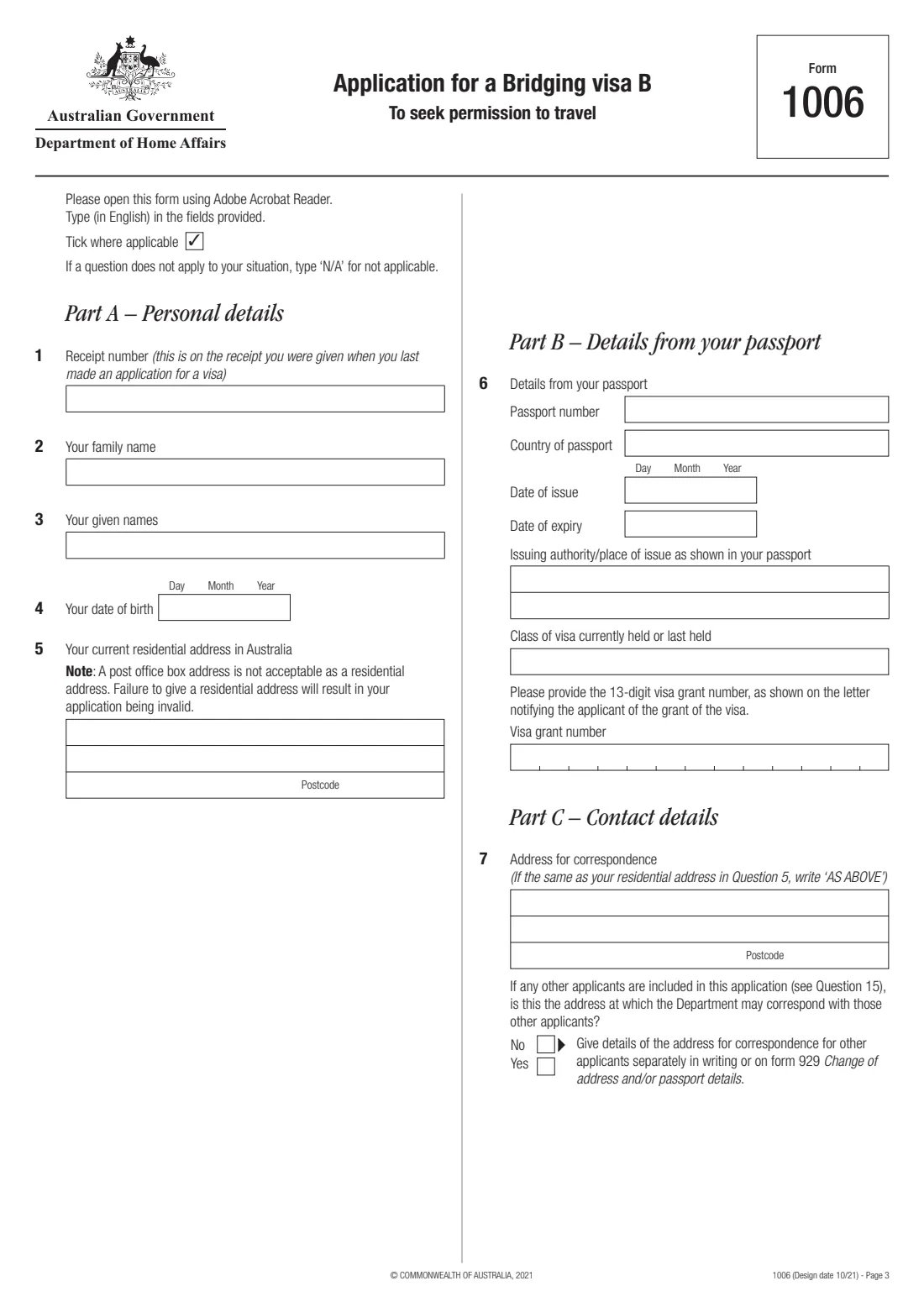
- Part A — Personal details (questions 1–5)Main applicant
- Part B — Passport and current visa (question 6)Main applicant
- Part C — Contact details (questions 7–9)Main applicant
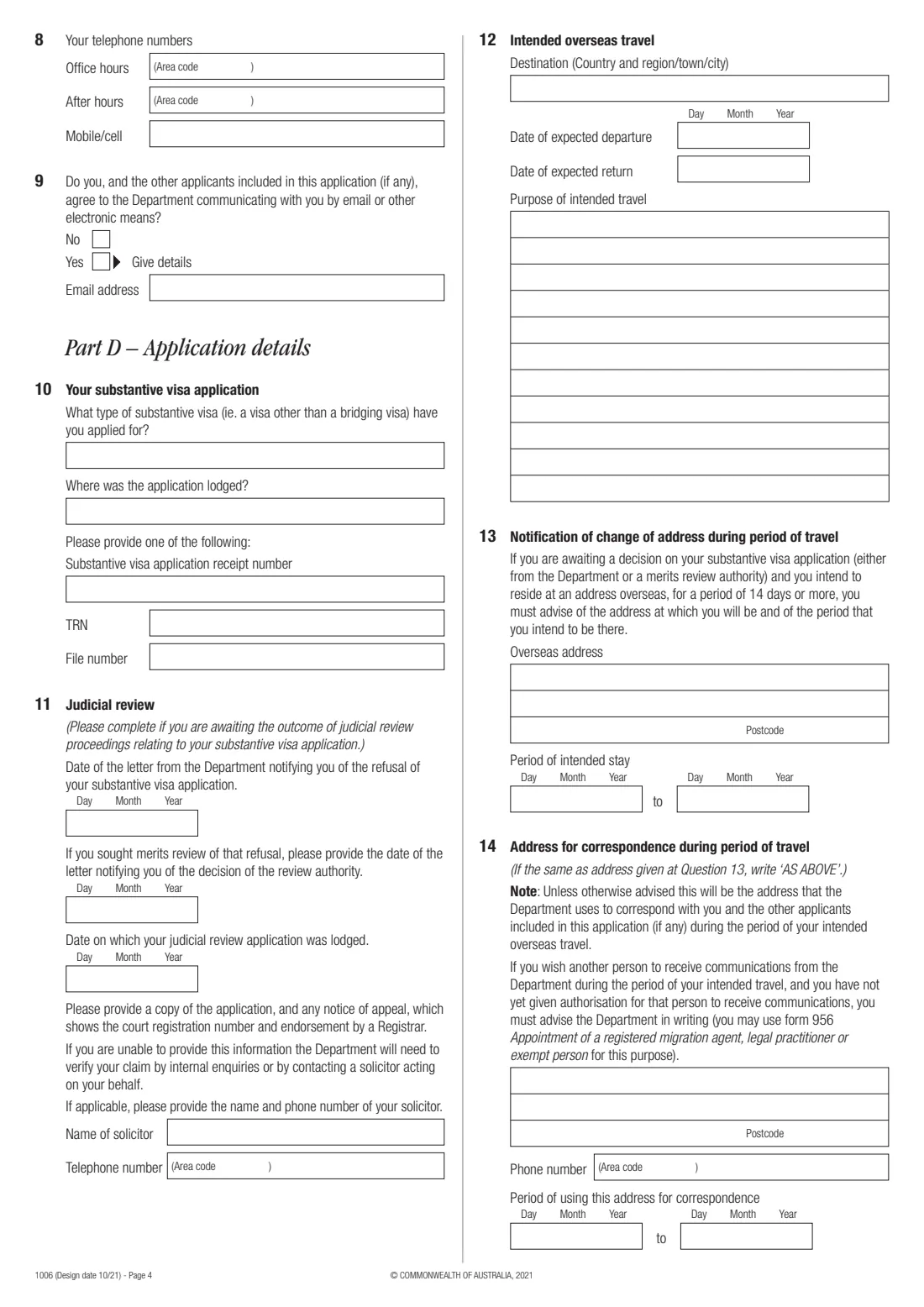
- Part D — Your substantive visa application (question 10)Main applicant
- Judicial review (question 11)Main applicant
- Intended overseas travel (question 12)Main applicant
- Overseas address during travel (question 13)Main applicant
- Address for correspondence during travel (question 14)Main applicant
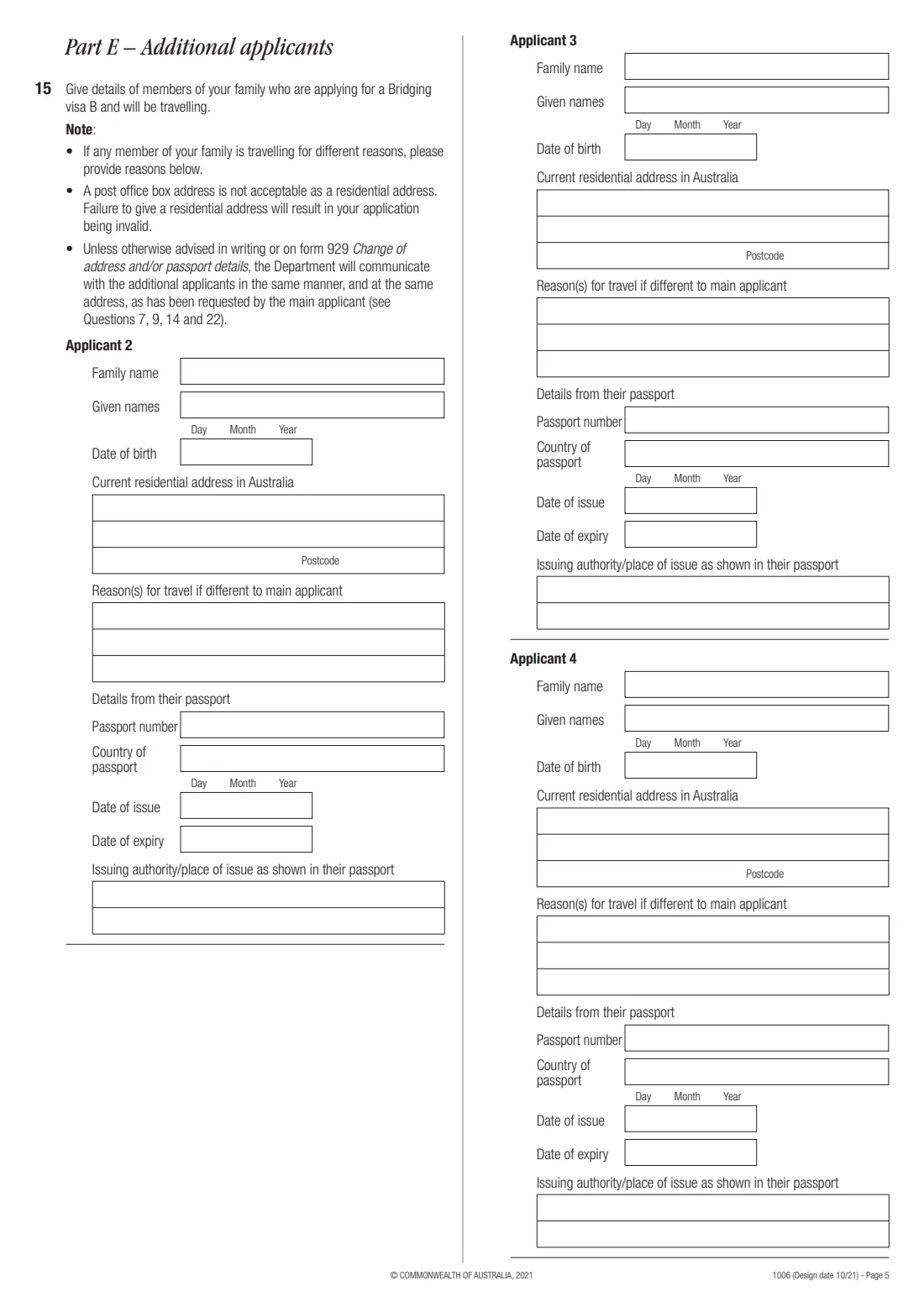
- Part E — Applicant 2 (question 15)Main applicant
- Part E — Applicant 3 (question 15)Main applicant
- Part E — Applicant 4 (question 15)Main applicant
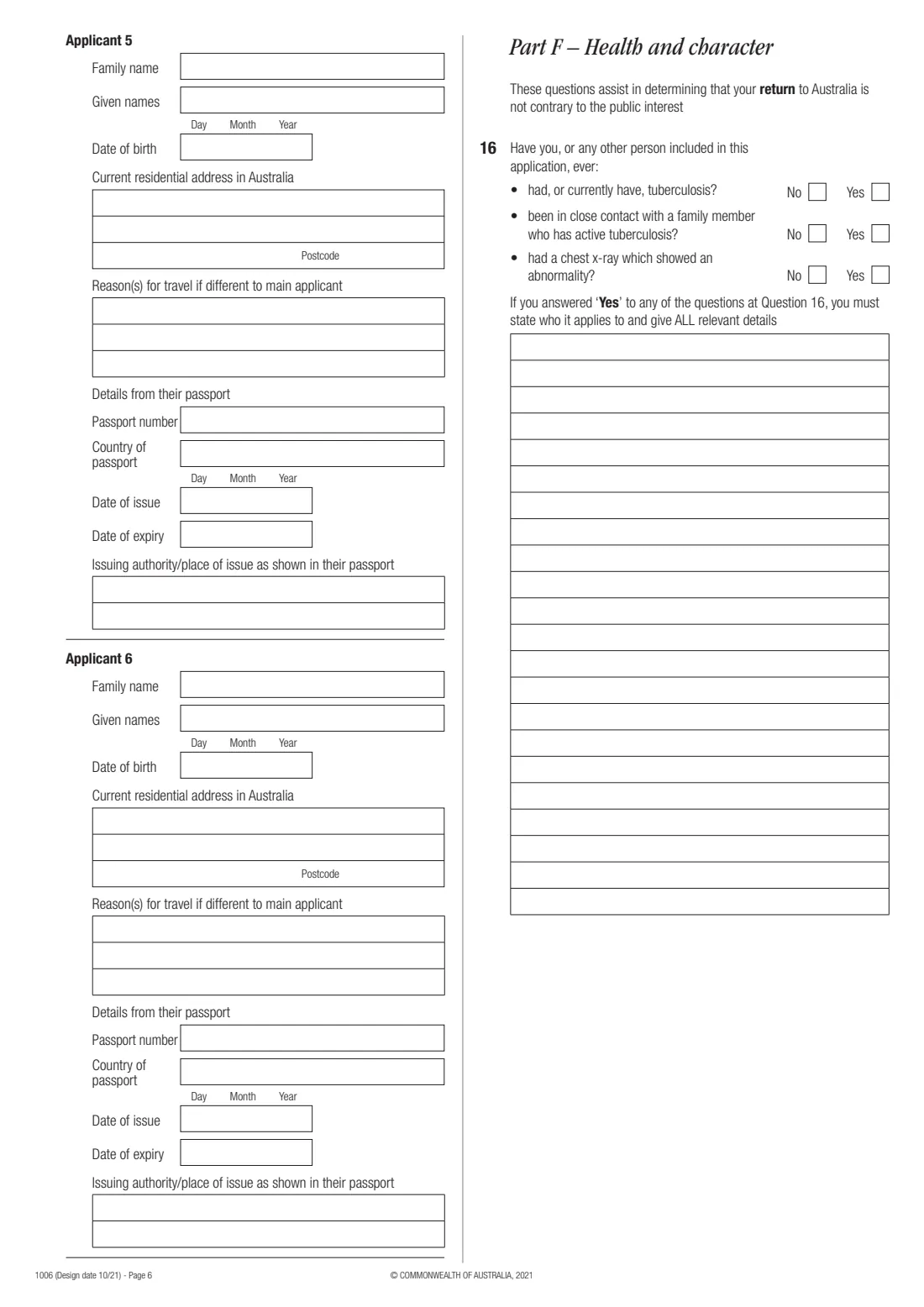
- Part E — Applicant 5 (question 15)Main applicant
- Part E — Applicant 6 (question 15)Main applicant
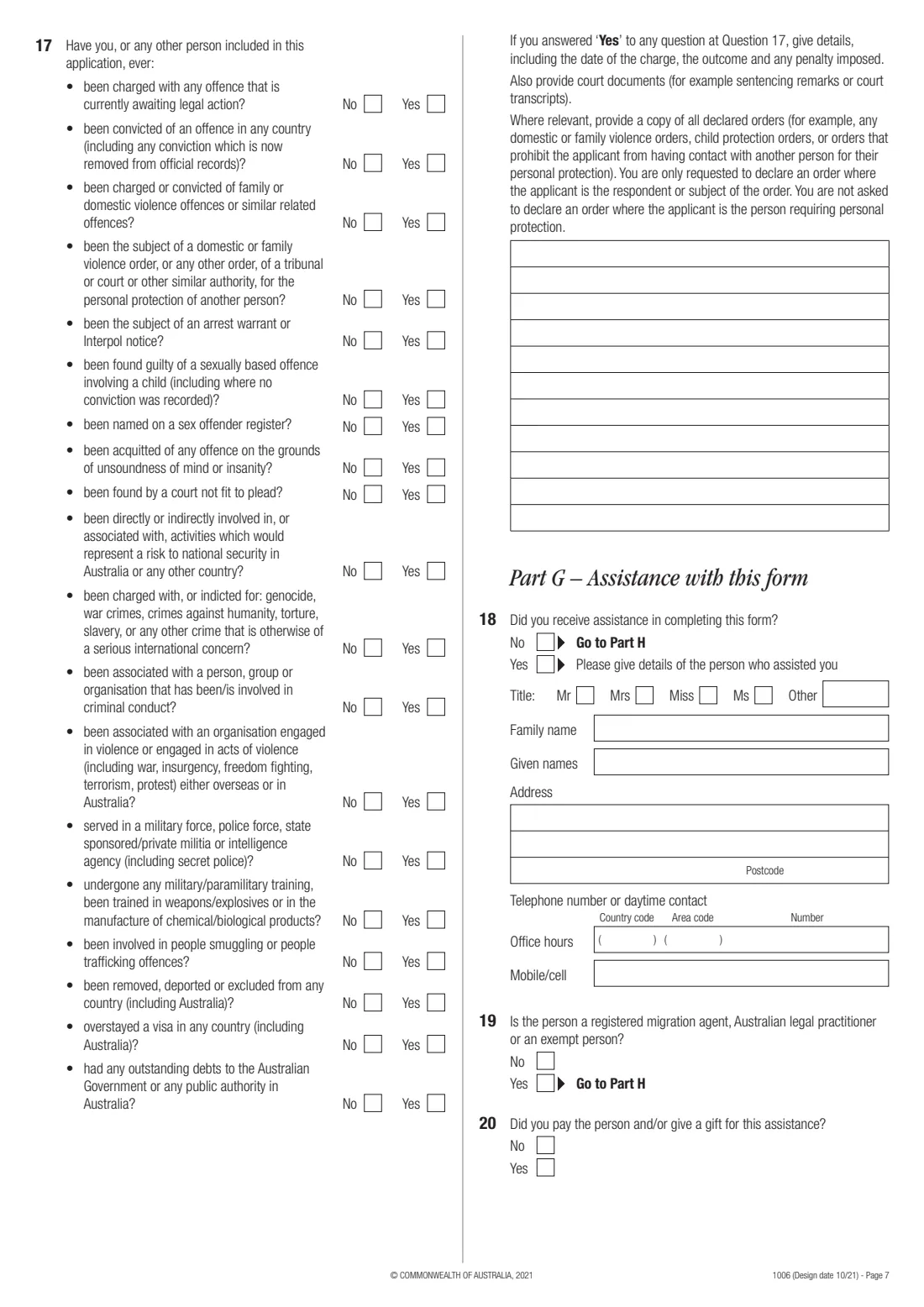
- Part F — Health and character (questions 16–17)Main applicant
- Part G — Assistance with this form (questions 18–20)Main applicant
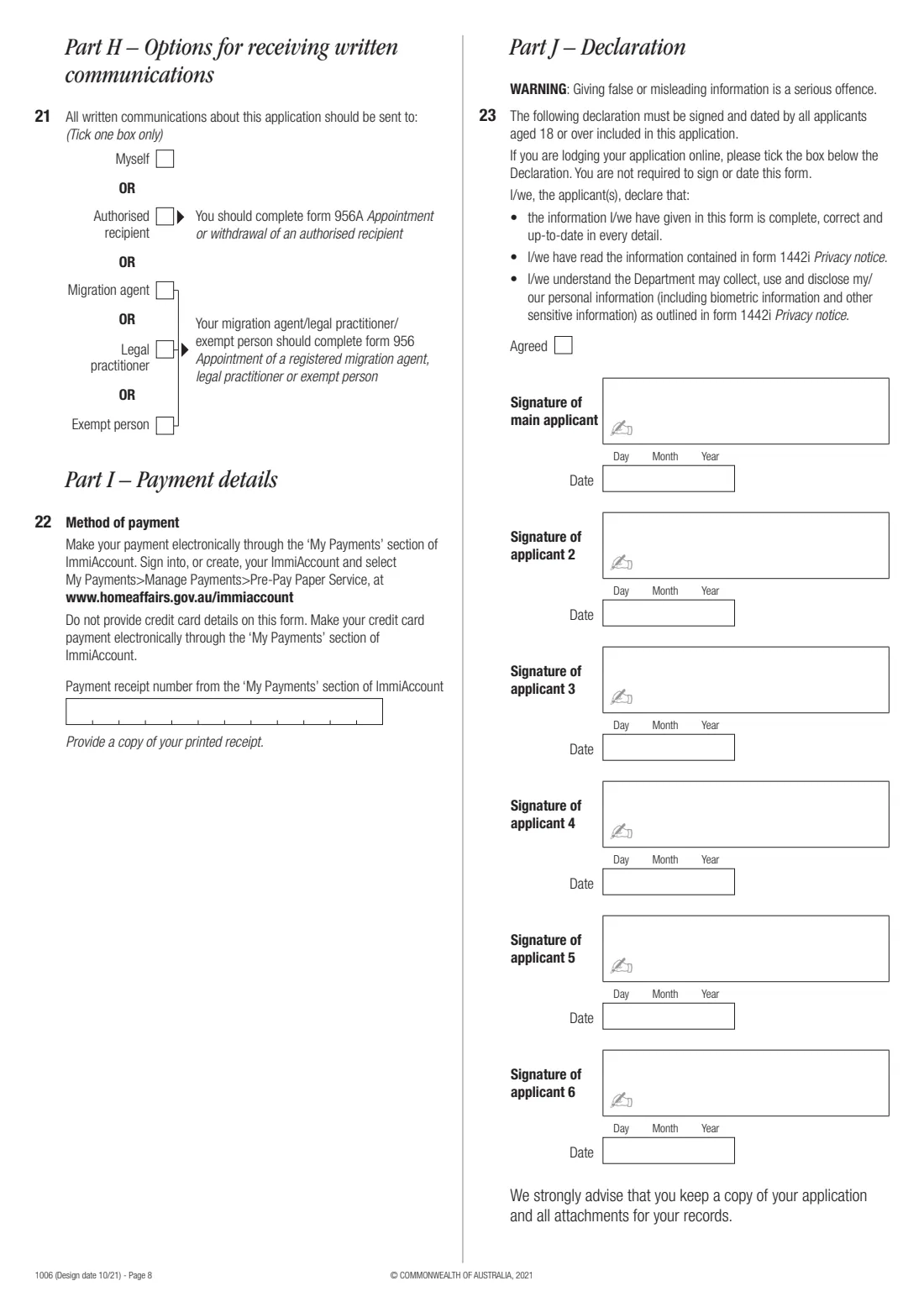
- Parts H–J — Communications, payment and declaration (questions 21–23)Main applicant
How to fill out Form 1006 — Bridging visa B (permission to travel), step by step
1 Parts A–C: you and your contact details
Your receipt number, name, date of birth and residential address in Australia, your passport and current visa with its grant number, your correspondence address, phone numbers and whether the Department may email you.
2 Part D: your application and travel
The substantive visa you've applied for and where it was lodged, any judicial review dates and solicitor, your destination and travel dates, your purpose for travelling, any overseas address for a stay of 14 days or more, and your correspondence address while away.
3 Part E: family members travelling
Switch on an applicant for each family member who is applying and travelling: name, date of birth, residential address, any different reason for travel, and passport details.
4 Part F: health and character
Answer the three tuberculosis and x-ray questions and the 19 character questions for everyone in the application. Any Yes needs details of who it applies to and what happened.
5 Parts G–J: help, payment, declaration
Say whether someone helped you, where written communications go, give your payment receipt number, then sign and date — or tick Agreed if you lodge online.
Common mistakes to avoid
- Giving a PO box as your residential address — the form says that makes the application invalid.
- Lodging before paying the visa application charge — the application isn't valid until it's paid.
- Leaving a health or character question blank, or answering Yes without the details.
- Not giving any of the receipt number, TRN or file number for your substantive visa application.
- Forgetting the overseas address when you'll stay somewhere for 14 days or more while a decision is pending.
After you fill it out
Sign and date the declaration — every applicant 18 or over — or tick Agreed if you're lodging online. FileIt can send the PDF for e-signature.
Upload the completed form with your payment receipt and supporting documents through the Department's online forms page. FileIt doesn't lodge it.
Keep a copy of the application in your FileIt vault and wait for the grant before you travel.
Fill out Form 1006 — Bridging visa B (permission to travel) online with FileIt
- Pick the person. Choose someone from People and FileIt fills in their name, date of birth, address and other details it already knows.
- Answer plain-language questions. One part of the form at a time, with the official help text beside each question — 244 fields in all. Your answers save as you go.
- Check the live preview. Watch your answers land on the real Department of Home Affairs form, and let FileIt do any worksheet arithmetic.
- Generate the official PDF. FileIt prints your answers into the agency’s own PDF and files it in that person’s folder in your vault. Sign it, or send it for e-signature.
FileIt fills the form — it never files or submits anything for you. Deliver the finished form to whoever asked for it, the way the form’s instructions say.
Start Form 1006 — Bridging visa B (permission to travel) now — it’s freeForm 1006 — Bridging visa B (permission to travel): frequently asked questions
Who can get a Bridging visa B?
The form says you must hold a Bridging visa A or B, have substantial reasons for wishing to leave and re-enter Australia, and your return must not be contrary to the public interest.
Can I apply online instead?
You may be able to apply in ImmiAccount if your substantive visa was applied for there. If you can't, you complete Form 1006 and upload it through the Department's online forms page.
Can my family travel on the same application?
Yes. Members of your family unit who are travelling and need a Bridging visa B are included in Part E — there's room for five.
What if I'm awaiting judicial review?
Switch on question 11 and give the date of the refusal letter, any merits review decision and the date your judicial review application was lodged, and provide a copy of the court application.
Is there a charge?
Yes. Pay it through My Payments in ImmiAccount (Pre-Pay Paper Service) and give the 12-character receipt number at question 22. Don't put card details on the form.
Official sources
- Blank form (PDF), published by Department of Home Affairs: https://immi.homeaffairs.gov.au/form-listing/forms/1006.pdf
- Official instructions and guidance: https://immi.homeaffairs.gov.au/visas/getting-a-visa/visa-listing/bridging-visa-b-020
- Edition shown on this page: Design date 10/21 (checked 2026-10-19).
FileIt is not affiliated with or endorsed by Department of Home Affairs or any government. This page explains the form in general terms and is not legal, tax or immigration advice. Always read the official instructions, and check that you are using the edition the recipient accepts. Page last reviewed 2026-10-19.