What is E 1kv (2025) — capital income?
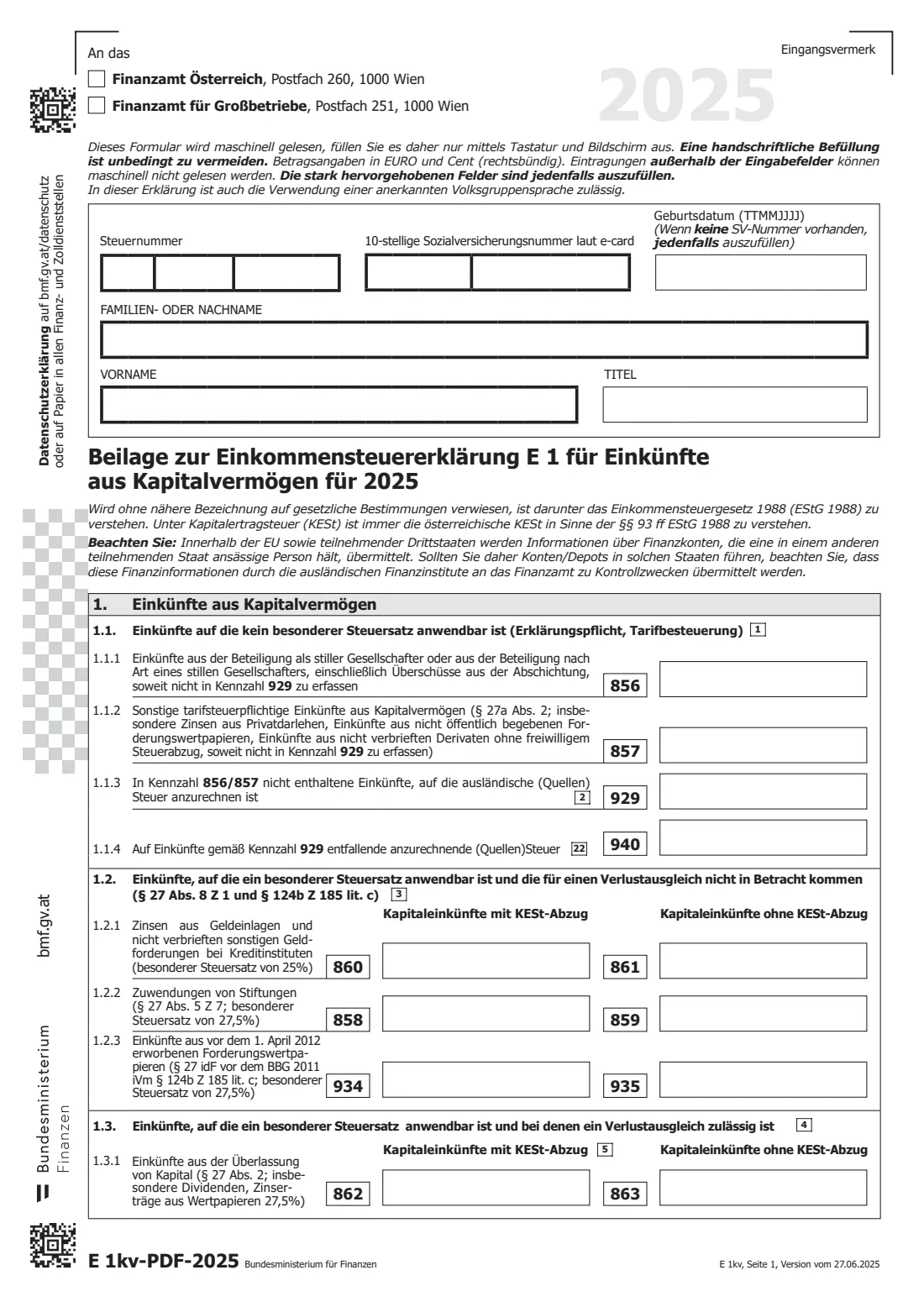
In Austria most capital income is taxed at source. An Austrian bank deducts capital gains tax (Kapitalertragsteuer, KESt) at 27.5% or 25%, and that usually settles it. You need the Beilage E 1kv when that isn't the whole story. That might be a foreign broker or bank that deducts no KESt, the sale of GmbH shares, crypto held outside an Austrian exchange, or a loss on one account that you want to set against a gain on another. You also need it to have KESt refunded or foreign withholding tax credited. The form is published by the Federal Ministry of Finance (Bundesministerium für Finanzen, BMF). The edition covered here is E 1kv-PDF-2025, Version vom 27.06.2025, for the 2025 tax year.
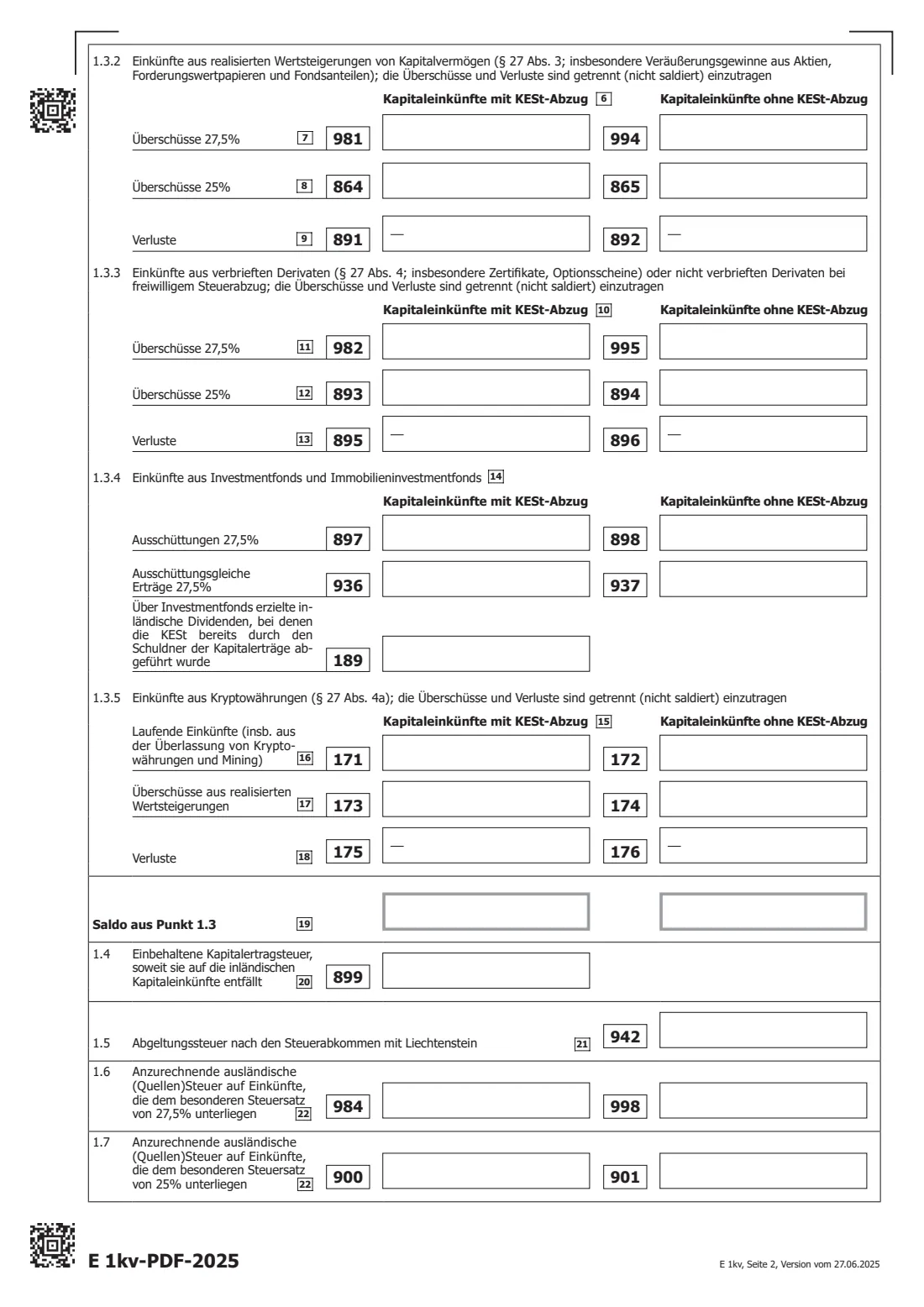
The E 1kv is a supplement to the income tax return, form E 1. It sorts capital income by how it is taxed: at your normal rates (1.1), at a special rate with no loss offset (1.2), or at a special rate within the loss offset (1.3). Part 1.3 covers dividends, realised gains and losses on shares, bonds, funds, derivatives and cryptocurrencies, each split into income 'with KESt deducted' and 'without KESt deducted'. It also has the KESt already withheld, the Liechtenstein final tax, creditable foreign tax, and two rarer claims: the KESt refund for home-loan repayment vehicles and the credit exclusion under § 27a (5).
FileIt explains each Kennzahl in English with the German wording alongside. It prints your amounts into the BMF's own PDF in the form's format (1.234,56), puts each loss after the form's printed minus sign, and works out the 'Saldo aus Punkt 1.3' balance the same way the form's script does. Your name can be pre-filled from your People records, and the finished PDF is saved in your vault. FileIt does not file anything: you sign the E 1kv and send it with your E 1, or enter the same figures in FinanzOnline.
- Who fills it
- Taxpayers with capital income to declare or KESt to reclaim for 2025
- Goes with
- The 2025 income tax return, form E 1
- Sent to
- Finanzamt Österreich (or the Finanzamt für Großbetriebe), or the same entries in FinanzOnline
- Free limit
- Capital income only has to be declared above €22 in total, as the form's notes say
- Signatures
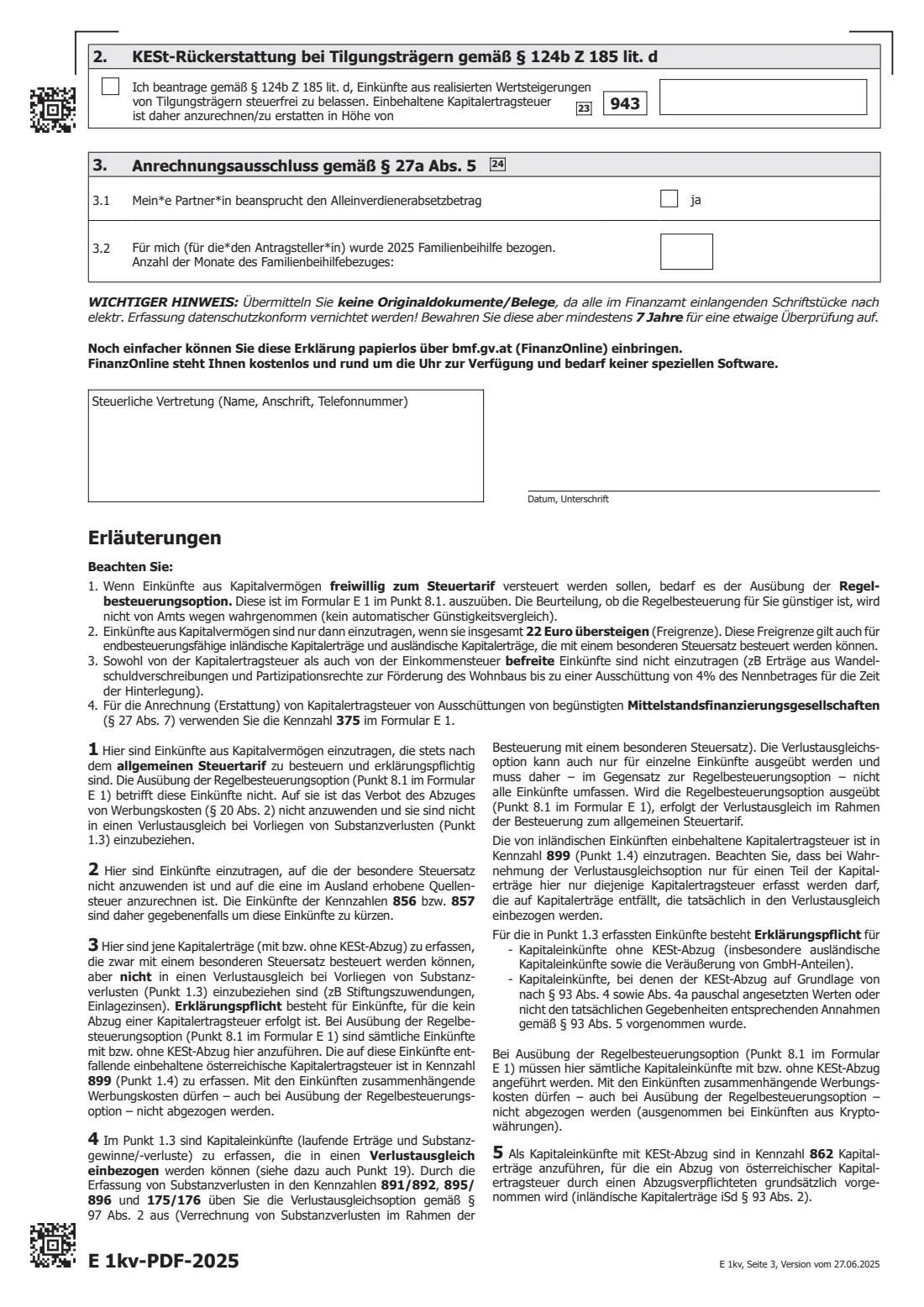
- You sign and date it by hand on page 3
- Edition
- E 1kv-PDF-2025, Version vom 27.06.2025
Who needs to fill out E 1kv (2025) — capital income?
- Investors with a foreign broker or bank account where no Austrian KESt was deducted on dividends, interest or gains.
- Anyone who sold shares in a GmbH or other capital they hold outside an Austrian bank.
- Investors who want losses on one account offset against gains on another (the loss offset option).
- People who opt to have capital income taxed at their normal rates instead (the Regelbesteuerungsoption on the E 1) to get KESt back.
- Holders of cryptocurrencies with income or gains not taxed at source by an Austrian provider.
- Taxpayers with income taxed at the normal rates, such as a silent partnership or interest on private loans.
When to use E 1kv (2025) — capital income
- With your 2025 income tax return (E 1) whenever you have capital income that wasn't fully taxed at source, or want KESt refunded.
- When you want to use the loss offset across accounts or banks for 2025.
- When foreign withholding tax was deducted and you want it credited under a double tax treaty.
- When you claim the KESt refund for investments that serve as a repayment vehicle for a home loan taken out before November 2010.
What you need before you start
- Your tax number, social security number (or date of birth) and name, as on the E 1.
- Annual tax reports or statements from every bank and broker for 2025, split into income with and without Austrian KESt.
- Dividends, interest, fund distributions and deemed distributed income (ausschüttungsgleiche Erträge) for each account.
- Realised gains and losses, kept separate, for shares, bonds, funds, derivatives and cryptocurrencies.
- The Austrian KESt withheld on the income you declare, and any foreign withholding tax that can be credited.
- For part 3: whether your partner claims the sole earner's credit, and how many months family allowance was received for you.
- Your filled-in E 1 for 2025.
What’s on E 1kv (2025) — capital income
The 2025 edition has 4 pages. FileIt asks for it in 8 parts, and it is signed by Taxpayer (steuerpflichtige*r):
- Tax office and your details (Finanzamt, Steuernummer, Name)Taxpayer (steuerpflichtige*r)
- 1.1 Income taxed at the normal tax rates (Einkünfte, auf die kein besonderer Steuersatz anwendbar ist)Taxpayer (steuerpflichtige*r)
- 1.2 Income at a special rate, not part of the loss offset (Einkünfte mit besonderem Steuersatz, ohne Verlustausgleich)Taxpayer (steuerpflichtige*r)
- 1.3 Income at a special rate, part of the loss offset (Einkünfte mit besonderem Steuersatz und Verlustausgleich)Taxpayer (steuerpflichtige*r)
- 1.4–1.7 Austrian KESt withheld and foreign taxes (Kapitalertragsteuer, ausländische Steuer)Taxpayer (steuerpflichtige*r)
- 2. KESt refund for repayment vehicles (KESt-Rückerstattung bei Tilgungsträgern, § 124b no. 185 (d))Taxpayer (steuerpflichtige*r)
- 3. Credit exclusion under § 27a (5) (Anrechnungsausschluss)Taxpayer (steuerpflichtige*r)
- Signature (Datum, Unterschrift)Taxpayer (steuerpflichtige*r)
How to fill out E 1kv (2025) — capital income, step by step
1 Tax office and your details
Tick the tax office and give your tax number, social security number (or date of birth if you have none), surname, first name and title. The heavily framed boxes must always be filled in.
2 1.1 Income at the normal rates
Income from a silent partnership (856) and other income taxed at your normal rates, such as interest on private loans (857). Income with creditable foreign withholding tax goes in 929, with that tax in 940. Reduce 856 or 857 by the income you put in 929.
3 1.2 Special rate, no loss offset
Interest on bank deposits (25%), foundation distributions and income from debt securities bought before April 2012 (27.5%). Use one box for income with KESt deducted and one for income without.
4 1.3 Special rate, with loss offset
Dividends and securities interest (862 / 863), then realised gains and losses on capital assets, derivatives and cryptocurrencies, and fund distributions. Gains and losses go in separate boxes and are not netted. Enter losses as positive amounts: the form prints the minus sign in front. FileIt shows the resulting balance for each column, as the form calculates it.
5 1.4 to 1.7 Taxes
The Austrian KESt withheld on the domestic income you declared (899), the Liechtenstein final tax (942) and creditable foreign withholding tax on income at 27.5% (984 / 998) and at 25% (900 / 901). Only enter foreign tax that can really be credited, not tax you can reclaim abroad.
6 2. and 3. Special claims
Part 2 is the KESt refund for repayment vehicles under § 124b no. 185 (d): tick the box and give the amount in 943. Part 3 matters if you use the normal-rates option. Say whether your partner claims the sole earner's credit, and give the months of family allowance received for you.
7 Signature
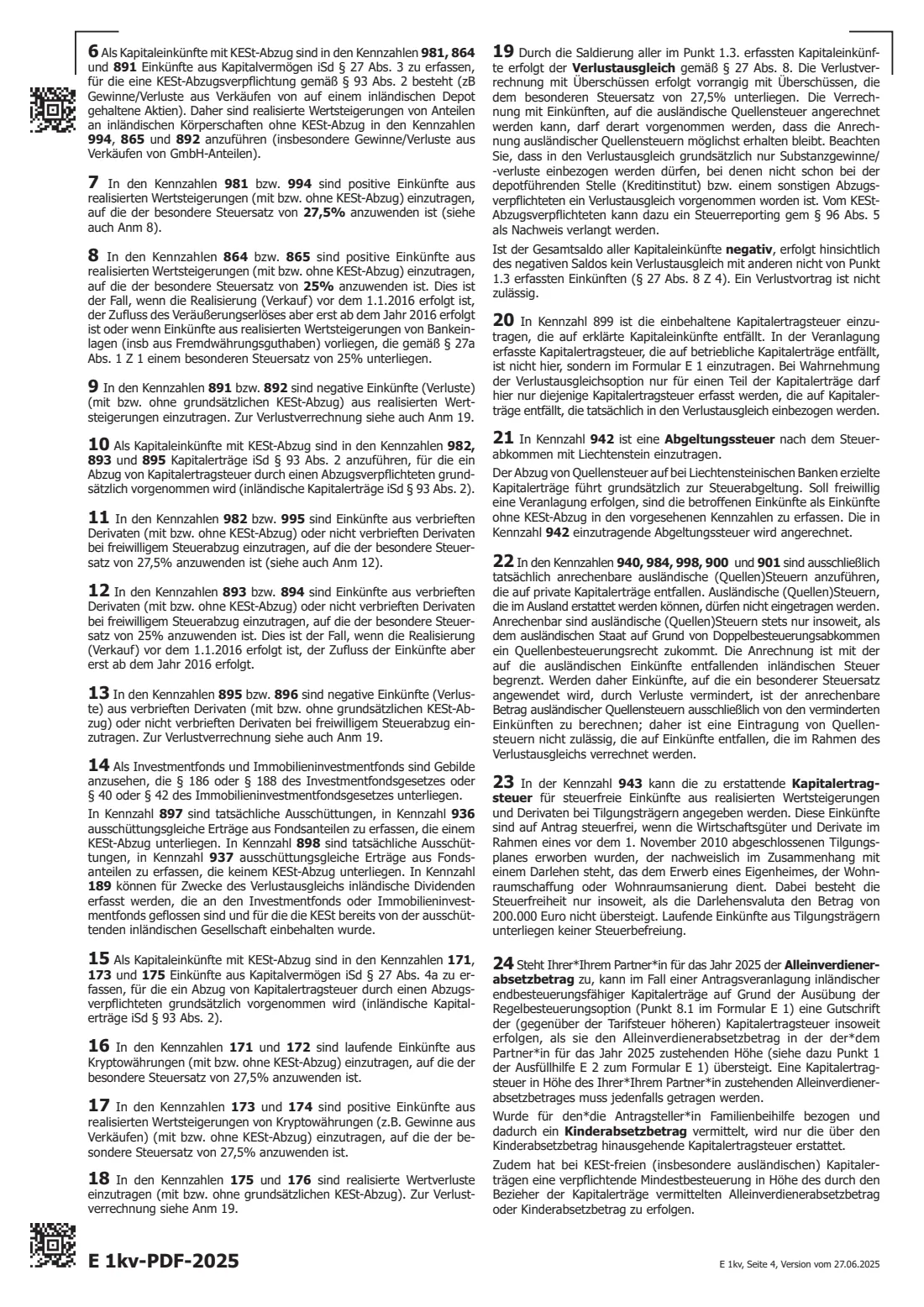
Add your tax representative if you have one, date it and sign by hand on page 3. Pages 3 and 4 also carry the BMF's numbered notes, which the help texts in FileIt follow.
Common mistakes to avoid
- Netting gains and losses yourself. The form wants them in separate boxes, and losses as amounts after the printed minus sign.
- Mixing up 'with KESt' and 'without KESt'. A foreign broker's income is almost always 'without'.
- Entering foreign tax that can be refunded abroad. Only creditable tax goes in 940, 984, 998, 900 and 901.
- Leaving out Kennzahl 899 when you use the loss offset or the normal-rates option. That KESt is what gets credited.
- Declaring income that is exempt from both KESt and income tax. The notes say not to include it.
- Sending bank statements with the form. The notes say originals are destroyed after scanning; keep them for 7 years instead.
After you fill it out
Print the E 1kv, sign it by hand beside the date and put it with your E 1 for 2025.
Post both to the tax office you ticked. FileIt doesn't file anything for you.
Keep your bank and broker tax reports for at least 7 years in case the tax office asks.
FileIt keeps the finished PDF in your vault, next to the rest of your 2025 tax papers.
Fill out E 1kv (2025) — capital income online with FileIt
- Pick the person. Choose someone from People and FileIt fills in their name, date of birth, address and other details it already knows.
- Answer plain-language questions. One part of the form at a time, with the official help text beside each question — 99 fields in all. Your answers save as you go.
- Check the live preview. Watch your answers land on the real Bundesministerium für Finanzen (BMF) — Finanzamt Österreich form, and let FileIt do any worksheet arithmetic.
- Generate the official PDF. FileIt prints your answers into the agency’s own PDF and files it in that person’s folder in your vault. Sign it, or send it for e-signature.
FileIt fills the form — it never files or submits anything for you. Deliver the finished form to whoever asked for it, the way the form’s instructions say.
Start E 1kv (2025) — capital income now — it’s freeE 1kv (2025) — capital income: frequently asked questions
My Austrian bank deducted KESt on everything. Do I need the E 1kv?
Usually not, because KESt deducted in Austria generally settles the tax. You need it if you want the loss offset or the normal-rates option, or if some income had no KESt deducted.
What does 'with KESt deducted' mean?
Income on which an Austrian payer, typically a bank holding your account, deducted capital gains tax. Income from foreign accounts and the sale of GmbH shares is usually 'without KESt deducted'.
How do I enter a loss?
As a positive amount in the loss box (891 / 892, 895 / 896, 175 / 176). The form prints the minus sign in front of the box, and FileIt counts it as negative in the balance for part 1.3.
Is there a minimum amount?
The notes say capital income only has to be declared if it comes to more than €22 in total (the Freigrenze), including income that could be taxed at a special rate.
Where do I opt for taxation at my normal rates?
On the main E 1, point 8.1. The E 1kv carries the figures. The notes add that the tax office doesn't check for you whether that option is better.
Is the E 1kv in English?
No, it is a German form. FileIt explains each line in English and prints your answers into the official BMF PDF.
Does FileIt submit the E 1kv?
No. FileIt fills the PDF and saves it in your vault. You sign it and send it with your E 1, or enter the same figures in FinanzOnline.
Official sources
- Blank form (PDF), published by Bundesministerium für Finanzen (BMF) — Finanzamt Österreich: https://formulare.bmf.gv.at/service/formulare/inter-Steuern/pdfs/2025/E1kv.pdf?open=download
- Official instructions and guidance: https://formulare.bmf.gv.at/service/formulare/inter-Steuern/
- Edition shown on this page: E 1kv-PDF-2025, Version vom 27.06.2025 (checked 2026-10-19).
FileIt is not affiliated with or endorsed by Bundesministerium für Finanzen (BMF) — Finanzamt Österreich or any government. This page explains the form in general terms and is not legal, tax or immigration advice. Always read the official instructions, and check that you are using the edition the recipient accepts. Page last reviewed 2026-10-19.