What is the zakat assistance application form template?
Mosques and Islamic charities that distribute zakat carry a trust: the funds must reach people who are eligible, and the committee must decide fairly and quietly. That means understanding each household's income, expenses, savings and debts — questions that are hard to ask face to face and easy to forget on a scrap of paper. This template asks them clearly, in a private online form the applicant can complete at home.
The first page covers the household: contact details, whether the applicant is Muslim (with a note that other funds may help those who aren't), marital status, how they know the masjid, and who lives with them. The second page sets out monthly income, expenses, savings and any gold, silver or investments. Answering "Yes, I'm in debt" opens questions about each creditor and amount, the total and overdue sums, how the debt came about and whether it carries interest — information many committees use when considering the category of those in debt.
The last page describes the need, the amount and who should be paid, with uploads for ID and supporting documents. The applicant signs a declaration, and the application is filed as a PDF in your FileIt vault, kept to the people you choose.
- Best for
- Mosques, Islamic centres and Muslim charities distributing zakat and sadaqah
- Filled in by
- The applicant, or with an imam or volunteer
- Time to complete
- About 15 minutes, plus gathering documents
- Includes
- Household members, income, expenses, savings, debt and creditor details, the need, document uploads and declaration
Who uses a zakat assistance application form?
- A masjid zakat committee reviewing applications every month
- An Islamic charity accepting applications from several cities
- Ramadan zakat distribution, when requests peak
- Helping a family facing eviction because of rent arrears
- Recording decisions so help is consistent from year to year
Questions on this zakat assistance application form
44 questions over 3 pages · includes signature, file upload, conditional questions, multiple pages, consent checkbox.
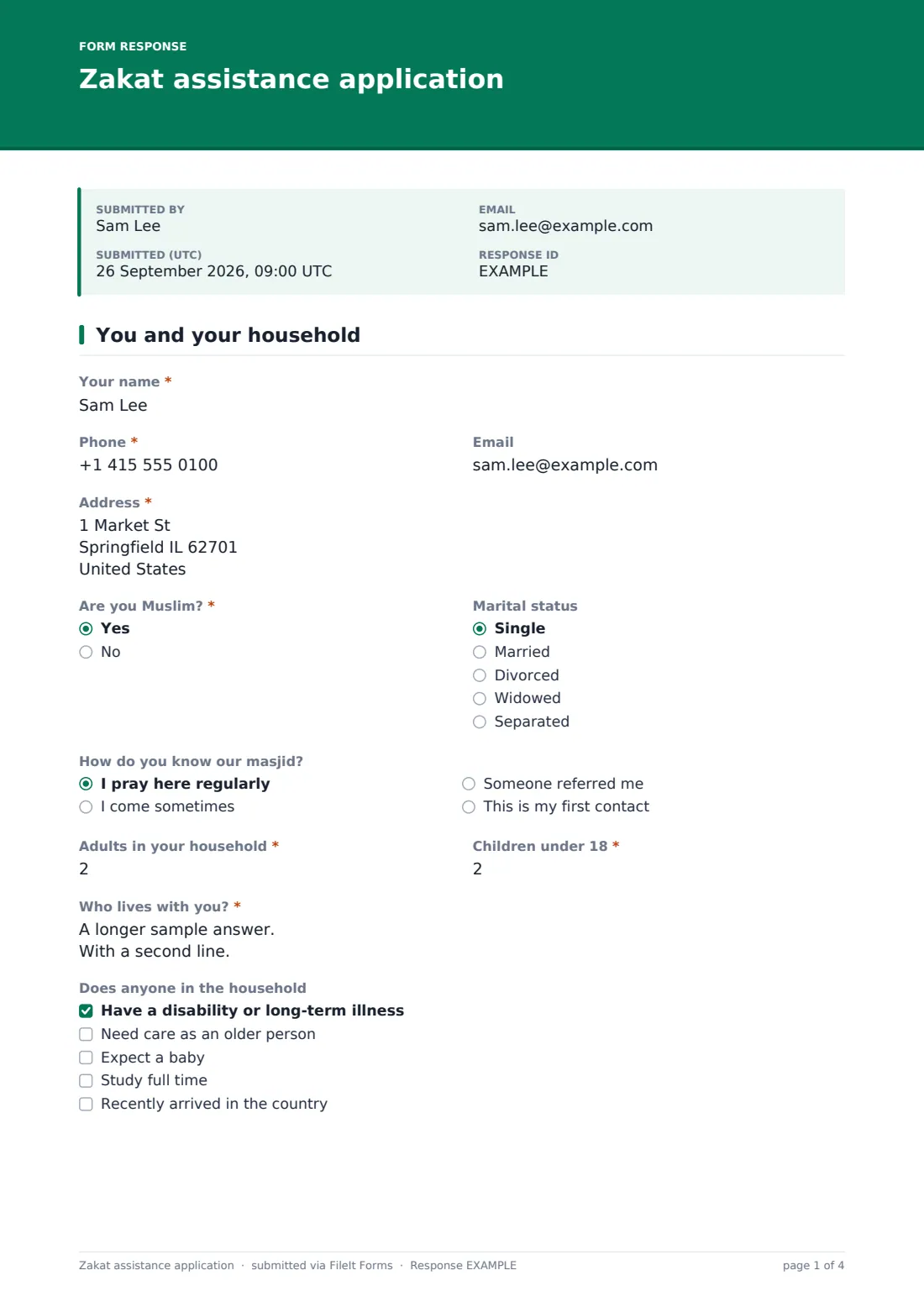
1 You and your household
- Your name*
- Phone*
- Address*
- Are you Muslim?* Yes · No
- Marital status Single · Married · Divorced · Widowed · Separated
- How do you know our masjid? I pray here regularly · I come sometimes · Someone referred me · This is my first contact
- Who referred you? asked only when it applies
- Adults in your household*
- Children under 18*
- Who lives with you?*
- Does anyone in the household Have a disability or long-term illness · Need care as an older person · Expect a baby · Study full time · Recently arrived in the country
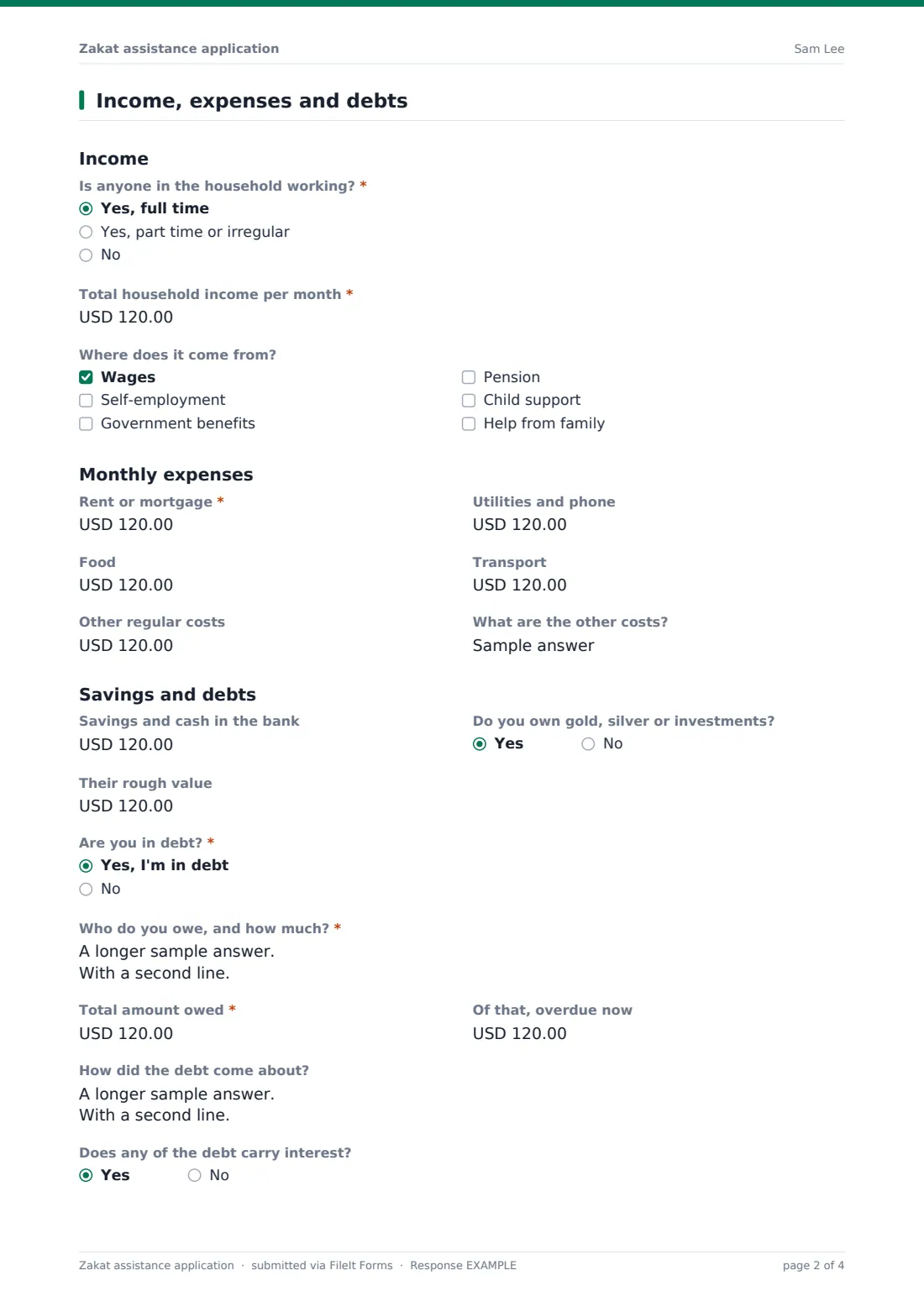
2 Income, expenses and debts
- Is anyone in the household working?* Yes, full time · Yes, part time or irregular · No
- Total household income per month*
- Where does it come from? Wages · Self-employment · Government benefits · Pension · Child support · Help from family
- Rent or mortgage*
- Utilities and phone
- Food
- Transport
- Other regular costs
- What are the other costs?
- Savings and cash in the bank
- Do you own gold, silver or investments?
- Their rough value asked only when it applies
- Are you in debt?* Yes, I'm in debt · No
- Who do you owe, and how much?* asked only when it applies
- Total amount owed* asked only when it applies
- Of that, overdue now asked only when it applies
- How did the debt come about? asked only when it applies
- Does any of the debt carry interest? asked only when it applies
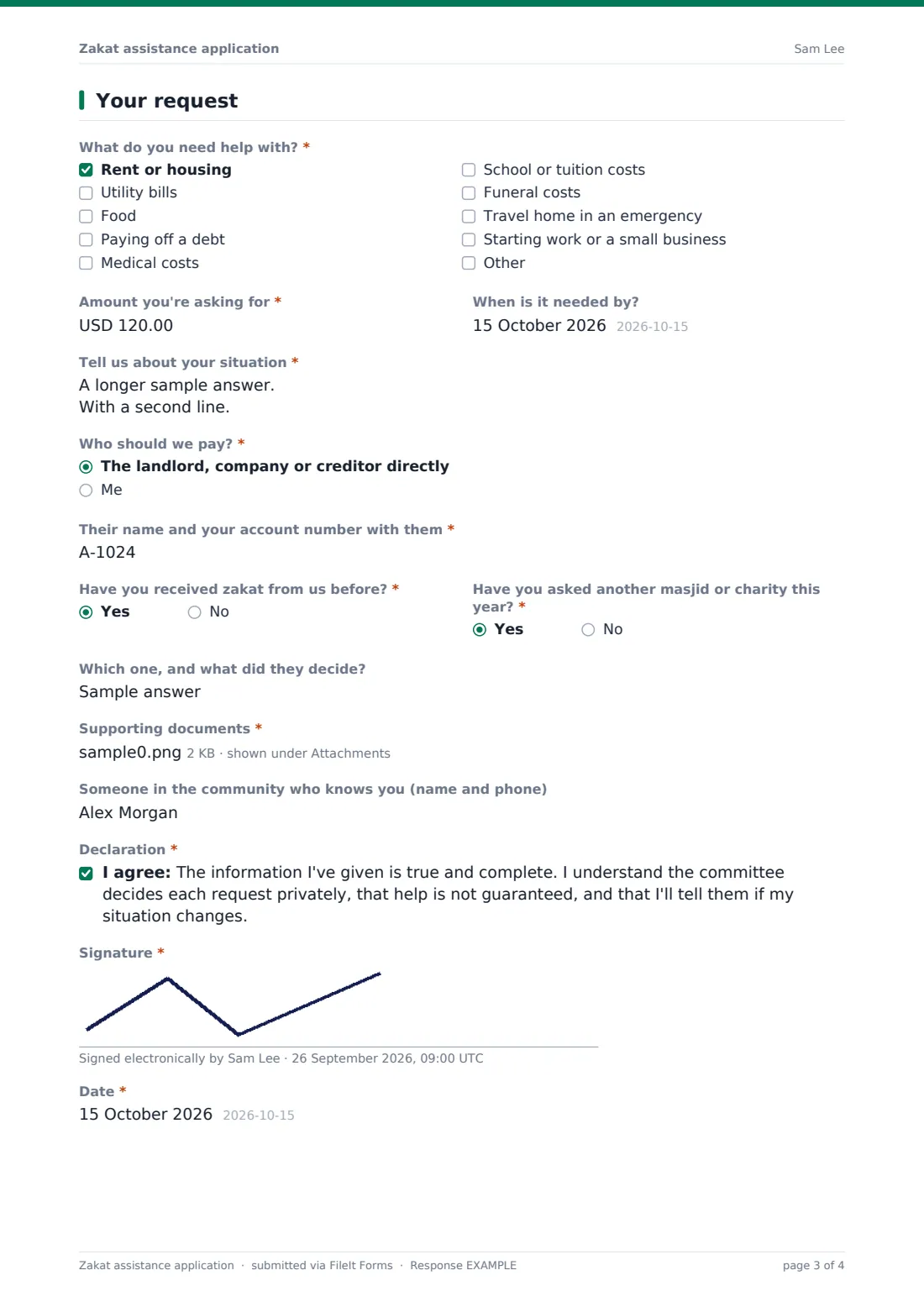
3 Your request
- What do you need help with?* Rent or housing · Utility bills · Food · Paying off a debt · Medical costs · School or tuition costs · Funeral costs · Travel home in an emergency · Starting work or a small business
- Amount you're asking for*
- When is it needed by?
- Tell us about your situation*
- Who should we pay?* The landlord, company or creditor directly · Me
- Their name and your account number with them* asked only when it applies
- Have you received zakat from us before?*
- Have you asked another masjid or charity this year?*
- Which one, and what did they decide? asked only when it applies
- Supporting documents*
- Someone in the community who knows you (name and phone)
- Declaration*
- Signature*
- Date*
The zakat assistance application form, page by page
1 You and your household
The applicant gives their name, phone, optional email and address, and answers "Are you Muslim?" — help text explains other funds may help those who aren't. They add marital status and "How do you know our masjid?"; a referral asks who referred them. "Adults in your household" and "Children under 18" are followed by "Who lives with you?" with first name, age and relationship. A checklist notes anyone with a disability, older people needing care, a pregnancy, full-time students or recent arrivals.
2 Income, expenses and debts
The applicant says whether anyone is working, gives "Total household income per month" and where it comes from. Monthly expenses are broken into rent or mortgage, utilities and phone, food, transport and other regular costs. "Savings and cash in the bank" and "Do you own gold, silver or investments?" — with their rough value — give the committee the full picture.
"Are you in debt?" is required. A yes asks "Who do you owe, and how much?" (with an example in the help text), "Total amount owed", how much is overdue, "How did the debt come about?" and whether any of it carries interest.
3 Your request
"What do you need help with?" covers rent, bills, food, paying off a debt, medical, school and funeral costs, emergency travel home and starting work. The applicant gives the amount, when it's needed and their situation in their own words. "Who should we pay?" prefers paying the landlord, company or creditor directly, which asks for their name and the account number. They say whether they've had zakat from you before or asked elsewhere this year, upload ID and supporting documents, add a community reference and sign the declaration.
Make the template yours
- Change the currency on the money questions to match your country
- Rewrite the declaration in your committee's own words
- Rename "masjid" to mosque, Islamic centre or your charity's name
- Remove the Muslim question if you're collecting sadaqah or general-fund requests
- Limit notification emails to the committee members who review requests
- File applications in a private folder only the committee can open
Tips for a better zakat assistance application form
- Agree eligibility guidance with a qualified scholar before applications open — the form doesn't decide it
- Pay creditors and landlords directly wherever you can
- Keep every application confidential, including from other volunteers
- Reply to every applicant, and suggest other help when you can't assist
- Ask applicants to tell you if their situation changes
Every response becomes a PDF in your vault
Each application is saved as a signed PDF in your FileIt vault with the ID and supporting documents attached, and the form owner is emailed. The applicant gets a copy if they gave an email address.
The committee can review applications in the Responses table, search for earlier requests from the same household, and export a CSV of amounts requested to keep alongside its own record of decisions.
- Start from this template. It opens in the FileIt Forms designer — change any question, add pages, set the rules for when questions appear.
- Share it. Turn on a public link, or send it to people by email, each with their own link. They don’t need a FileIt account.
- Get the answers as PDFs. Each response is saved as a PDF in the vault folder you choose, with uploaded files attached — and listed in a Responses table you can export to CSV.
Zakat assistance application form: frequently asked questions
Is this zakat application form template free?
Yes. It's one of the starter templates in FileIt's Forms app, available on every account including the free plan.
Does the form decide who is eligible for zakat?
No. It gathers the household's information. Your committee and scholars apply your own guidance on eligibility.
When do the debt questions appear?
Only when the applicant answers "Yes, I'm in debt". They then list each creditor and amount, the total, what's overdue and how the debt came about.
What documents can applicants upload?
Up to eight PDFs or photos — typically ID, a lease, bills, debt or eviction letters and proof of income.
Who can see the applications?
They stay in your FileIt account, in the Responses tab and the vault folder you choose. Keep the notification list to the committee.
Can we use it for sadaqah or a general hardship fund?
Yes. Rename the form, adjust the declaration and remove the zakat-specific questions you don't need.