What is a workplace violence policy acknowledgement?
Most workplace violence starts with warning signs someone noticed but didn't report: a remark made as a "joke", an angry customer who keeps coming back, an ex-partner waiting in the car park. A clear policy only helps if people know it, and an acknowledgement form is the simplest way to show each employee has been told.
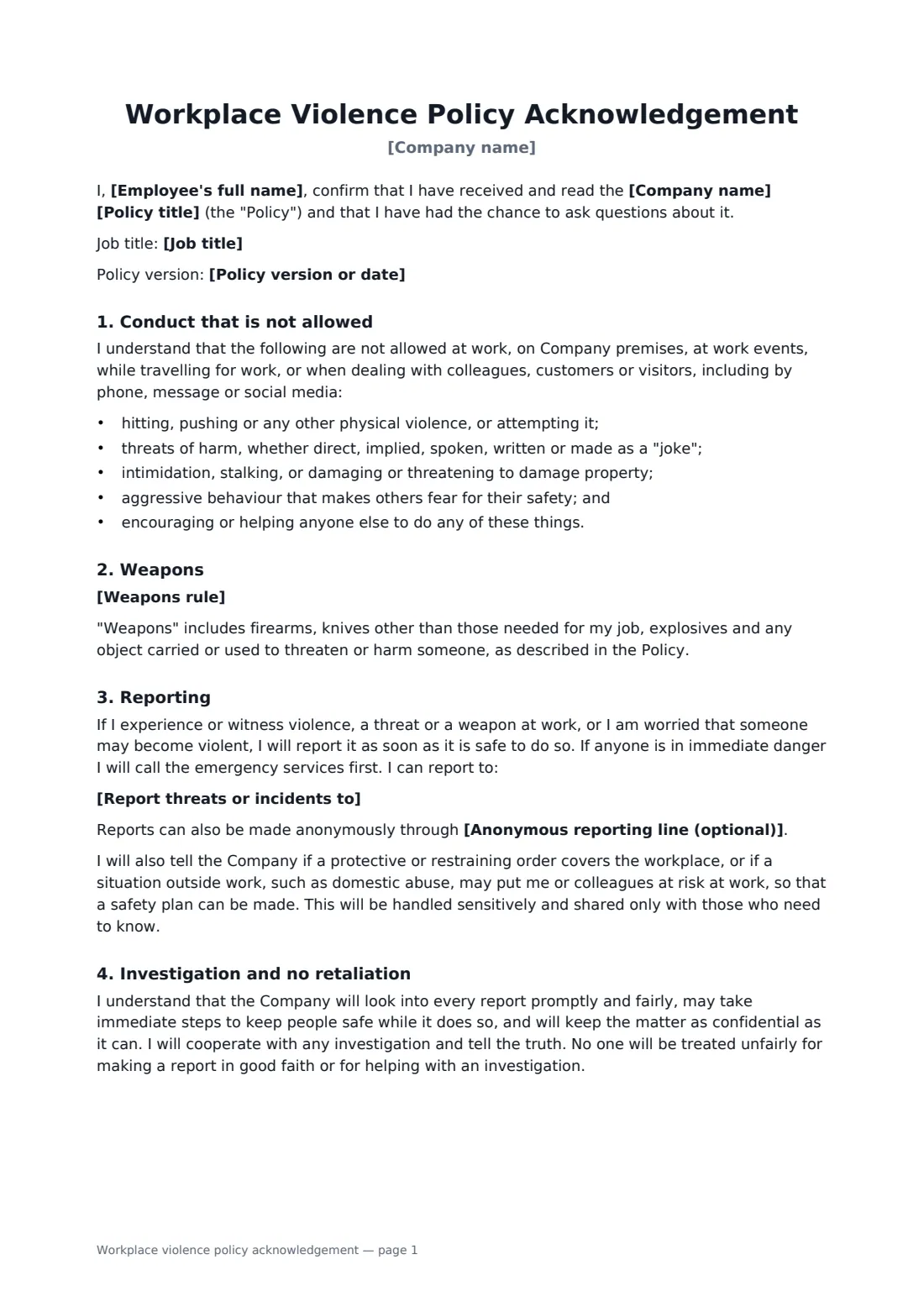
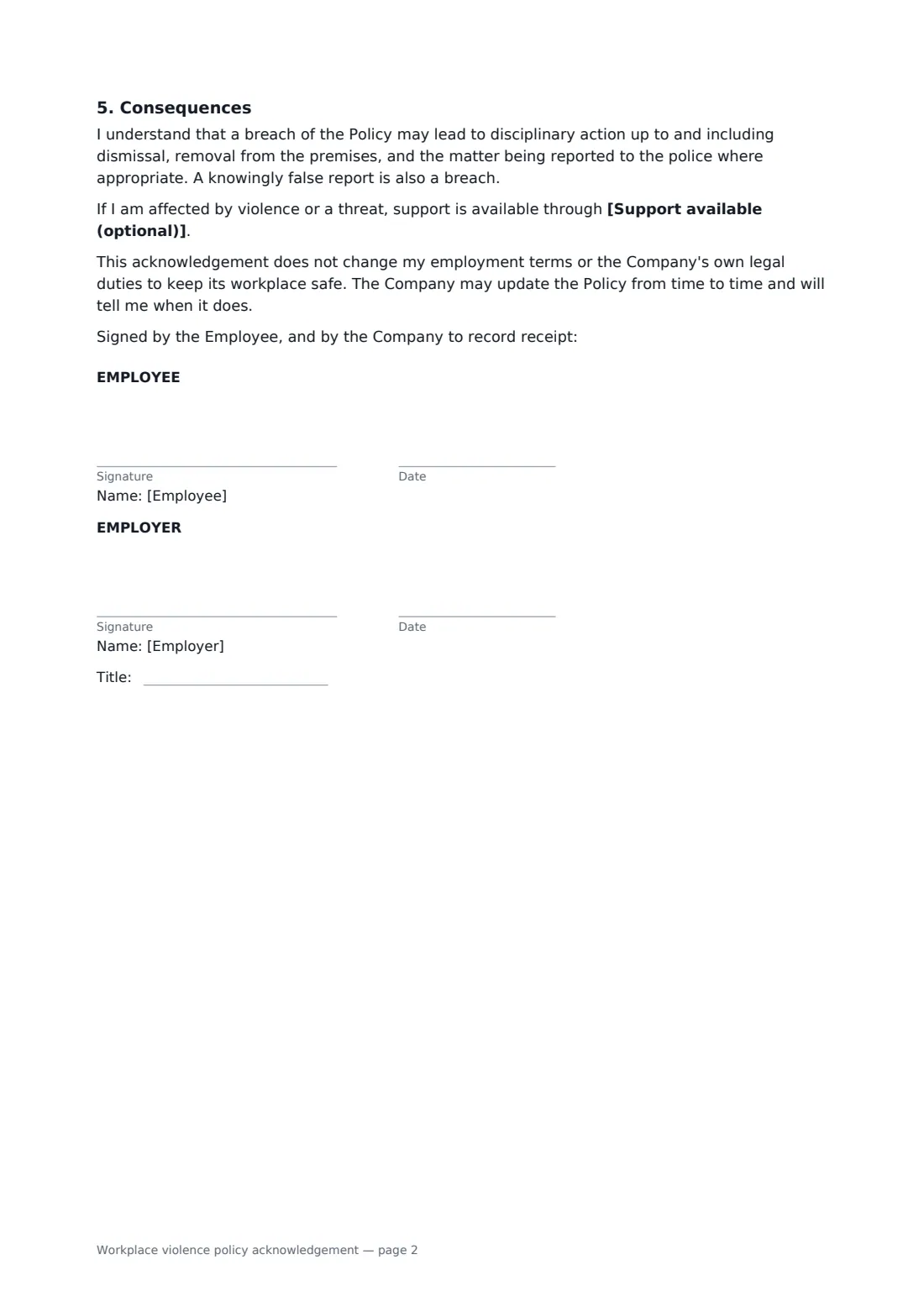
This form records the policy title and version, then summarises what is not allowed — physical violence, threats in any form, intimidation, stalking and property damage, at work and online. You pick the weapons rule that matches your policy. It lists who to report to, with an optional anonymous line, asks the employee to tell you about a protective order or a risk from outside work such as domestic abuse, and explains how reports are investigated, that no one is penalised for reporting in good faith, and the consequences of a breach.
- Best for
- Every employee, and especially customer-facing and lone roles
- Signed by
- The employee, then the employer with job title
- Covers
- Prohibited conduct, weapons, reporting, investigation, consequences
- Length
- About 2 pages
When to use a workplace violence policy acknowledgement
- Onboarding staff in retail, healthcare, hospitality or public services
- Rolling out a new violence prevention policy
- Refreshing acknowledgements after an incident or threat
- Meeting a client's or insurer's request for a signed policy record
- Briefing security and reception teams on reporting routes
What you fill in
9 blanks, then the name and email of each person who signs: employee, employer.
1 Details
- Company name*
- Employee's full name*
- Job title
2 The policy
- Policy title*
- Policy version or date
- Weapons rule* No weapons are allowed anywhere on Company premises, in Company vehicles or while working, whether or not the employee has a licence or permit. · No weapons are allowed in Company buildings, in Company vehicles or while working. Any exception for a lawfully stored weapon in a personal vehicle in the car park is as set out in the Policy.
3 Reporting
- Report threats or incidents to*
- Anonymous reporting line (optional)
- Support available (optional)
4 Who signs
- Employee signature and date
- Employer signature and date, job title · The manager or HR person recording the acknowledgement.
What the workplace violence policy acknowledgement covers
- Conduct that is not allowed
- Weapons
- Reporting
- Investigation and no retaliation
- Consequences
Using the workplace violence policy acknowledgement, step by step
1 Enter the employee and the policy
Add the employee's name and job title, and the title and version of your policy.
2 Choose the weapons rule
Pick the option your policy actually says — a full ban, or a ban with a stated exception for lawfully stored weapons in personal vehicles.
3 List the reporting routes
Name the people and numbers to report to, one per line, and add an anonymous hotline and support service if you have them.
4 Send for signature
Share the policy with the employee and send the form. They sign first and you sign to record receipt.
Tips before you send it
- Train managers to take every threat seriously, even one made as a joke, and to escalate rather than handle it alone.
- Make sure reception and security know what to do if someone named in a protective order turns up.
- Review the reporting contacts at least once a year — an out-of-date phone number defeats the purpose.
- Pair this with a workplace incident report so reports are recorded the same way every time.
Sign it online in minutes
- Fill in the blanks. Names, dates and amounts go straight into the agreement — the preview shows exactly where.
- Name who signs. Tick “This is me” for your own part. FileIt builds the PDF with every signature, date box on the right line, and you can check or move anything before sending.
- Send it. Each signer gets a secure link and signs from any device — no account needed. The signed PDF, with an audit trail and a Certificate of Completion, is filed in your vault and emailed to everyone.
Workplace violence policy acknowledgement: frequently asked questions
Can we ban all weapons at work?
Usually you can ban weapons in your buildings and vehicles, but some places limit banning lawfully owned firearms kept locked in a personal vehicle. The form offers both wordings — choose the one your policy uses.
Why does it mention domestic abuse?
Violence from outside work can follow someone to work. The form invites employees to share a risk or a protective order so a safety plan can be made, handled sensitively and on a need-to-know basis.
Will employees be protected if they report?
Yes. The form says no one is treated unfairly for reporting in good faith or helping with an investigation. A knowingly false report is a breach.
Does this change the employee's contract?
No. It records that the policy was received and understood, and says it doesn't change employment terms or the company's own safety duties.