What is a website purchase agreement?
Buying an existing website is really buying an income stream, so the paperwork needs to cover more than the domain. What exactly is included: the email list, the affiliate accounts, the social profiles? Are the traffic and revenue figures in the listing real? What stops the seller launching a near-identical site the following month? A website purchase agreement pins all of that down before money changes hands.
This template lists the domains and every other asset included or left out, the seller's traffic, revenue and profit figures, and the price, paid through escrow. It sets out a step-by-step handover, a buyer inspection period with a refund if something material cannot be fixed, and promises that the seller owns the assets and did not inflate traffic. Claims have a time limit and cap. It also includes a transition support period and a non-compete tied to the site's niche.
- Best for
- Blogs, affiliate and content sites, small e-commerce stores and SaaS side projects
- Signed by
- The seller and the buyer
- Payment
- Through escrow, released after handover and inspection
- Length
- About 3 pages, initialled on every page
When to use a website purchase agreement
- Buying an affiliate review site from its founder after finding it on a marketplace
- Selling a hobby blog that has grown a steady advertising income
- Acquiring a small competitor's online store and its email list
- A founder selling a side-project SaaS tool with its code and customer accounts
- Recording a private website sale agreed directly between two business owners
What you fill in
19 blanks, then the name and email of each person who signs: seller, buyer.
1 The parties
- Date of this agreement*
- Seller (company or person)*
- Seller address
- Buyer (company or person)*
- Buyer address
2 What is sold
- Domain name(s)*
- Other assets included*
- Not included
3 Seller's figures
- Traffic figures given by the seller*
- Revenue and profit figures given by the seller*
4 Price
- Currency*
- Purchase price*
- Escrow service*
- Escrow fees are paid by* the Buyer · the Seller · the Buyer and the Seller equally
5 Handover
- Buyer's inspection period after handover (days)*
- Transition support (days)*
- Non-compete period (months)*
- Non-compete covers*
- Governing law*
6 Who signs
- Seller signature and date, job title, initials on every page
- Buyer signature and date, job title, initials on every page
What the website purchase agreement covers
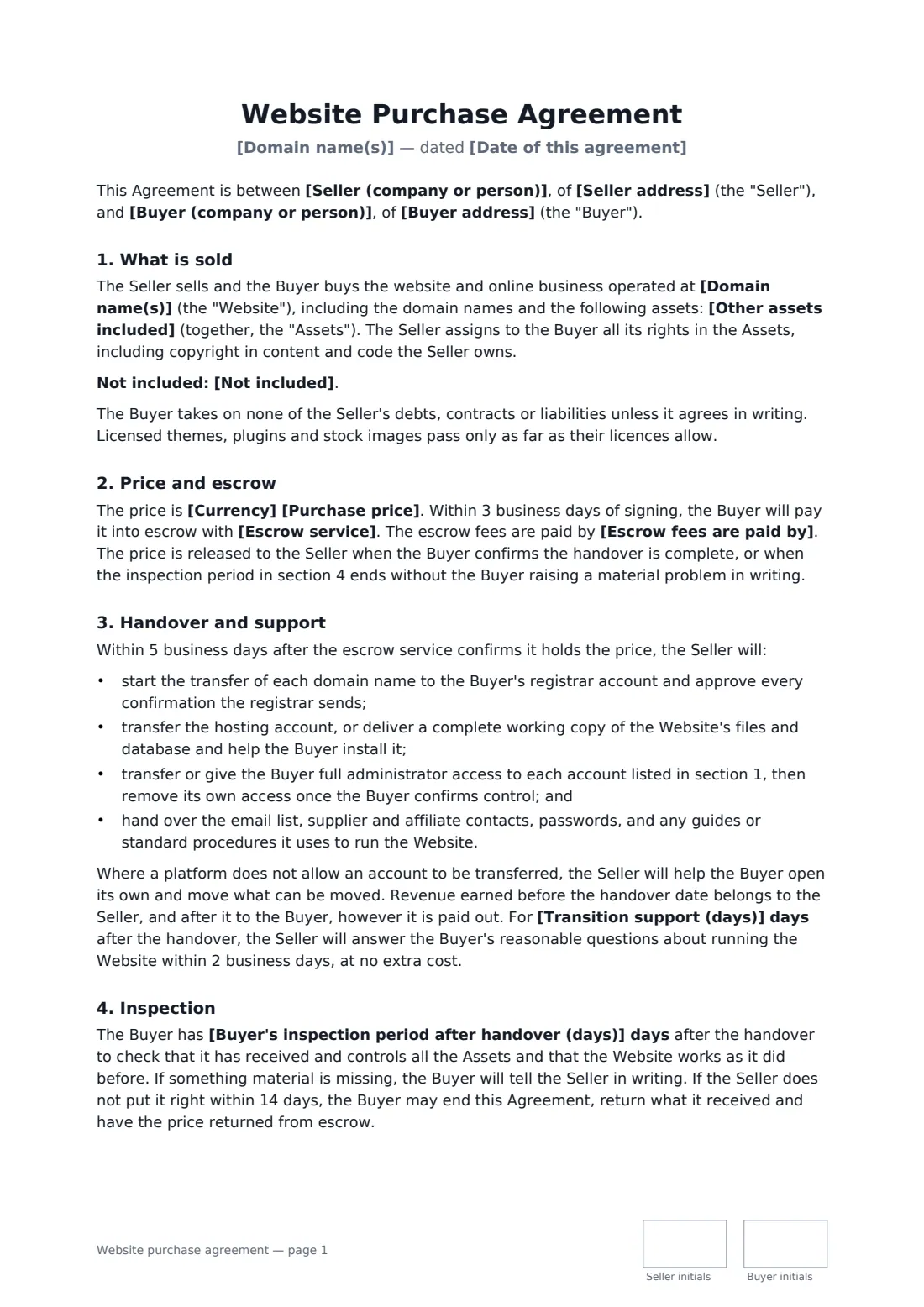
- What is sold
- Price and escrow
- Handover and support
- Inspection
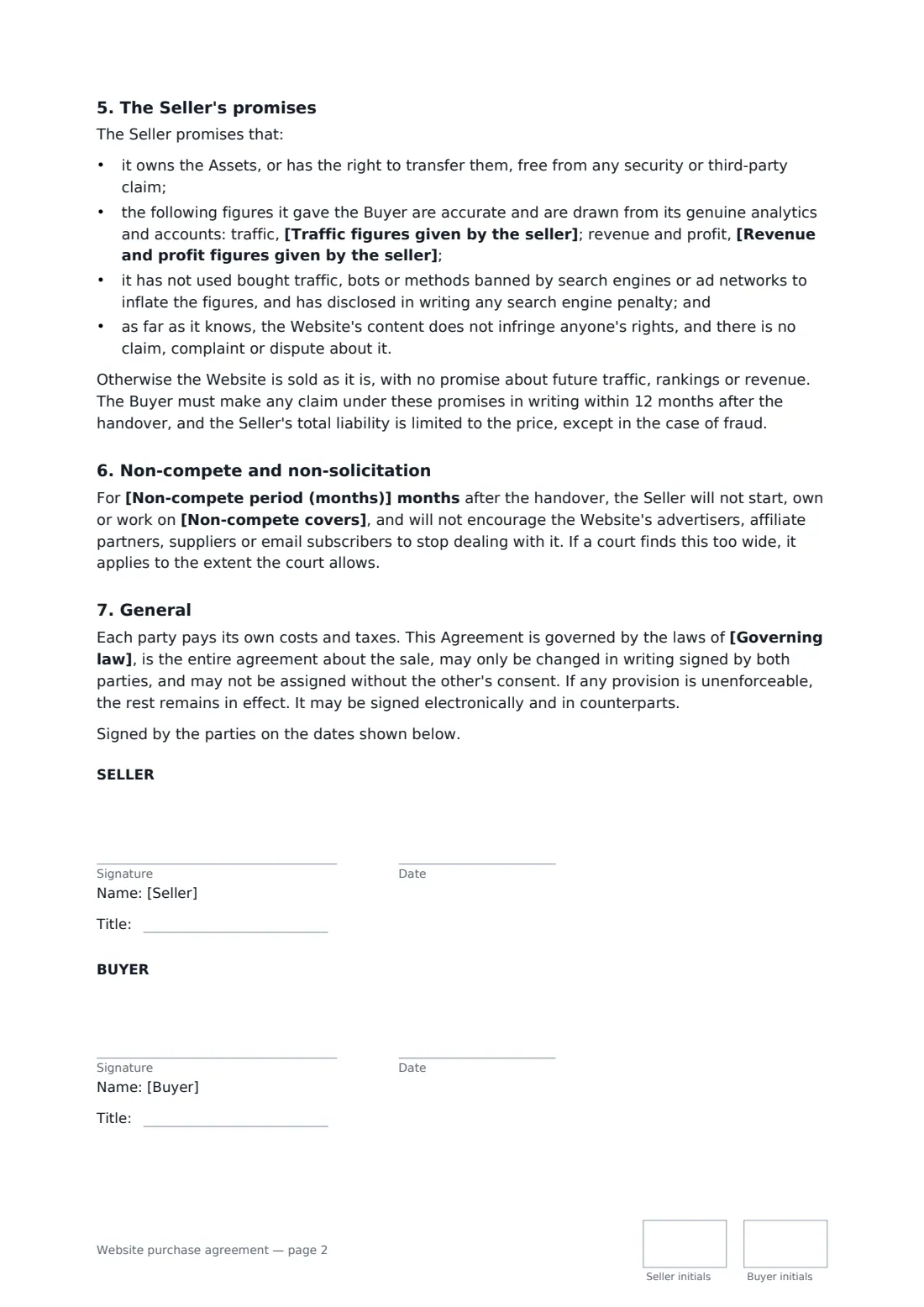
- The Seller's promises
- Non-compete and non-solicitation
- General
Using the website purchase agreement, step by step
1 List what is being sold
Enter the domains and the other assets, such as content, code, hosting, email list, analytics, social and affiliate accounts. List anything that stays with the seller.
2 Record the seller's numbers
Enter the traffic and revenue figures the buyer relied on, with the period they cover. The seller promises they are accurate.
3 Set the price and escrow
Enter the price and the escrow service, and choose who pays its fees. The money is released after handover and the inspection period.
4 Agree handover terms and sign
Set the inspection period, the days of transition support and the non-compete period and niche. Send it to the other side to sign and initial.
Tips before you send it
- Ask for read-only access to analytics and payout dashboards before signing. Screenshots are easy to fake.
- Check whether each affiliate and advertising programme allows accounts to be transferred. Some require the buyer to reapply.
- Move the domain first and the hosting second, so the site never points at an account nobody controls.
- Keep the non-compete narrow, tied to the site's actual niche. Very broad restrictions may not be enforced.
Sign it online in minutes
- Fill in the blanks. Names, dates and amounts go straight into the agreement — the preview shows exactly where.
- Name who signs. Tick “This is me” for your own part. FileIt builds the PDF with every signature, date and initials box on the right line, and you can check or move anything before sending.
- Send it. Each signer gets a secure link and signs from any device — no account needed. The signed PDF, with an audit trail and a Certificate of Completion, is filed in your vault and emailed to everyone.
Website purchase agreement: frequently asked questions
Why use escrow to buy a website?
Escrow means the buyer's money is held by a third party while the domain and accounts are transferred. The seller knows the money is there, and the buyer knows it will not be released until they have the site.
What if traffic drops after I buy the site?
The seller promises that the historical figures are accurate and were not inflated, but not that traffic or rankings will continue. A drop alone is not a breach. Inaccurate past figures are.
What if an account cannot be transferred?
The seller helps the buyer open its own account and move what can be moved. Revenue before handover belongs to the seller, and after handover to the buyer.
How is this different from a domain name transfer agreement?
A domain transfer agreement sells only the domain name. This one sells the whole website business, with content, accounts, revenue promises, transition support and a non-compete.