What is a rent receipt?
Tenants often need proof that they paid rent: for a benefits claim, a mortgage or visa application, a tax return, or simply peace of mind after paying in cash. A rent receipt signed by the landlord is the cleanest record, and it helps the landlord keep the rent account straight too.
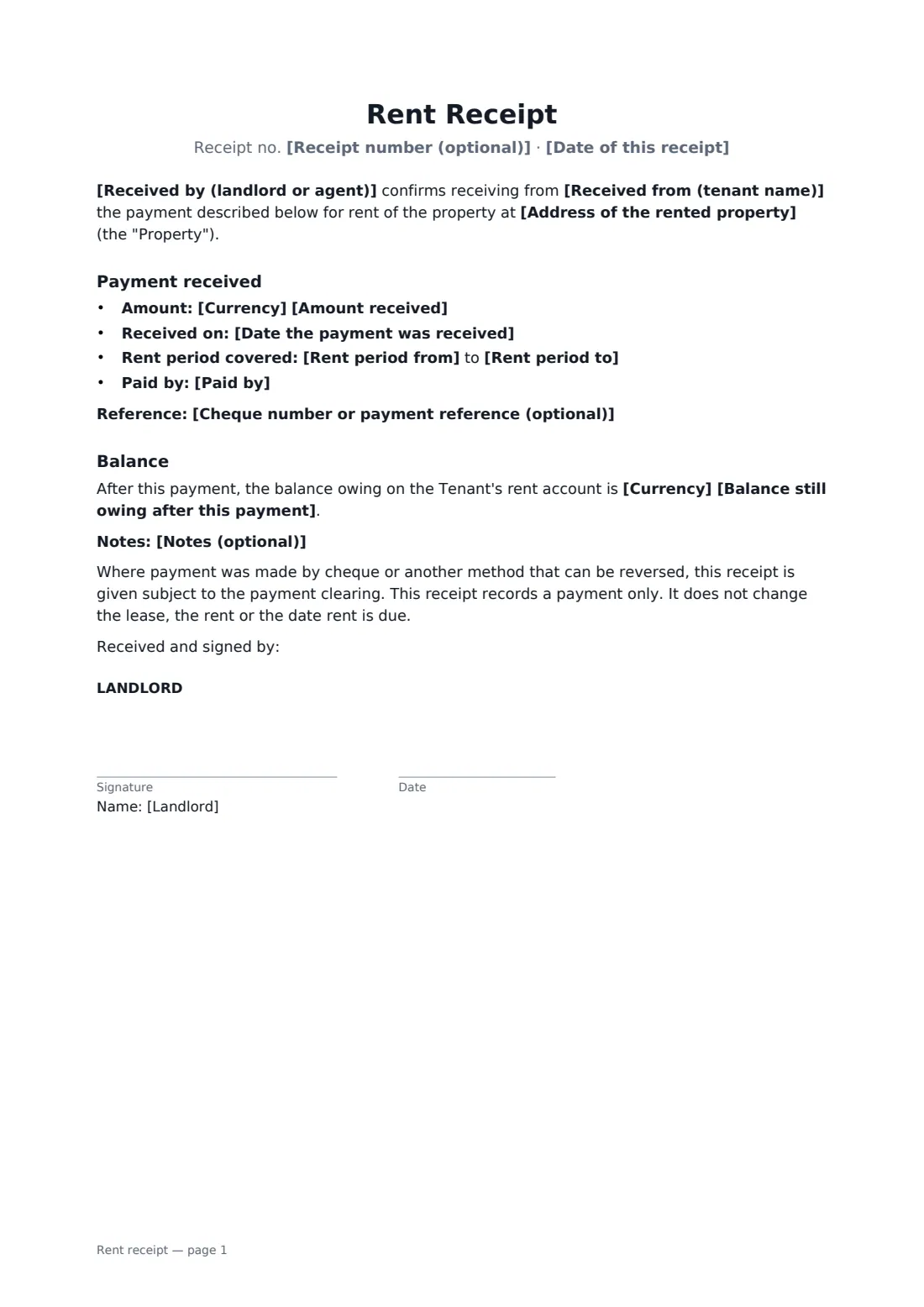
This receipt records the property, the person who paid, the amount, the date received and the exact period covered. You pick the payment method and can add a cheque number or bank reference. It always states the balance still owing, which prevents arguments months later, and notes that a cheque receipt depends on the cheque clearing. Only the landlord signs.
- Best for
- Confirming a single rent payment, especially cash or cheque
- Signed by
- Landlord or agent only
- Payment methods
- Transfer, cash, cheque, money order, card, app or direct debit
- Length
- 1 page
When to use a rent receipt
- A tenant who pays rent in cash each month
- Proof of rent for a mortgage, visa or benefits application
- Confirming a catch-up payment and the balance left over
- A lodger or room tenant who asks for receipts for their records
- Recording a payment that covers rent plus a parking space
What you fill in
14 blanks, then the name and email of each person who signs: landlord.
1 The receipt
- Receipt number (optional)
- Date of this receipt*
- Received by (landlord or agent)*
- Received from (tenant name)*
- Address of the rented property*
2 The payment
- Currency*
- Amount received*
- Date the payment was received*
- Rent period from*
- Rent period to*
- Paid by* bank transfer · cash · cheque · money order · debit or credit card · mobile payment app · standing order or direct debit
- Cheque number or payment reference (optional)
3 Balance
- Balance still owing after this payment*
- Notes (optional)
4 Who signs
- Landlord signature and date · The landlord or the agent who received the payment.
What the rent receipt covers
- Payment received
- Balance
Using the rent receipt, step by step
1 Fill in the parties
Add who received the payment and who paid it, the property address and an optional receipt number.
2 Record the payment
Enter the amount, the date received, the period covered and the payment method, with a reference if there is one.
3 State the balance
Enter the balance still owing — 0.00 if the account is clear — and any notes about what the payment includes.
4 Sign and send
Sign as the landlord. The tenant gets the signed PDF, and you can keep a copy filed in your FileIt vault.
Tips before you send it
- Number your receipts in sequence so a missing one stands out.
- Always issue a receipt for cash. Some places require landlords to give one on request.
- Write the exact dates covered, not just "October rent", if the tenancy doesn't start on the 1st.
- If a payment covers several months or arrears, say so in the notes.
Sign it online in minutes
- Fill in the blanks. Names, dates and amounts go straight into the agreement — the preview shows exactly where.
- Name who signs. Tick “This is me” for your own part. FileIt builds the PDF with every signature, date box on the right line, and you can check or move anything before sending.
- Send it. Each signer gets a secure link and signs from any device — no account needed. The signed PDF, with an audit trail and a Certificate of Completion, is filed in your vault and emailed to everyone.
Rent receipt: frequently asked questions
Does the tenant need to sign?
No. A receipt is the landlord's confirmation of money received, so only the landlord signs. The tenant receives the signed copy.
What if the tenant paid only part of the rent?
Enter the amount actually received and the balance still owing. The receipt shows both, so there is no doubt about what is outstanding.
Can I use it for a deposit?
Use the security deposit receipt instead. It covers where the deposit is held and how deductions and return work, which a rent receipt does not.
Is an e-signed receipt accepted as proof?
Most organisations accept an electronically signed receipt as evidence of payment, and e-signatures are recognised under the US ESIGN Act, eIDAS and UK law. Whoever asks for the proof may still set their own requirements.