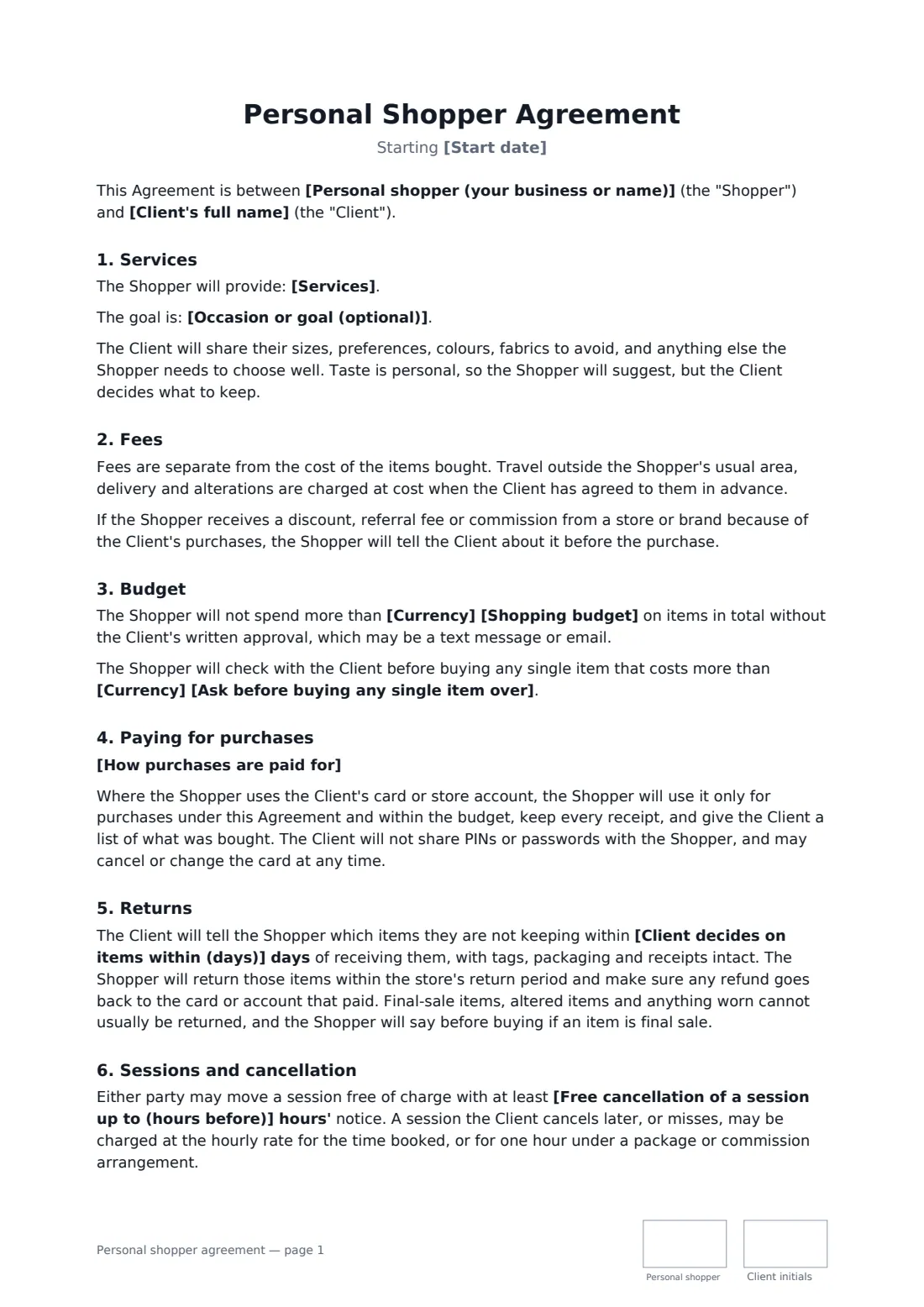
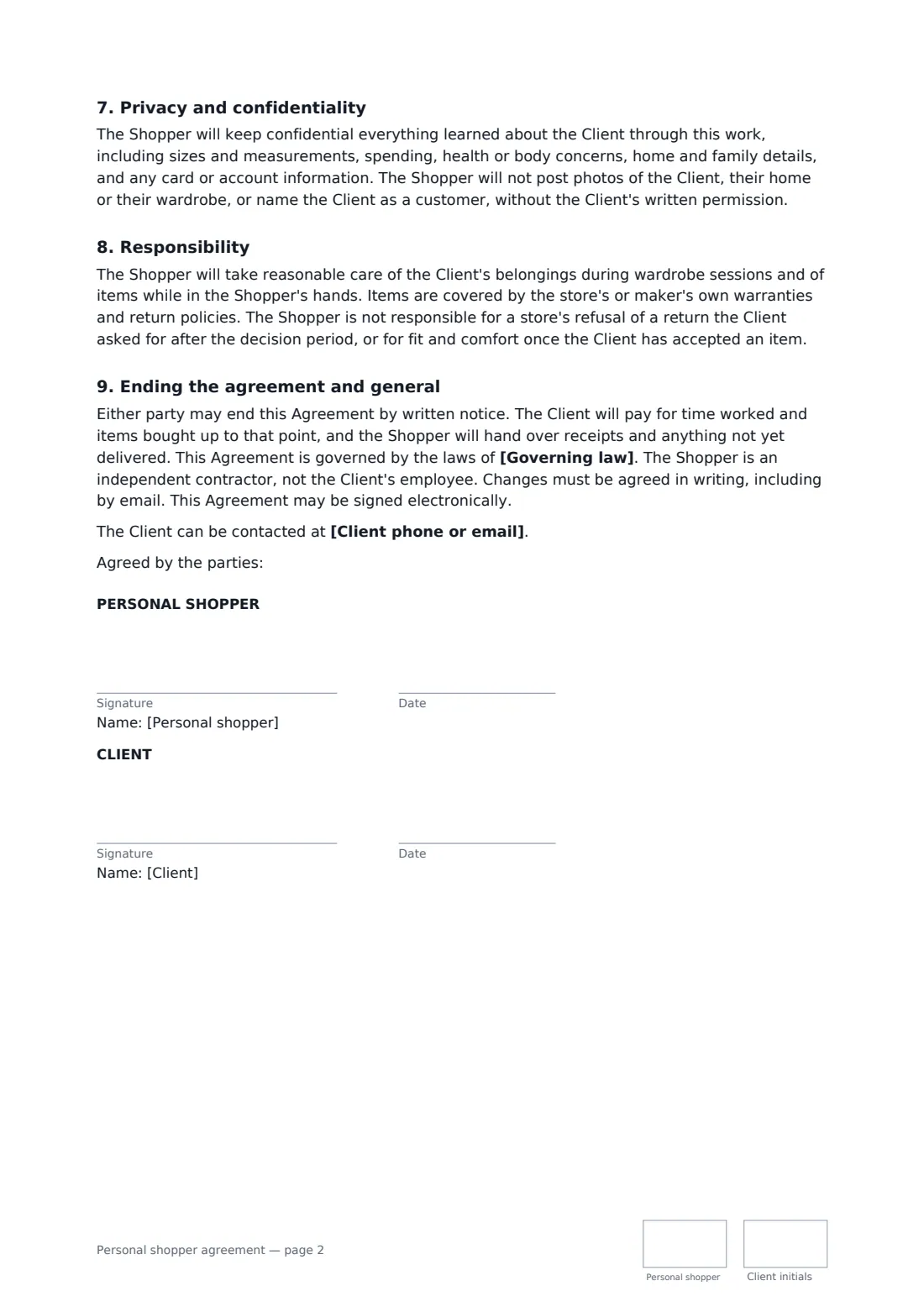
What is a personal shopper agreement?
Personal shopping is built on trust. The client hands over their sizes, their taste, sometimes their front door key and a credit card, and the shopper comes back with bags of things they hope the client will love. When it goes wrong it's nearly always about money: the budget was a guess, a card was used for something unexpected, or a return window closed before anyone noticed.
This agreement settles those points up front. You list the services — wardrobe review, shopping, outfit building, gifts — and choose how you're paid: by the hour, a package fee or a commission on what the client keeps. It sets a total budget and an optional per-item limit, says whether purchases go on the client's card or you pay and get reimbursed, gives the client a set number of days to decide what to return, and requires you to disclose any store discount or referral fee. It also protects the client's privacy: no photos of their home or wardrobe, and no naming them as a customer without permission.
- Best for
- Personal shoppers, wardrobe stylists and image consultants
- Signed by
- The shopper or stylist and the client
- Fees
- Hourly, package or commission on items kept
- Length
- 2 to 3 pages, initialled on every page
When to use a personal shopper agreement
- A stylist building a new work wardrobe for a client starting a job
- A personal shopper buying holiday gifts for a busy executive's family
- An image consultant doing a seasonal closet edit and shopping trip
- A shopper choosing an outfit for a wedding, gala or photo shoot
- An independent stylist paid only by commission on the pieces the client keeps
What you fill in
17 blanks, then the name and email of each person who signs: personal shopper, client.
1 The parties
- Personal shopper (your business or name)*
- Client's full name*
- Client phone or email
2 The services
- Start date*
- Services*
- Occasion or goal (optional)
3 Fees and budget
- How the shopper is paid* an hourly rate · a fixed package fee · a commission on purchases
- Currency*
- Hourly rate or package fee
- Commission on purchases (%)
- Shopping budget*
- Ask before buying any single item over
- How purchases are paid for* The Client pays the stores directly, or the Shopper uses a card the Client provides for this purpose. · The Shopper pays and the Client reimburses the receipted cost.
- Client reimburses within (days)
4 Returns
- Client decides on items within (days)*
5 Other terms
- Free cancellation of a session up to (hours before)*
- Governing law*
6 Who signs
- Personal shopper signature and date, initials on every page · The personal shopper, stylist or styling business.
- Client signature and date, initials on every page · The person the shopping is done for.
What the personal shopper agreement covers
- Services
- Fees
- Budget
- Paying for purchases
- Returns
- Sessions and cancellation
- Privacy and confidentiality
- Responsibility
- Ending the agreement and general
Using the personal shopper agreement, step by step
1 Describe the job
Edit the list of services and add the occasion or goal if there is one. The client agrees to share sizes and preferences, and the agreement is clear that they make the final call on what they keep.
2 Pick how you're paid
Choose an hourly rate, a fixed package or a percentage of the items the client keeps after returns. Your fees are always kept separate from the cost of the clothes.
3 Set the budget and card rules
Enter the total shopping budget and, if you like, a price above which you'll check before buying. Choose whether the client pays stores directly or hands you a card, or whether you buy and get reimbursed.
4 Returns, cancellation and send
Set how many days the client has to decide on each item and your session cancellation window, add the governing law, and send it. You both sign and initial each page.
Tips before you send it
- Keep the client's decision window comfortably shorter than the shortest store return window you shop in.
- Photograph every receipt as you go and send the list the same day — it's the easiest way to stay trusted with a card.
- Mention final-sale items before you buy them, every time. They're the most common source of disputes.
- If you earn store commission or a stylist discount, say so in writing. The agreement requires it, and clients appreciate the honesty.
Sign it online in minutes
- Fill in the blanks. Names, dates and amounts go straight into the agreement — the preview shows exactly where.
- Name who signs. Tick “This is me” for your own part. FileIt builds the PDF with every signature, date and initials box on the right line, and you can check or move anything before sending.
- Send it. Each signer gets a secure link and signs from any device — no account needed. The signed PDF, with an audit trail and a Certificate of Completion, is filed in your vault and emailed to everyone.
Personal shopper agreement: frequently asked questions
Can I use the client's credit card?
Yes, if the client chooses that option. The agreement limits use to purchases within the budget, requires every receipt to be kept and listed, and says the client never shares PINs or passwords and can cancel the card at any time.
What if the client doesn't like what I bought?
They tell you within the decision period you set, with tags and receipts intact, and you return the items within each store's own return window. Refunds go back to whatever paid for the item.
Can I charge commission and an hourly rate?
The template offers one fee model per agreement — hourly, a package or commission — to keep the bill easy to understand. If you want a mix, you can describe it in the services and use the hourly or package option.
Can this agreement be signed online?
Generally yes. In the US (ESIGN Act and UETA), the UK, the EU (eIDAS), Canada and many other countries, an electronic signature is valid for an ordinary service contract like this. FileIt adds an audit trail and a Certificate of Completion to the signed PDF.
Is this template free?
Yes. You can use it free with FileIt's eSignature app, and your client signs from a link — no account needed.