What is a individual development plan?
Most development conversations end with good intentions and no follow-up. An individual development plan, or IDP, writes down where the employee wants to go, what they will do to get there, and what the manager will give them in time, money and support, with dates to check progress.
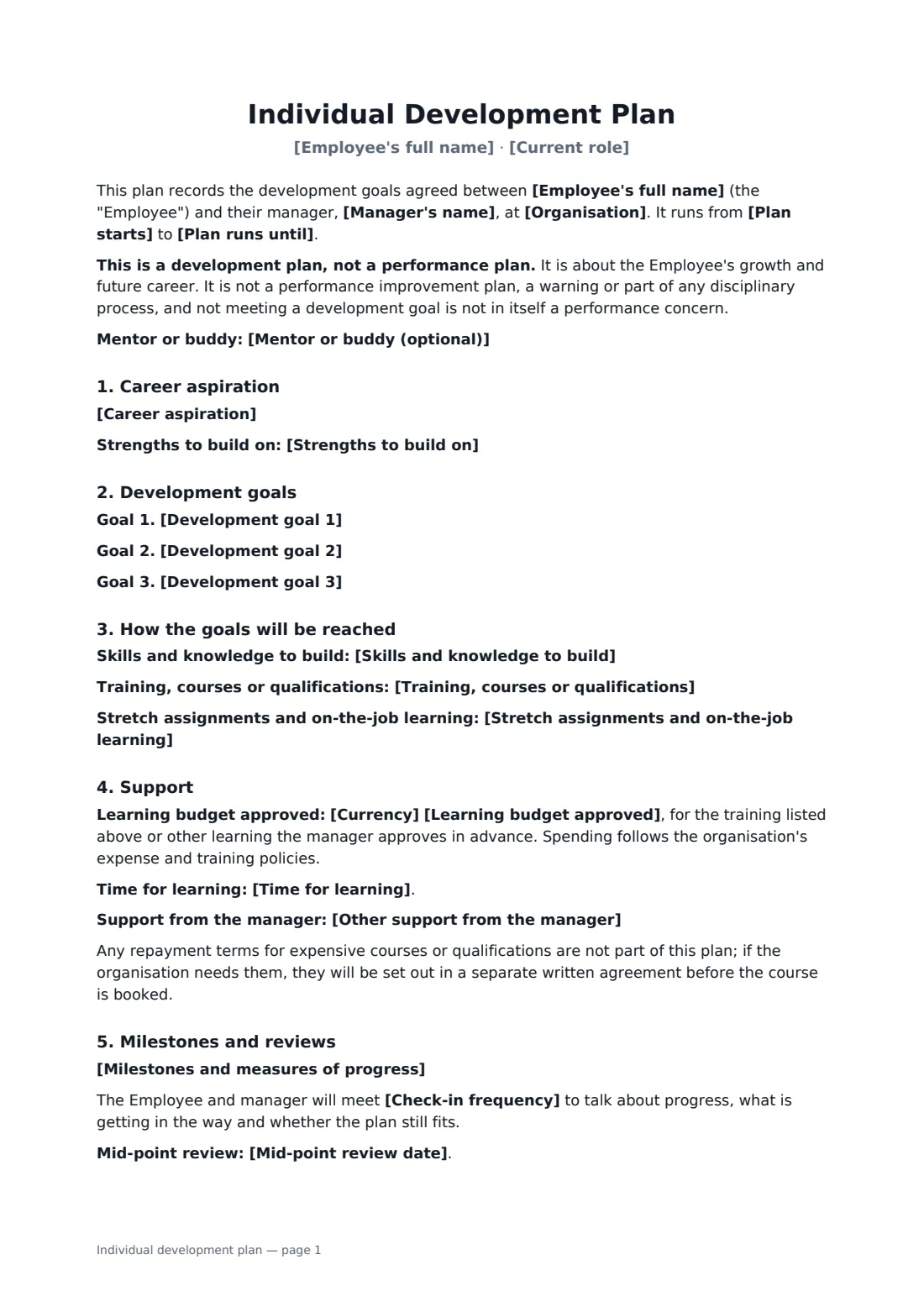
This template records the employee, their role, the manager and an optional mentor, and the plan's start and end dates. It then sets out the employee's career aspiration in their own words, strengths to build on, up to three development goals, the skills to build, training and courses, stretch assignments, any learning budget and time allowed, other support, milestones, how often check-ins happen, a mid-point review and the final review. It says clearly that it is a development plan, not a performance plan or part of any disciplinary process, and that it promises no promotion or pay rise.
- Best for
- Annual career conversations, high-potential programmes, new managers, career changes
- Signed by
- The employee and their manager
- Plan length
- You choose, usually 6 to 12 months
- Length
- 2 pages
When to use a individual development plan
- Preparing an employee for a first team lead role
- Following up an annual review with a separate growth plan
- Agreeing a learning budget and course for the year
- Planning a move into a different team or specialism
- Supporting an employee back from a long absence to rebuild skills
What you fill in
23 blanks, then the name and email of each person who signs: employee, manager.
1 The plan
- Organisation*
- Employee's full name*
- Current role*
- Manager's name*
- Plan starts*
- Plan runs until*
- Mentor or buddy (optional)
2 Goals
- Career aspiration*
- Strengths to build on
- Development goal 1*
- Development goal 2
- Development goal 3
3 Actions
- Skills and knowledge to build*
- Training, courses or qualifications
- Stretch assignments and on-the-job learning
4 Support
- Currency
- Learning budget approved
- Time for learning
- Other support from the manager
5 Milestones and reviews
- Milestones and measures of progress*
- Check-in frequency* every two weeks · monthly · every two months · quarterly
- Mid-point review date
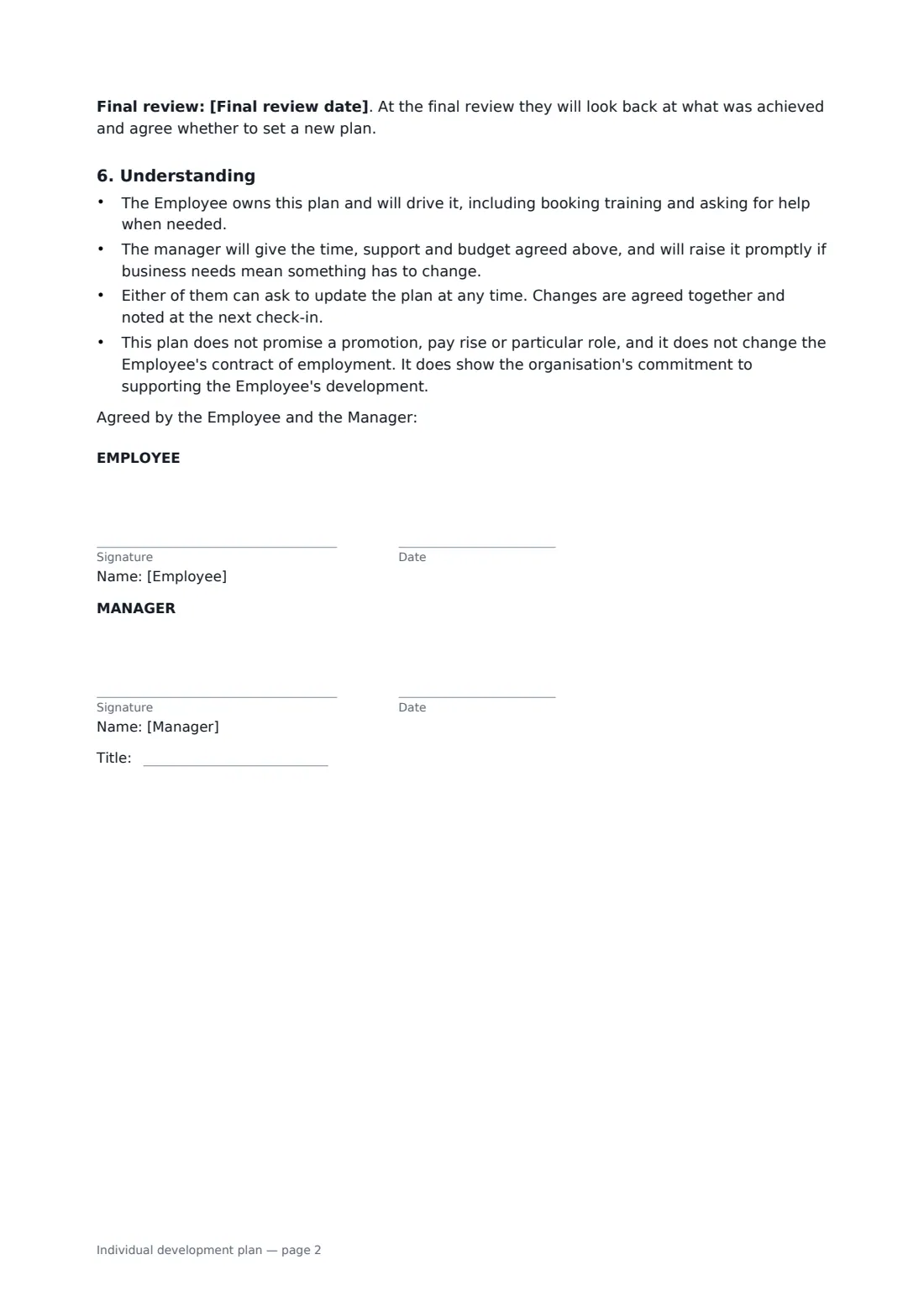
- Final review date*
6 Who signs
- Employee signature and date · The person whose development the plan is about. The plan works best when they draft the goals themselves.
- Manager signature and date, job title · The employee's manager, who commits to the support and budget in the plan.
What the individual development plan covers
- Career aspiration
- Development goals
- How the goals will be reached
- Support
- Milestones and reviews
- Understanding
Using the individual development plan, step by step
1 Set up the plan
Enter the employee, role, manager and any mentor, and the start and end dates.
2 Write the goals
Let the employee describe their career aspiration and strengths, then agree up to three development goals.
3 Plan the actions
List the skills to build, training or courses with rough dates, and stretch assignments or on-the-job learning.
4 Agree the support
Add any learning budget, the time allowed for learning and the manager's other support.
5 Milestones and sign
Set milestones, the check-in frequency and review dates, then both sign. The plan is filed in your vault for the reviews.
Tips before you send it
- Ask the employee to draft the goals. People follow through on plans they wrote.
- Keep it separate from performance reviews. The template says so, and employees speak more openly when it's true.
- Make milestones observable: "presented the churn analysis to leadership" rather than "improved data skills".
- If an expensive course comes with repayment terms, put them in a separate training or tuition agreement before booking.
Sign it online in minutes
- Fill in the blanks. Names, dates and amounts go straight into the agreement — the preview shows exactly where.
- Name who signs. Tick “This is me” for your own part. FileIt builds the PDF with every signature, date box on the right line, and you can check or move anything before sending.
- Send it. Each signer gets a secure link and signs from any device — no account needed. The signed PDF, with an audit trail and a Certificate of Completion, is filed in your vault and emailed to everyone.
Individual development plan: frequently asked questions
Is an IDP the same as a performance improvement plan?
No. An IDP is about growth and future career. A performance improvement plan deals with performance concerns. This template states that missing a development goal is not in itself a performance concern.
Does signing promise a promotion?
No. The plan says it does not promise a promotion, pay rise or particular role, and doesn't change the employment contract.
Can the plan change?
Yes. Either of you can ask to update it at any time. Changes are agreed together and noted at the next check-in.
Can we sign it online?
Yes. Both of you sign by email link, and the signed plan is kept with the employee's records in FileIt.