What is a esports player agreement?
Esports rosters change fast, and so do the arguments: who gets the prize money, how many hours of scrims are expected, whether the team can make a player stream, what happens when another team wants to sign them. Some leagues ask to see written player contracts, and players deserve to know what they are signing up for.
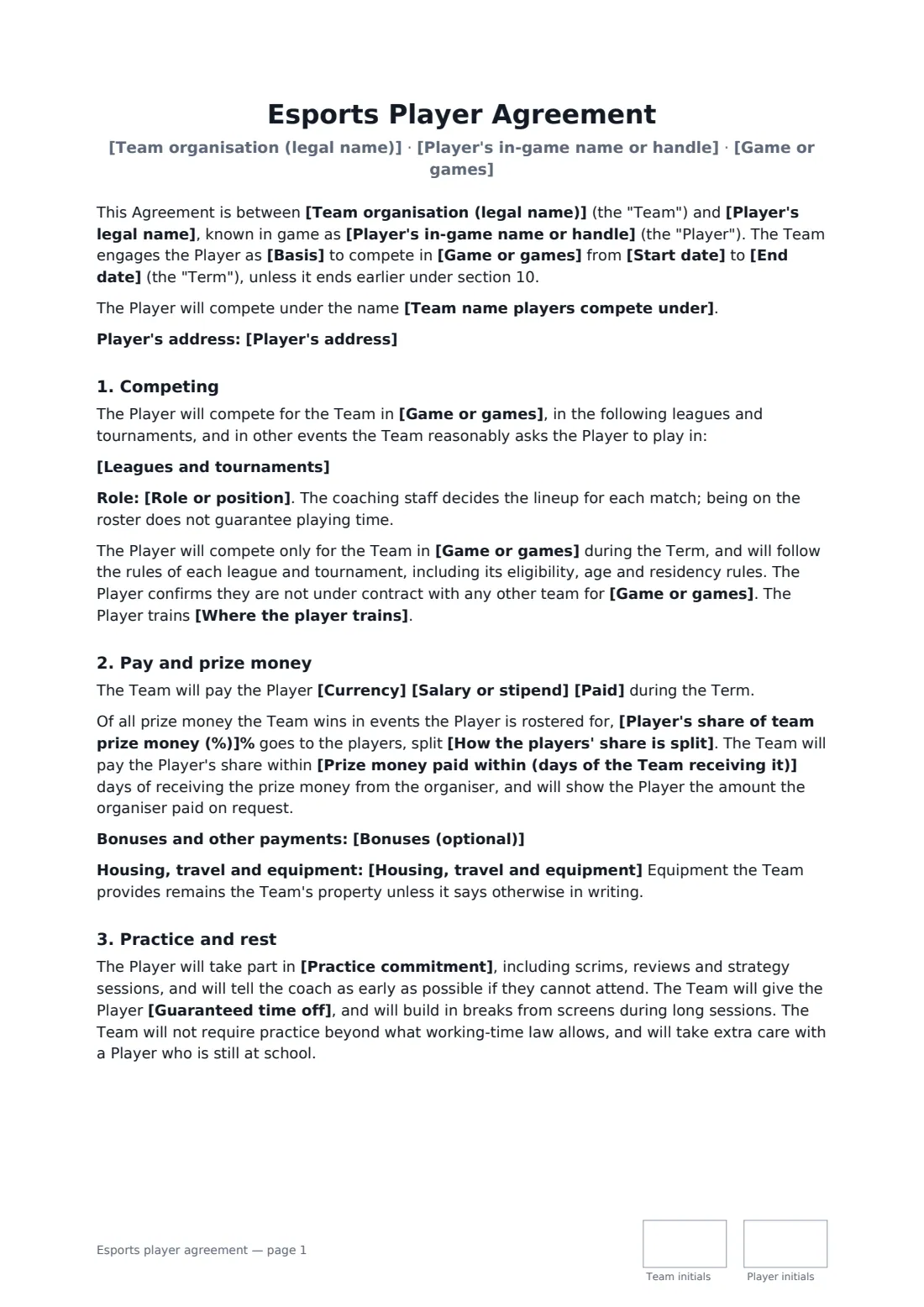
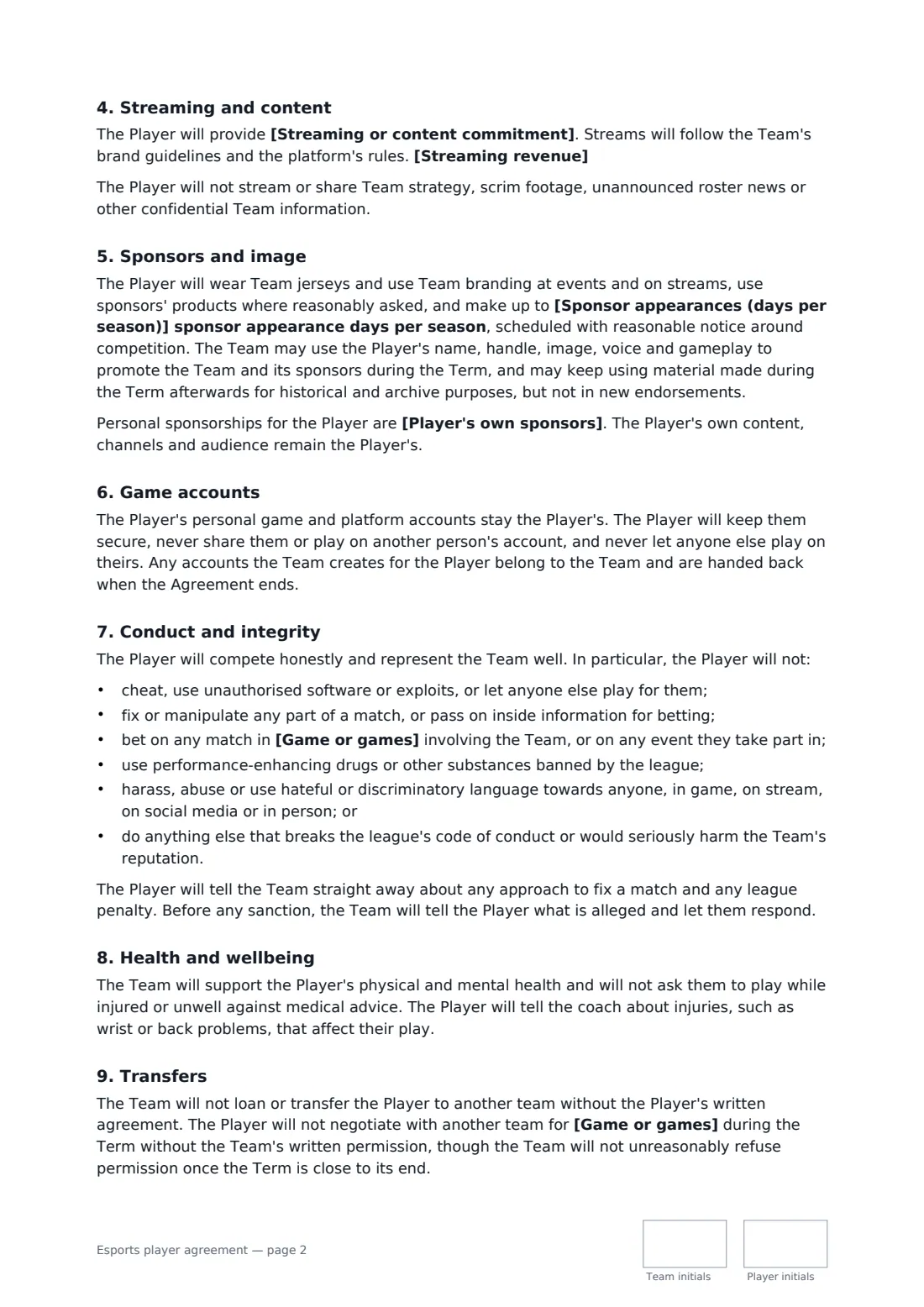
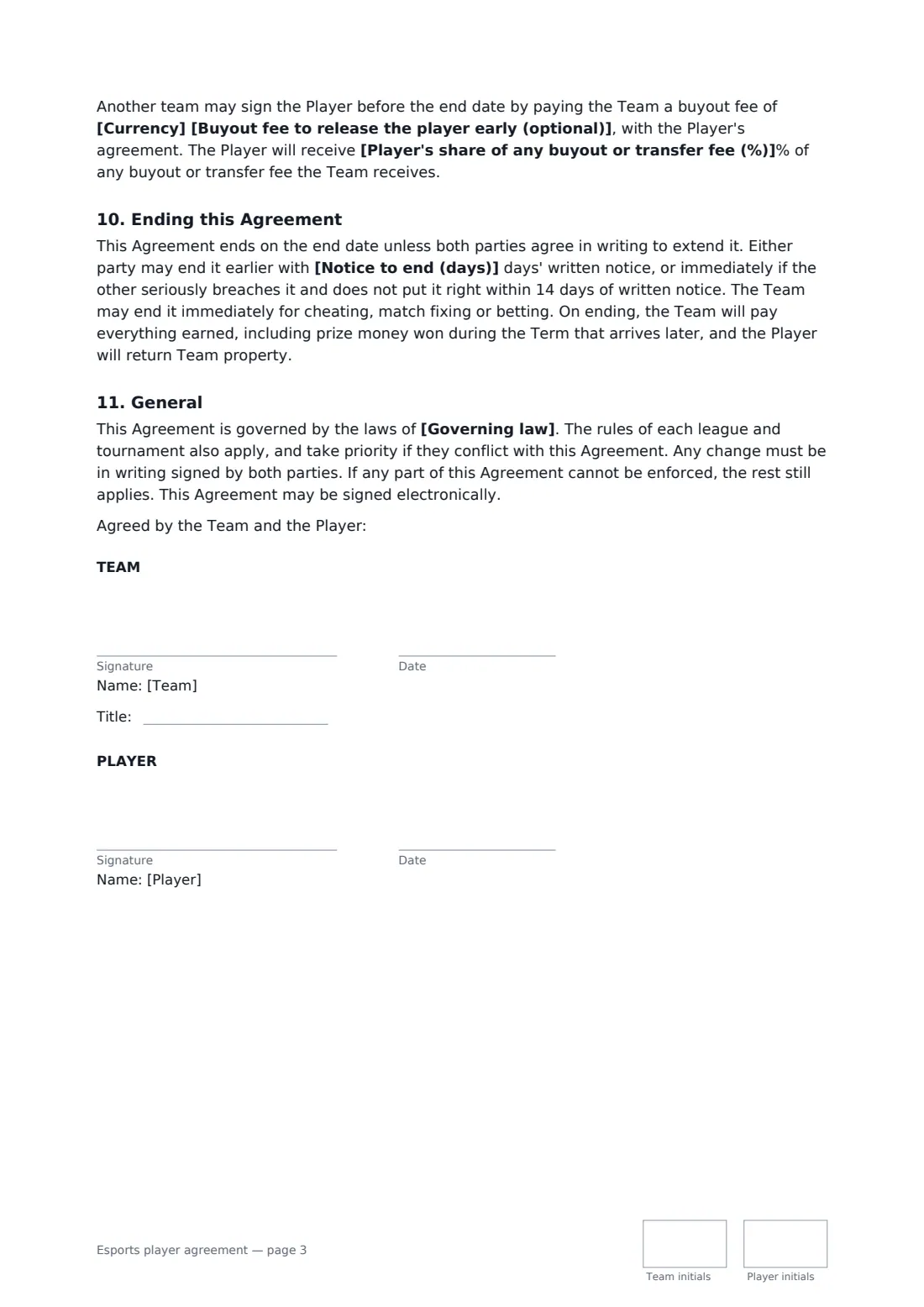
This template sets out the game, the player's role and the leagues and tournaments they will compete in; salary or stipend; the players' share of prize money, how it is split and how fast it is paid; bonuses, housing, travel and equipment; the practice commitment and guaranteed days off; streaming duties and who keeps streaming revenue; sponsor appearances, image rights and the player's own sponsors; ownership of game accounts; a conduct and integrity section covering cheating, account sharing, match fixing, betting and abuse; health and wellbeing; transfers, loans and any buyout fee with the player's share; and ending the contract. If the player is under 18, a parent or guardian consent section is added on the signature page.
- Best for
- Amateur, semi-pro and professional esports teams and organisations
- Signed by
- The team and the player, with a parent or guardian consent section for minors
- Pay terms
- Salary or stipend, prize money share, bonuses, buyout share
- Length
- 3-4 pages, initialled on every page
When to use a esports player agreement
- Signing a five-player roster for a regional league season
- Adding a substitute paid only from prize money
- Signing a 16-year-old player with a parent's consent
- Setting streaming and sponsor duties for a content-focused player
- Agreeing a buyout fee before a player draws interest from bigger teams
What you fill in
33 blanks, then the name and email of each person who signs: team, player.
1 The parties
- Start date*
- End date*
- Team organisation (legal name)*
- Team name players compete under
- Player's legal name*
- Player's in-game name or handle*
- Player's address
- Basis* an independent contractor · an employee of the Team
2 Competing
- Game or games*
- Role or position
- Leagues and tournaments*
- Where the player trains* remotely from the player's home · at the Team's training facility · at the Team's gaming house · partly remotely and partly at the Team's facility
3 Pay and prize money
- Currency*
- Salary or stipend
- Paid per month · per week · every two weeks · per year, in monthly instalments
- Player's share of team prize money (%)*
- How the players' share is split*
- Prize money paid within (days of the Team receiving it)*
- Bonuses (optional)
- Housing, travel and equipment
4 Practice and content
- Practice commitment*
- Guaranteed time off*
- Streaming or content commitment
- Streaming revenue* The Player keeps the revenue from their own channels. · The Player keeps the revenue from their own channels, except sponsorship deals placed by the Team. · Streaming revenue is shared as set out under bonuses and other payments in section 2.
5 Sponsors and image
- Sponsor appearances (days per season)*
- Player's own sponsors* allowed, unless they compete with a Team sponsor, with notice to the Team · allowed only with the Team's written approval · not allowed during this Agreement
6 Transfers and ending
- Buyout fee to release the player early (optional)
- Player's share of any buyout or transfer fee (%)
- Notice to end (days)*
- Governing law*
7 If the player is a minor
- Is the player under 18?* No · Yes
- Parent or guardian's full name
- Parent or guardian's phone and email
8 Who signs
- Team signature and date, job title, initials on every page · The owner, general manager or another officer of the team's organisation who can sign player contracts.
- Player signature and date, initials on every page · The player signs in their own legal name. If the player is under 18, a parent or guardian also signs the consent section at the end.
What the esports player agreement covers
- Competing
- Pay and prize money
- Practice and rest
- Streaming and content
- Sponsors and image
- Game accounts
- Conduct and integrity
- Health and wellbeing
- Transfers
- Ending this Agreement
- General
- Parent or guardian consent
Using the esports player agreement, step by step
1 Name the team, player and term
Enter the team's legal name and brand, the player's legal name and handle, and the start and end dates. Choose whether the player is a contractor or an employee.
2 Set out the competing
Name the game, the player's role and the leagues and tournaments, and where the player trains.
3 Agree the money
Add any salary, the percentage of prize money that goes to the players and how it is split, how fast it is paid, and any bonuses, housing and equipment.
4 Practice, streaming and sponsors
Set the practice commitment, guaranteed days off, any streaming hours and who keeps streaming revenue, sponsor appearance days and whether the player can have their own sponsors.
5 Transfers, ending and minors
Add an optional buyout fee and the player's share, the notice to end and the governing law. If the player is under 18, choose Yes and add the parent's details; a consent section appears for them to sign.
Tips before you send it
- Check your league's rules first. Many set minimum contract terms, age limits or prize money rules that take priority.
- Be specific about practice hours and days off. Burnout is one of the main reasons players leave.
- Keep players' personal game accounts theirs. Teams that take accounts invite disputes when players leave.
- Contracts with minors can need extra steps in some places, such as court approval or protecting part of their earnings. Take local advice before signing a minor to a long contract.
Sign it online in minutes
- Fill in the blanks. Names, dates and amounts go straight into the agreement — the preview shows exactly where.
- Name who signs. Tick “This is me” for your own part. FileIt builds the PDF with every signature, date and initials box on the right line, and you can check or move anything before sending.
- Send it. Each signer gets a secure link and signs from any device — no account needed. The signed PDF, with an audit trail and a Certificate of Completion, is filed in your vault and emailed to everyone.
Esports player agreement: frequently asked questions
Who gets the prize money?
You set the percentage of the team's prize winnings that goes to the players and how it is split between them, for example equally between the players who played. The team pays the player's share within the days you choose after the organiser pays it.
Can the team transfer a player?
Not without the player's written agreement. If you add a buyout fee, another team can sign the player early by paying it, with the player's agreement, and the player receives the share of the fee you set.
How does the parent sign for a minor?
When you say the player is under 18, the agreement adds a parent or guardian consent section with their name and contact details and a signature line on the last page. Add the parent as an extra signer in the editor and place a signature box on that line, so they sign the consent as well as the player.
What counts as misconduct?
Cheating, account sharing, match fixing, betting on the team's matches, banned substances and abusive or hateful behaviour in game, on stream or online. The team must tell the player what is alleged and let them respond before any sanction.
Can players sign online?
Yes. Players get a link by email and sign in their browser. FileIt keeps the audit trail with the signed PDF.