What is a conference attendance agreement?
Conference tickets, flights and hotels add up quickly, and a professional course can cost more than a month's salary. Most employers are glad to invest, but they'd like the learning to come back to the team, and they'd rather not fund a CV boost for someone who resigns the following month.
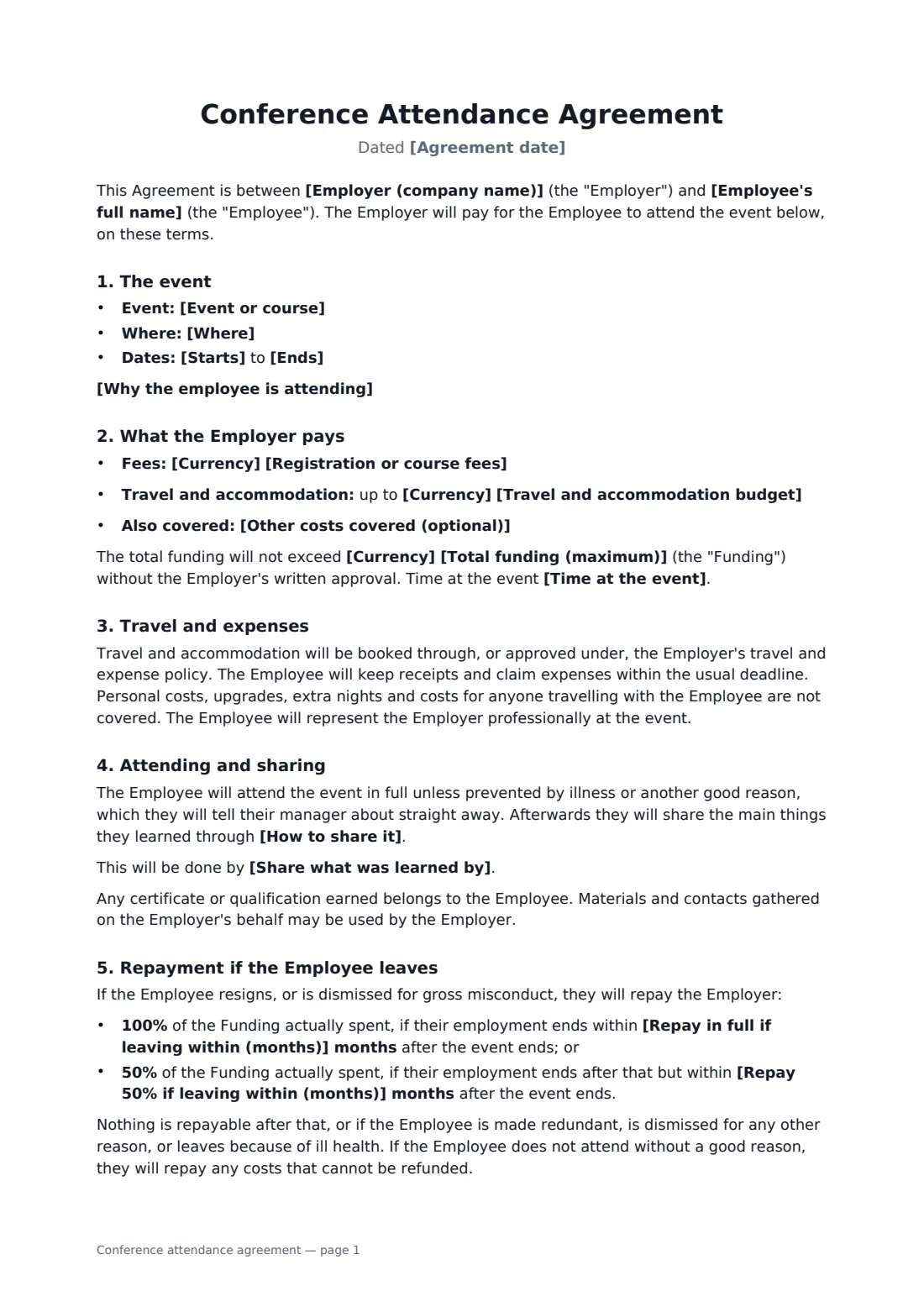
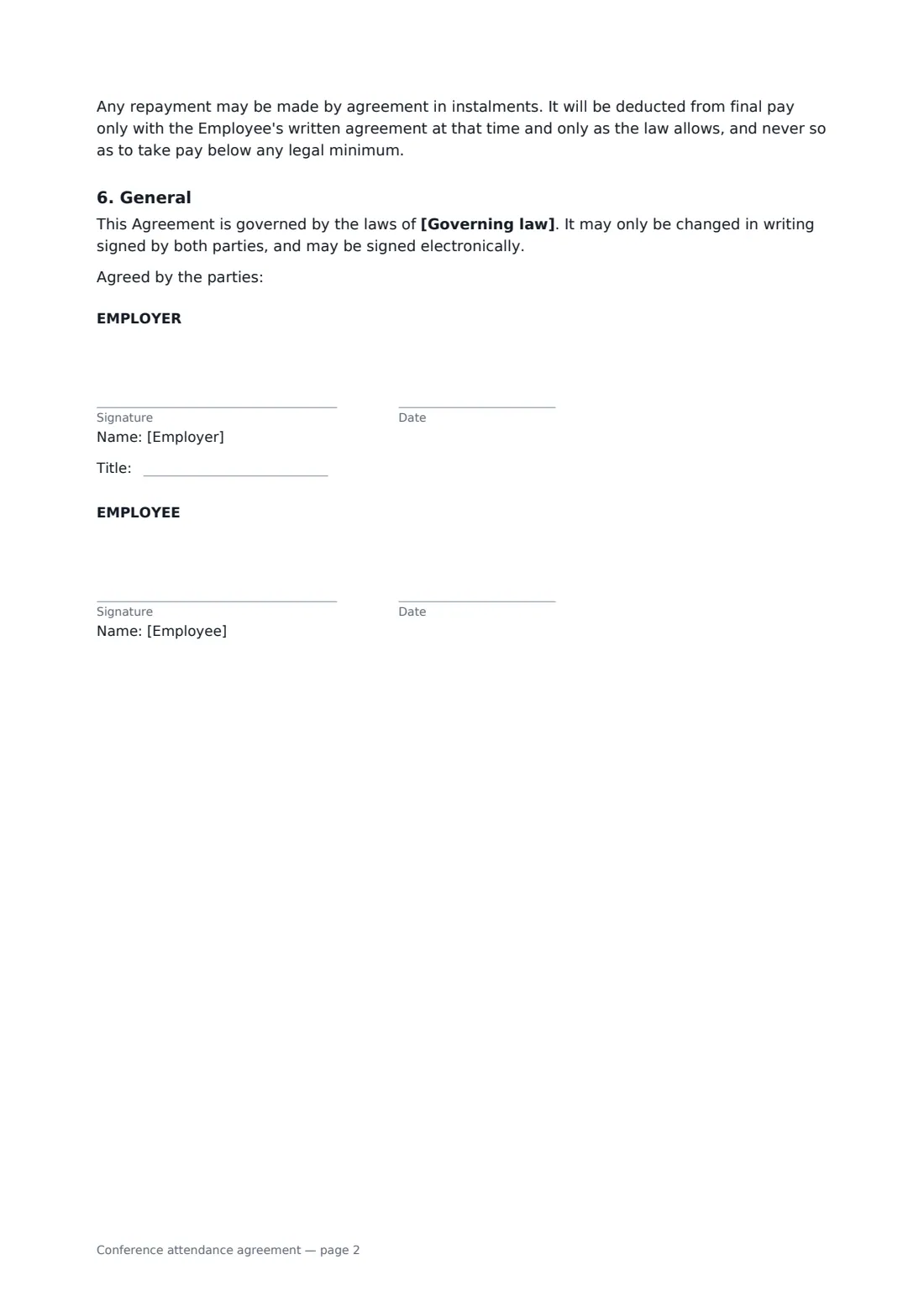
This agreement names the event or course, where it takes place and the dates, with an optional purpose. It lists the fees, travel budget and other costs covered, caps the total funding, and says how time at the event counts. It applies your travel and expense policy, asks the employee to attend in full and share what they learned in the way you choose, and keeps any certificate theirs. A two-step repayment scale applies only if they resign or are dismissed for gross misconduct within the periods you set, and never if they're made redundant or leave through ill health.
- Best for
- Funded conferences, trade shows, courses and certifications
- Signed by
- The employer and the employee
- Repayment
- 100% then 50% within periods you set; none after
- Length
- About 2 pages
When to use a conference attendance agreement
- Sending a developer to an overseas technology conference
- Funding a sales manager's place at a trade show
- Paying for a professional certification course and exam
- A multi-day leadership programme with hotel stays
- Approving a team member's request to speak at an event
What you fill in
19 blanks, then the name and email of each person who signs: employer, employee.
1 The parties
- Agreement date*
- Employer (company name)*
- Employee's full name*
2 The event
- Event or course*
- Where*
- Starts*
- Ends*
- Why the employee is attending
3 Costs
- Currency*
- Registration or course fees*
- Travel and accommodation budget
- Other costs covered (optional)
- Total funding (maximum)*
- Time at the event* counts as normal working time on full pay · counts as working time for event days only, with travel on non-working days paid as the travel policy says
4 Sharing
- Share what was learned by
- How to share it*
5 Repayment
- Repay in full if leaving within (months)*
- Repay 50% if leaving within (months)*
- Governing law*
6 Who signs
- Employer signature and date, job title · The manager or HR person approving the funding.
- Employee signature and date
What the conference attendance agreement covers
- The event
- What the Employer pays
- Travel and expenses
- Attending and sharing
- Repayment if the Employee leaves
- General
Using the conference attendance agreement, step by step
1 Describe the event
Enter the event or course, where it is, the dates and, if you like, why the employee is going.
2 Set the funding
Add the fees, travel and accommodation budget, any other costs covered and the total cap, and choose how time at the event counts.
3 Agree sharing and repayment
Choose how and when the employee shares what they learned, then set the months for full and half repayment, and the governing law.
4 Send for signature
Send before anything is booked. Both of you sign, and the agreement is kept with the employee's records.
Tips before you send it
- Keep repayment periods short and in proportion to the cost — long tie-ins for modest amounts can look unfair and may not be enforceable.
- Check local rules on training repayment clauses; some places restrict them.
- Sign the agreement before booking, not after the invoice arrives.
- A ten-minute team presentation is often the most useful way to share what was learned.
Sign it online in minutes
- Fill in the blanks. Names, dates and amounts go straight into the agreement — the preview shows exactly where.
- Name who signs. Tick “This is me” for your own part. FileIt builds the PDF with every signature, date box on the right line, and you can check or move anything before sending.
- Send it. Each signer gets a secure link and signs from any device — no account needed. The signed PDF, with an audit trail and a Certificate of Completion, is filed in your vault and emailed to everyone.
Conference attendance agreement: frequently asked questions
When does the employee have to repay?
Only if they resign, or are dismissed for gross misconduct, within the periods you set: 100% in the first period and 50% in the second. Nothing is repayable after that.
Is anything repayable if we make them redundant?
No. The agreement says nothing is repayable on redundancy, any other dismissal or leaving because of ill health.
Can repayment be taken from final pay?
Only with the employee's written agreement at the time and only as the law allows, never taking pay below a legal minimum. It can also be repaid in instalments.
How is this different from tuition reimbursement?
Tuition reimbursement covers longer study such as a degree, often paid back after each course. This agreement is for a single event or short course paid up front.