What is a climbing waiver?
Climbing gyms and guides know where things go wrong: a missed auto-belay clip, a belayer who isn't paying attention, an awkward bouldering landing on a padded floor. A climbing waiver should name those risks rather than hide behind general language, and it should record what each climber is allowed to do on the wall.
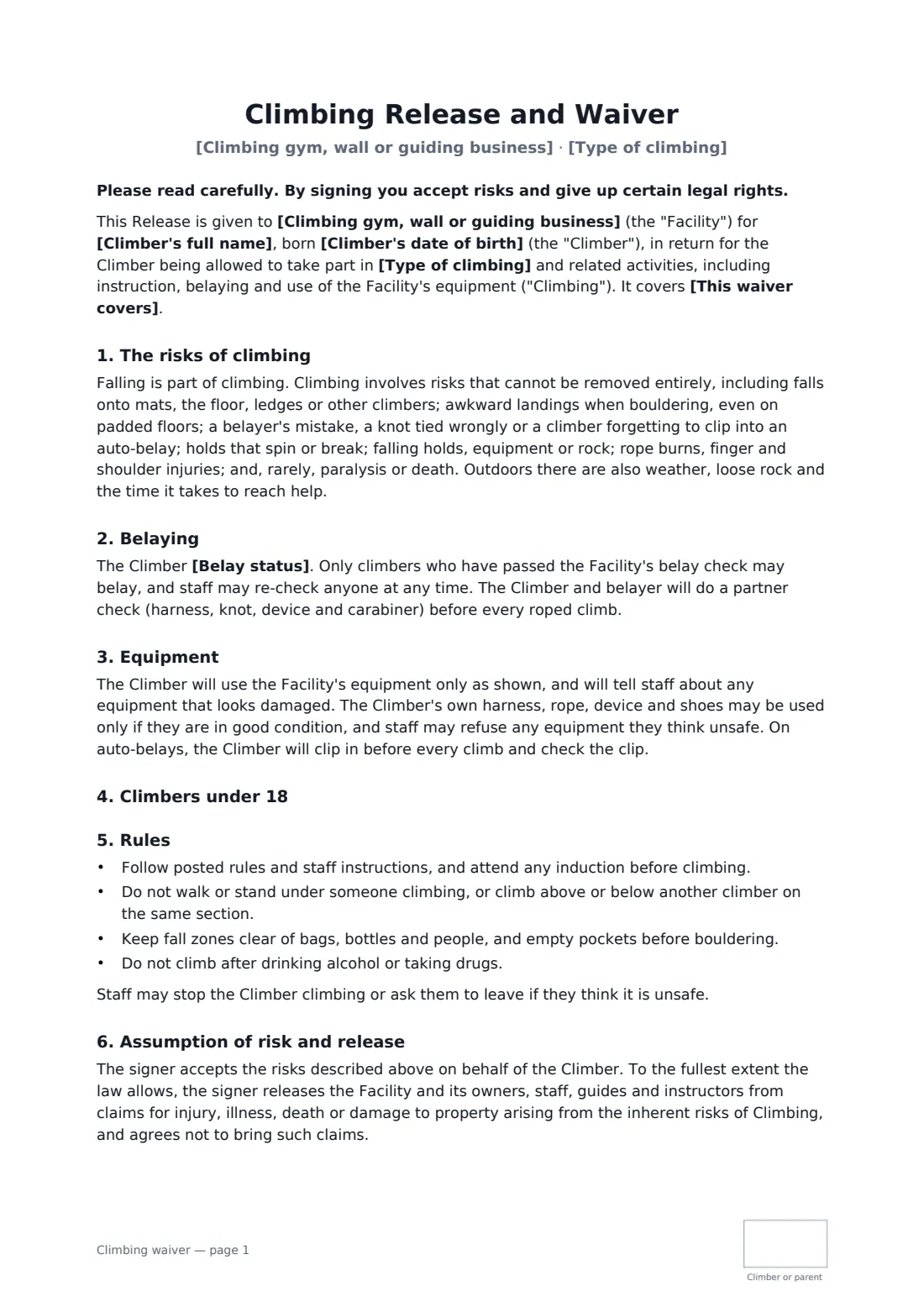
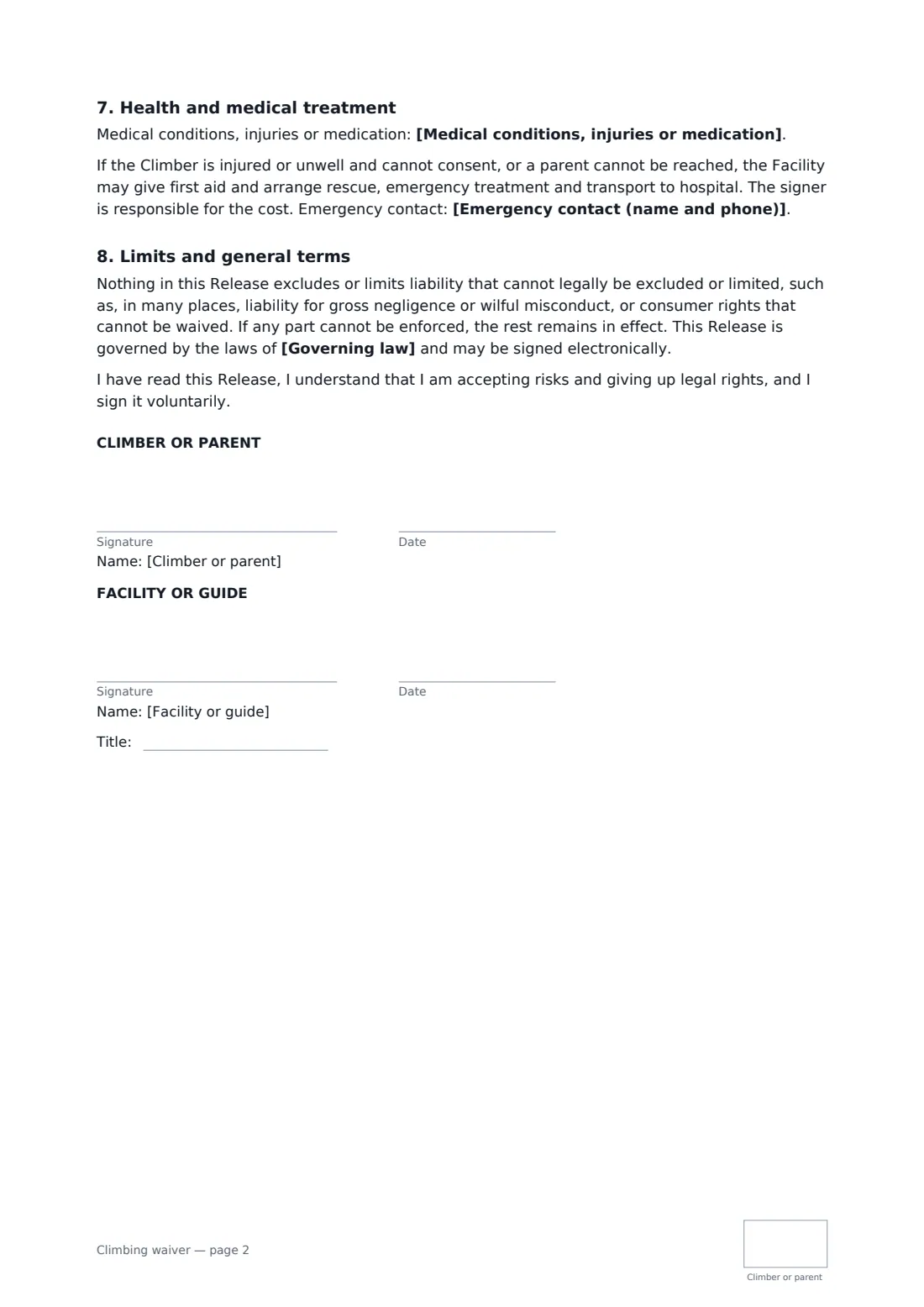
This template covers indoor roped climbing and bouldering, bouldering only, or guided outdoor climbing. It records whether the climber has passed your belay check (top-rope, lead, or not yet) and, for under-18s, how they must be supervised — with a belay-checked adult, only in staff-led sessions, or alone after a youth check. Climbers agree to partner checks, auto-belay clipping, keeping fall zones clear and not walking under others, and to your staff's right to stop them. Personal gear can be refused if staff think it unsafe. Adults sign for themselves and a parent signs for a minor; the release goes as far as the law allows, and every page is initialled.
- Best for
- Climbing and bouldering gyms, school and leisure-centre walls, outdoor guides
- Signed by
- The climber or a parent, and the facility
- Records
- Belay status, youth supervision rule, medical notes, emergency contact
- Covers
- One visit, 12 months, or until withdrawn
- Length
- 2 pages, initialled on every page
When to use a climbing waiver
- First-time visitors before an induction
- Members re-signing each year
- Climbing birthday parties for children
- Youth teams and after-school climbing clubs
- Guided days on outdoor crags
What you fill in
12 blanks, then the name and email of each person who signs: climber or parent, facility or guide.
1 The facility
- Climbing gym, wall or guiding business*
- Type of climbing* indoor roped climbing and bouldering · indoor bouldering only · guided outdoor rock climbing
- This waiver covers* a single visit on the date signed · all visits for 12 months from signing · all visits until withdrawn in writing
2 The climber
- Climber's full name*
- Climber's date of birth*
- Who signs* The climber (18 or over) · A parent or guardian of a climber under 18
- Parent or guardian's name
- Supervision of a climber under 18 an adult who has passed the facility's belay check stays with them and belays them · they climb only in a staff-led session, class or party · they may climb unaccompanied once they pass the facility's youth belay and safety check
- Belay status* has not passed a belay check here and will not belay others until they do · has passed the facility's top-rope belay check · has passed the facility's top-rope and lead belay checks · does not belay — bouldering or staff belay only
- Medical conditions, injuries or medication
- Emergency contact (name and phone)*
3 The facility
- Governing law*
4 Who signs
- Climber or parent signature and date, initials on every page · The adult climber, or a parent or legal guardian signing for a climber under 18.
- Facility or guide signature and date, job title, initials on every page
What the climbing waiver covers
- The risks of climbing
- Belaying
- Equipment
- Climbers under 18
- Rules
- Assumption of risk and release
- Health and medical treatment
- Limits and general terms
Using the climbing waiver, step by step
1 Set up your facility
Your name fills in. Choose the type of climbing and how long the waiver lasts, and set the governing law.
2 Record belay status
Choose whether the climber has passed your top-rope or lead check, hasn't yet, or only boulders. Update it with a new waiver when they pass.
3 Choose the youth rule
For under-18s, pick how they must be supervised, in line with your own policy. Adults signing see a note that younger climbers need their own waiver.
4 Send, sign and file
Climbers or parents sign and initial each page online — on their phone or a front-desk tablet — and you countersign. The waiver is filed in your FileIt vault.
Tips before you send it
- Pair the waiver with a short, practical induction; a form is no substitute for showing people how to fall.
- Make auto-belay clipping a habit with signs and gates, not just a clause.
- Re-check belayers you haven't seen for a while — the form lets staff do so at any time.
- Ask a local lawyer how parent-signed waivers are treated where you operate.
Sign it online in minutes
- Fill in the blanks. Names, dates and amounts go straight into the agreement — the preview shows exactly where.
- Name who signs. Tick “This is me” for your own part. FileIt builds the PDF with every signature, date and initials box on the right line, and you can check or move anything before sending.
- Send it. Each signer gets a secure link and signs from any device — no account needed. The signed PDF, with an audit trail and a Certificate of Completion, is filed in your vault and emailed to everyone.
Climbing waiver: frequently asked questions
Does it cover bouldering?
Yes. Choose bouldering only or roped climbing and bouldering. The risks section covers bouldering falls onto padded floors.
How do I record a climber's belay check?
Choose their belay status from the list. When they pass a new check, send an updated waiver or keep your own belay records alongside.
Can a parent sign for a teenager?
Yes. Choose the parent option and the supervision rule for under-18s. The form explains how parent-signed waivers work in many places.
Will the waiver protect us from every claim?
No. It applies to the extent the law allows and leaves out liability that can't be excluded, such as gross negligence in many places.