What is a capital contribution agreement?
Most small companies need more money from their owners at some point, for a new location, a vehicle, or simply to get through a slow season. Putting cash in on a handshake causes trouble later. Was it a loan or capital? Did one owner's bigger contribution buy a bigger share? What if the other owner never paid their half? A capital contribution agreement answers those questions before the money moves.
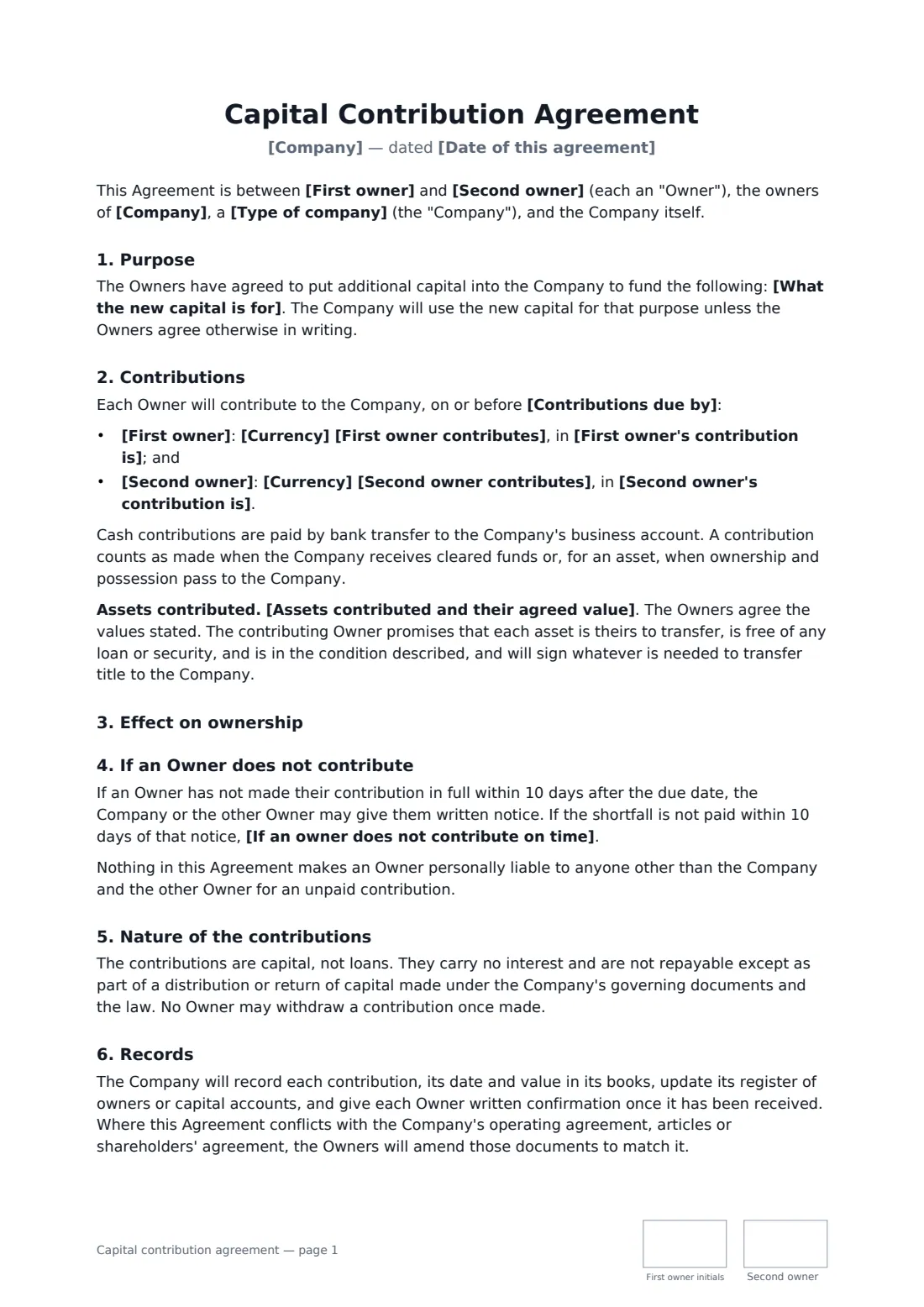
This template records each owner's contribution and whether it is cash or an asset at an agreed value, the due date, and whether ownership percentages stay the same or change to new figures you enter. It gives a clear process if an owner falls short, with three options to choose from. It confirms the money is capital, not a loan, and has the company acknowledge and record each contribution in its books.
- Best for
- Two-owner LLCs, small corporations and partnerships
- Signed by
- Both owners and the company
- Contributions
- Cash, assets at an agreed value, or both
- Length
- About 2 to 3 pages, initialled by both owners
When to use a capital contribution agreement
- Two co-owners each putting in money to open a second shop
- One owner contributing a van and the other matching its value in cash
- Owners topping up working capital after a difficult year
- Recording an uneven contribution that changes the ownership split
- Formalising contributions already promised in an operating agreement
What you fill in
17 blanks, then the name and email of each person who signs: first owner, second owner, company.
1 The parties
- Date of this agreement*
- Company*
- Type of company* limited liability company · corporation · private limited company · partnership
- First owner*
- Second owner*
2 The contributions
- What the new capital is for
- Currency*
- First owner contributes*
- First owner's contribution is* cash · assets described below
- Second owner contributes*
- Second owner's contribution is* cash · assets described below
- Assets contributed and their agreed value
3 Timing and ownership
- Contributions due by*
- Effect on ownership* Ownership percentages do not change · Ownership percentages change as set out below
- New ownership percentages
- If an owner does not contribute on time* the other owner may contribute the shortfall, and ownership is adjusted to reflect what each actually contributed · the other owner may lend the shortfall to the company, repayable with interest before any distribution to owners · the owners will meet within 14 days to agree what to do, and nothing changes until they do
- Governing law*
4 Who signs
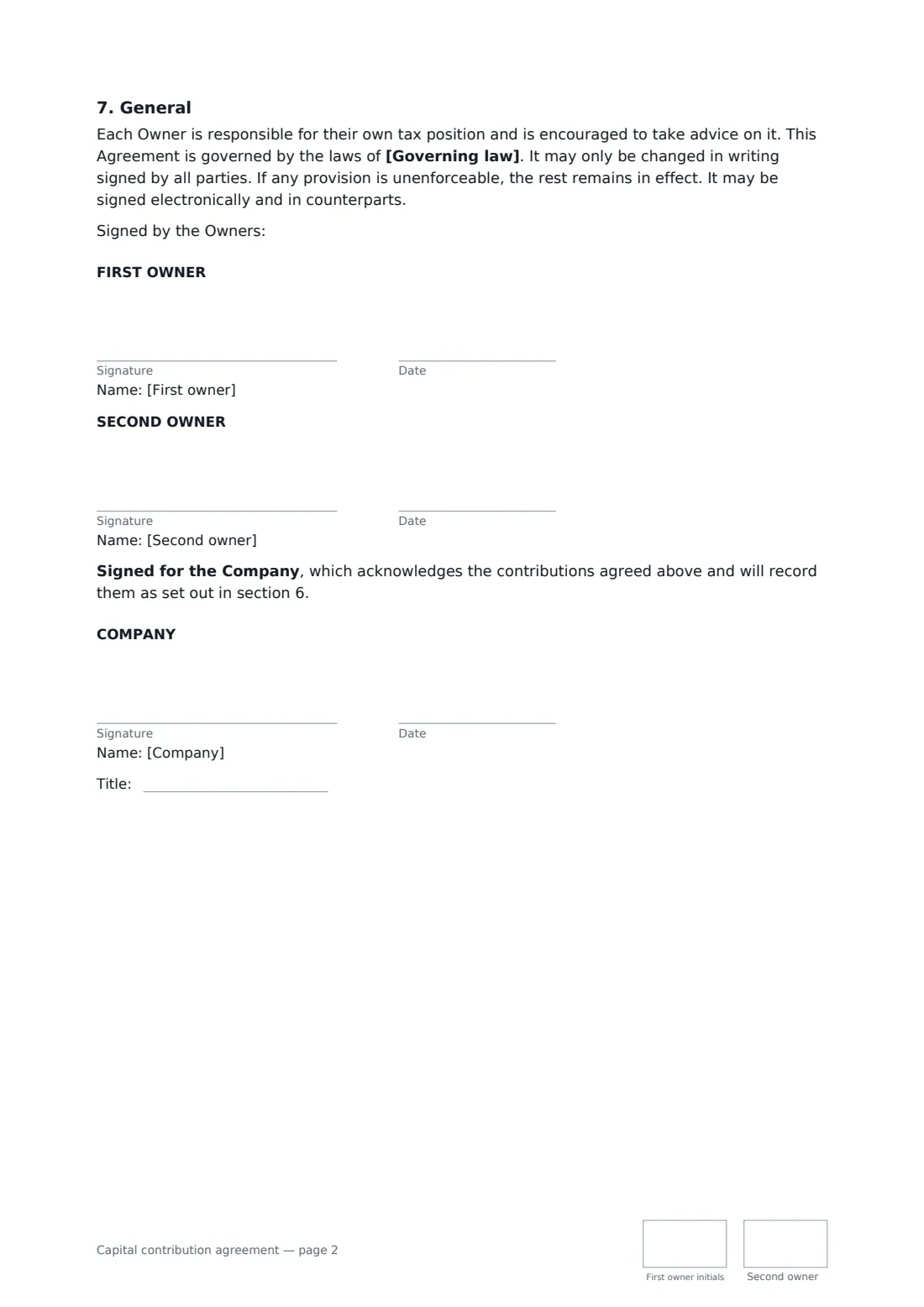
- First owner signature and date, initials on every page
- Second owner signature and date, initials on every page
- Company signature and date, job title, initials on every page · Signs to acknowledge the contributions and update its records. Often one of the owners signing as director or manager.
What the capital contribution agreement covers
- Purpose
- Contributions
- Effect on ownership
- If an Owner does not contribute
- Nature of the contributions
- Records
- General
Using the capital contribution agreement, step by step
1 Name the company and owners
Enter the company, its type and the two owners. Add what the money is for if you want the company bound to use it that way.
2 Enter each contribution
Give each owner's amount and whether it is cash or an asset. For assets, describe them and the value you have agreed.
3 Decide on ownership and shortfalls
Choose whether percentages stay the same or change, entering the new split if they do. Pick what happens if an owner does not pay on time.
4 Sign as owners and as the company
Both owners sign, then the company signs to acknowledge the contributions. The signed copy is saved in your vault next to the company's other records.
Tips before you send it
- Read your operating agreement or shareholders' agreement first. It may already set rules for capital calls that this agreement should follow.
- Have an asset valued independently if the owners cannot agree on a figure.
- If an owner would rather lend than contribute, use a shareholder loan agreement instead. Loans and capital are treated differently for tax and on insolvency.
- Ask your accountant how the contributions should appear in the books and whether new shares need to be filed with a registry.
Sign it online in minutes
- Fill in the blanks. Names, dates and amounts go straight into the agreement — the preview shows exactly where.
- Name who signs. Tick “This is me” for your own part. FileIt builds the PDF with every signature, date and initials box on the right line, and you can check or move anything before sending.
- Send it. Each signer gets a secure link and signs from any device — no account needed. The signed PDF, with an audit trail and a Certificate of Completion, is filed in your vault and emailed to everyone.
Capital contribution agreement: frequently asked questions
What is the difference between a capital contribution and a loan?
A loan is repaid, often with interest. A capital contribution is not repaid. It increases the owner's stake or capital account and comes back only through distributions or on winding up. This template treats the money as capital.
Does putting in more money mean a bigger share?
Only if you choose that. If owners contribute in line with their current stakes, percentages usually stay the same. If not, you can enter the new split.
What if one owner cannot pay?
After notice, the option you chose applies: the other owner can make up the shortfall and own more, lend it to the company, or the owners meet to agree a way forward.
Can I use it with more than two owners?
The template is set up for two owners. With three or more, prepare your own version of the agreement and upload it to FileIt eSignature to send it for signature.