What is a accident information exchange form?
Straight after a collision, people are shaken and in a hurry, and a scribbled phone number on a receipt is often all they leave with. Days later the insurer asks for a licence number, a policy number or the other car's plate, and nobody can find it. A form filled in at the roadside, or soon after, keeps every detail together and lets both drivers confirm it is right.
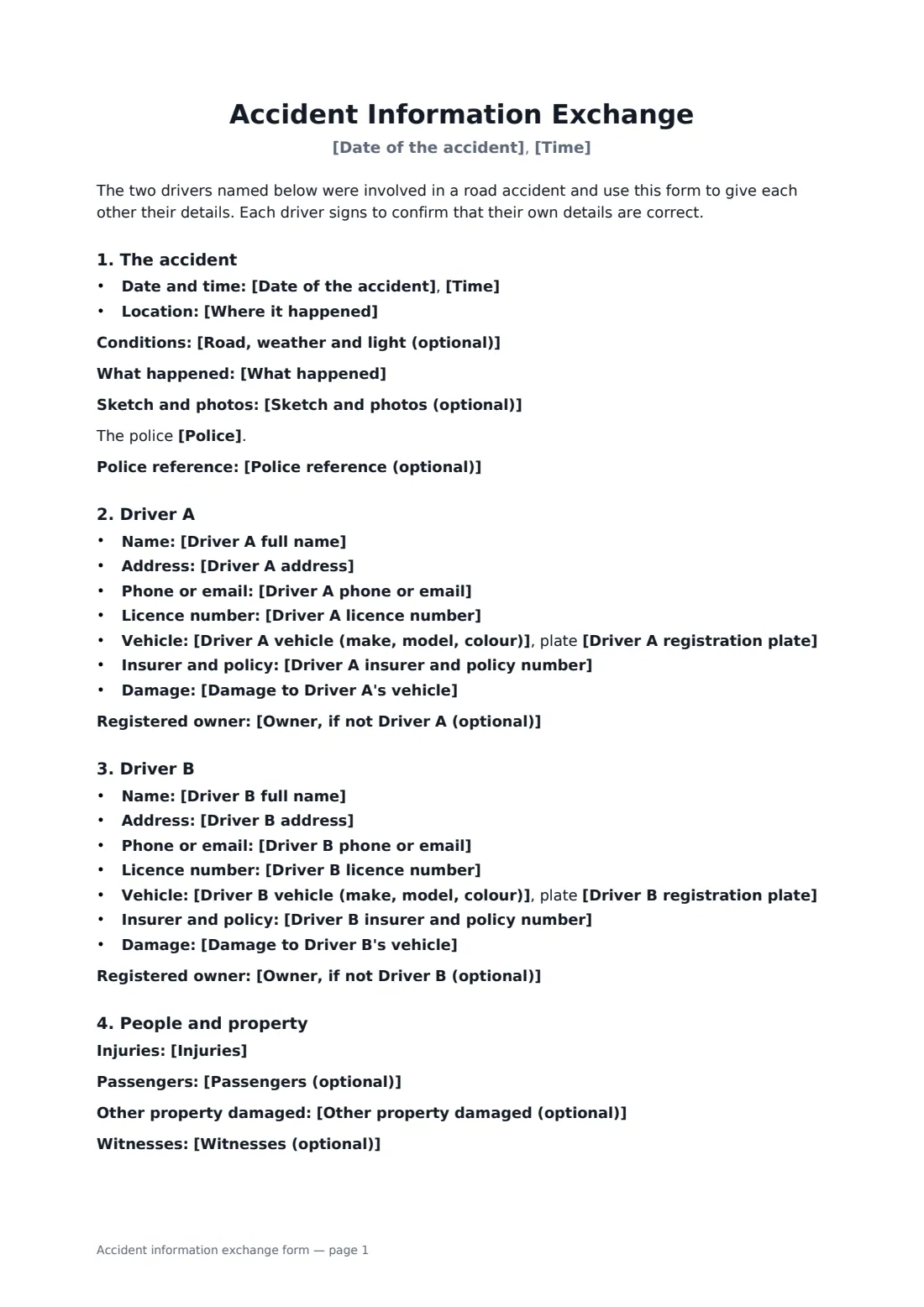
This form records the date, time and place, the road and weather, and a short neutral description of what happened. For each driver it captures name, address, contact, licence number, vehicle and plate, the registered owner if different, insurer and policy number, and the damage. It notes injuries, passengers, other property hit, witnesses, photos or a sketch, and whether the police came. Both drivers sign to confirm their own details. The wording says plainly that signing is not an admission of fault and settles nothing.
- Best for
- Drivers swapping details after a road accident
- Signed by
- Both drivers
- Fault
- Not admitted by either driver
- Length
- 2 pages
When to use a accident information exchange form
- A minor collision at a junction or roundabout
- Someone reversing into your parked car while you're nearby
- A car park scrape where both drivers want it on record
- Recording a witness's details before they leave
- Giving your insurer complete details the same day
What you fill in
30 blanks, then the name and email of each person who signs: driver a, driver b.
1 The accident
- Date of the accident*
- Time*
- Where it happened*
- Road, weather and light (optional)
- What happened*
- Sketch and photos (optional)
- Police* were not called · attended the scene · were told about it afterwards
- Police reference (optional)
2 Driver A
- Driver A full name*
- Driver A address*
- Driver A phone or email*
- Driver A licence number*
- Driver A vehicle (make, model, colour)*
- Driver A registration plate*
- Owner, if not Driver A (optional)
- Driver A insurer and policy number*
- Damage to Driver A's vehicle*
3 Driver B
- Driver B full name*
- Driver B address*
- Driver B phone or email*
- Driver B licence number*
- Driver B vehicle (make, model, colour)*
- Driver B registration plate*
- Owner, if not Driver B (optional)
- Driver B insurer and policy number*
- Damage to Driver B's vehicle*
4 Others involved
- Injuries*
- Passengers (optional)
- Other property damaged (optional)
- Witnesses (optional)
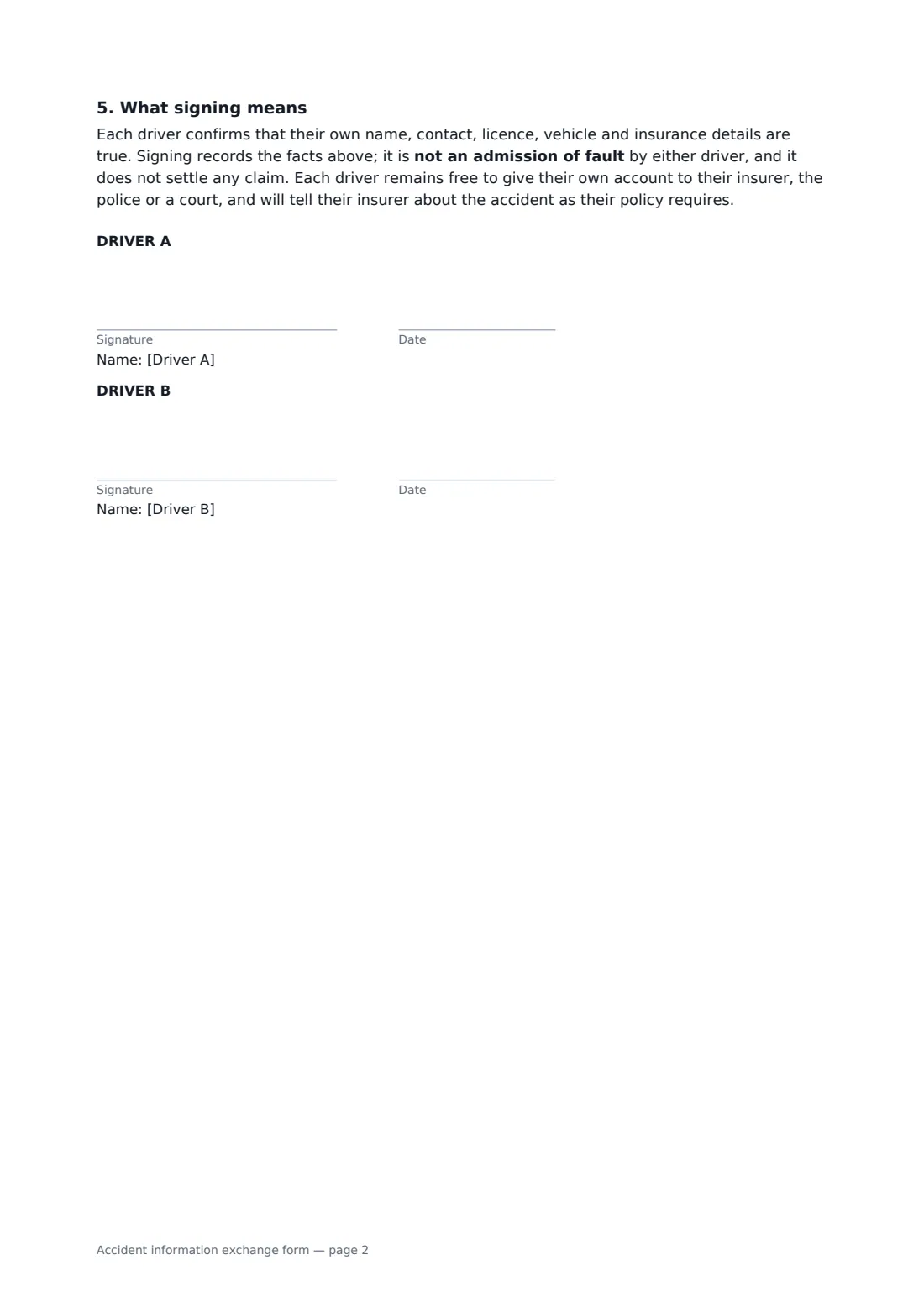
5 Who signs
- Driver A signature and date · Usually you, filling in the form.
- Driver B signature and date · The other driver. They sign to confirm their own details are correct.
What the accident information exchange form covers
- The accident
- Driver A
- Driver B
- People and property
- What signing means
Using the accident information exchange form, step by step
1 The accident
Enter the date, time and location, the conditions, and a short description you both accept. Note photos or a sketch and whether the police attended.
2 Driver A
Your name fills in from your account. Add your address, contact, licence, vehicle, plate, insurer and policy, and the damage to your vehicle.
3 Driver B
Enter the same details for the other driver, ideally copied from their licence and insurance documents, not from memory.
4 Others and signing
Record injuries, passengers, other damage and witnesses. Then add the other driver as a signer. Each of you signs on your own phone, and the signed form goes into your vault with your car documents.
Tips before you send it
- Make sure everyone is safe and call the emergency services first if anyone is hurt.
- Check where you are whether the accident must be reported to the police, for example when someone is injured or a driver leaves.
- Photograph both vehicles, plates, the scene and the other driver's documents if they agree.
- Keep the description neutral. Tell your insurer your own version separately.
- Tell your insurer promptly, even if you don't plan to claim. Most policies require it.
Sign it online in minutes
- Fill in the blanks. Names, dates and amounts go straight into the agreement — the preview shows exactly where.
- Name who signs. Tick “This is me” for your own part. FileIt builds the PDF with every signature, date box on the right line, and you can check or move anything before sending.
- Send it. Each signer gets a secure link and signs from any device — no account needed. The signed PDF, with an audit trail and a Certificate of Completion, is filed in your vault and emailed to everyone.
Accident information exchange form: frequently asked questions
Does signing mean I accept the blame?
No. The form says signing is not an admission of fault by either driver and does not settle any claim. Each driver can still give their own account to their insurer, the police or a court.
What if we disagree about what happened?
Write down only what you both accept, such as the place and time, and keep your own account for your insurer. The form is about swapping details, not deciding who caused it.
Can the other driver sign on their phone at the roadside?
Yes. Send the envelope to their email and they can sign on their phone without a FileIt account. You can also fill it in later and send it once you're both home.
Is this the same as a police report or insurance claim form?
No. It is a record between the drivers. Your insurer will have its own claim form, and the police their own report where one is needed. This form makes both easier to fill in.
What about a cyclist or pedestrian?
Record their details under people involved or witnesses. The form is built for two drivers, so for a more complex accident use it as a checklist and give your insurer the full picture.