What is a car accident settlement release?
After a minor collision, drivers sometimes agree to settle without going through insurance — one pays for the other's repairs and both move on. A handshake leaves both sides exposed: the payer has no proof the matter is closed, and the person paid has no proof of what was promised. A short written release fixes that.
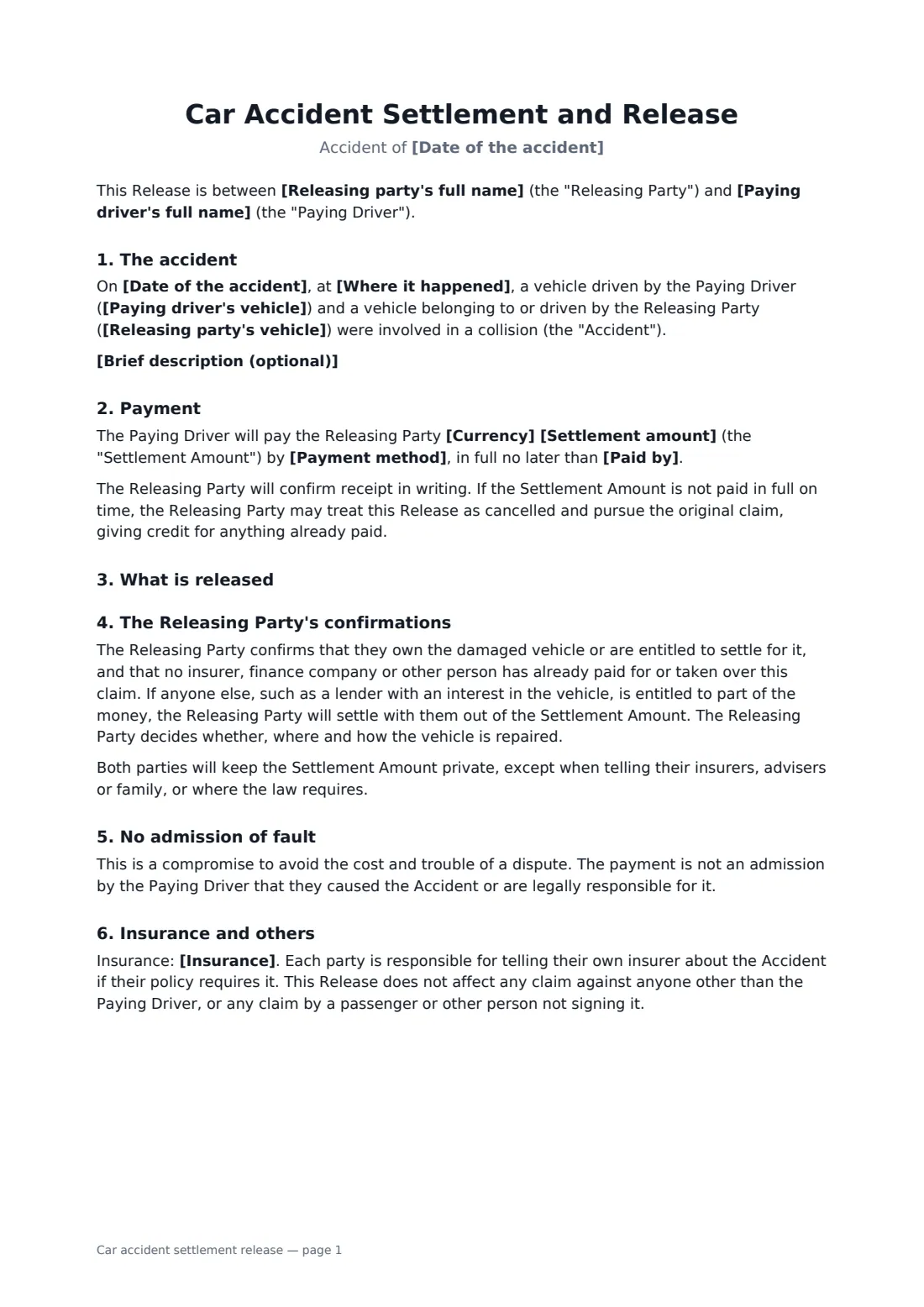
This template records the accident, both vehicles, the amount and when and how it is paid, including in two instalments. You choose whether only property damage is released — repairs, towing, a rental car, loss of value — or personal injury too, in which case the release warns that injuries can appear later and confirms the person had the chance to see a doctor and take advice. The release takes effect only once the money is paid in full, says the payment is not an admission of fault, records the insurance position, and keeps passengers' and third parties' claims out of it.
- Best for
- Minor collisions settled privately between drivers
- Signed by
- The releasing party and the paying driver
- You set
- Accident details, vehicles, amount, payment, claims released, insurance
- Length
- About 2 pages
When to use a car accident settlement release
- Paying for another driver's bumper after a low-speed rear-end collision
- Settling a car park scrape without an insurance claim
- Covering a neighbour's repairs after reversing into their car
- A business settling with a driver after a minor accident in a company van
- Paying in two instalments for a larger repair bill
What you fill in
15 blanks, then the name and email of each person who signs: releasing party, paying driver.
1 The parties
- Paying driver's full name*
- Paying driver's vehicle*
- Releasing party's full name*
- Releasing party's vehicle*
2 The accident
- Date of the accident*
- Where it happened*
- Brief description (optional)
3 The settlement
- Claims released* property damage only · property damage and personal injury
- Currency*
- Settlement amount*
- Paid by*
- Payment method* bank transfer · cheque · cash, with a written receipt · two instalments, as set out below
- Instalment details
- Insurance* neither party will make an insurance claim for this accident · the releasing party may still claim from their own insurer for any amount not covered here
- Governing law*
4 Who signs
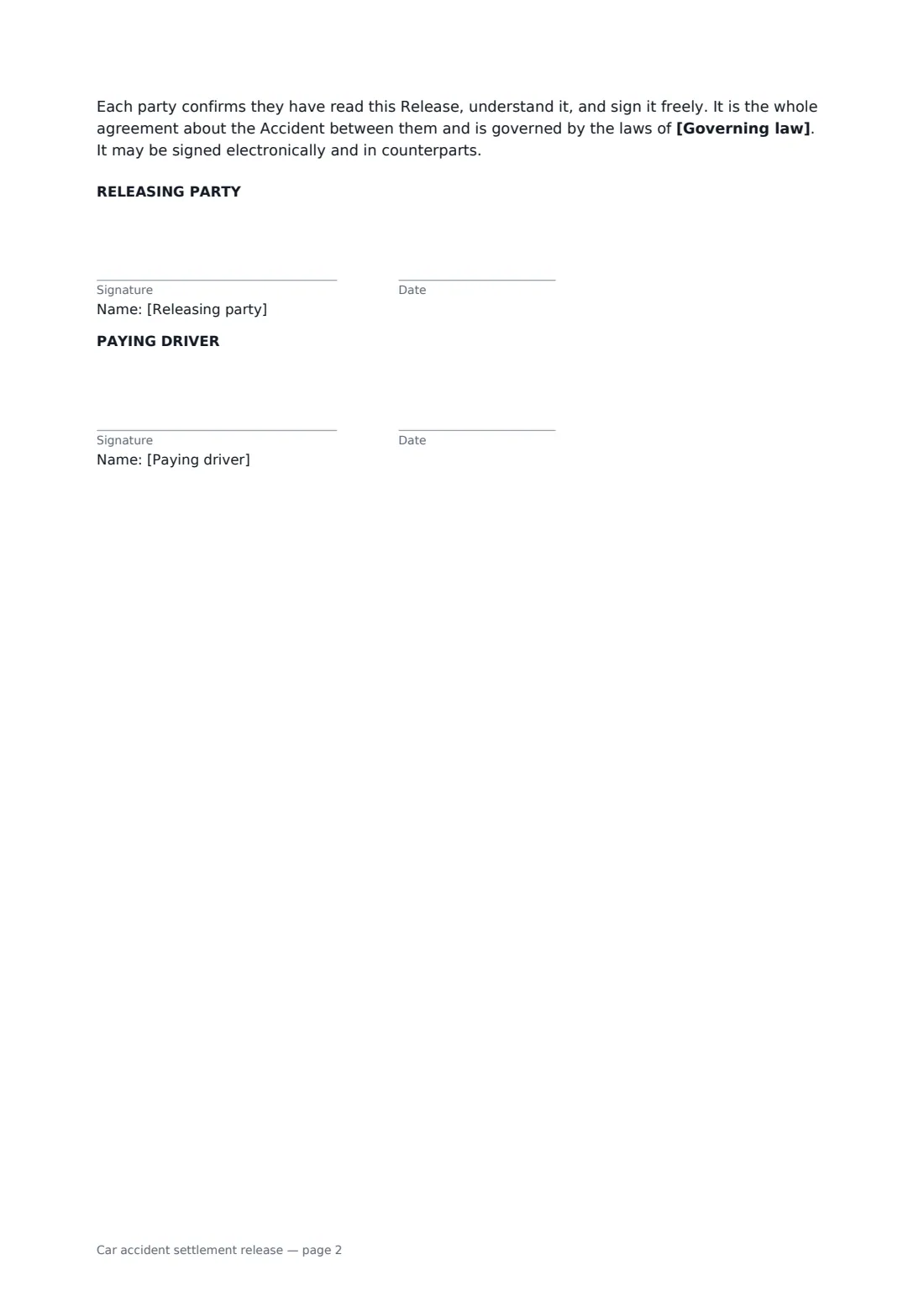
- Releasing party signature and date · The person being paid, whose vehicle was damaged or who was injured.
- Paying driver signature and date · The other driver, who pays the settlement.
What the car accident settlement release covers
- The accident
- Payment
- What is released
- The Releasing Party's confirmations
- No admission of fault
- Insurance and others
Using the car accident settlement release, step by step
1 Record the accident
Enter the date and place, both vehicles with their plates, and a short description if it helps. Keep it factual; the release says that paying is not an admission of fault.
2 Set the payment
Enter the amount, the date it must be paid by and the method. If the money isn't paid in time, the release lets the other driver go back to the original claim, with credit for anything already paid.
3 Choose what is released
Pick property damage only, or property damage and personal injury. Releasing injury claims is a bigger step; the field help explains why many people take advice first.
4 Sort out insurance and sign
Choose whether either side will claim on insurance, add the governing law, and send it to the other driver. Both sign on their phones, and you each get the signed PDF.
Tips before you send it
- Get a written repair estimate before agreeing an amount — hidden damage behind a bumper is common.
- Check your insurance policy: many insurers expect to be told about every accident, even one you settle privately, and settling without telling them can affect your cover.
- Some places require an accident to be reported to the police or a licensing authority when someone is injured or damage is above a certain amount. A private settlement doesn't remove that duty.
- Think carefully before releasing injury claims, especially soon after the accident.
- Pay by bank transfer where you can, so there is a record matching the release.
Sign it online in minutes
- Fill in the blanks. Names, dates and amounts go straight into the agreement — the preview shows exactly where.
- Name who signs. Tick “This is me” for your own part. FileIt builds the PDF with every signature, date box on the right line, and you can check or move anything before sending.
- Send it. Each signer gets a secure link and signs from any device — no account needed. The signed PDF, with an audit trail and a Certificate of Completion, is filed in your vault and emailed to everyone.
Car accident settlement release: frequently asked questions
Can we settle a car accident without insurance?
Often, yes, for minor damage. But your policy may require you to report the accident anyway, and reporting rules to police or authorities still apply. The release lets you record whether either side will make an insurance claim.
Does paying mean I admit I caused the accident?
No. The release says the payment is a compromise to avoid a dispute and not an admission of fault or liability.
What if the other driver later finds they were injured?
If you chose property damage only, injury claims are not released and they can still bring one. If you released injury claims too, the release covers injuries that appear later — which is why it warns them to get advice first.
What happens if the money isn't paid?
The release only takes effect once the full amount is paid. If it isn't paid on time, the releasing party can treat it as cancelled and pursue the original claim, giving credit for anything already received.
Is an e-signed release valid?
Electronic signatures are generally valid for settlement agreements like this in the US, UK, EU and Canada. FileIt adds an audit trail and a Certificate of Completion to the signed PDF.