What is J243 Inventory?
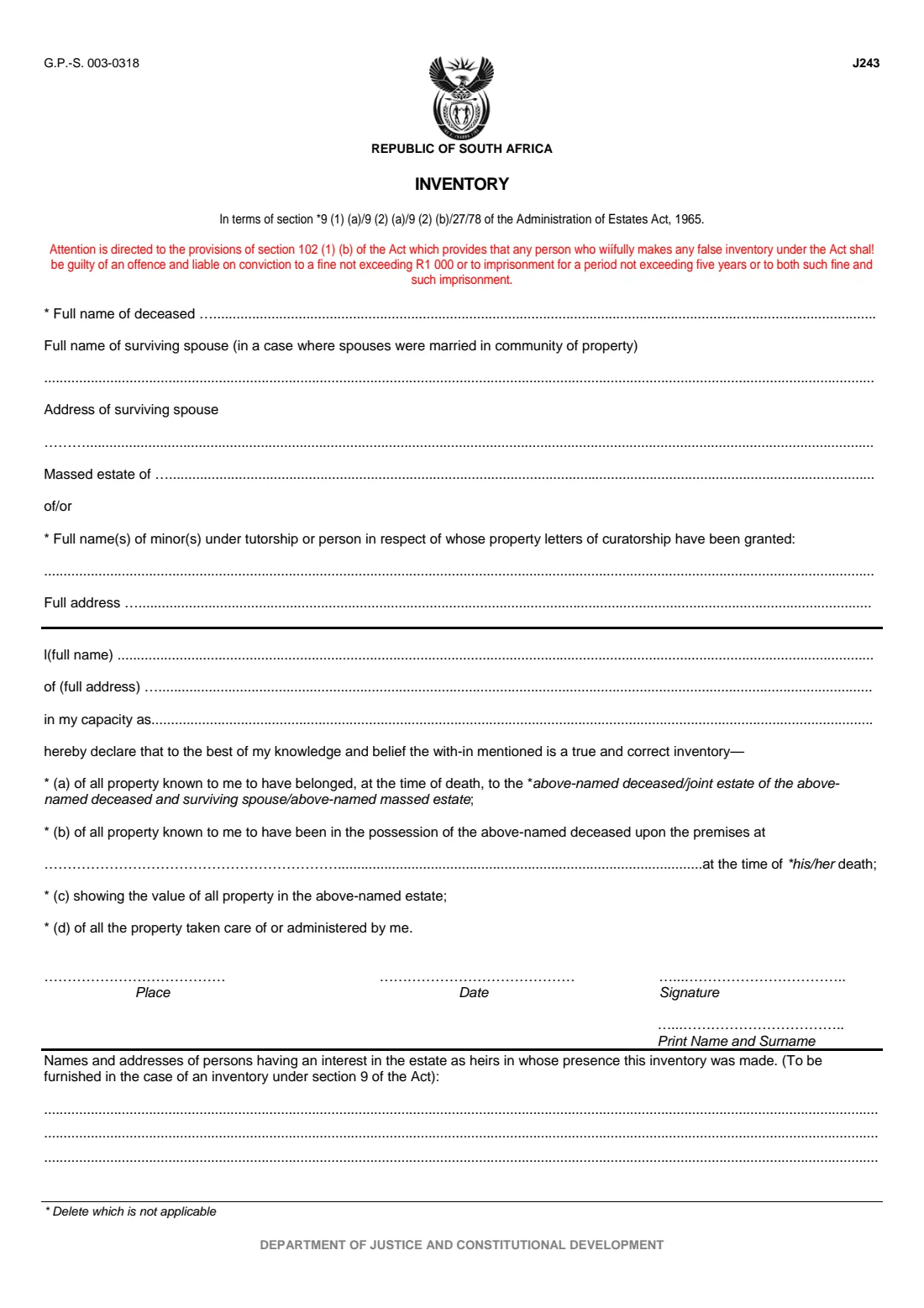
The J243 is the inventory the Master of the High Court asks for when an estate is reported. Under section 9 of the Administration of Estates Act, the surviving spouse (or, if there is none, the nearest relative living in the district) makes an inventory of all property known to have belonged to the deceased and delivers it to the Master, normally within 14 days of the death. The same form is used by executors under section 27 and by tutors and curators under section 78.
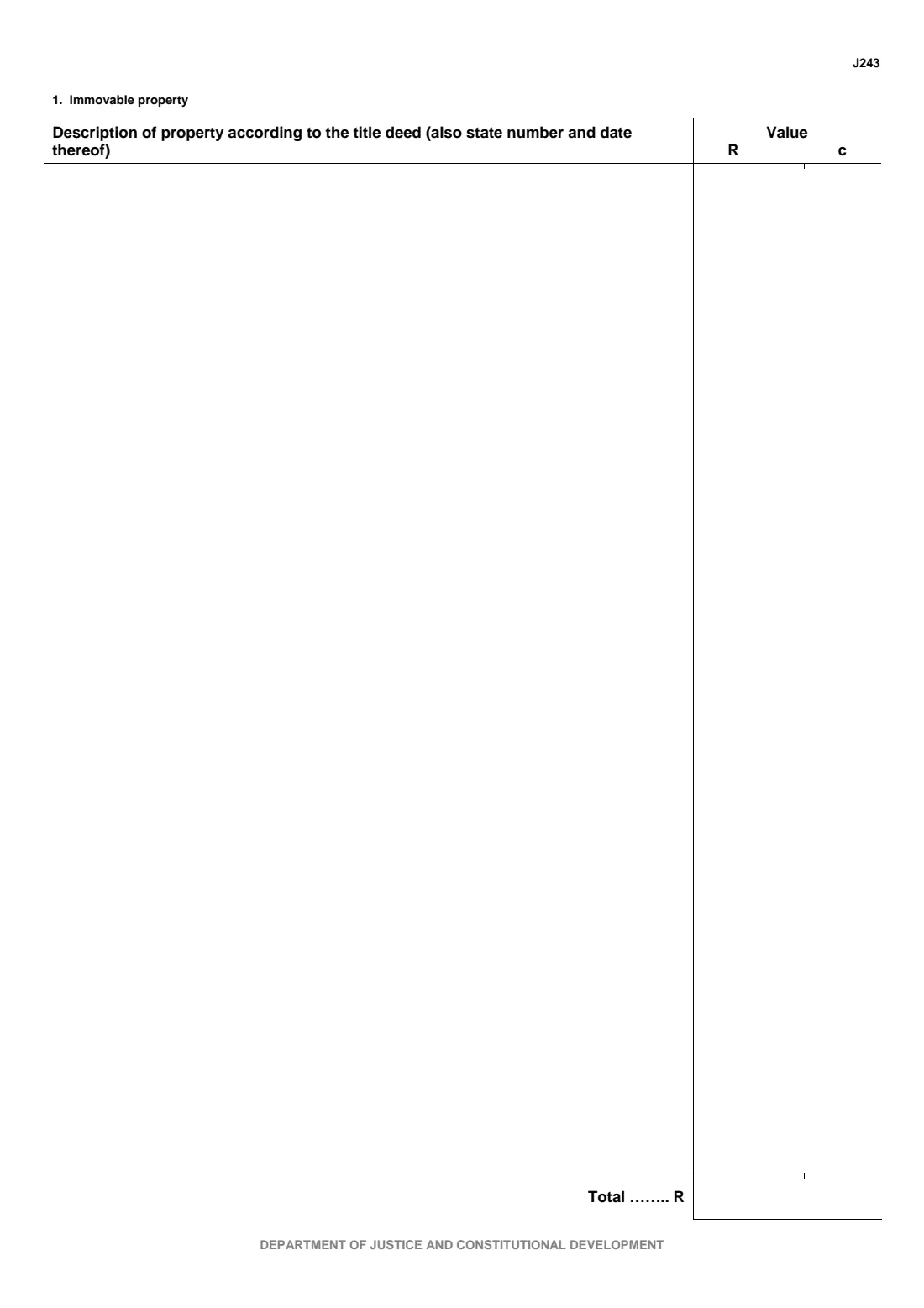
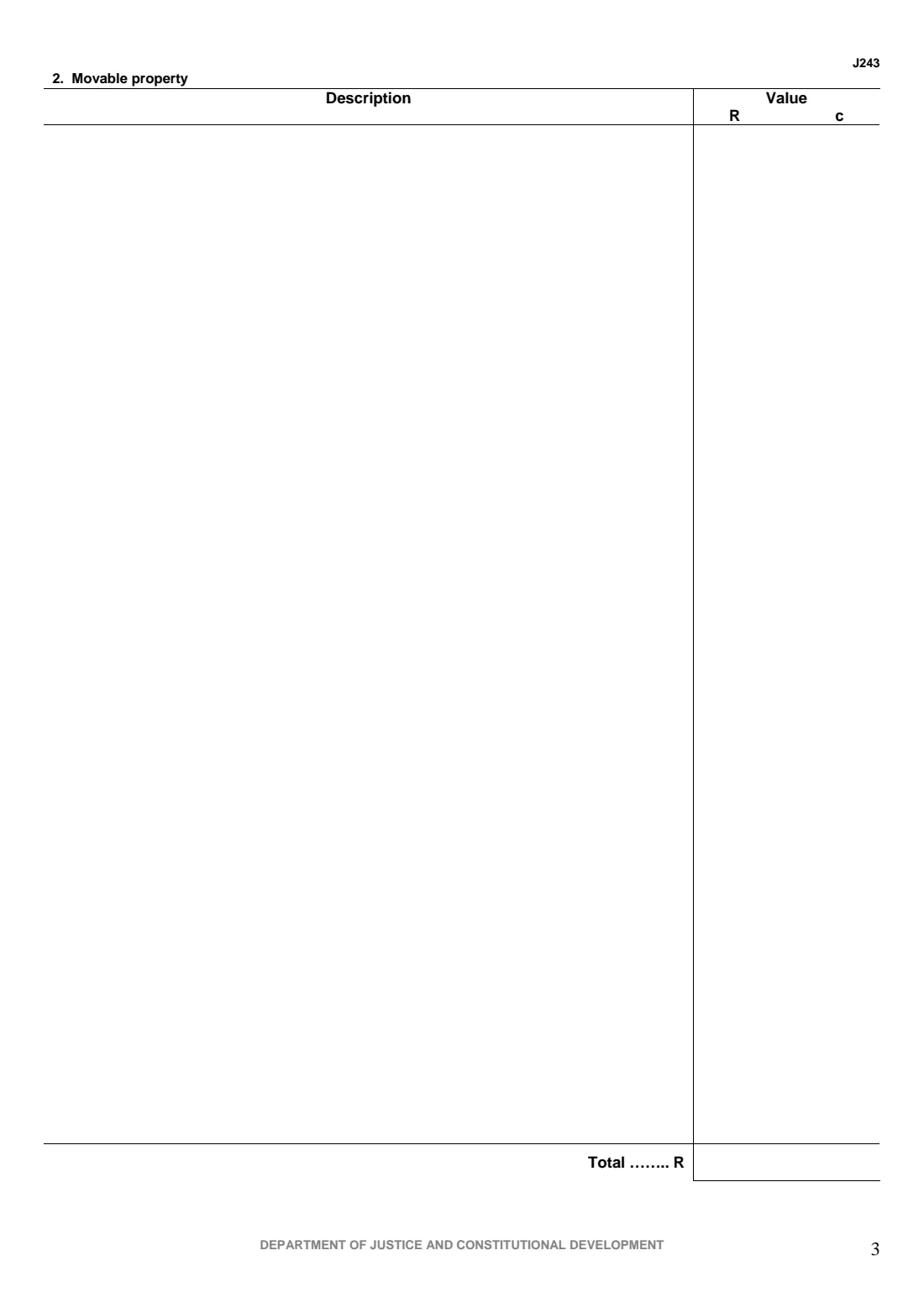
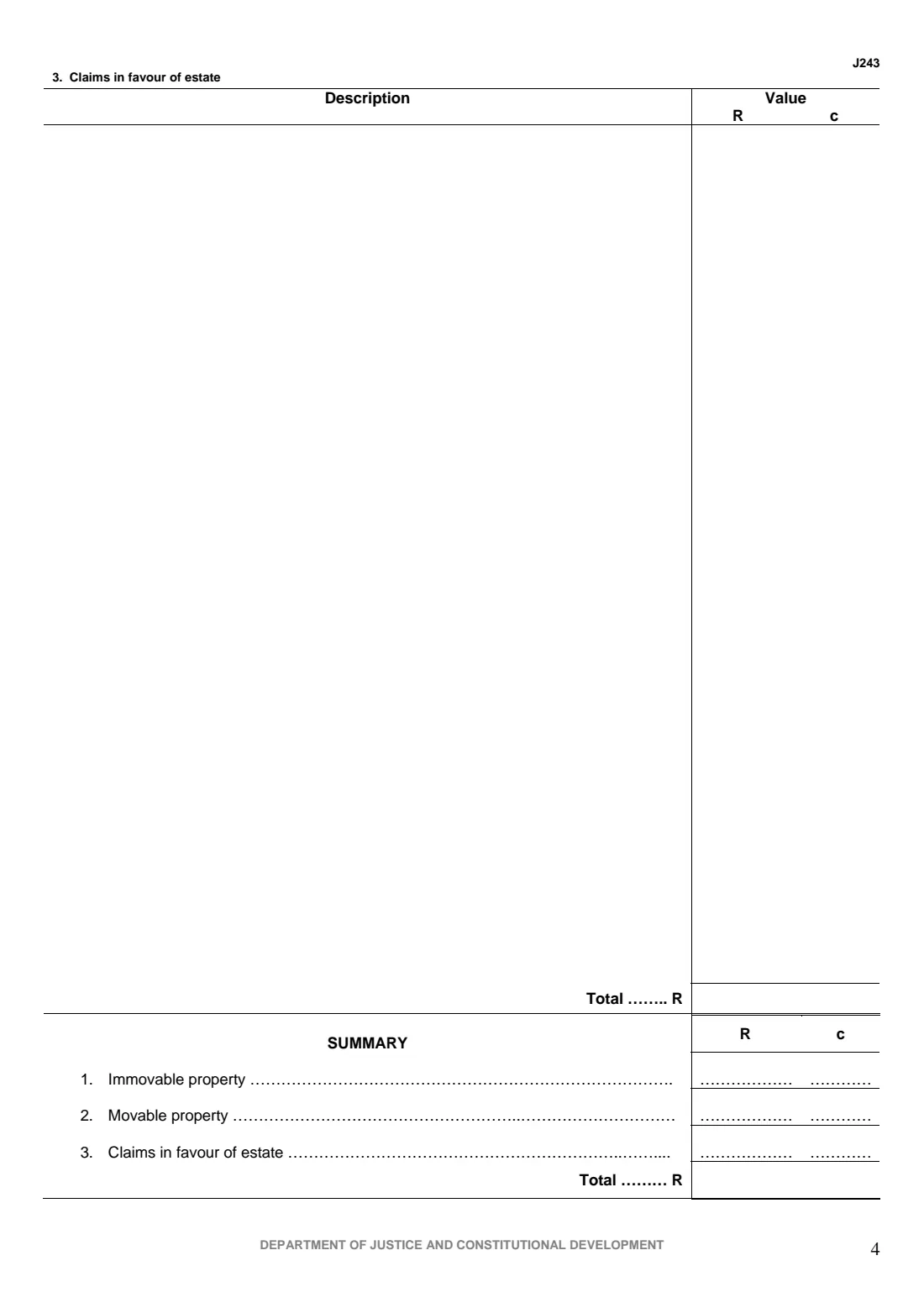
Page 1 records whose estate it is, who is making the inventory and in what capacity, and which heirs were present. Pages 2 to 4 list the property in three groups, immovable property, movable property and claims in favour of the estate, each with its value in rand and cents, and end with a summary.
FileIt asks which situation applies and strikes out the wording that doesn't, as the form asks. It adds up every page and the summary, splits each amount into the form's R and c columns, and checks that each description fits its row.
- Who fills it
- The surviving spouse or nearest relative, or an executor, tutor or curator
- Lodged with
- The Master of the High Court, with the death notice
- Deadline
- Section 9: within 14 days of the death, or longer if the Master allows
- Signatures
- Signed by hand by the person making the inventory
- Pages
- 4
- Agency
- Department of Justice and Constitutional Development — Master of the High Court
Who needs to fill out J243 Inventory?
- The surviving spouse reporting a deceased estate, or the nearest relative where there is no spouse.
- Spouses who were married in community of property, where the inventory covers the joint estate.
- An executor whom the Master has ordered to lodge an inventory with values.
- A tutor or curator listing the property they look after for a minor or another person.
- Anyone who received a written notice from the Master asking for an inventory.
When to use J243 Inventory
- When reporting an estate to the Master, for estates both above and below R250 000.
- When the Master sends a written notice asking for an inventory.
- As an executor, tutor or curator, within 30 days of your letters, and again whenever property comes to light that is not yet on an inventory.
What you need before you start
- The deceased's full name and, for a joint estate, the surviving spouse's name and address.
- Title deeds for land and buildings: erf or farm number, title deed number and date.
- Recent bank statements, vehicle registration papers and investment or share statements.
- Details of money owed to the deceased, such as loans, refunds or unpaid salary.
- A fair value for each item; the Master's small-estate list also asks for proof of values.
- The names and addresses of any heirs who were present when you made the inventory.
What’s on J243 Inventory
The 2010 edition has 4 pages. FileIt asks for it in 9 parts:
- Which inventory this isPerson making the inventory
- Page 1: The estatePerson making the inventory
- Page 1: You, making the inventoryPerson making the inventory
- Page 1: Heirs present when the inventory was madePerson making the inventory
- Page 2: 1. Immovable propertyPerson making the inventory
- Page 3: 2. Movable propertyPerson making the inventory
- Page 4: 3. Claims in favour of the estatePerson making the inventory
- Page 4: SummaryPerson making the inventory
- Amounts as printed (calculated)Person making the inventory
How to fill out J243 Inventory, step by step
1 Which inventory this is
Choose whether you are the surviving spouse or relative (section 9(1)(a)), answering a notice from the Master (9(2)(a) or 9(2)(b)), an executor (section 27) or a tutor or curator (section 78). FileIt strikes out the other section numbers and the statements (a) to (d) that don't apply.
2 Page 1: The estate and you
Enter the deceased's full name. For a joint estate add the surviving spouse's name and address; for a massed estate under a joint will, the testators' names. Then your own name, address and capacity, the place and date, and the heirs who were present.
3 Page 2: Immovable property
List each piece of land or building as described in the title deed, with the deed's number and date, and its value. Up to 25 items fit on the page.
4 Page 3: Movable property
Bank accounts, vehicles, furniture, jewellery, shares, unit trusts and other belongings, one item per row with its value. Up to 24 items.
5 Page 4: Claims and summary
Money owed to the estate, up to 20 items. FileIt adds up each page and fills in the summary, so the three totals and the overall total always agree.
Common mistakes to avoid
- Leaving the section numbers and statements that don't apply undeleted. FileIt strikes them out from your one choice.
- Describing land loosely instead of as in the title deed, with its number and date.
- Listing debts of the deceased: the inventory lists property and claims in favour of the estate, not what the estate owes.
- Totals that don't match the rows or the summary.
- Forgetting the heirs who were present, which section 9 asks you to endorse on the inventory.
After you fill it out
Sign the inventory by hand and lodge it with the Master's office together with the J294 death notice, the death certificate and the other reporting documents.
For an estate under R250 000, the Master's list asks for proof of the values and a list of creditors where there are any.
FileIt files the completed inventory in the deceased's vault folder, so the family can find it when the executor or Master asks.
Fill out J243 Inventory online with FileIt
- Pick the person. Choose someone from People and FileIt fills in their name, date of birth, address and other details it already knows.
- Answer plain-language questions. One part of the form at a time, with the official help text beside each question — 247 fields in all. Your answers save as you go.
- Check the live preview. Watch your answers land on the real Department of Justice and Constitutional Development — Master of the High Court form, and let FileIt do any worksheet arithmetic.
- Generate the official PDF. FileIt prints your answers into the agency’s own PDF and files it in that person’s folder in your vault.
FileIt fills the form — it never files or submits anything for you. Deliver the finished form to whoever asked for it, the way the form’s instructions say.
Start J243 Inventory now — it’s freeJ243 Inventory: frequently asked questions
Who has to make the inventory?
Section 9 places it on the surviving spouse (or spouses jointly) or, if there is none, the nearest relative or connection living in the district where the deceased ordinarily lived. Executors, tutors and curators make their own under sections 27 and 78.
How quickly must it be lodged?
Under section 9, within 14 days of the death or within any longer period the Master allows. Executors, tutors and curators have 30 days from their letters.
What counts as immovable property?
Land and anything permanently attached to it, such as a house, flat (sectional title unit) or farm. Everything else the deceased owned goes under movable property, and money owed to them goes under claims.
How do I value the items?
Give your best estimate of what each item was worth at the date of death. If the Master believes an estimate is not reasonably correct, the Act lets the Master have the property appraised.
What if there are more items than rows?
Each page has a fixed number of rows. Group small items (for example 'household furniture and effects') or attach a further signed list.
Does FileIt send the inventory to the Master?
No. FileIt prints your answers into the Master's official PDF. You sign it and lodge it yourself.
Official sources
- Blank form (PDF), published by Department of Justice and Constitutional Development — Master of the High Court: https://www.justice.gov.za/master/m_forms/J243.pdf
- Official instructions and guidance: https://www.justice.gov.za/master/deceased-how.html
- Edition shown on this page: J243 (G.P.-S. 003-0318) (checked 2026-10-19).
FileIt is not affiliated with or endorsed by Department of Justice and Constitutional Development — Master of the High Court or any government. This page explains the form in general terms and is not legal, tax or immigration advice. Always read the official instructions, and check that you are using the edition the recipient accepts. Page last reviewed 2026-10-19.