What is Form I-730?
Form I-730 lets a person admitted to the United States as a refugee, or granted asylum, petition for a spouse or unmarried child to receive the same status. It's often called a follow-to-join petition, because it's used when the family member wasn't included in the principal's own case. A permanent resident who got their green card from refugee or asylee status can file it too.
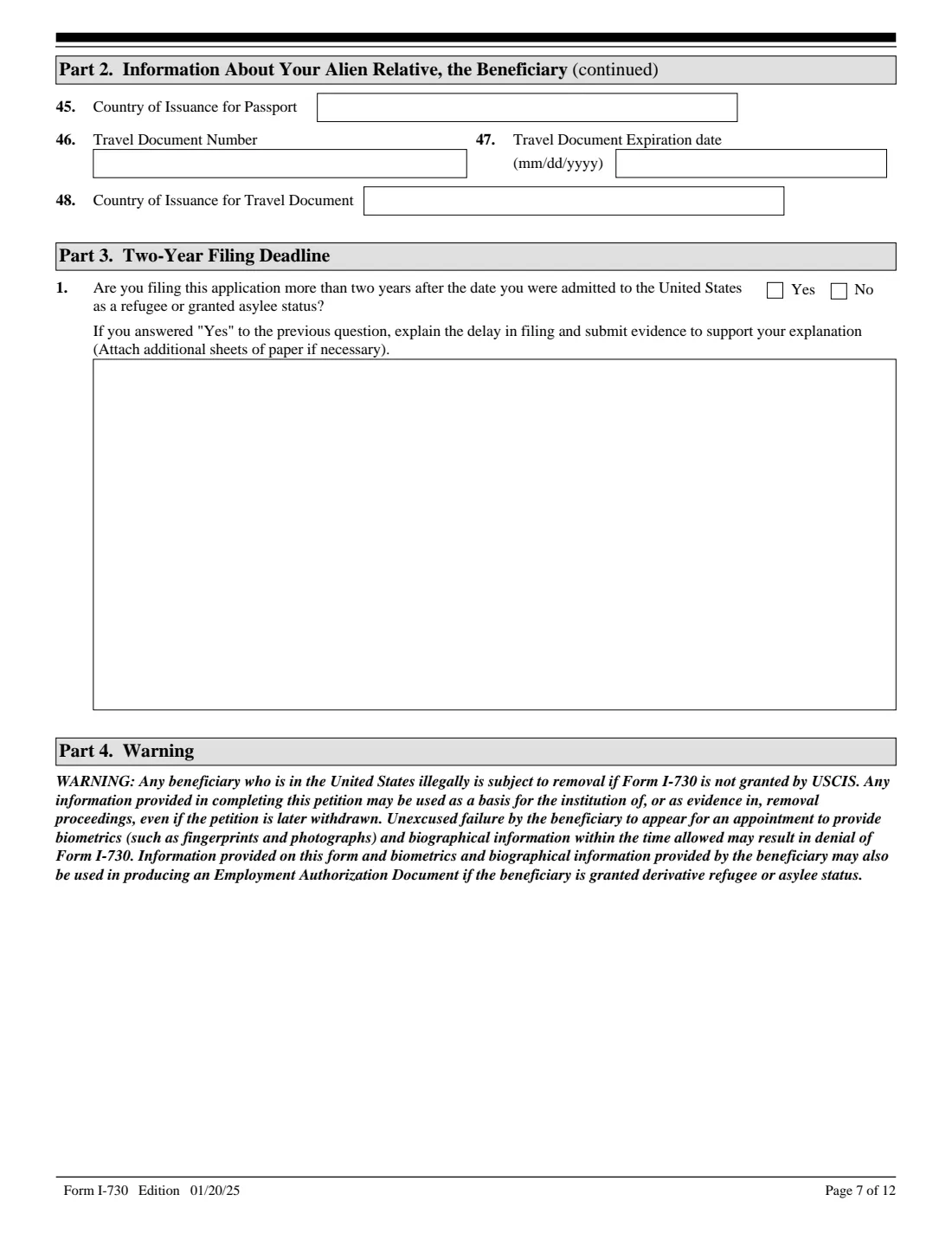
The relationship must have existed when you were admitted as a refugee or granted asylum, and a child must be unmarried. You file a separate Form I-730 for each relative, normally within two years of your own admission or asylum grant; USCIS may excuse a later filing for humanitarian reasons, which you explain in Part 3. USCIS charges no fee for this petition.
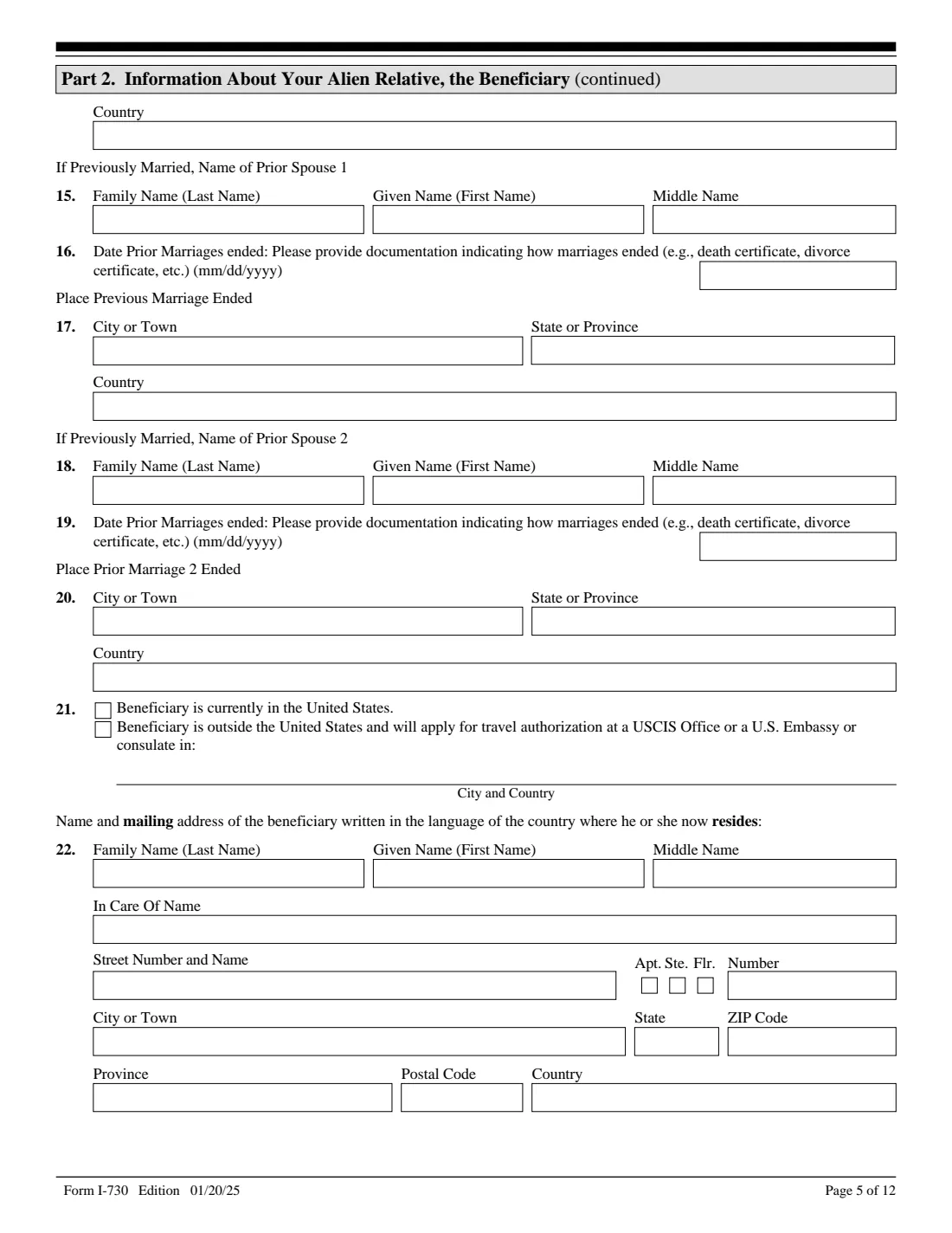
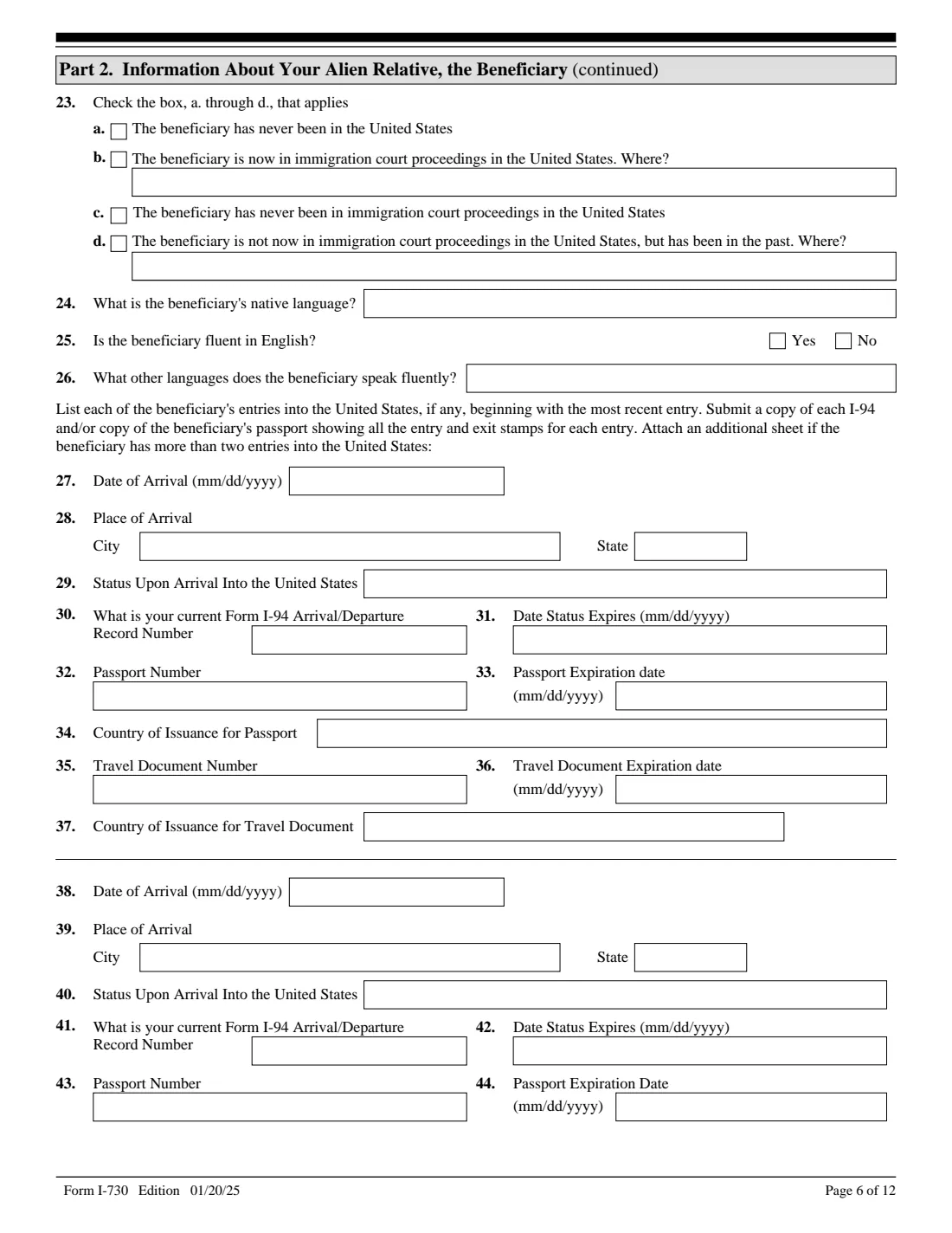
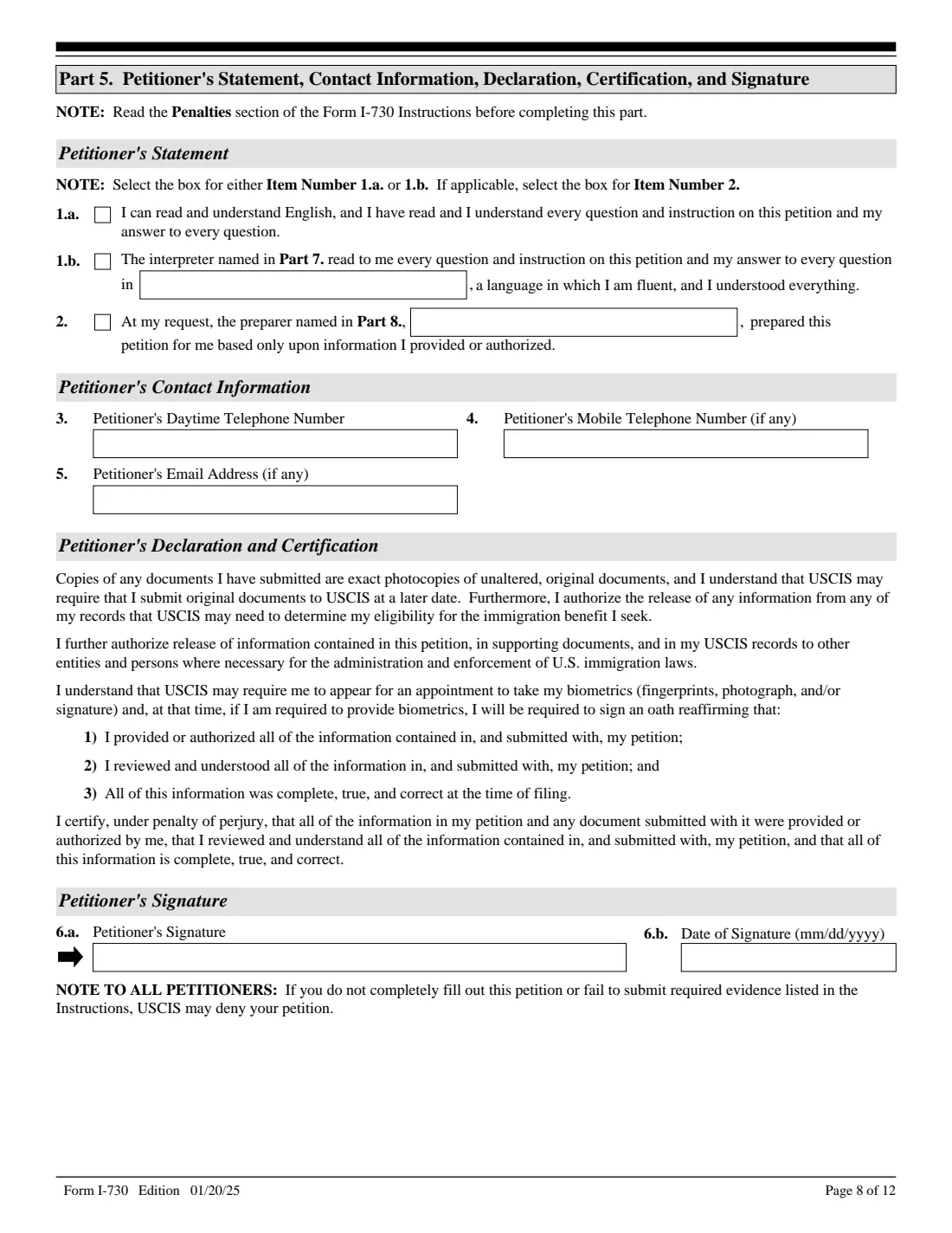
FileIt guides you through the twelve-page petition, with your details, the beneficiary's, both of your marriages and the beneficiary's past entries into the United States, and prints everything into the official USCIS PDF. The beneficiary's own statement (Part 6) shows only when they need it. You print it and sign by hand. FileIt keeps the filled PDF in your vault and never files anything.
- Who fills it
- The petitioner: a refugee or asylee, or a permanent resident who held refugee or asylee status.
- For
- A spouse or unmarried child. One petition per relative.
- Deadline
- Normally within two years of your admission as a refugee or grant of asylum; explain any delay in Part 3.
- Fee
- None.
- Signatures
- The petitioner signs by hand; a beneficiary in the U.S. aged 14 or older signs Part 6 too.
- Edition
- 01/20/25 (OMB No. 1615-0037, expires 02/28/2027).
Who needs to fill out Form I-730?
- Refugees whose spouse or child stayed behind when they were admitted to the United States.
- Asylees who want their spouse or child to receive derivative asylum status.
- Green card holders who adjusted from refugee or asylee status and are still within the filing time.
- Families where the relative is already in the United States and needs derivative status here.
When to use Form I-730
- Within two years of the date you were admitted as a refugee or granted asylum.
- After that only with an explanation of humanitarian reasons for the delay, and evidence.
- Once for each spouse or child you're petitioning for.
What you need before you start
- Proof of your refugee or asylee status, such as your Form I-94 or the asylum approval notice.
- Proof of the relationship: a marriage certificate for a spouse, a birth or adoption record for a child.
- Documents showing how any earlier marriages ended, for you and for the beneficiary.
- The beneficiary's identity details, addresses, and any U.S. entries with I-94 and passport details.
- Any photos and translations the instructions ask for.
What’s on Form I-730
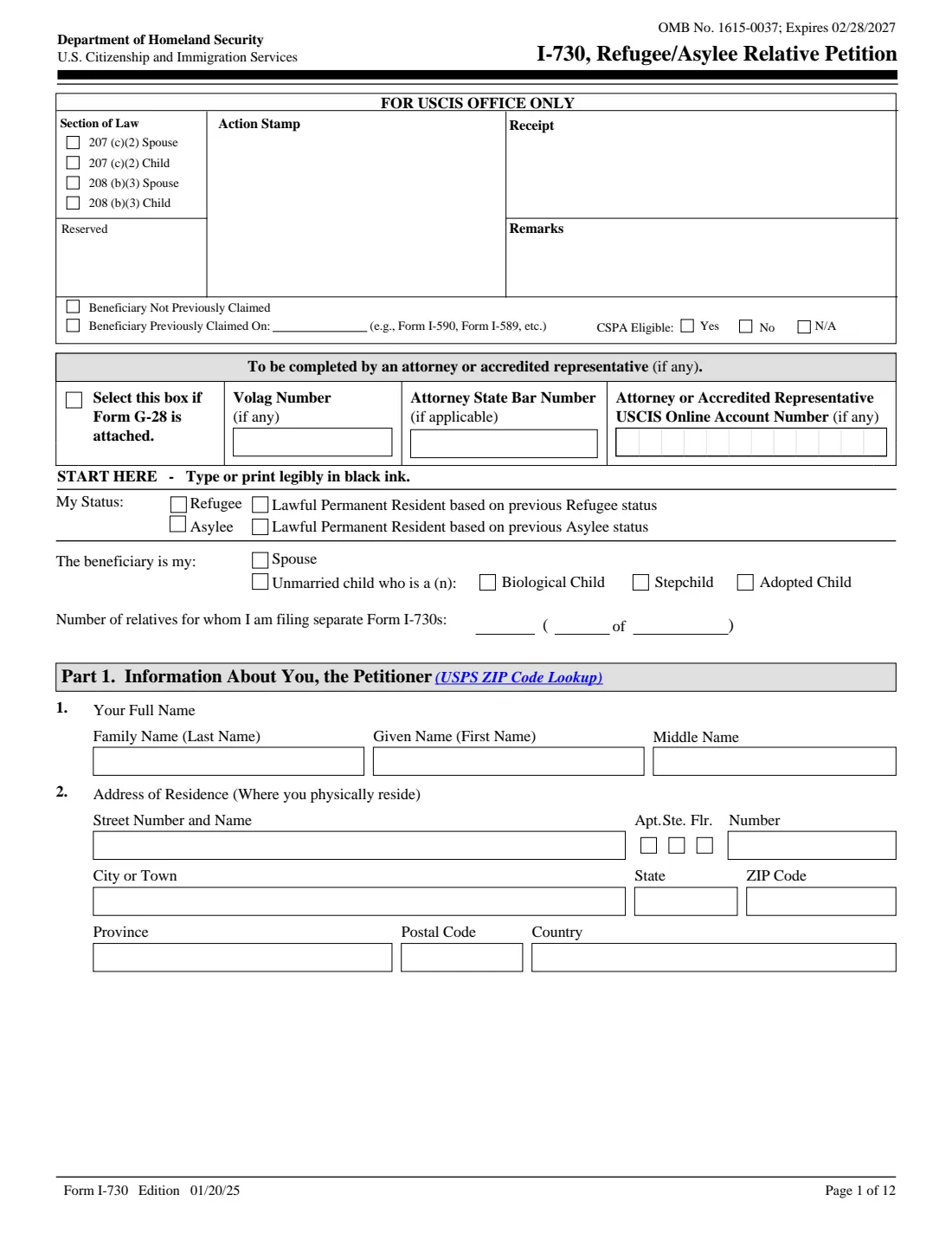
The 2025 edition has 12 pages. FileIt asks for it in 9 parts:
- Attorney or accredited representative (top of page 1)Preparer
- Your status and the beneficiaryPetitioner
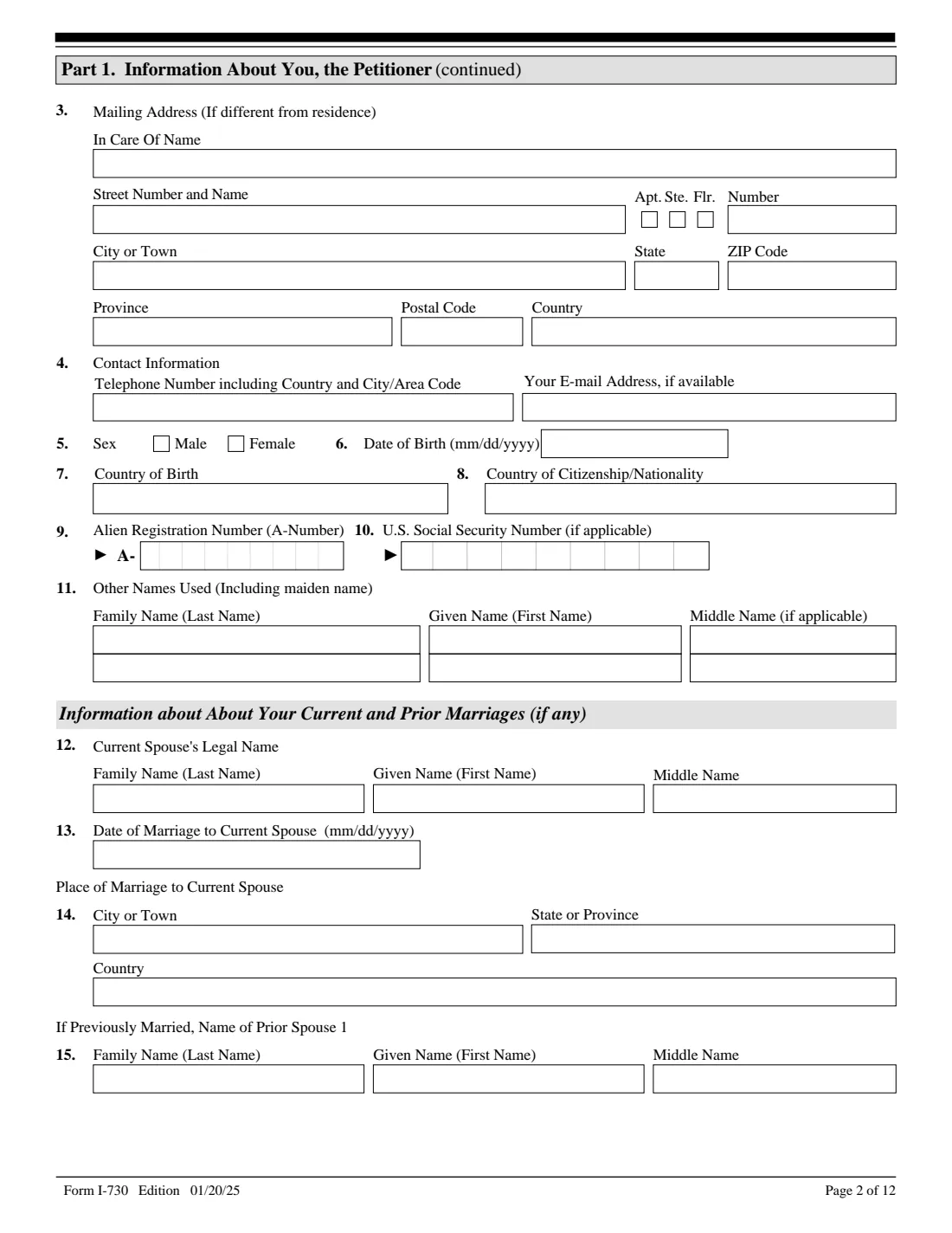
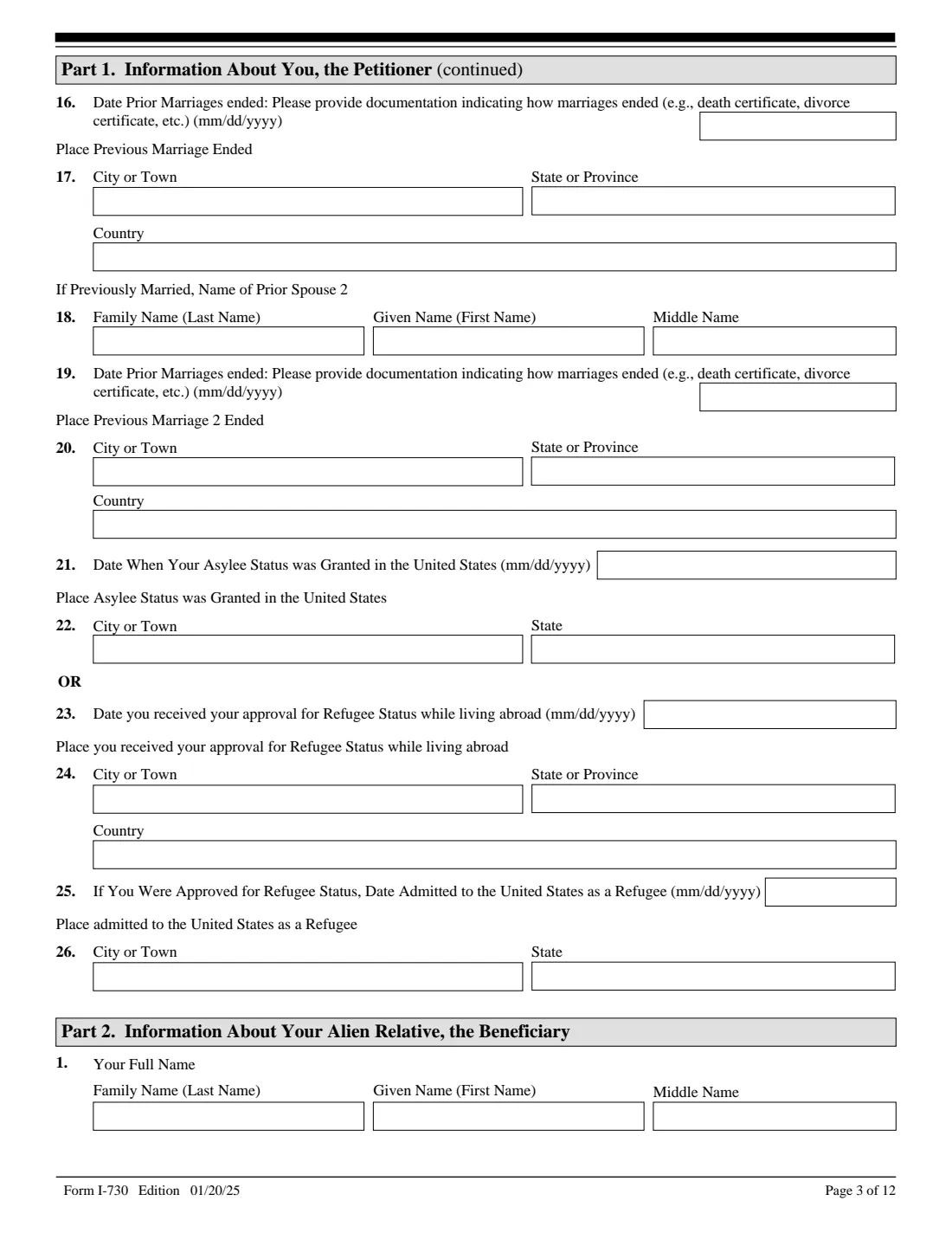
- Part 1. Information about you, the petitionerPetitioner
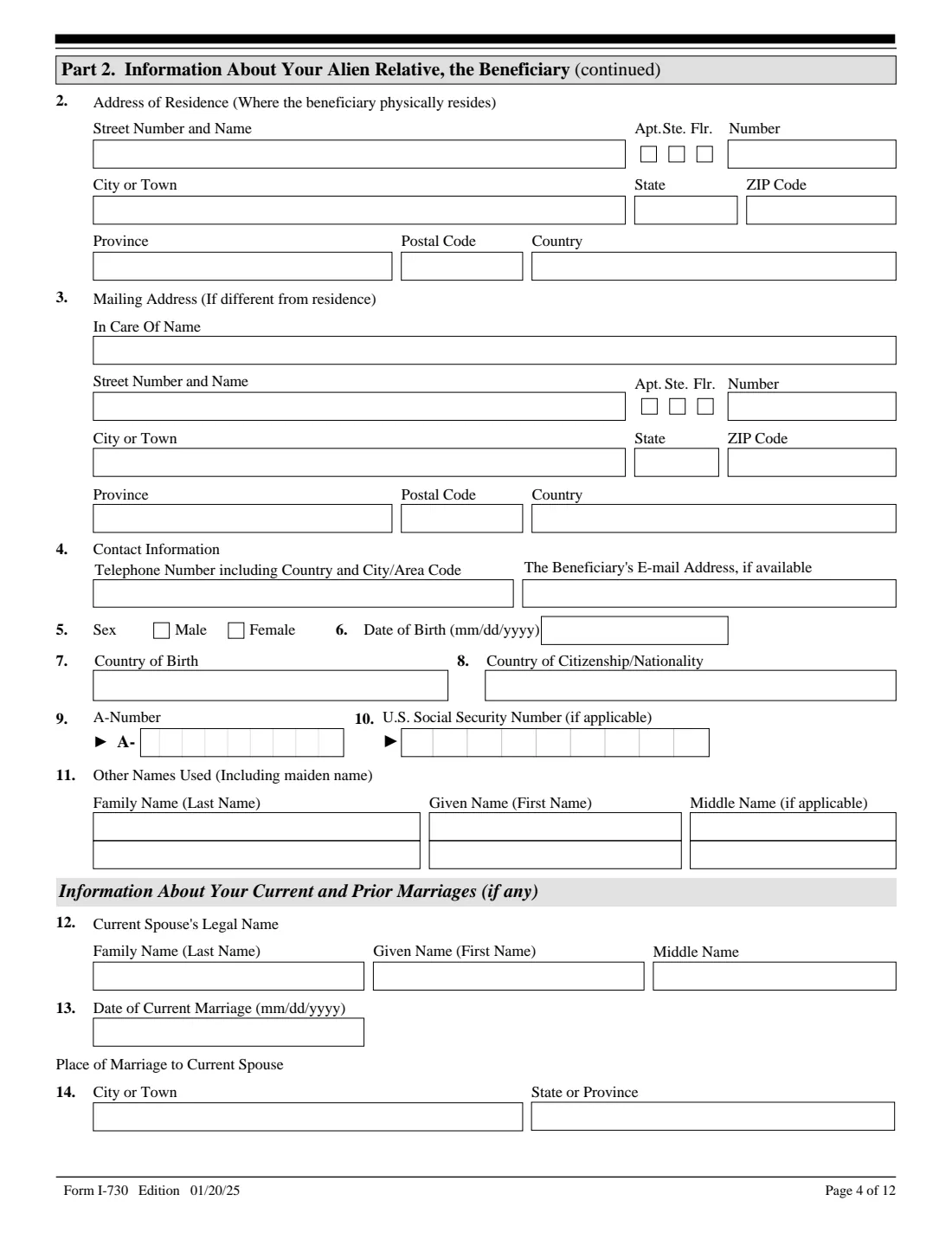
- Part 2. Information about your relative, the beneficiaryPetitioner
- Part 3. Two-year filing deadlinePetitioner
- Part 5. Petitioner's statement, contact information and certificationPetitioner
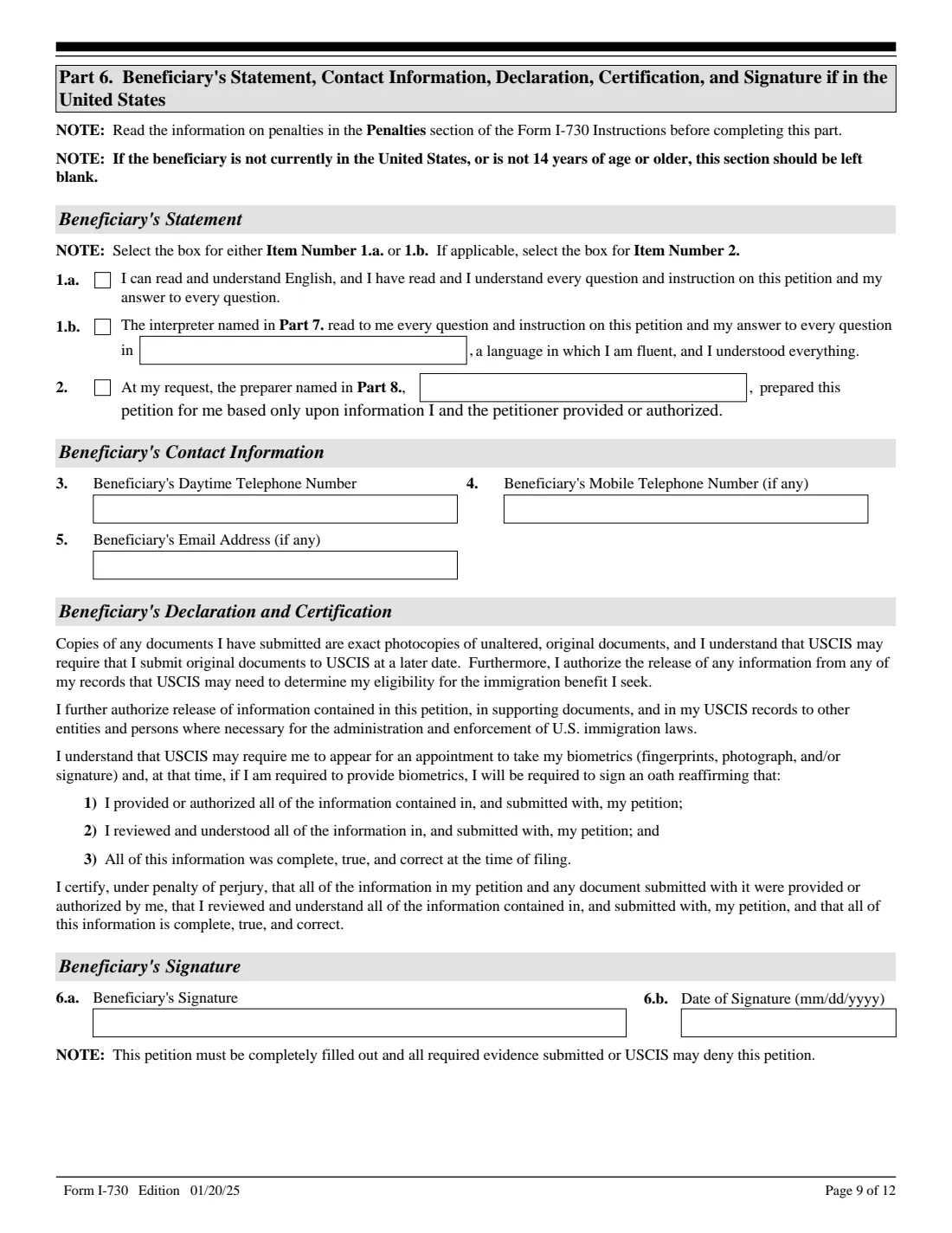
- Part 6. Beneficiary's statement and certification (if in the United States)Beneficiary
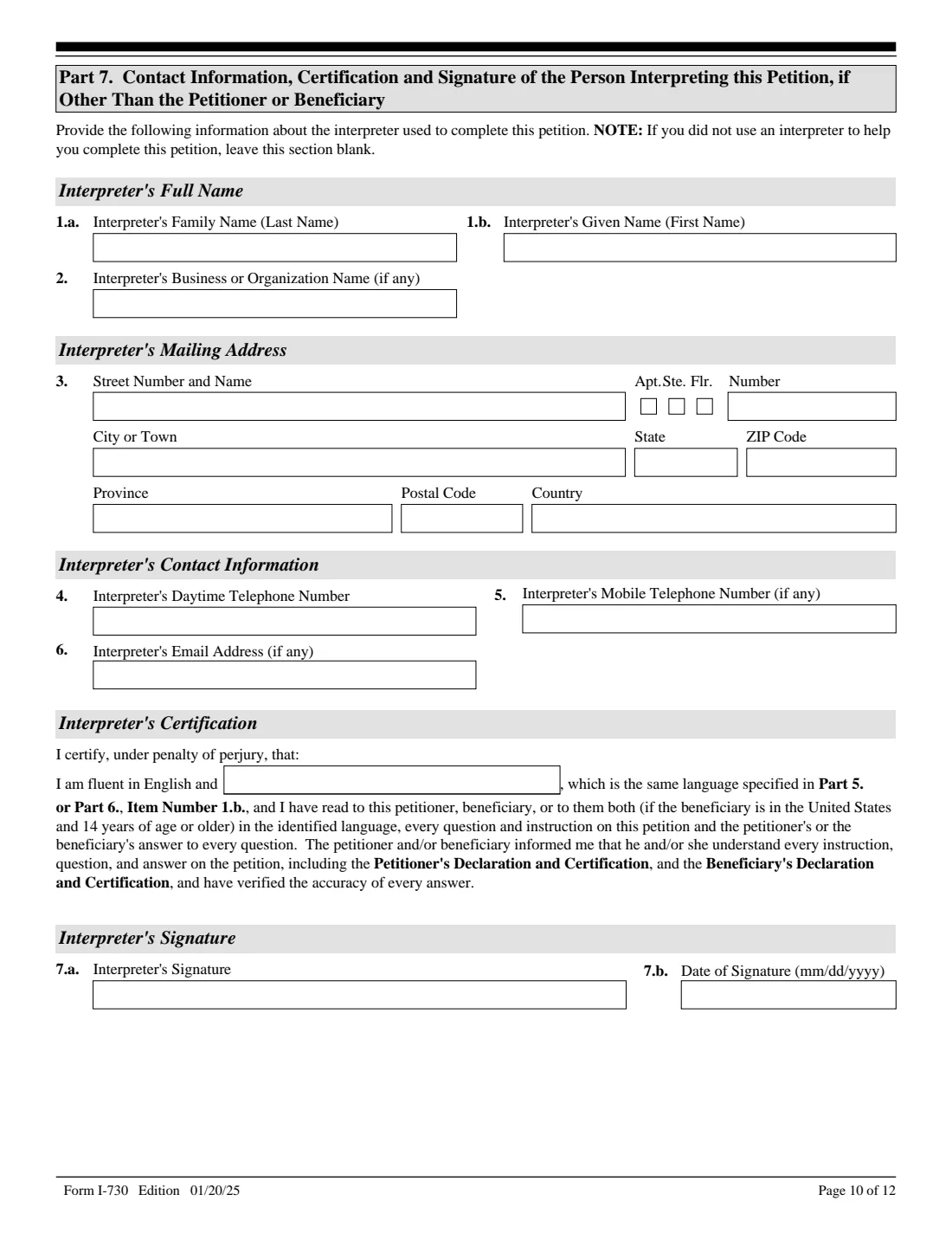
- Part 7. Interpreter's contact information, certification and signatureInterpreter
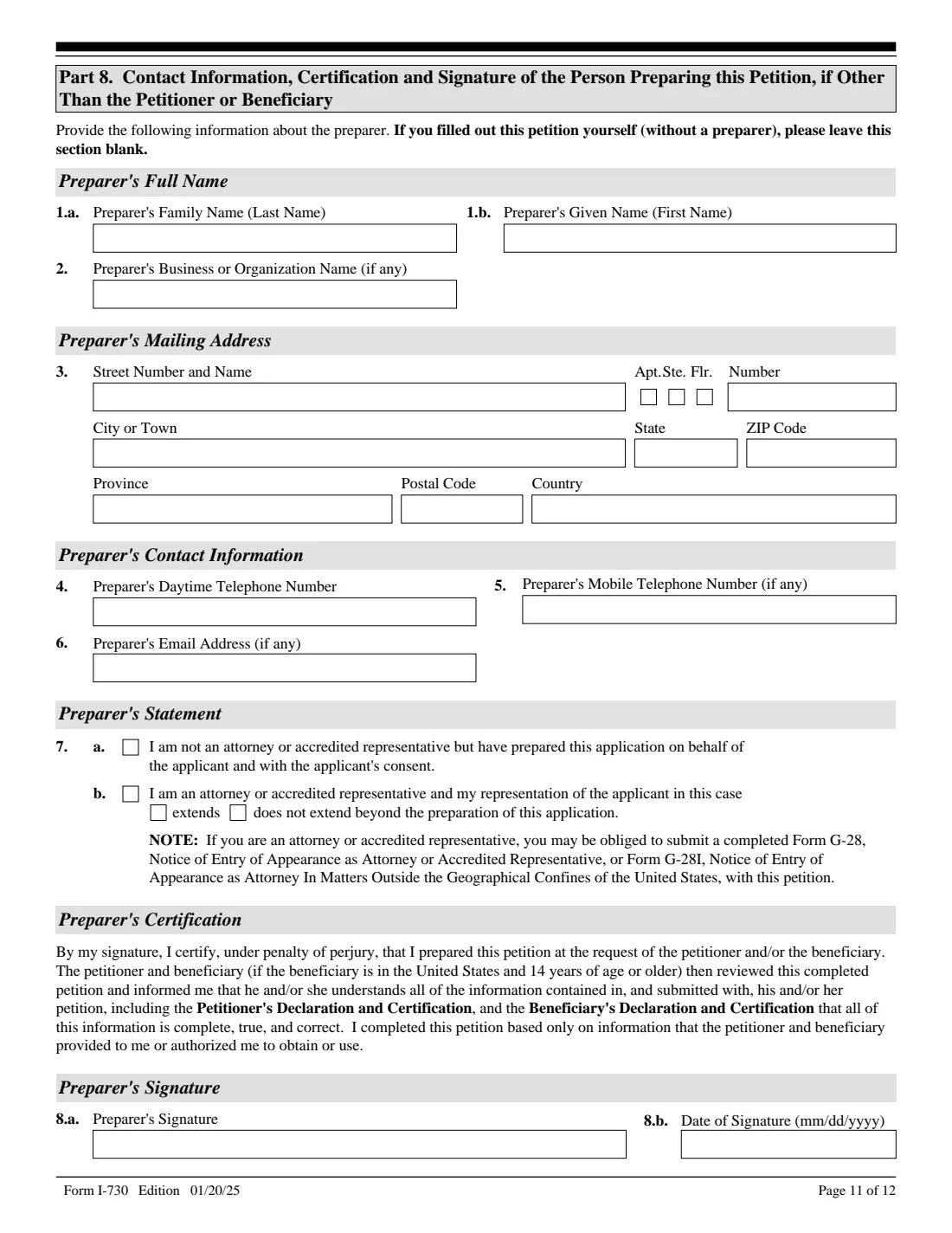
- Part 8. Person preparing this petition, if other than the petitioner or beneficiaryPreparer
How to fill out Form I-730, step by step
1 Your status and the beneficiary
Mark your status (refugee, asylee, or permanent resident from either), whether the beneficiary is your spouse or unmarried child, and how many I-730s you are filing (for example 1 of 3).
2 Part 1. About you
Your name, addresses, contact details, birth and citizenship, A-Number, other names, your marriages, and when and where you were granted asylum or approved and admitted as a refugee.
3 Part 2. About the beneficiary
Their name, addresses, birth, identity numbers and marriages, whether they are in the U.S. or will apply abroad, their name and address in the local language, court proceedings, languages and up to two past entries into the U.S.
4 Part 3. Two-year deadline
Say whether you are filing more than two years after your admission or asylum grant, and if so explain the delay.
5 Parts 5 to 8. Statements and signatures
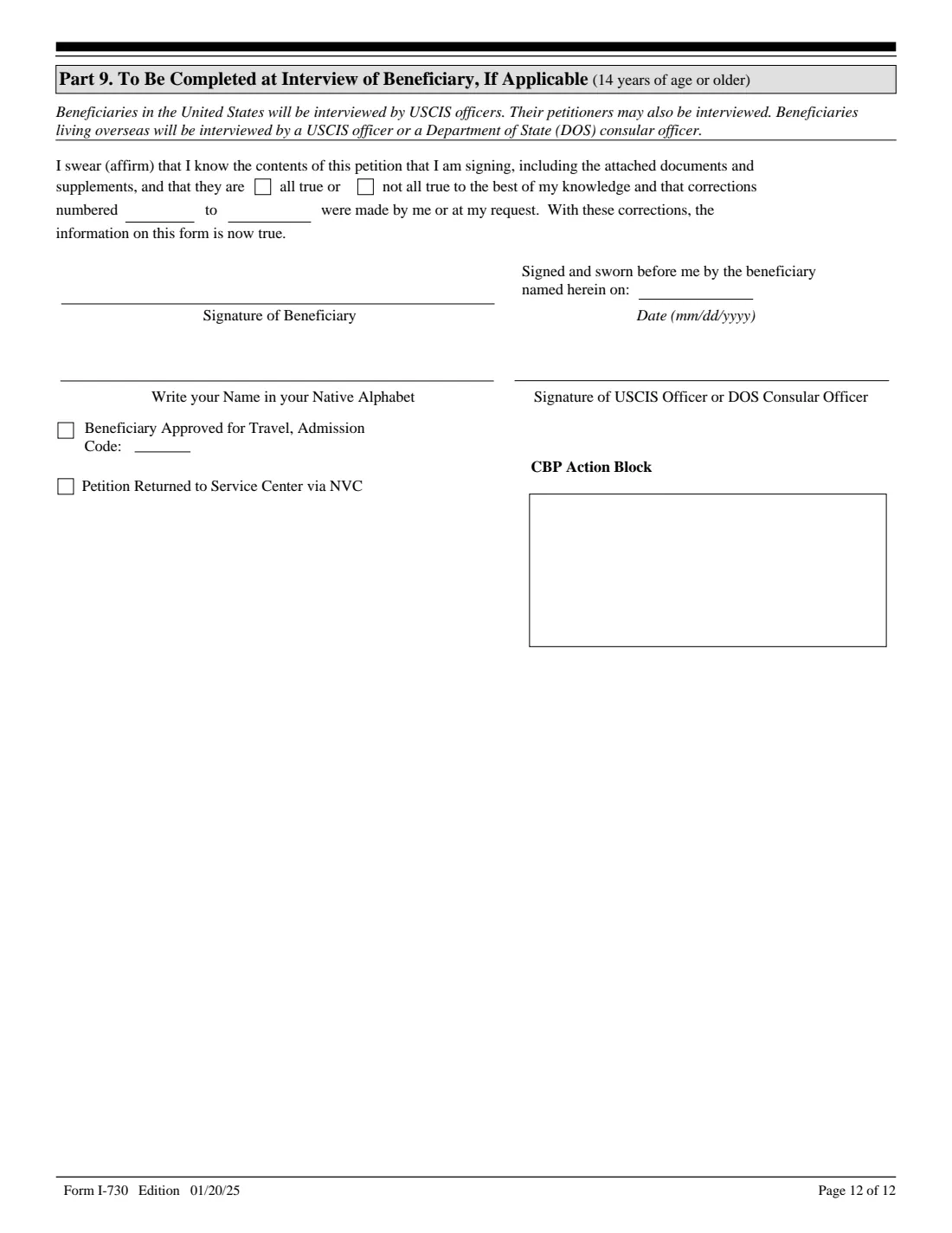
Your statement and contact details, the beneficiary's statement if they are in the U.S. and 14 or older, and the interpreter and preparer if anyone helped. Part 9 is completed later, at the interview.
Common mistakes to avoid
- Putting two relatives on one petition: each needs their own Form I-730.
- Petitioning for a relationship that didn't exist when you were admitted or granted asylum.
- Filing late without explaining the delay and giving evidence.
- Leaving out documents showing how earlier marriages ended.
- Typing a name instead of signing by hand.
After you fill it out
Print the petition, sign Part 5 by hand (and Part 6 for a beneficiary in the U.S. aged 14 or older), and mail it with the evidence to the address on the USCIS Form I-730 page.
USCIS may interview you or the beneficiary; a beneficiary abroad is interviewed by USCIS or a consular officer.
FileIt keeps the filled PDF in your vault alongside your own immigration documents.
Fill out Form I-730 online with FileIt
- Pick the person. Choose someone from People and FileIt fills in their name, date of birth, address and other details it already knows.
- Answer plain-language questions. One part of the form at a time, with the official help text beside each question — 234 fields in all. Your answers save as you go.
- Check the live preview. Watch your answers land on the real U.S. Citizenship and Immigration Services (USCIS) form, and let FileIt do any worksheet arithmetic.
- Generate the official PDF. FileIt prints your answers into the agency’s own PDF and files it in that person’s folder in your vault.
FileIt fills the form — it never files or submits anything for you. Deliver the finished form to whoever asked for it, the way the form’s instructions say.
Start Form I-730 now — it’s freeForm I-730: frequently asked questions
Who can I petition for with Form I-730?
Your spouse or your unmarried child, if the relationship existed when you were admitted as a refugee or granted asylum.
Is there a deadline?
Generally two years from your admission as a refugee or grant of asylum. USCIS may accept a later petition for humanitarian reasons, which you explain in Part 3.
Is there a filing fee?
No. USCIS doesn't charge a fee for Form I-730.
I have a green card now. Can I still file?
Yes, if you got permanent residence based on your earlier refugee or asylee status. Mark that status at the top of the form.
Does the beneficiary sign?
Only if they are in the United States and 14 or older, in Part 6. Otherwise that part stays blank.
Can I fill out Form I-730 online with FileIt?
Yes. FileIt guides you through the paper petition and prints your answers on the official USCIS PDF. You print it and sign by hand; FileIt doesn't file it.
Official sources
- Blank form (PDF), published by U.S. Citizenship and Immigration Services (USCIS): https://www.uscis.gov/sites/default/files/document/forms/i-730.pdf
- Official instructions and guidance: https://www.uscis.gov/i-730
- Edition shown on this page: 01/20/25 (OMB 1615-0037, expires 02/28/2027) (checked 2026-10-19).
FileIt is not affiliated with or endorsed by U.S. Citizenship and Immigration Services (USCIS) or any government. This page explains the form in general terms and is not legal, tax or immigration advice. Always read the official instructions, and check that you are using the edition the recipient accepts. Page last reviewed 2026-10-19.