What is Form I-129F?
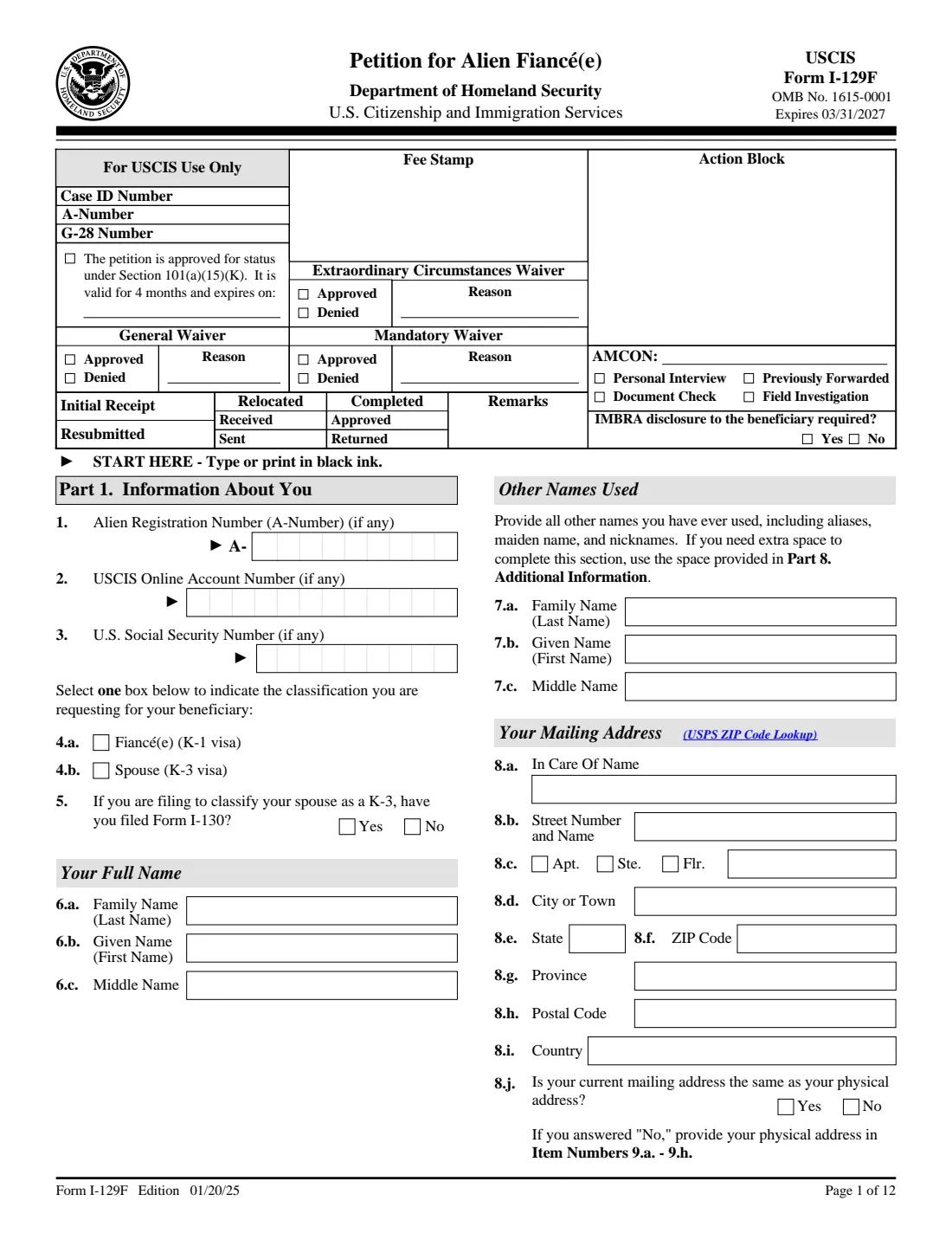
Form I-129F is U.S. Citizenship and Immigration Services' Petition for Alien Fiancé(e). A U.S. citizen files it so their fiancé(e) living abroad can get a K-1 visa, come to the United States and marry within 90 days of arriving. It is also used for a K-3 visa, for a spouse when a Form I-130 has already been filed. The current edition is 01/20/25.
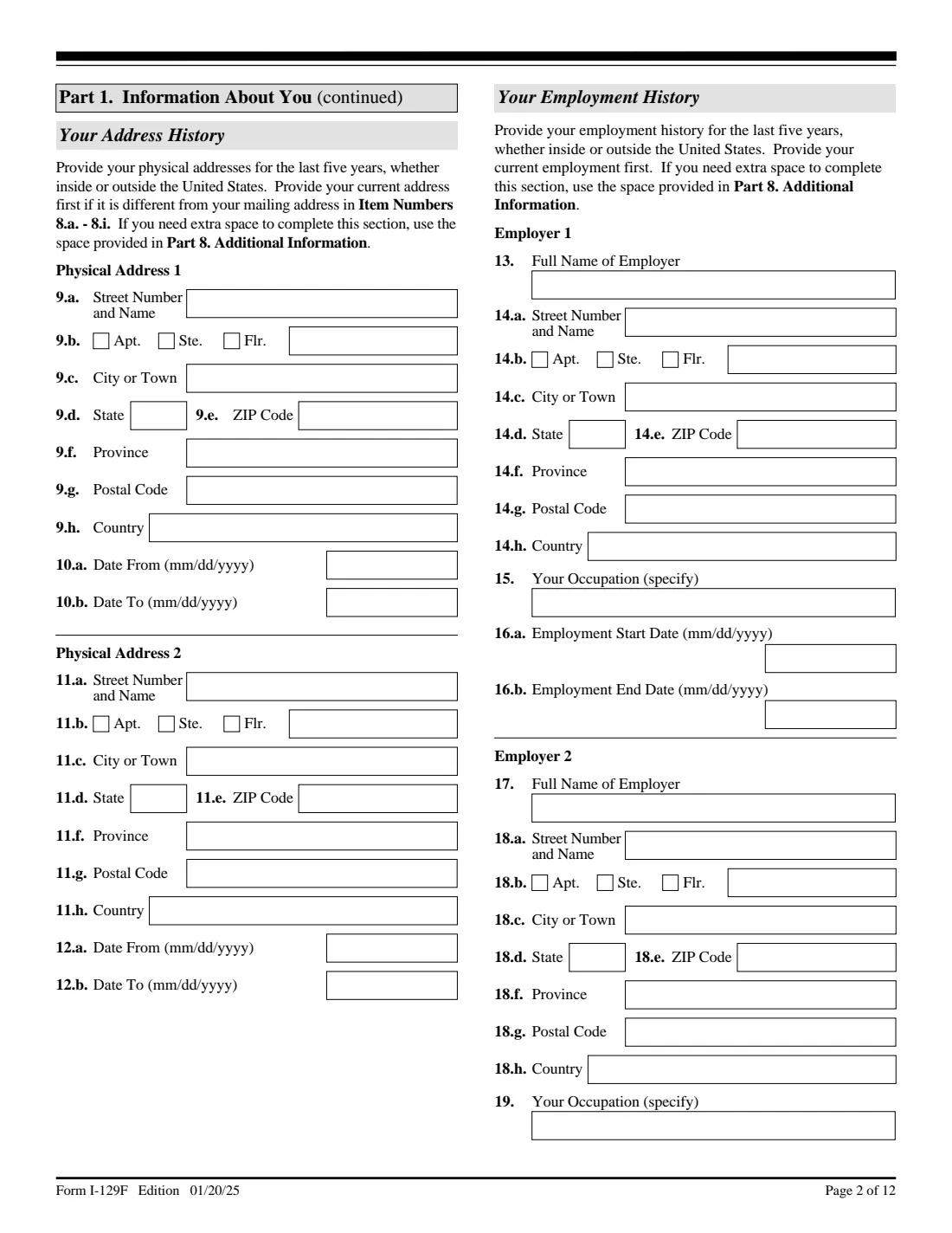
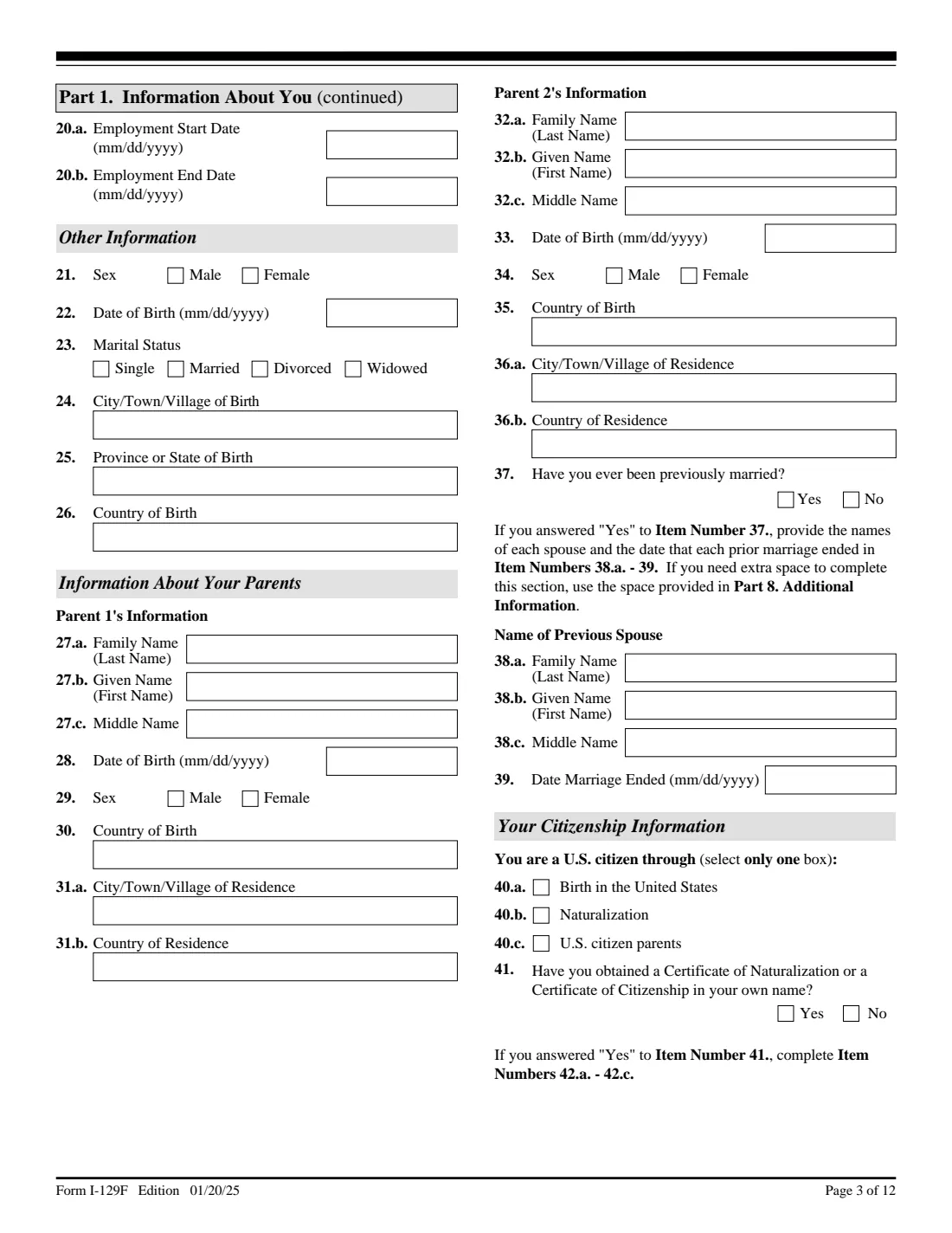
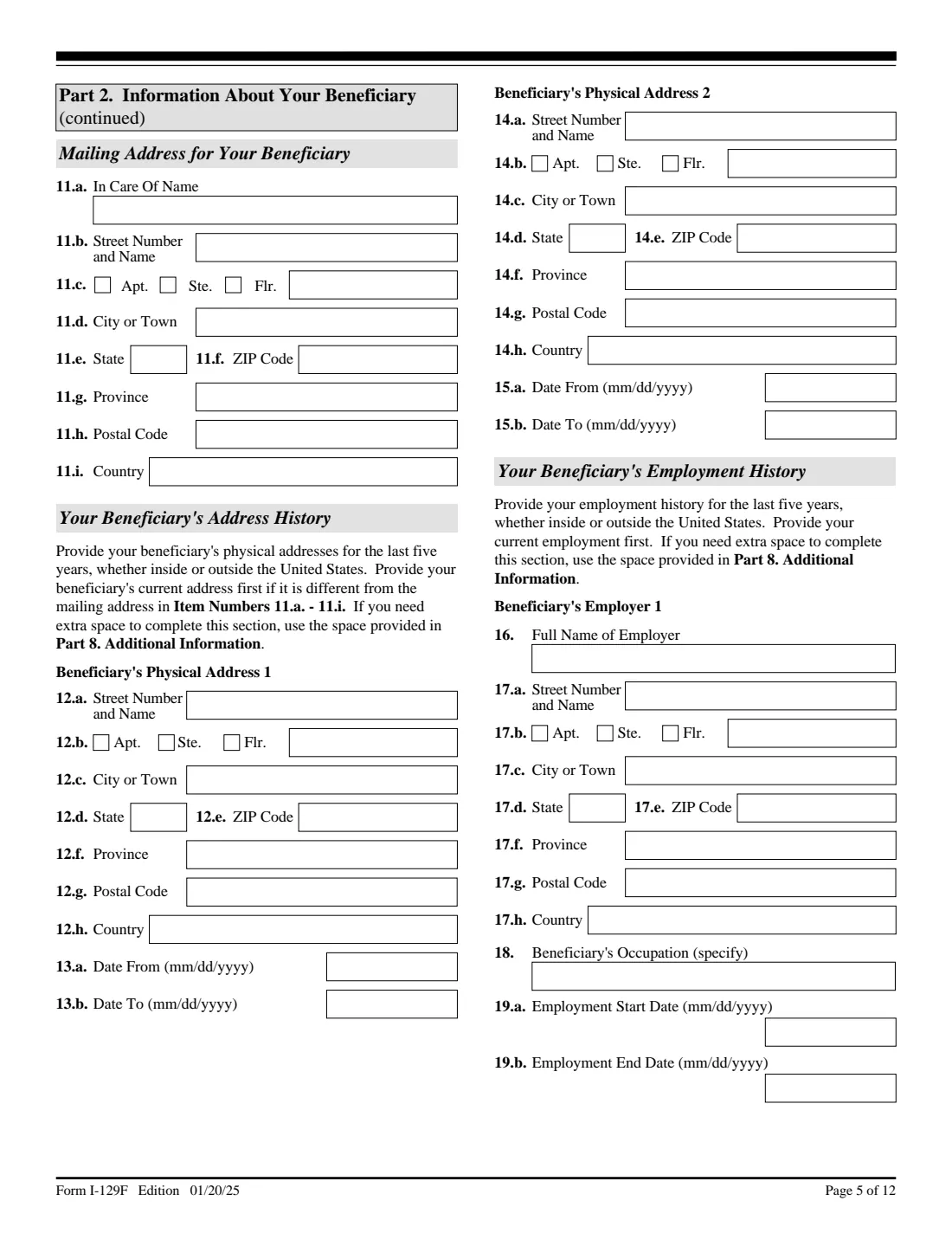
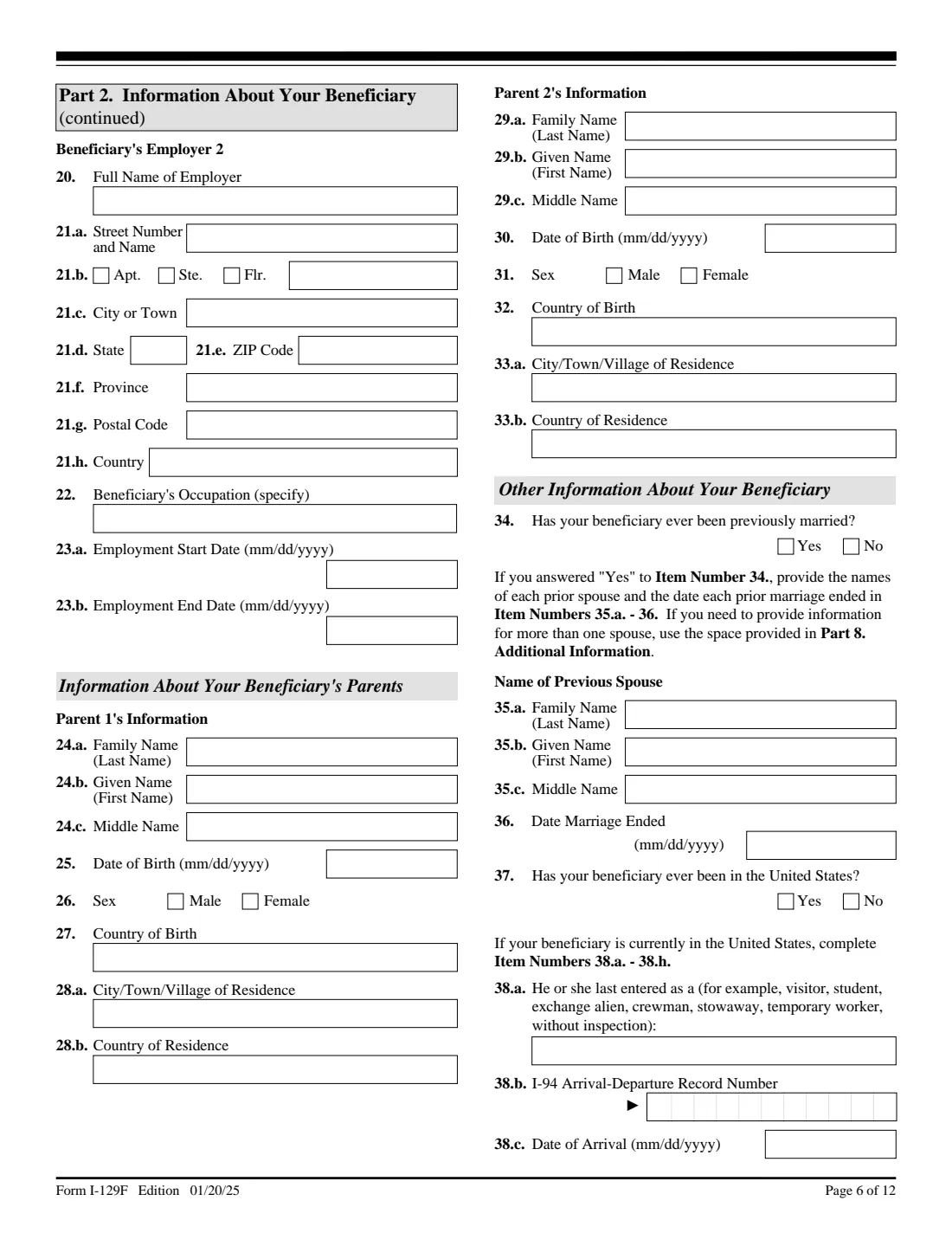
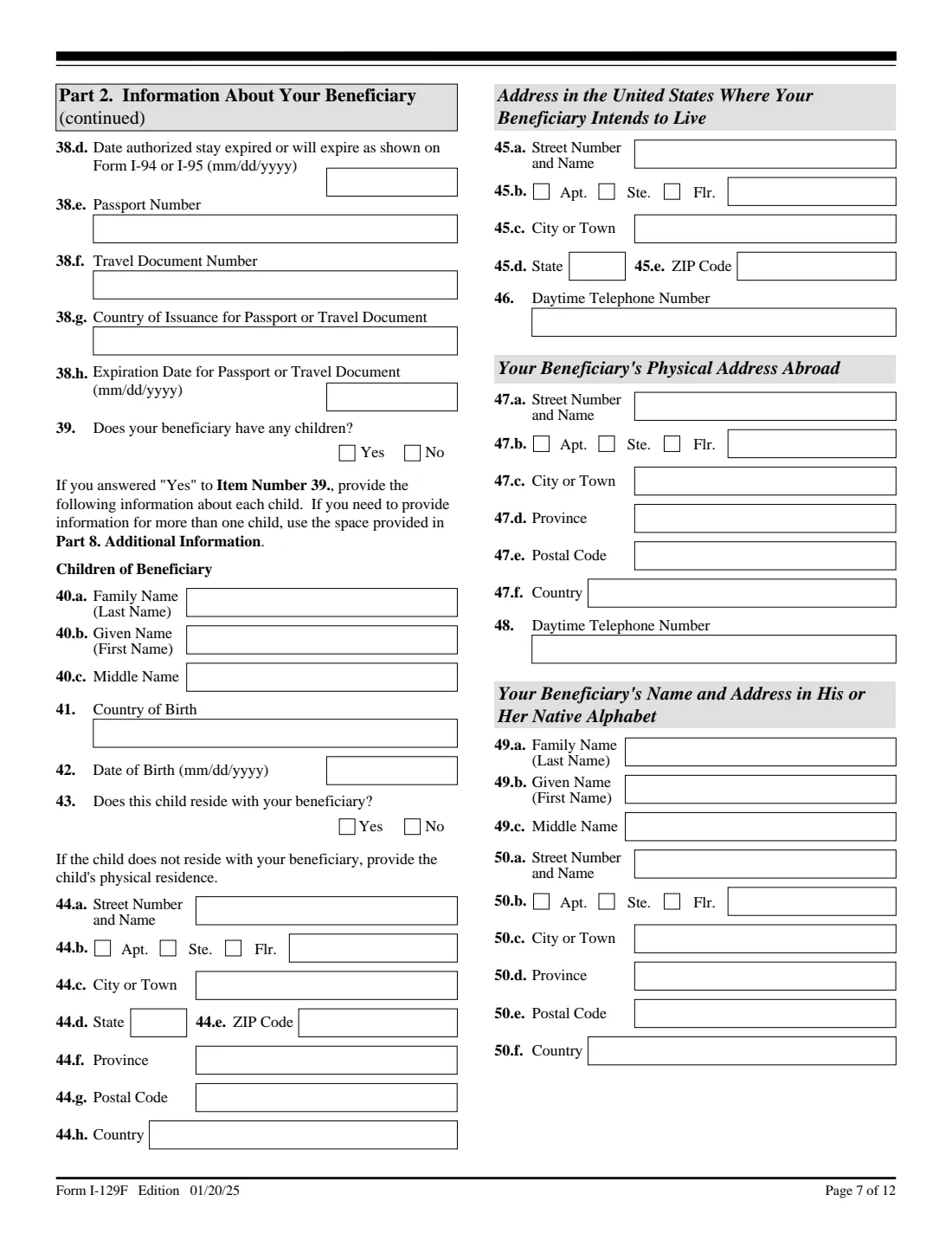
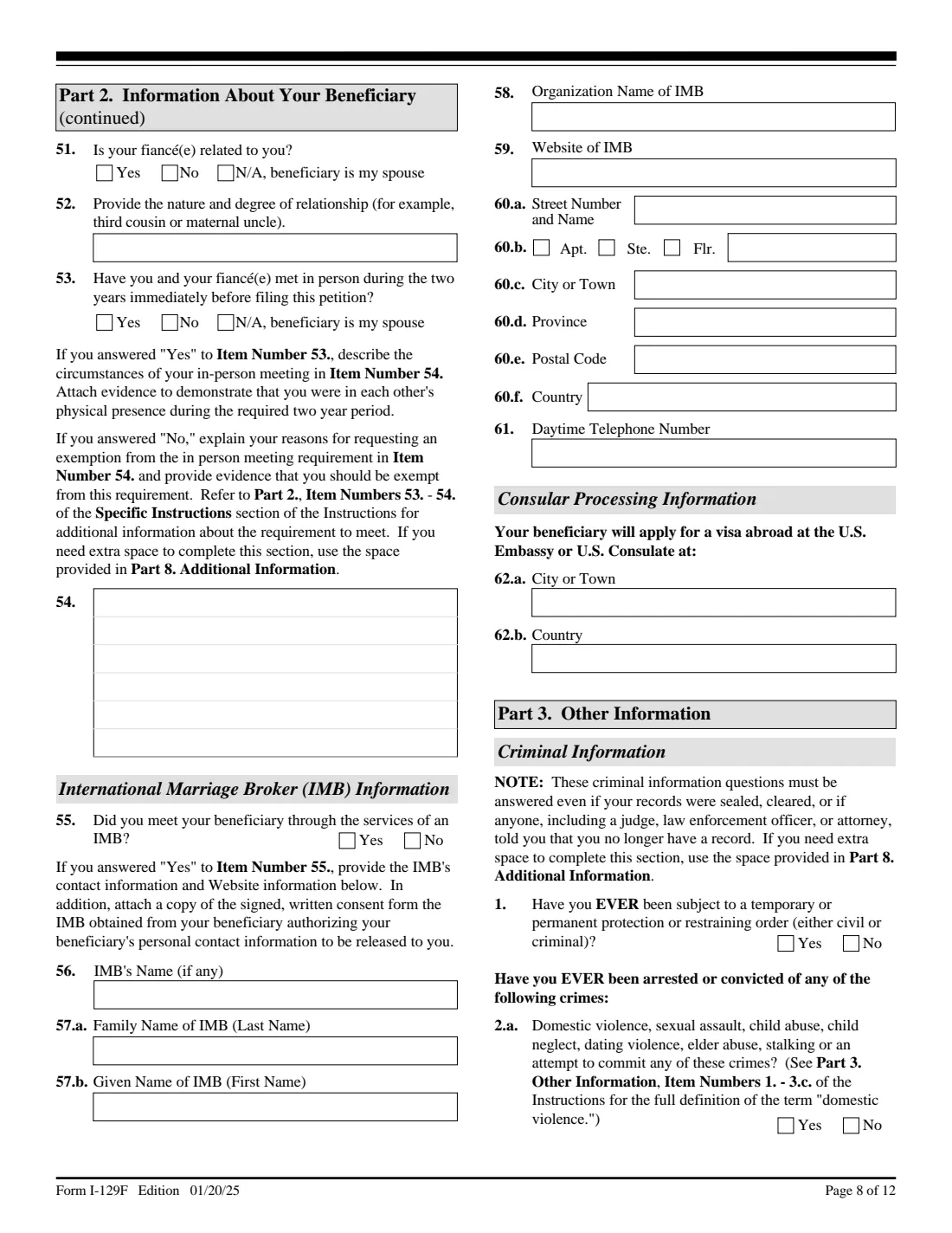
The 12-page form asks for a lot about both of you: names, five years of addresses and employment, parents, prior marriages, and how you became a citizen. For your fiancé(e) it adds any time in the United States, children, the address where they'll live, their address abroad, and their name and address in their native alphabet. It asks whether you've met in person in the last two years, whether you met through an international marriage broker, and questions about protection orders and certain crimes, which are part of the IMBRA safeguards.
FileIt pre-fills your name and date of birth from your vault, walks you through each section in order, prints PRESENT for current addresses, and fills USCIS's own PDF, with longer answers fitted into their boxes and native-alphabet names in Cyrillic or Greek printed properly. The finished form is saved in your vault. USCIS needs a handwritten signature, and FileIt never files it for you.
- Who files
- A U.S. citizen petitioning for a fiancé(e) (K-1) or for a spouse (K-3).
- Pages
- 12 (Parts 1-8).
- Meeting
- Item 53 asks whether you met in person in the two years before filing; if not, you explain why you ask for an exemption.
- Signature
- Handwritten by the petitioner, and by any interpreter and preparer.
- Edition
- 01/20/25 (OMB No. 1615-0001, expires 03/31/2027)
Who needs to fill out Form I-129F?
- U.S. citizens engaged to someone abroad who will come to the United States to marry.
- U.S. citizens whose spouse is abroad and who have already filed Form I-130, for a K-3 visa.
- Petitioners who met their partner through an international marriage broker, who must give the broker's details.
When to use Form I-129F
- Once you're engaged and both of you are free to marry.
- After you have met in person within the two years before filing, or when you can document why an exemption should apply.
- For a K-3, after Form I-130 for your spouse has been filed.
What you need before you start
- Your citizenship details: birth in the U.S., naturalization or citizen parents, and any certificate number.
- Five years of addresses and employers for both of you, with dates.
- Both partners' parents' names, birth dates and places, and where they live.
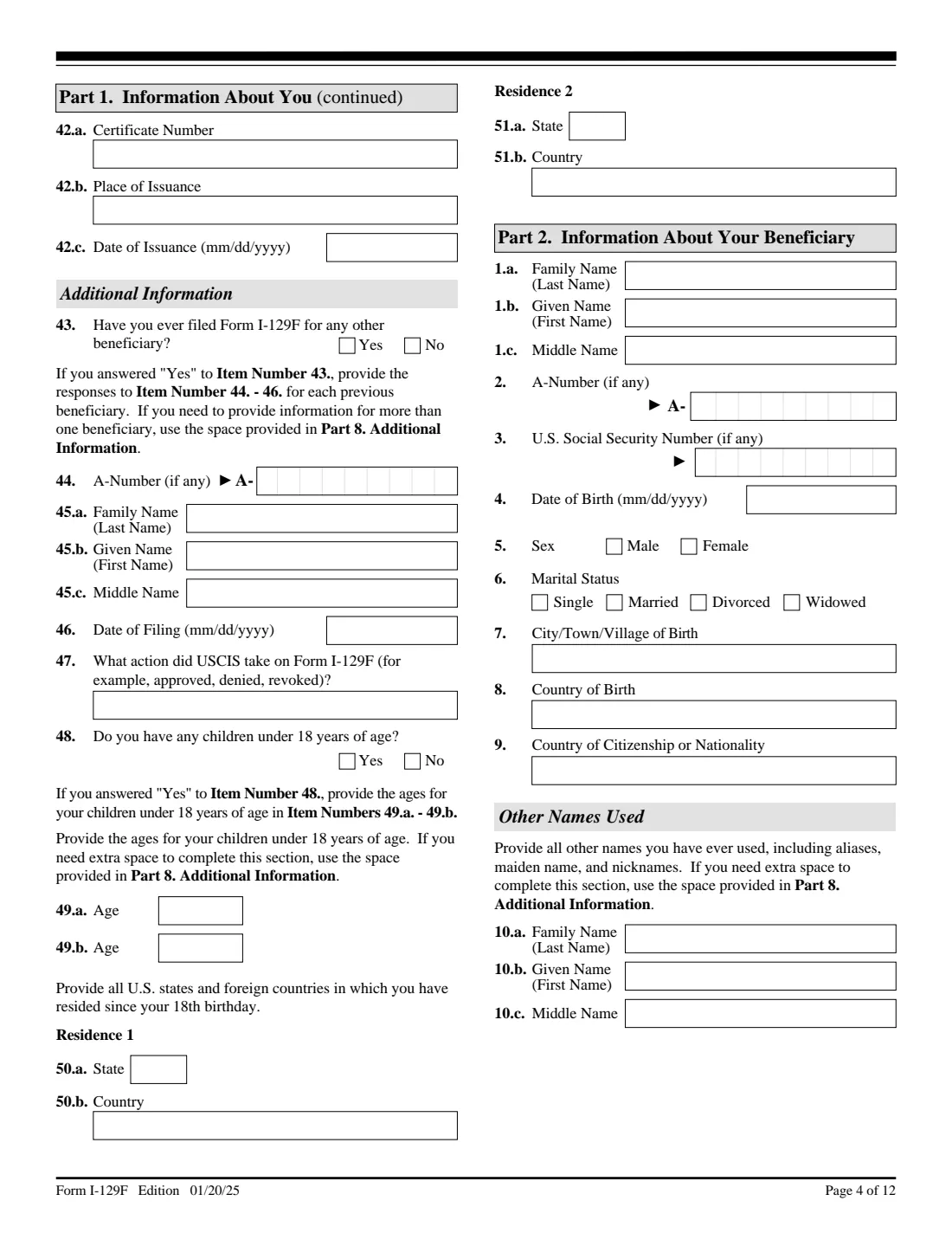
- Details of any prior marriages and the dates they ended, and any earlier I-129F petitions you filed.
- Your fiancé(e)'s passport, any I-94 details if they've been in the U.S., children, U.S. address-to-be and address abroad.
- Evidence that you met in person, and court records if you answer Yes to the criminal history questions.
What’s on Form I-129F
The 2025 edition has 12 pages. FileIt asks for it in 22 parts:
- Part 1. Information about you (the petitioner)Petitioner
- Part 1. Your mailing address and address historyPetitioner
- Part 1. Your employment historyPetitioner
- Part 1. Other information about youPetitioner
- Part 1. Information about your parentsPetitioner
- Part 1. Your prior marriages and citizenshipPetitioner
- Part 1. Additional information about youPetitioner
- Part 2. Information about your beneficiaryPetitioner
- Part 2. Beneficiary's mailing address and address historyPetitioner
- Part 2. Beneficiary's employment historyPetitioner
- Part 2. Information about your beneficiary's parentsPetitioner
- Part 2. Other information about your beneficiaryPetitioner
- Part 2. Children of your beneficiaryPetitioner
- Part 2. Where your beneficiary intends to live, and their address abroadPetitioner
- Part 2. Beneficiary's name and address in their native alphabetPetitioner
- Part 2. Relationship, meeting and marriage brokerPetitioner
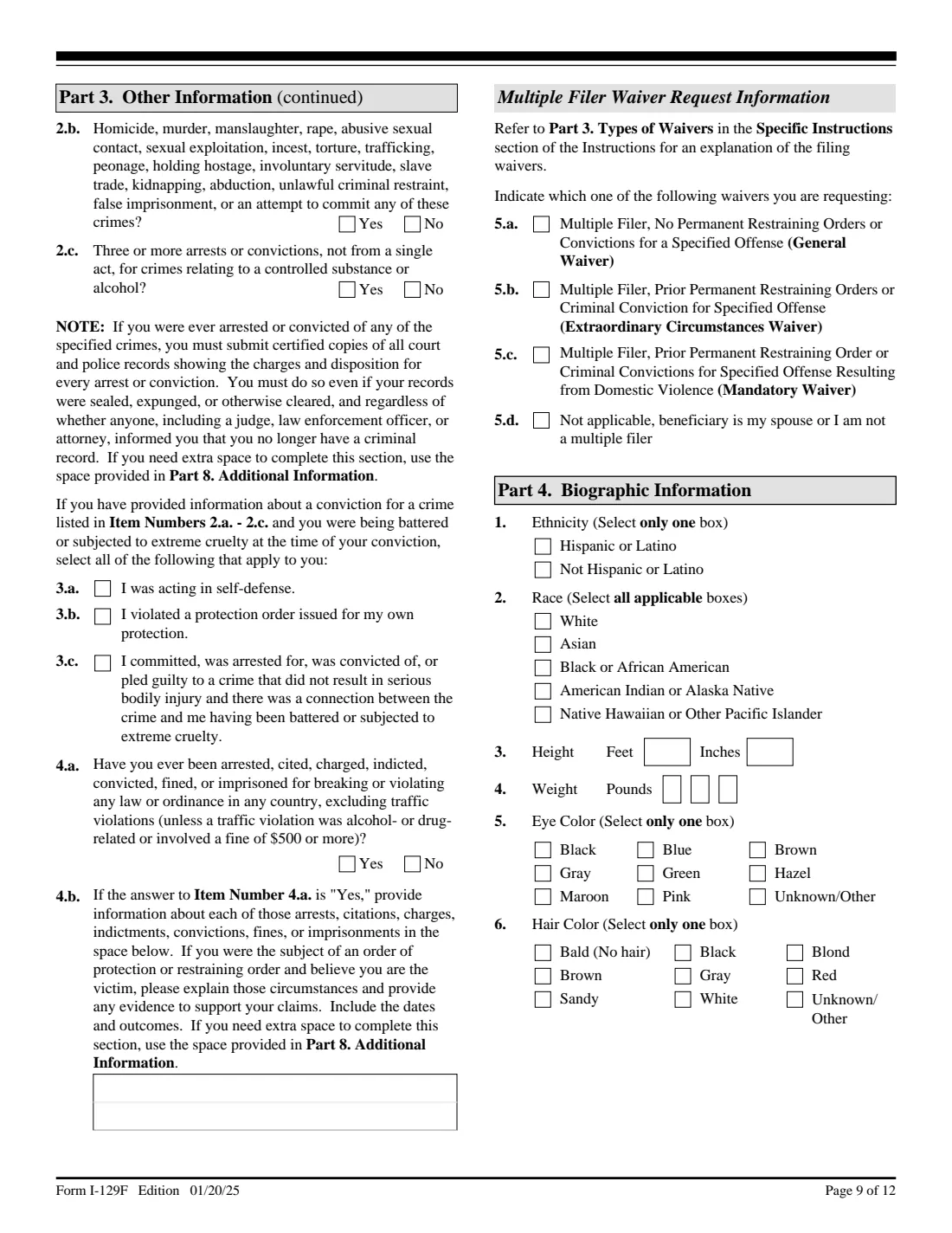
- Part 3. Other information (criminal information and waivers)Petitioner
- Part 4. Biographic information (about you, the petitioner)Petitioner
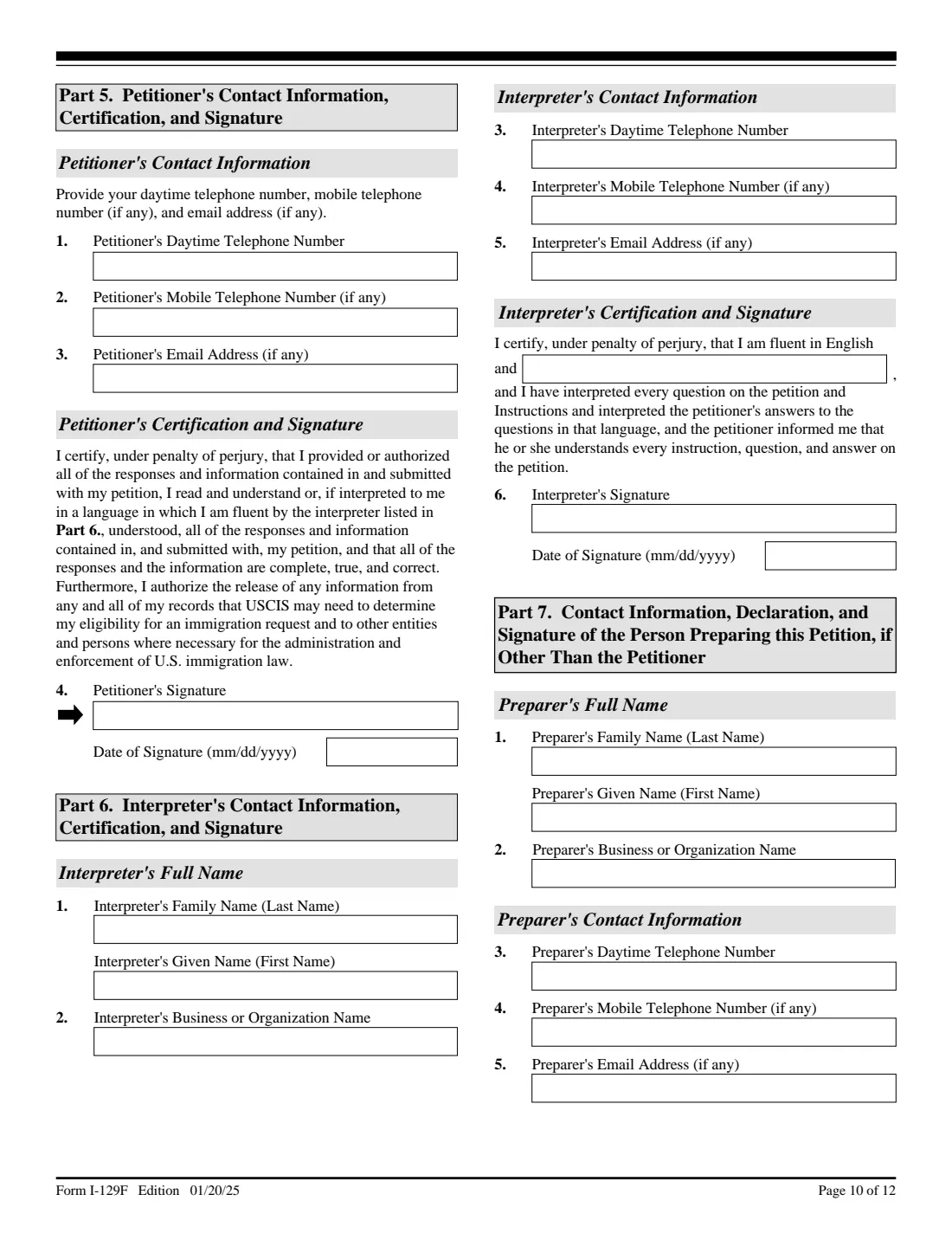
- Part 5. Petitioner's contact information, certification and signaturePetitioner
- Part 6. Interpreter's contact information, certification and signatureInterpreter
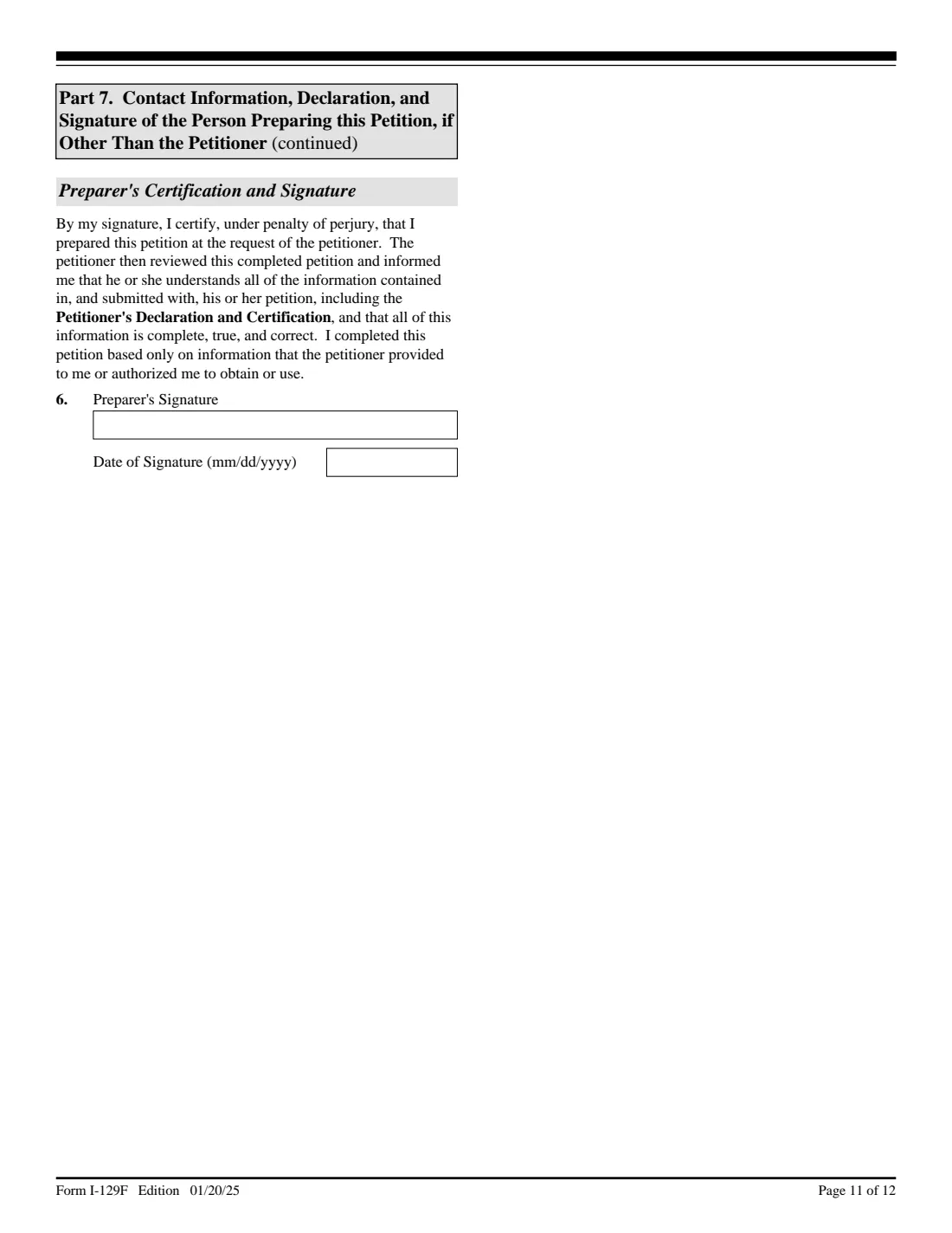
- Part 7. Person preparing this petition, if other than the petitionerPreparer
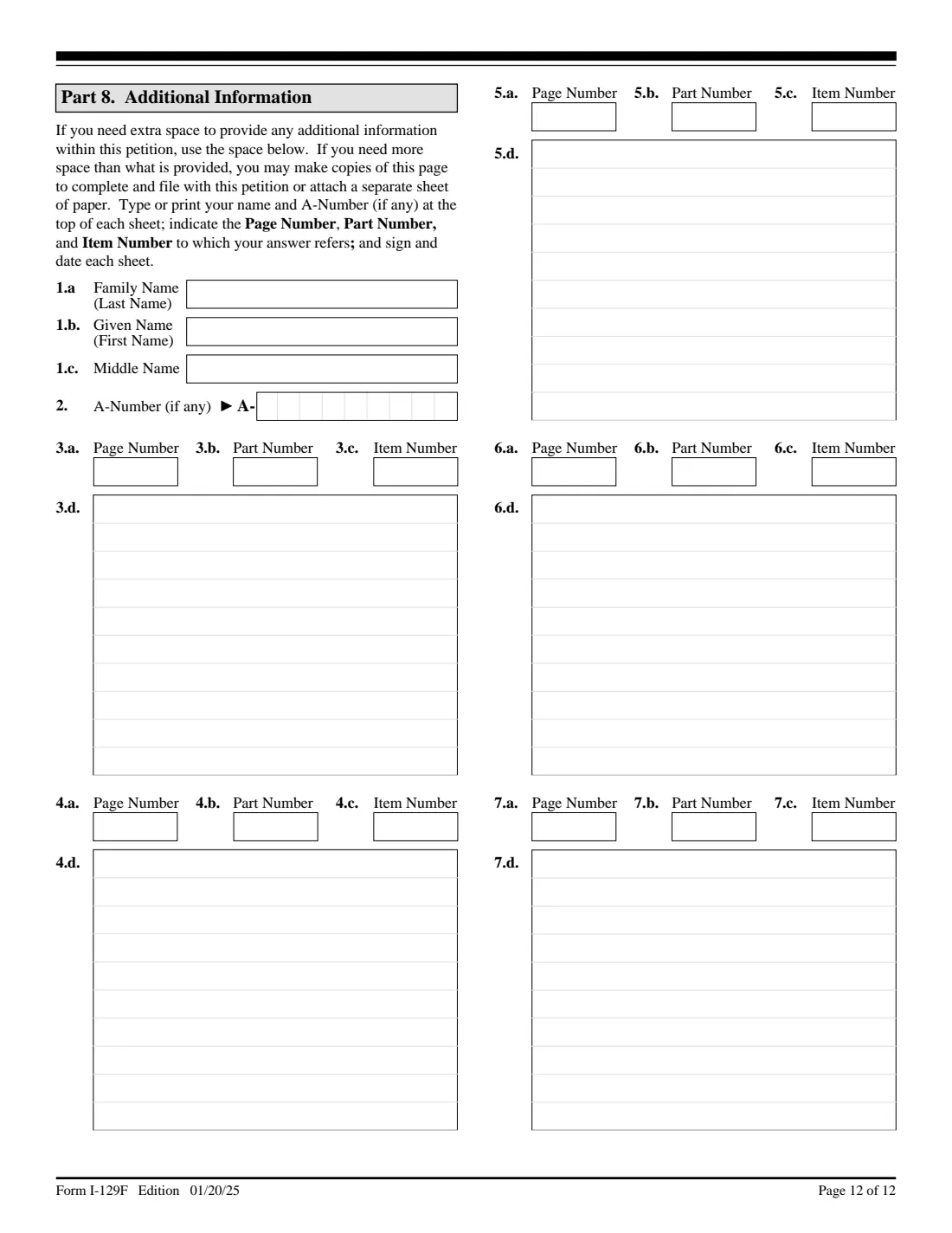
- Part 8. Additional informationPetitioner
How to fill out Form I-129F, step by step
1 Part 1. About you
Your identifiers, the K-1 or K-3 classification, names, mailing address, address and employment history, birth details, parents, prior marriages, citizenship, earlier I-129F filings, children under 18 and the states and countries you've lived in since turning 18.
2 Part 2. About your fiancé(e)
Their identity, mailing address and five-year address and job history, parents, prior marriages, time in the United States, children, where they intend to live, their address abroad and their name and address in their native alphabet.
3 Part 2. Relationship and broker
Whether you're related, whether you met in person in the last two years (and the details or reasons for an exemption), whether you met through an international marriage broker, and the U.S. Embassy or Consulate where your fiancé(e) will apply.
4 Part 3. Criminal information and waivers
Protection orders, arrests or convictions for specified crimes, and any other arrests, with details. Choose the multiple filer waiver that applies, or not applicable.
5 Parts 4 to 8
Your biographic details, contact information and signature, any interpreter and preparer, and Part 8 for anything that didn't fit, with your name and A-Number printed at the top.
Common mistakes to avoid
- Answering N/A to the relationship or meeting questions on a K-1: that option is only for a spouse.
- Leaving gaps in either partner's five-year history.
- Not explaining how and when you met in item 54, or not attaching evidence.
- Skipping the international marriage broker questions or the broker's consent form when one was used.
- Answering the criminal questions No because a record was sealed: the form says to answer even then.
After you fill it out
Print the petition, sign Part 5 by hand, and have any interpreter and preparer sign their parts.
Gather the evidence the instructions list, such as proof of citizenship, passport photos and proof of meeting, check uscis.gov/i-129f for the fee and filing address, and file it. FileIt never submits anything.
After approval, your fiancé(e) applies for the visa at the consulate you named. Keep a copy in your vault.
Fill out Form I-129F online with FileIt
- Pick the person. Choose someone from People and FileIt fills in their name, date of birth, address and other details it already knows.
- Answer plain-language questions. One part of the form at a time, with the official help text beside each question — 340 fields in all. Your answers save as you go.
- Check the live preview. Watch your answers land on the real U.S. Citizenship and Immigration Services (USCIS) form, and let FileIt do any worksheet arithmetic.
- Generate the official PDF. FileIt prints your answers into the agency’s own PDF and files it in that person’s folder in your vault.
FileIt fills the form — it never files or submits anything for you. Deliver the finished form to whoever asked for it, the way the form’s instructions say.
Start Form I-129F now — it’s freeForm I-129F: frequently asked questions
What is Form I-129F?
It is the Petition for Alien Fiancé(e): the form a U.S. citizen files so their fiancé(e) can come on a K-1 visa to marry in the United States, or so a spouse can use a K-3 visa.
Can a green-card holder file it?
No. The petitioner must be a U.S. citizen. Lawful permanent residents petition for a spouse with Form I-130.
Do we have to have met in person?
Item 53 asks whether you met in person during the two years before filing. If not, item 54 is where you explain why you're asking for an exemption, with evidence.
What is IMBRA in this form?
Items 55-61 and Part 3 come from the International Marriage Broker Regulation Act: questions about marriage brokers, protection orders and certain crimes.
How do native-alphabet names print?
FileIt prints items 49-50 in a font that covers Latin, Cyrillic and Greek letters. Scripts such as Arabic, Chinese or Hebrew can't be printed yet, so you write those by hand.
Does FileIt file the petition?
No. FileIt fills USCIS's official PDF and saves it in your vault. You sign and file it yourself.
Official sources
- Blank form (PDF), published by U.S. Citizenship and Immigration Services (USCIS): https://www.uscis.gov/sites/default/files/document/forms/i-129f.pdf
- Official instructions and guidance: https://www.uscis.gov/i-129f
- Edition shown on this page: 01/20/25 (OMB 1615-0001, expires 03/31/2027) (checked 2026-10-19).
FileIt is not affiliated with or endorsed by U.S. Citizenship and Immigration Services (USCIS) or any government. This page explains the form in general terms and is not legal, tax or immigration advice. Always read the official instructions, and check that you are using the edition the recipient accepts. Page last reviewed 2026-10-19.