What is Form DS-2029?
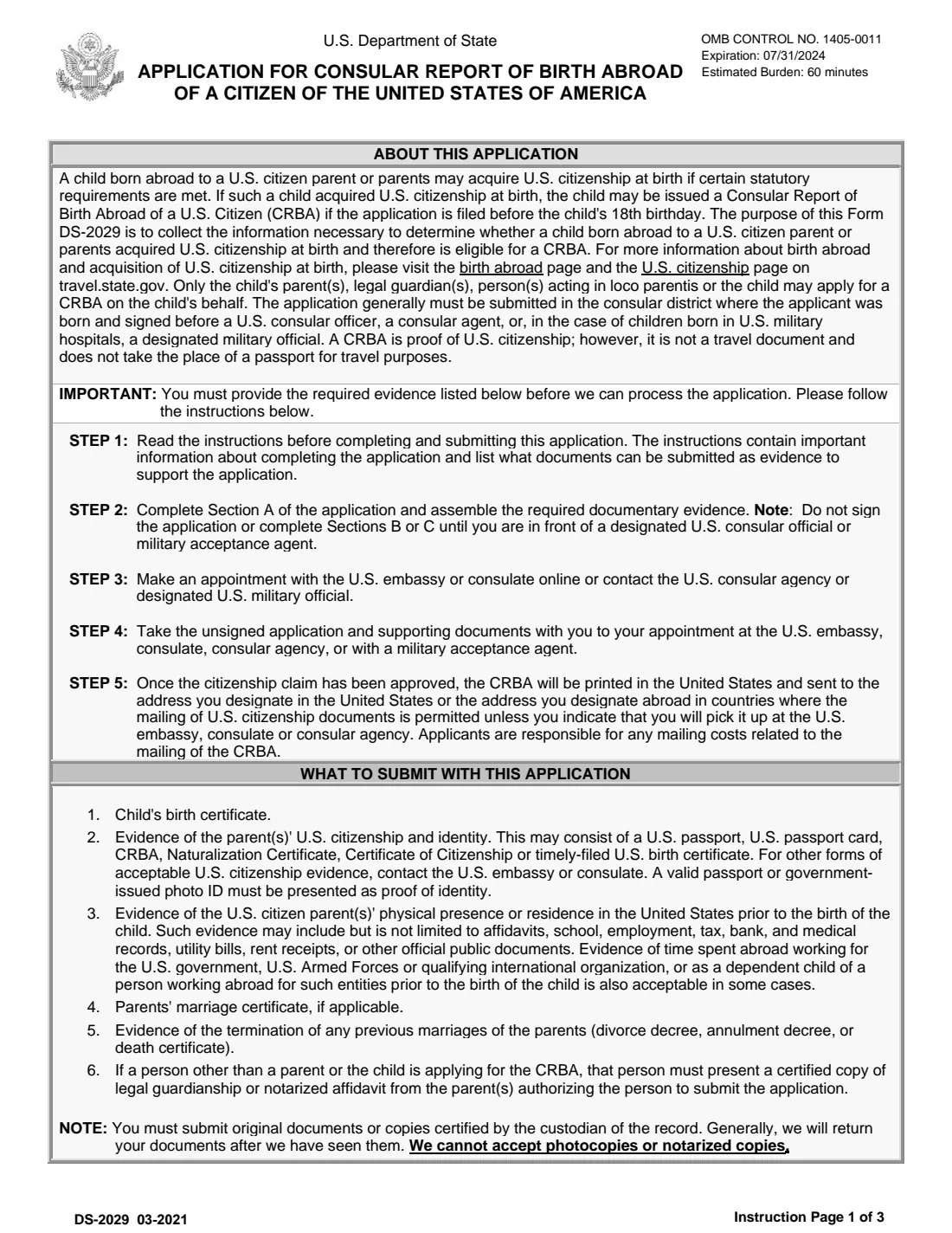
Form DS-2029 is the application for a Consular Report of Birth Abroad, or CRBA. A child born abroad to a U.S. citizen parent may acquire U.S. citizenship at birth if certain legal requirements are met, and the CRBA is the official record of it. The application must be filed before the child's 18th birthday, usually in the consular district where the child was born.
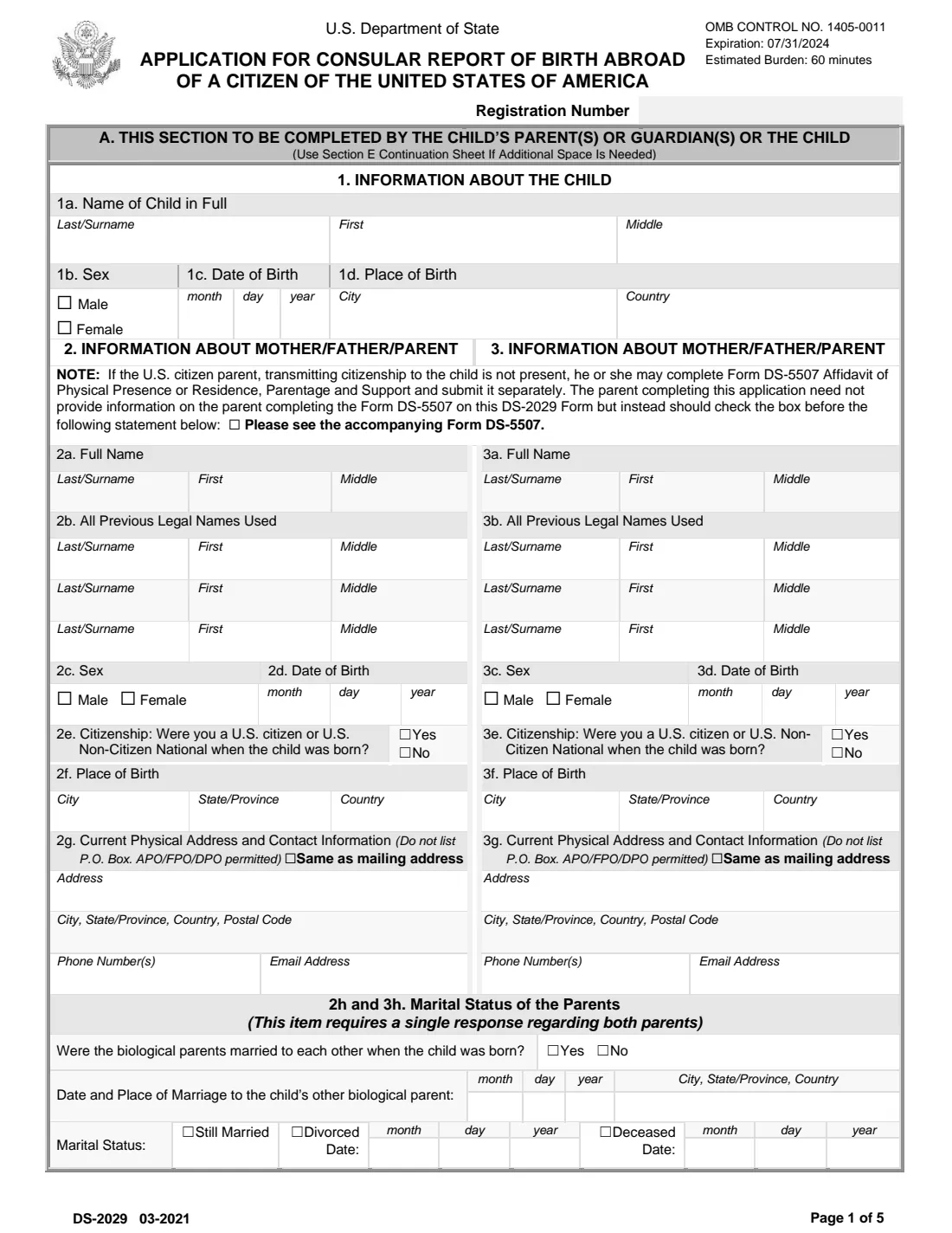
Section A covers the child's name, sex, date and place of birth, then details about each parent: names, all previous legal names, citizenship at the child's birth, place of birth, current address, marriages, every period spent in the United States, and any time abroad with the U.S. Armed Forces, a U.S. government agency or a qualifying international organization. The physical presence periods matter, because they show whether a parent can pass on citizenship. The CRBA proves citizenship but isn't a travel document, so the child still needs a passport to travel.
FileIt splits Section A into short steps for the child, each parent, their time in the U.S., and the parents' marriage, then places the answers on the State Department's own DS-2029. Dates are spread across the month, day and year boxes for you, and the continuation sheet is there for anything that doesn't fit. The child's details come from your family vault, and the unsigned application is saved to the child's folder for your consulate appointment.
- Who applies
- The child's parent(s), legal guardian(s), a person acting in loco parentis, or the child.
- Deadline
- Before the child's 18th birthday.
- Where
- At a U.S. embassy, consulate or consular agency (or with a designated military official for births in U.S. military hospitals), by appointment.
- Signed
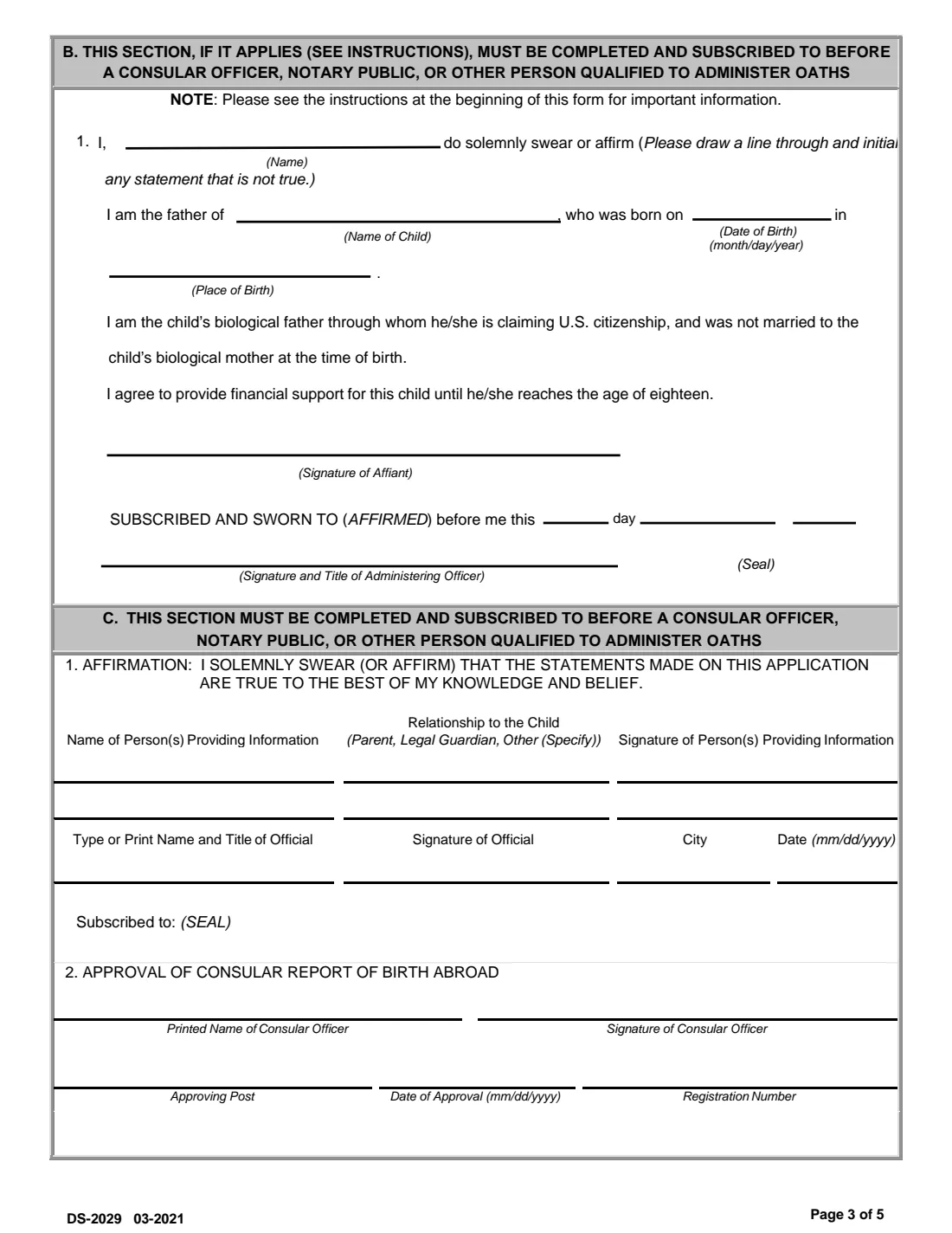
- At the appointment, in front of the consular officer. Sections B and C are completed there too.
- Edition
- DS-2029 03-2021 (OMB 1405-0011; printed expiry 07/31/2024)
Who needs to fill out Form DS-2029?
- U.S. citizen parents of a baby born in another country.
- Families abroad with a child under 18 who was never registered as a U.S. citizen at birth.
- Military families whose child was born in a U.S. military hospital overseas.
- Legal guardians applying for a child with written authority from the parents.
When to use Form DS-2029
- As soon as practical after a child is born abroad, and always before their 18th birthday.
- Before booking a consulate appointment, so you arrive with a completed but unsigned Section A.
- Together with Form DS-5507 when the U.S. citizen parent who passes on citizenship can't attend.
What you need before you start
- The child's local birth certificate.
- Each parent's passport or ID, and evidence of the U.S. parent's citizenship, such as a U.S. passport or naturalization certificate.
- Evidence of the U.S. citizen parent's time in the United States before the birth, such as school, employment, tax or medical records.
- The parents' marriage certificate, and divorce or death records for any earlier marriages.
- All previous legal names of each parent, and the dates of each period in the United States or in qualifying service abroad.
- Official documentation of any time abroad in the U.S. military, government service or a qualifying international organization.
What’s on Form DS-2029
The 2021 edition has 8 pages. FileIt asks for it in 8 parts:
- Section A, item 1: The childParent, legal guardian or the child
- Item 2: Mother/father/parentParent, legal guardian or the child
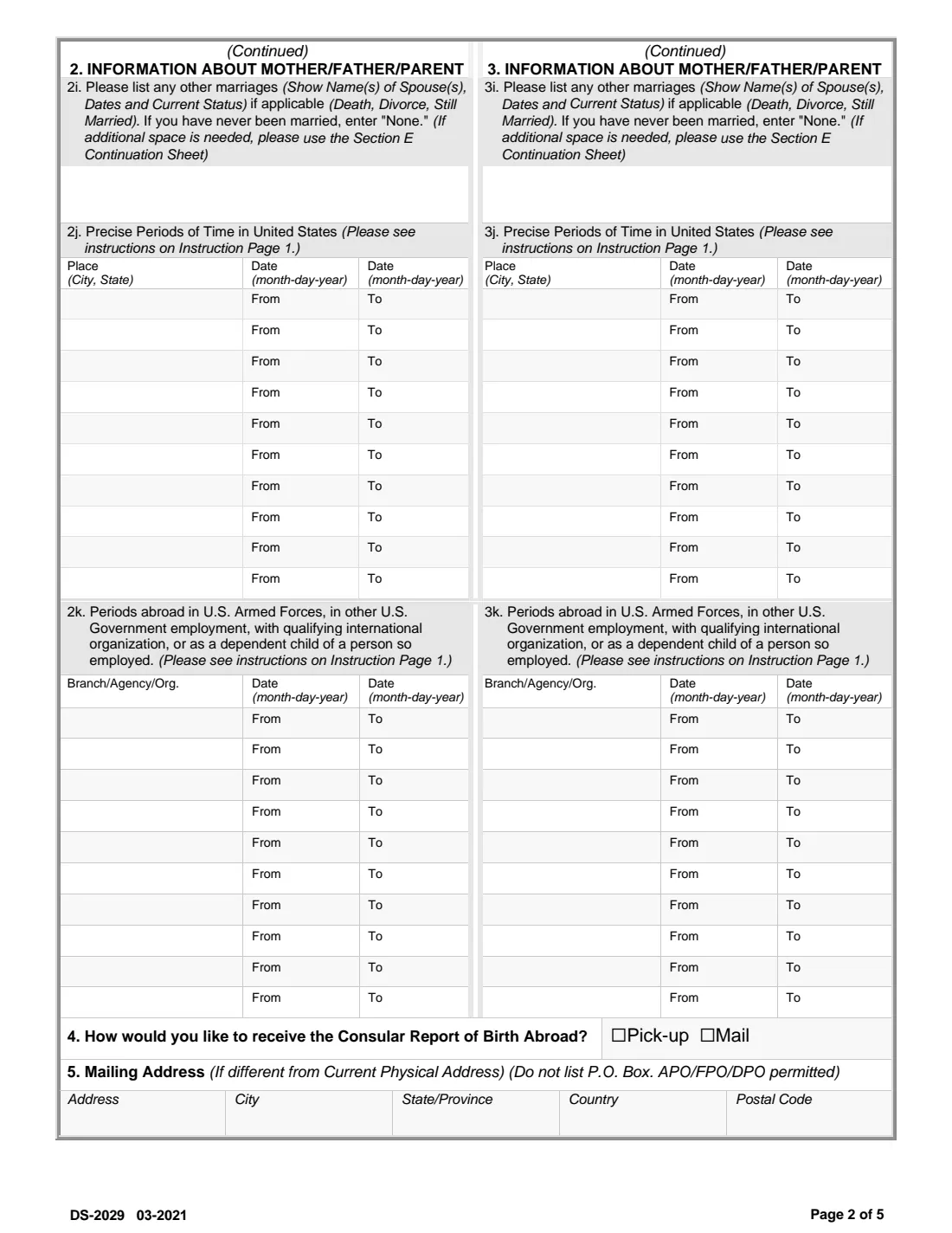
- Items 2j and 2k: This parent's time in the United States and abroad in serviceParent, legal guardian or the child
- Item 3: Second mother/father/parentParent, legal guardian or the child
- Items 3j and 3k: Second parent's time in the United States and abroad in serviceParent, legal guardian or the child
- Items 2h and 3h: Marital status of the parentsParent, legal guardian or the child
- Items 4 and 5: Getting the CRBAParent, legal guardian or the child
- Section E: Continuation sheetParent, legal guardian or the child
How to fill out Form DS-2029, step by step
1 Item 1: The child
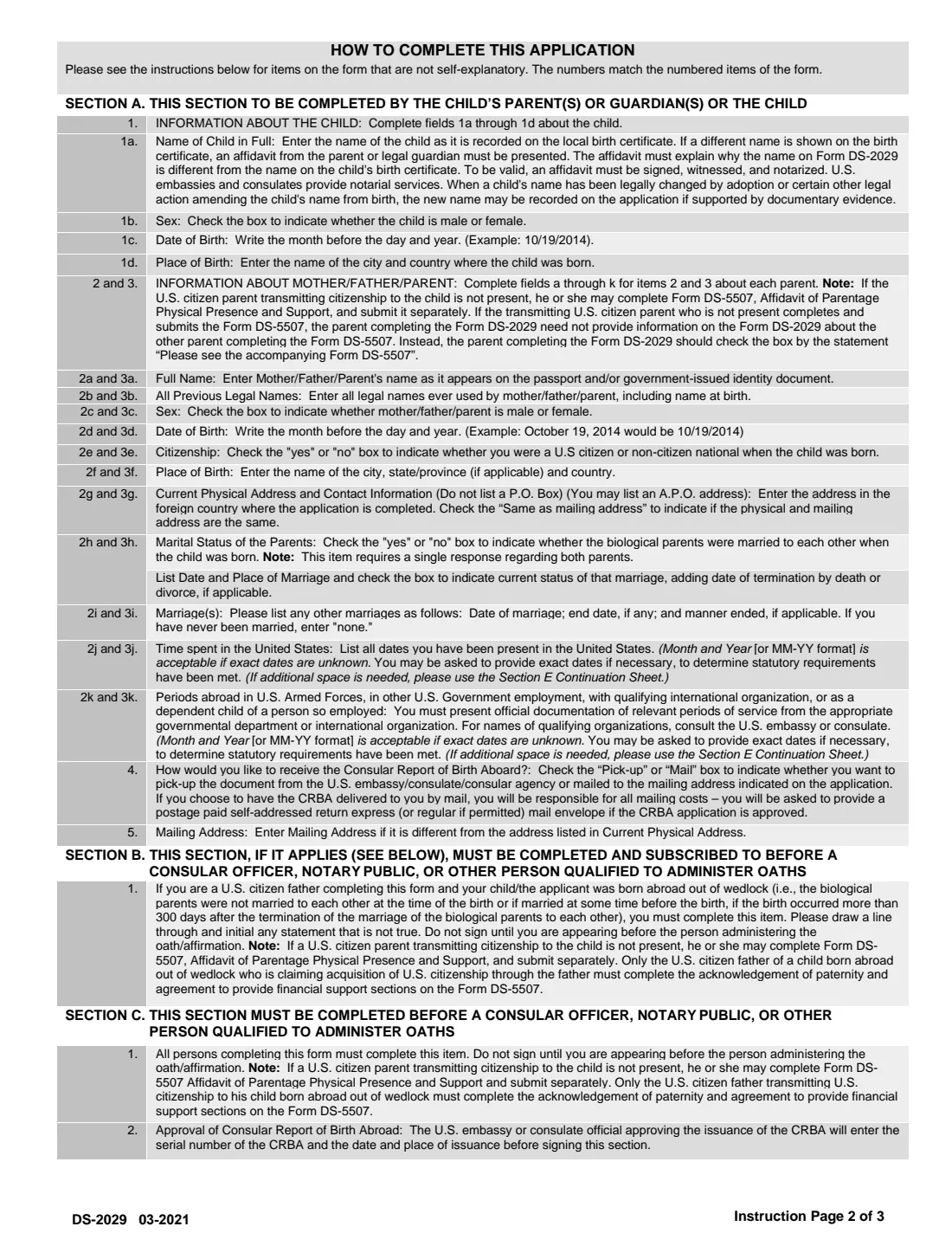
Enter the child's name exactly as it appears on the local birth certificate, their sex, date of birth, and city and country of birth.
2 Items 2a-2g and 3a-3g: The parents
For each parent, give their current and previous legal names, sex, date and place of birth, U.S. citizenship at the child's birth, current address and contact details.
3 Items 2i-2k: History
List other marriages (or None), every period in the United States with dates, and any time abroad in the U.S. military, government service or a qualifying organization.
4 Items 2h and 3h: Marriage
Say whether the biological parents were married to each other at the birth, with the date and place of marriage and its current status.
5 Items 4-5: Delivery
Choose to pick up the CRBA or have it mailed, and give a mailing address if it differs from your current address.
Common mistakes to avoid
- Signing the application, or filling in Sections B or C, before you're in front of the consular officer.
- Bringing photocopies or notarized copies. The form asks for originals or copies certified by the record's custodian.
- Leaving gaps in the U.S. physical presence periods for the U.S. citizen parent.
- Entering a different name from the local birth certificate without the required affidavit.
- Waiting until after the child turns 18, when a CRBA can no longer be issued.
After you fill it out
Book an appointment with the U.S. embassy or consulate and bring the unsigned application with all original documents.
Sign Section C in front of the consular officer, who completes the official parts. A U.S. citizen father not married to the mother at the birth also completes Section B there, or Form DS-5507.
Once approved, the CRBA is printed in the U.S. and mailed or held for pick-up. Store a scan in the child's FileIt folder, then apply for the child's passport.
Keep the CRBA somewhere safe. It can serve as the child's proof of U.S. citizenship for later applications, such as a passport.
Fill out Form DS-2029 online with FileIt
- Pick the person. Choose someone from People and FileIt fills in their name, date of birth, address and other details it already knows.
- Answer plain-language questions. One part of the form at a time, with the official help text beside each question — 189 fields in all. Your answers save as you go.
- Check the live preview. Watch your answers land on the real U.S. Department of State form, and let FileIt do any worksheet arithmetic.
- Generate the official PDF. FileIt prints your answers into the agency’s own PDF and files it in that person’s folder in your vault.
FileIt fills the form — it never files or submits anything for you. Deliver the finished form to whoever asked for it, the way the form’s instructions say.
Start Form DS-2029 now — it’s freeForm DS-2029: frequently asked questions
Is a CRBA the same as a passport?
No. The form says a CRBA is proof of U.S. citizenship but is not a travel document and doesn't take the place of a passport.
Is there an age limit for a CRBA?
Yes. The application must be filed before the child's 18th birthday.
What if the U.S. citizen parent can't come to the appointment?
They can complete Form DS-5507 and send it separately. Then tick the box on the DS-2029 that says to see the accompanying DS-5507, and skip that parent's details.
Do I sign the DS-2029 before my appointment?
No. The instructions say to complete Section A only, and to sign and complete Sections B and C in front of the consular officer or military acceptance agent.
What if I don't know exact dates for my time in the U.S.?
The instructions accept month and year (or MM-YY) when exact dates are unknown, though you may be asked for exact dates later.
Does FileIt submit the application?
No. FileIt fills the official PDF and saves it in your vault. You bring it to your consulate appointment.
Do I bring originals or copies?
Originals, or copies certified by the custodian of the record. The form says photocopies and notarized copies aren't accepted, and originals are generally returned after review.
Who pays for mailing the CRBA?
You do. If you choose mail, you may be asked for a postage-paid, self-addressed return envelope once the application is approved.
Can someone other than a parent apply?
A legal guardian or person acting in loco parentis can, with a certified copy of the guardianship or a notarized affidavit from the parents authorizing them.
Official sources
- Blank form (PDF), published by U.S. Department of State: https://eforms.state.gov/Forms/ds2029.pdf
- Official instructions and guidance: https://travel.state.gov/content/travel/en/international-travel/while-abroad/birth-abroad.html
- Edition shown on this page: DS-2029 03-2021 (OMB 1405-0011; the expiry printed on the form is 07/31/2024) (checked 2026-10-19).
FileIt is not affiliated with or endorsed by U.S. Department of State or any government. This page explains the form in general terms and is not legal, tax or immigration advice. Always read the official instructions, and check that you are using the edition the recipient accepts. Page last reviewed 2026-10-19.