What is Form 14A?
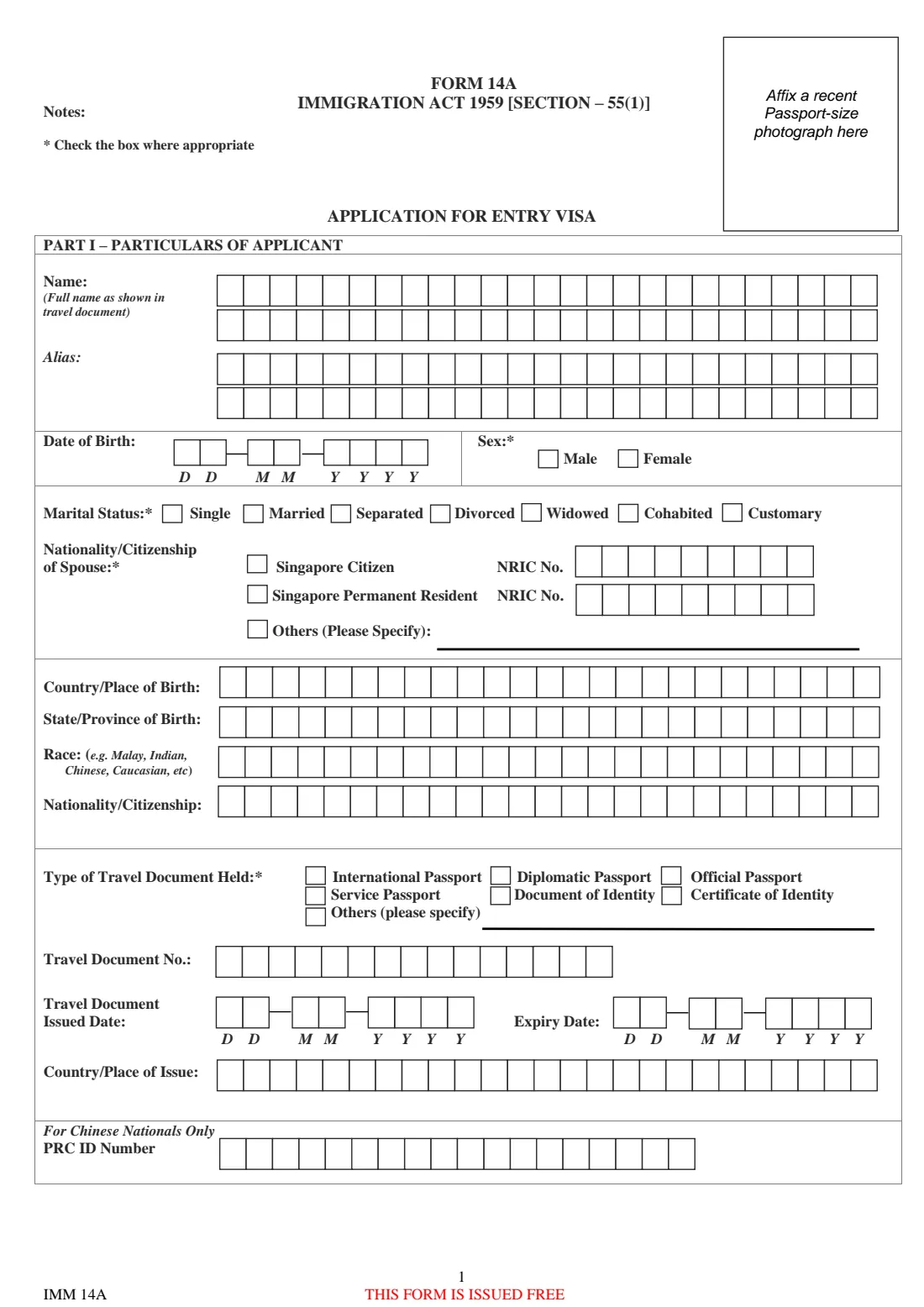
Form 14A, marked IMM 14A and issued under section 55(1) of the Immigration Act 1959, is the Immigration & Checkpoints Authority's (ICA) application for an entry visa to Singapore. Visitors of nationalities that need a visa use it — for example a parent coming to see a son or daughter who works in Singapore, or grandparents visiting a new grandchild. The four-page form covers the applicant's particulars and travel document, their home address, the planned visit, where they will stay, any long stays in other countries, a travelling companion for young children, the local contact in Singapore, four background questions and the applicant's declaration. The form carries no edition date; FileIt uses the version ICA published in September 2026.
The application can go in two ways. A local contact in Singapore — a relative, friend or company — or one of ICA's strategic partners can submit it online through ICA's e-Service, uploading the signed form. Or the applicant can lodge it at the nearest Singapore Overseas Mission or its authorised visa agent. Either way, ICA asks for the form signed by the applicant, a recent passport-size photograph, a copy of the passport's personal-particulars page and, case by case, a letter of introduction (Form V39A) signed by the local contact.
FileIt guides you through every part of Form 14A and prints the answers onto ICA's own PDF: capital letters one per box where the form has letter boxes, the date boxes split into day, month and year, and the chosen boxes marked. Long names are broken between words across the two rows of boxes. The finished PDF is saved in the person's vault folder, and because an e-Service application uploads the signed form, you can send it to the applicant for e-signature. FileIt never submits the application to ICA.
- Who fills it
- The visitor applying for the visa (a parent or guardian for a child), with the local contact's details in Part III
- Given to
- ICA, through the e-Service by a local contact or strategic partner, or at a Singapore Overseas Mission or its authorised visa agent
- When
- Before travelling to Singapore, for each trip the visa should cover
- Signatures
- The applicant signs Part V; the local contact signs the separate letter of introduction (V39A) when it is asked for
- Cost of the form
- The form itself is issued free, as printed at the foot of every page
- Edition
- IMM 14A (no edition date printed; retrieved September 2026)
Who needs to fill out Form 14A?
- Visitors whose nationality requires a visa to enter Singapore, coming for a social or business visit.
- Parents, parents-in-law and other relatives visiting family members who live or work in Singapore.
- Friends of Singapore residents invited to visit, with the resident acting as the local contact.
- Business visitors whose local contact is a Singapore company, or who are booked into a hotel.
- Children travelling to Singapore — a parent or guardian completes the form, and the travelling companion part applies to a child of 12 or under.
- Singapore citizens, permanent residents and companies who act as a relative's or guest's local contact and want to help them get the form right.
When to use Form 14A
- Before booking non-refundable travel, leaving time for ICA to process the application.
- For each new visit if the visa you hold does not cover it: the form lets you ask for a single, double, triple or multiple-journey visa.
- When a relative plans a longer stay — if it is more than 30 days, Part II asks for the reason and the duration.
- When the applicant has a new passport, because the visa application is tied to the travel document number and dates.
What you need before you start
- The applicant's passport or other travel document, with its number, issue and expiry dates and country of issue.
- A recent passport-size colour photograph, taken within the last three months, to affix on page 1.
- The applicant's full address in their country of origin or residence, including state, prefecture and county or district where these apply.
- Occupation, highest qualification, annual income converted to Singapore dollars, and religion.
- The expected arrival date, visa type, purpose of visit and how long the visit will last.
- The full Singapore address where the applicant will stay: block or house number, floor, unit, postal code, street and building name, and a contact number.
- Details of any country or place (other than the country of origin) where the applicant lived for a year or more in the last five years, with dates.
- The local contact's name, relationship to the applicant, phone number and email address.
- For nationals of the People's Republic of China, the 18-character PRC resident ID number.
- For a child of 12 or under travelling with a companion, the companion's name, relationship, date of birth, nationality and travel document number.
What’s on Form 14A
The 2026 edition has 4 pages. FileIt asks for it in 10 parts, and it is signed by Applicant:
- Part I – Particulars of applicantApplicant
- Part I – Travel documentApplicant
- Address in country/place of origin/residenceApplicant
- Part II – Other detailsApplicant
- Address in SingaporeApplicant
- Residence in other countries/places (last 5 years)Applicant
- Details of travelling companionApplicant
- Part III – Particulars of local contactLocal contact (sponsor)
- Part IV – Antecedent of applicantApplicant
- Part V – Declaration by applicantApplicant
How to fill out Form 14A, step by step
1 Part I – Particulars of applicant
Give the name exactly as it appears in the travel document, plus any alias, date of birth, sex and marital status. If the applicant is married, separated or in a customary marriage, say whether the spouse is a Singapore citizen or permanent resident (with their NRIC number) or another nationality. Then country and state or province of birth, race and nationality.
The name has two rows of 25 boxes. FileIt breaks a long name between words across the rows so no word is split, and warns you if the name will not fit.
2 Part I – Travel document
Tick the type of travel document held — international (ordinary), diplomatic, official or service passport, document of identity, certificate of identity or other — and give its number, issue and expiry dates and country of issue. Chinese nationals also give their PRC ID number in the row at the bottom of page 1.
Check that the passport will still be valid for the whole trip; FileIt warns if it expires before the arrival date you give.
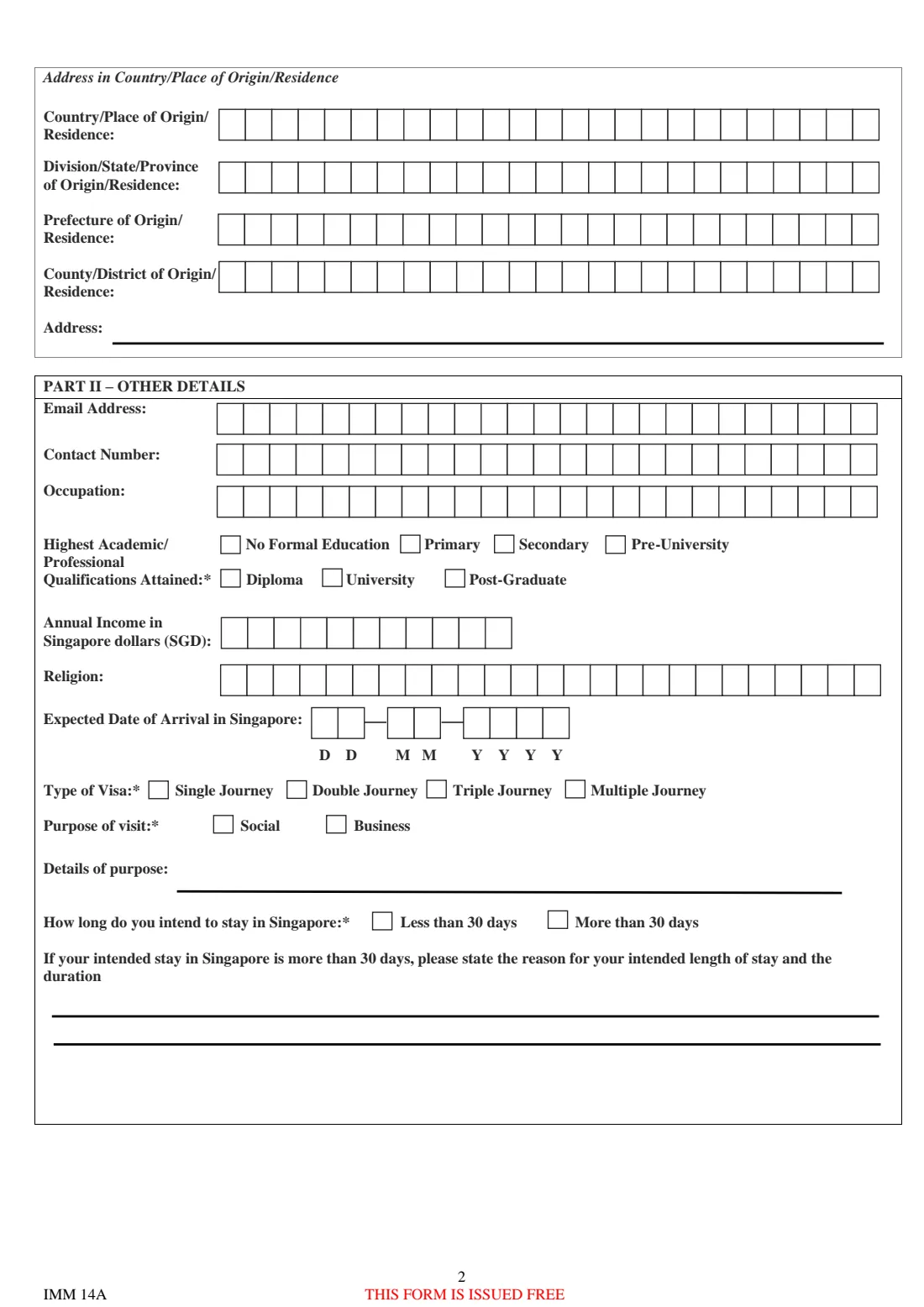
3 Address in country/place of origin/residence
Where the applicant normally lives: country, division or state, prefecture and county or district, then the full address on one line. Leave the prefecture and county rows empty if the country does not use them.
4 Part II – Other details
Email, contact number and occupation go into 25-letter boxes, so keep them short. Tick the highest qualification, give the annual income in Singapore dollars and the religion, then the expected arrival date.
Choose the type of visa (single, double, triple or multiple journey) and the purpose (social or business), and describe the purpose in a line — for example visiting a son and his family. Say whether the stay will be less or more than 30 days; for more than 30 days, explain why and for how long.
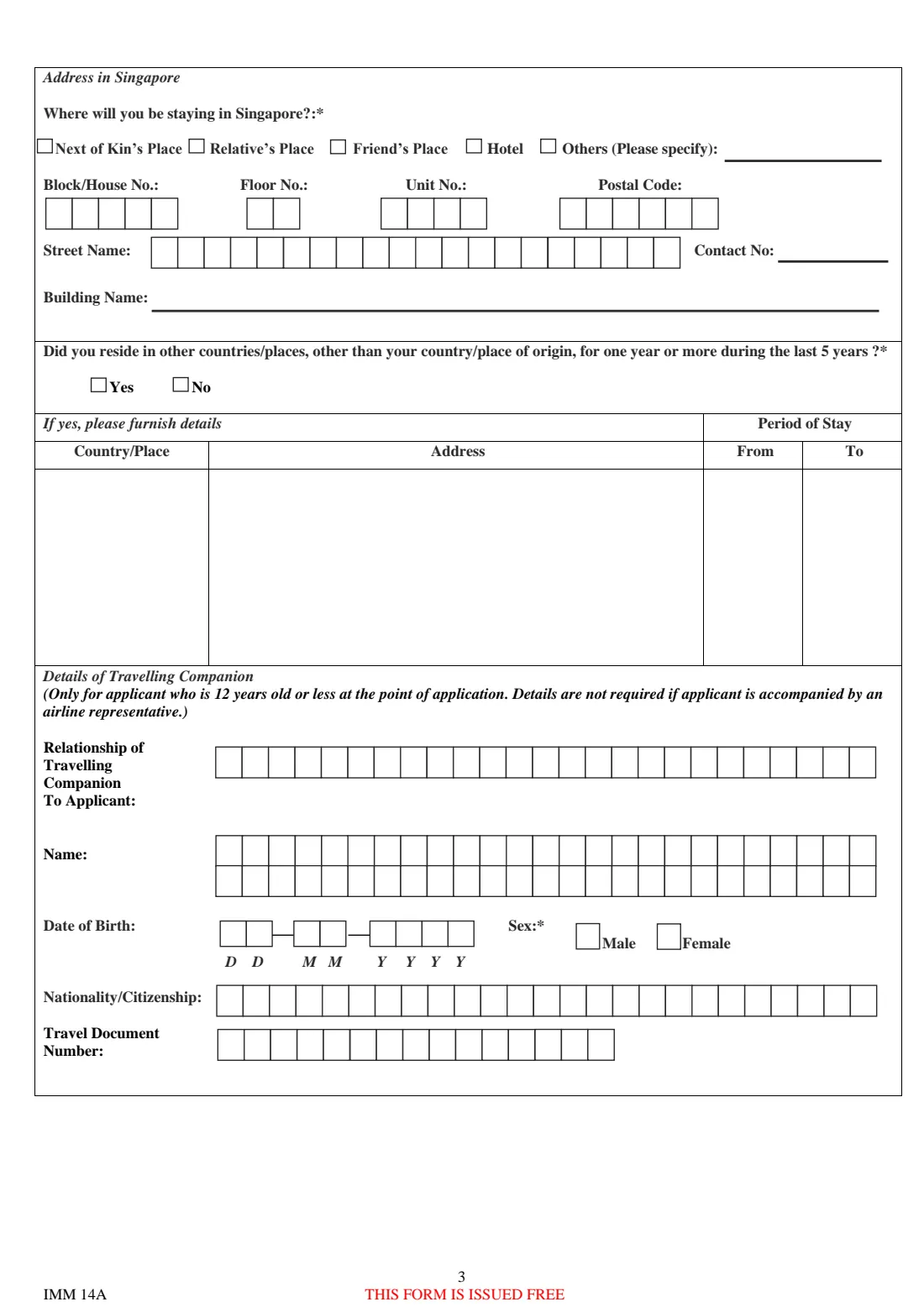
5 Address in Singapore
Tick where the applicant will stay — next of kin's, relative's or friend's place, a hotel, or somewhere else — and give the address in the form's boxes: block or house number, floor and unit (for a flat such as Blk 123 #08-45), the six-digit postal code, the street name and the building name, with a contact number there.
6 Residence in other countries/places
Answer whether the applicant lived in any country or place other than their country of origin for one year or more in the last five years. If yes, list each one with the address and the period of stay from and to. FileIt keeps the columns lined up so each row reads across.
7 Details of travelling companion
Only for an applicant who is 12 years old or less when applying, and not needed if an airline representative accompanies the child. Give the companion's relationship to the child, name, date of birth, sex, nationality and travel document number.
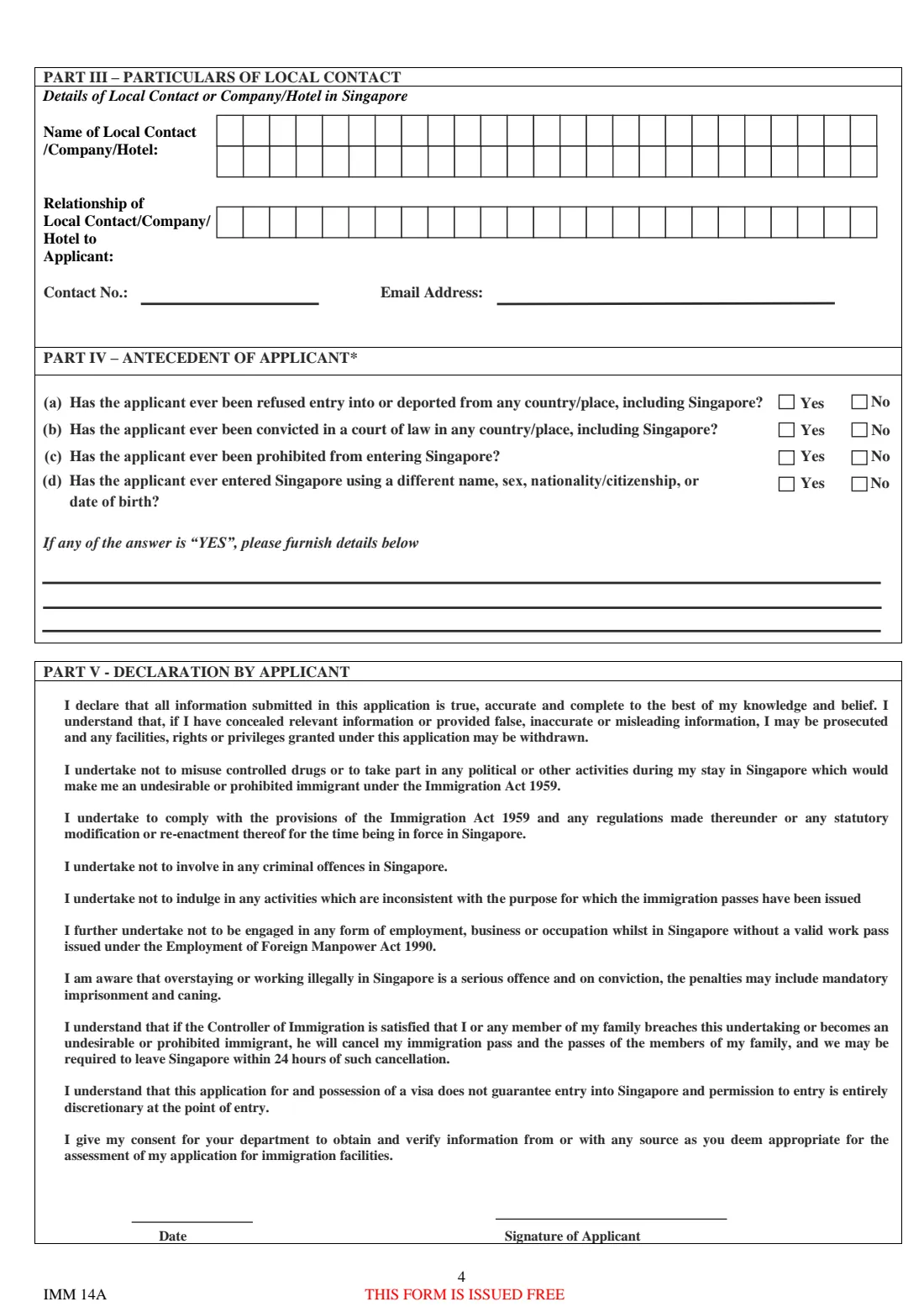
8 Part III – Particulars of local contact
The local contact, company or hotel in Singapore: their name, relationship to the applicant, phone number and email. For a family visit this is usually the relative the applicant is coming to see, and for an e-Service application it is the person who submits it.
9 Part IV – Antecedent of applicant
Four yes-or-no questions: has the applicant ever been refused entry into or deported from any country, been convicted in a court of law anywhere, been prohibited from entering Singapore, or entered Singapore using a different name, sex, nationality or date of birth? If any answer is yes, give the details on the lines below. Answer every question truthfully.
10 Part V – Declaration by applicant
The applicant declares that the information is true and undertakes, among other things, not to misuse controlled drugs, not to work without a valid work pass and to comply with the Immigration Act 1959. The declaration warns that overstaying or working illegally can lead to mandatory imprisonment and caning, and that a visa does not guarantee entry. The applicant signs and dates it.
Common mistakes to avoid
- Writing the name differently from the passport. Use exactly the spelling and order in the travel document.
- Squeezing a long email address into the 25 boxes. If it does not fit, use a shorter address.
- Forgetting the spouse's NRIC number when the spouse is a Singapore citizen or permanent resident.
- Ticking 'More than 30 days' without explaining the reason and the length of the stay.
- Leaving Part IV blank, or answering yes without giving details below.
- Filling in the travelling companion part for an applicant older than 12.
- Using a passport that expires before or during the trip.
- Sending the form without the applicant's signature — it must be signed by the applicant.
After you fill it out
Have the applicant sign and date Part V, and affix a recent passport-size photograph. If the application is made through ICA's e-Service, the local contact uploads the signed form with the other documents ICA asks for, so an e-signature through FileIt can save posting paper back and forth. If you lodge it at a Singapore Overseas Mission or its authorised visa agent, print the form and sign it by hand.
Collect the supporting documents: a copy of the passport's personal-particulars page and, if ICA asks for one, the letter of introduction (Form V39A) signed by the local contact. Documents in other languages need official translations. FileIt does not submit anything; the local contact or the applicant does.
Keep the filled form in the FileIt vault for the applicant, next to their passport. If they visit again, most answers can be reused and only the dates and details of the new trip need changing.
Fill out Form 14A online with FileIt
- Pick the person. Choose someone from People and FileIt fills in their name, date of birth, address and other details it already knows.
- Answer plain-language questions. One part of the form at a time, with the official help text beside each question — 96 fields in all. Your answers save as you go.
- Check the live preview. Watch your answers land on the real Immigration & Checkpoints Authority (ICA) form, and let FileIt do any worksheet arithmetic.
- Generate the official PDF. FileIt prints your answers into the agency’s own PDF and files it in that person’s folder in your vault. Sign it, or send it for e-signature.
FileIt fills the form — it never files or submits anything for you. Deliver the finished form to whoever asked for it, the way the form’s instructions say.
Start Form 14A now — it’s freeForm 14A: frequently asked questions
Can I fill in Form 14A online?
Yes. FileIt lets you fill in Form 14A online for free and prints the answers onto ICA's official PDF, one letter per box. You then sign it, or send it to the applicant for e-signature, and submit it through the e-Service or at a mission yourself.
Where do I submit Form 14A?
Either online through ICA's e-Service, by a local contact in Singapore or a strategic partner, or at the nearest Singapore Overseas Mission or its authorised visa agent. FileIt does not submit it for you.
Who is the local contact?
The person, company or hotel in Singapore connected to the visit, usually the relative or friend the applicant is visiting. Their details go in Part III, and for an e-Service application they submit it.
Does the local contact sign Form 14A?
No. Form 14A is signed by the applicant only. When ICA asks for it, the local contact signs a separate letter of introduction, Form V39A.
Is there a fee for Form 14A?
The form itself is issued free, as printed on every page. Check ICA's visa pages for any visa fee, since FileIt does not quote it.
Do I need the travelling companion section?
Only when the applicant is 12 years old or less at the time of application, and not if the child is accompanied by an airline representative.
What if the visit is longer than 30 days?
Tick 'More than 30 days' and explain the reason and the intended duration in the lines provided.
Can the applicant sign electronically?
For an e-Service application the signed form is uploaded, so FileIt offers e-signature for the applicant. For a paper application at an overseas mission, print it and sign by hand.
Official sources
- Blank form (PDF), published by Immigration & Checkpoints Authority (ICA): https://www.ica.gov.sg/docs/default-source/ica/forms/form14a.pdf
- Official instructions and guidance: https://www.ica.gov.sg/enter-transit-depart/entering-singapore/visa_requirements
- Edition shown on this page: IMM 14A (no edition date printed; retrieved September 2026) (checked 2026-09-25).
FileIt is not affiliated with or endorsed by Immigration & Checkpoints Authority (ICA) or any government. This page explains the form in general terms and is not legal, tax or immigration advice. Always read the official instructions, and check that you are using the edition the recipient accepts. Page last reviewed 2026-09-25.