
What is Tax Residency Certificate application?
When income comes from another country, that country often taxes it unless you can show you are tax resident somewhere it has a double taxation avoidance agreement (DTAA) with. In Sri Lanka, the proof is a Tax Residency Certificate from the Inland Revenue Department. The CLR_TRC application is how individuals and entities ask for one.
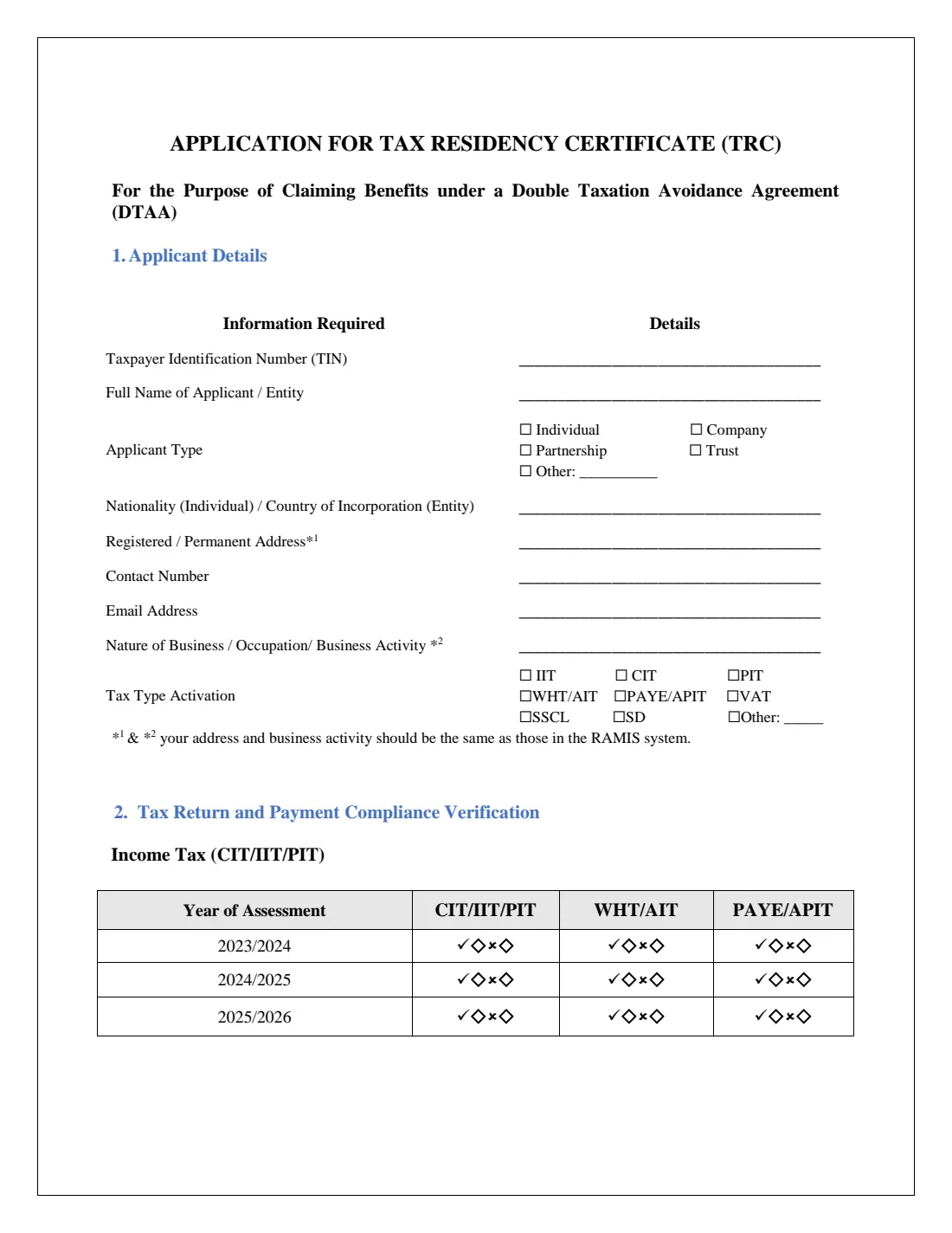
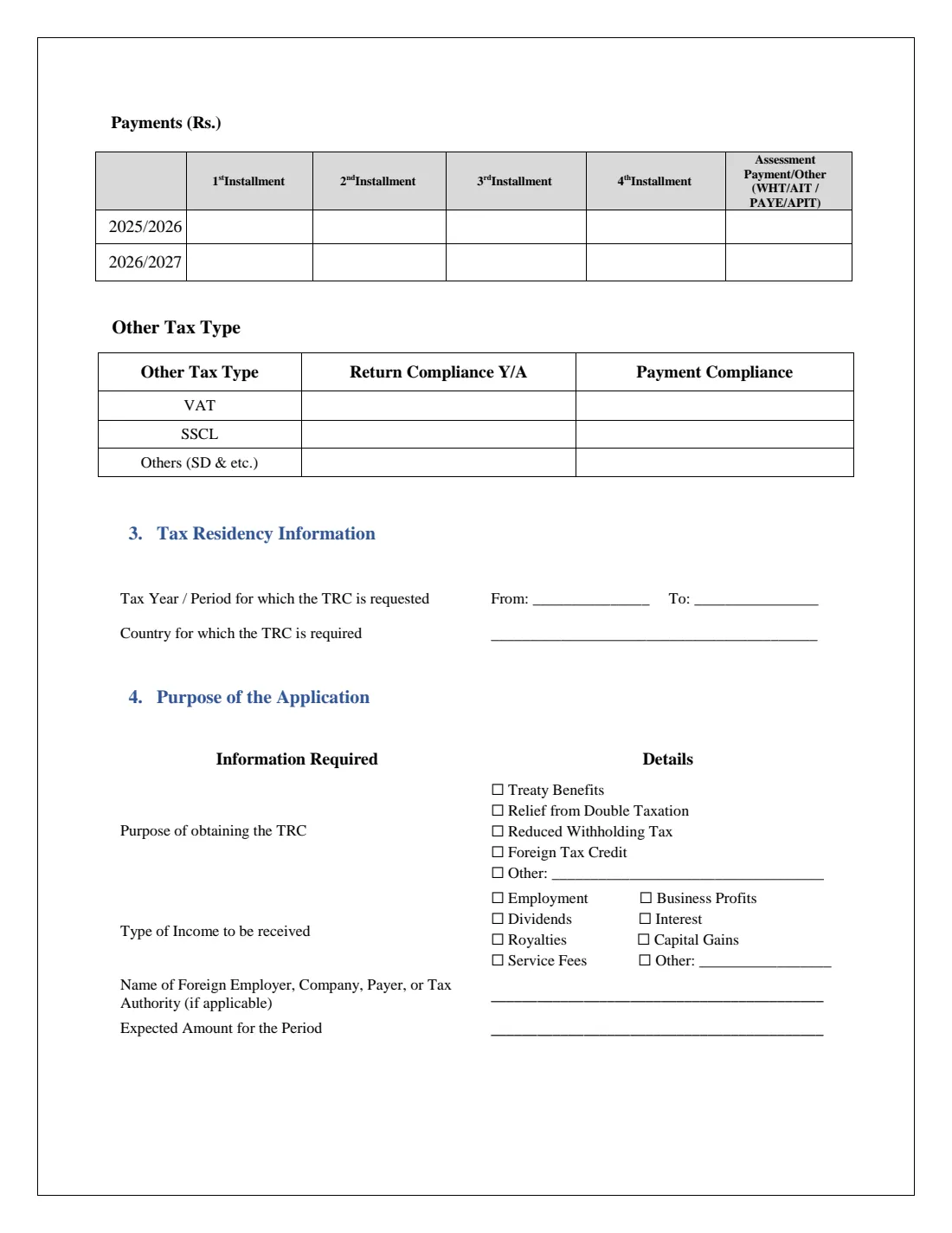
The three-page form asks for your registration details as they stand in RAMIS, the taxes activated for you, a short record of income tax returns and payments for recent years of assessment, any VAT, SSCL or other tax compliance, the period and country the certificate is for, the purpose and the type of income, and the documents you attach. It closes with a declaration that your returns and payments are up to date.
FileIt asks the questions in order, marks the boxes and the ✓ / × diamonds you choose, formats the payment amounts in rupees and prints everything onto IRD's own PDF. Your name and email can come from People. The finished application is saved in your vault, ready to submit to the Department yourself. FileIt never files it.
- Who fills it
- Individuals, companies, partnerships and trusts resident in Sri Lanka
- Given to
- The Inland Revenue Department, Sri Lanka
- Purpose
- Claiming benefits under a double taxation avoidance agreement
- Signatures
- The form has a declaration but no signature line
- Pages
- 3
- Edition
- CLR_TRC_2026_E (October 2026)
Who needs to fill out Tax Residency Certificate application?
- Sri Lankan residents earning fees, salaries, dividends, interest or royalties from abroad.
- Consultants and freelancers whose foreign clients ask for a certificate of residence before paying without full withholding tax.
- Companies claiming reduced withholding tax on payments from a treaty country.
- Taxpayers claiming a foreign tax credit or relief from double taxation.
- Partnerships and trusts asked for proof of Sri Lankan tax residence by a foreign tax authority.
When to use Tax Residency Certificate application
- Before a foreign payer withholds tax at the full rate, so the treaty rate can be applied.
- When a foreign tax authority or payer asks for a certificate of residence.
- For each tax year or period the foreign payer needs covered.
- Once your RAMIS registration, returns and payments are up to date, because the declaration confirms they are.
What you need before you start
- Your TIN, and your address and business activity exactly as in RAMIS.
- The tax types activated for you (IIT, CIT, PIT, WHT/AIT, PAYE/APIT, VAT, SSCL, SD).
- Your filing and payment status for income tax for the recent years of assessment, and your instalment payments.
- The period and the treaty country the certificate is for.
- The name of the foreign employer, payer or tax authority, and the expected amount.
- A copy of your passport or NIC (individuals) or certificate of incorporation (entities), plus any request from the foreign side.
What’s on Tax Residency Certificate application
The 2026 edition has 3 pages. FileIt asks for it in 8 parts:
- 1. Applicant detailsApplicant
- Tax type activationApplicant
- 2. Income tax return and payment complianceApplicant
- 2. Payments (Rs.)Applicant
- 2. Other tax typesApplicant
- 3. Tax residency informationApplicant
- 4. Purpose of the applicationApplicant
- 5. Supporting documents attachedApplicant
How to fill out Tax Residency Certificate application, step by step
1 1. Applicant details
TIN, full name, type of applicant, nationality or country of incorporation, address, contact details and business activity. Then tick each tax type activated for you. The form reminds you that the address and activity should match RAMIS.
2 2. Compliance verification
For each year of assessment printed on the form, mark the ✓ or × diamond for CIT/IIT/PIT, WHT/AIT and PAYE/APIT, leaving taxes that don't apply blank. Then give the instalments paid for the years shown, and the return and payment position for VAT, SSCL and other taxes.
3 3. Tax residency information
The period the certificate should cover and the country it is for, which is the other side of the tax treaty.
4 4. Purpose of the application
Tick why you need it (treaty benefits, relief from double taxation, reduced withholding tax, foreign tax credit or other) and the types of income involved. Name the foreign payer or authority if there is one, and the expected amount.
5 5. Supporting documents and declaration
Tick the documents you attach. The declaration confirms that the information is true and that your registration, returns and payments are up to date.
Common mistakes to avoid
- Giving an address or business activity that differs from your RAMIS registration.
- Applying while a return or payment is still outstanding, which the declaration says has been complied with.
- Naming the wrong country or period, which makes the certificate useless to the foreign payer.
- Forgetting the foreign payer's or tax authority's request when you have one.
- Using last year's form. The printed years of assessment change with each edition.
After you fill it out
Check the printed form against your RAMIS details, attach the supporting documents and submit it to the Inland Revenue Department as it directs. FileIt doesn't submit anything for you.
When the certificate arrives, send it to the foreign payer or tax authority that asked for it.
Keep the application and the certificate in your vault. Add the certificate's validity period so FileIt reminds you to apply again before the next tax year.
Fill out Tax Residency Certificate application online with FileIt
- Pick the person. Choose someone from People and FileIt fills in their name, date of birth, address and other details it already knows.
- Answer plain-language questions. One part of the form at a time, with the official help text beside each question — 70 fields in all. Your answers save as you go.
- Check the live preview. Watch your answers land on the real Inland Revenue Department, Sri Lanka form, and let FileIt do any worksheet arithmetic.
- Generate the official PDF. FileIt prints your answers into the agency’s own PDF and files it in that person’s folder in your vault.
FileIt fills the form — it never files or submits anything for you. Deliver the finished form to whoever asked for it, the way the form’s instructions say.
Start Tax Residency Certificate application now — it’s freeTax Residency Certificate application: frequently asked questions
What is a Tax Residency Certificate?
An official confirmation from the Inland Revenue Department that you are resident in Sri Lanka for tax purposes for a given period. Foreign payers and tax authorities use it to apply the rates in a double taxation avoidance agreement.
Can companies apply too?
Yes. The form covers individuals, companies, partnerships, trusts and other applicants. An entity gives its country of incorporation and attaches its certificate of incorporation or business registration.
Does the form need a signature?
This edition ends with a declaration but prints no signature or date line. Follow IRD's instructions when you submit it.
Why does the form ask about my tax compliance?
The Department checks that your returns and payments are up to date before certifying residence, and the declaration confirms that they are.
Is a new form needed every year?
The compliance grids print specific years of assessment, so expect IRD to publish a new edition each year. FileIt records which edition you used.
Can I apply on behalf of someone else?
The form lists an authorisation letter among the supporting documents for applications submitted by a representative.
Official sources
- Blank form (PDF), published by Inland Revenue Department, Sri Lanka: https://www.ird.gov.lk/en/Downloads/Forms_Clearances/CLR_TRC_2026_E.pdf
- Official instructions and guidance: https://www.ird.gov.lk/en/Downloads/SitePages/Forms.aspx
- Edition shown on this page: CLR_TRC_2026_E (PDF dated 9 October 2026, years of assessment 2023/2024 to 2026/2027) (checked 2026-10-19).
FileIt is not affiliated with or endorsed by Inland Revenue Department, Sri Lanka or any government. This page explains the form in general terms and is not legal, tax or immigration advice. Always read the official instructions, and check that you are using the edition the recipient accepts. Page last reviewed 2026-10-19.