What is PR-DIS-E Proxy vote, disability (England)?
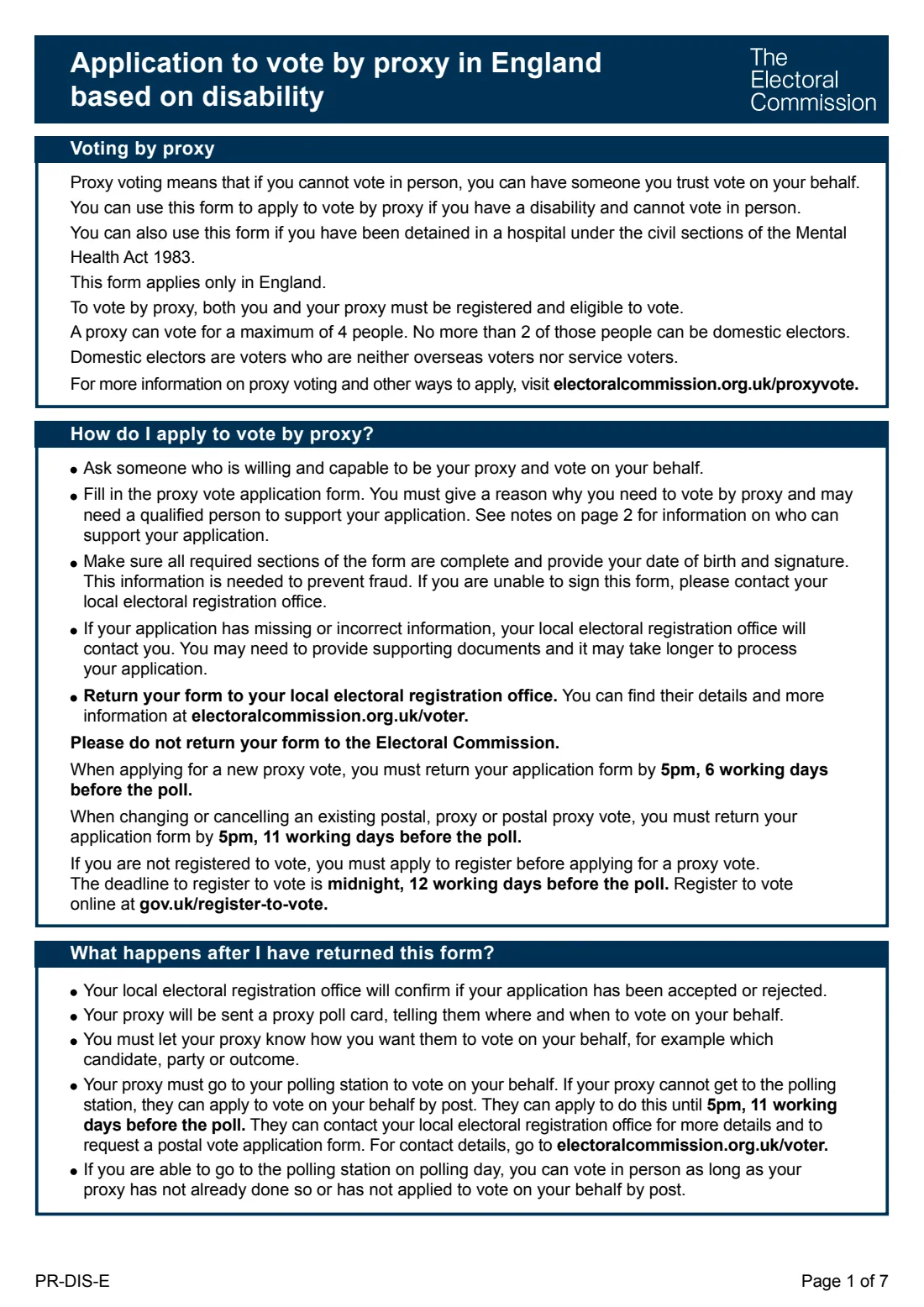
Proxy voting means someone you trust goes to your polling station and votes for you. Form PR-DIS-E is the application for voters in England who can't vote in person because of a disability, and for people detained in hospital under the civil sections of the Mental Health Act 1983. Both you and your proxy must be registered and eligible to vote.
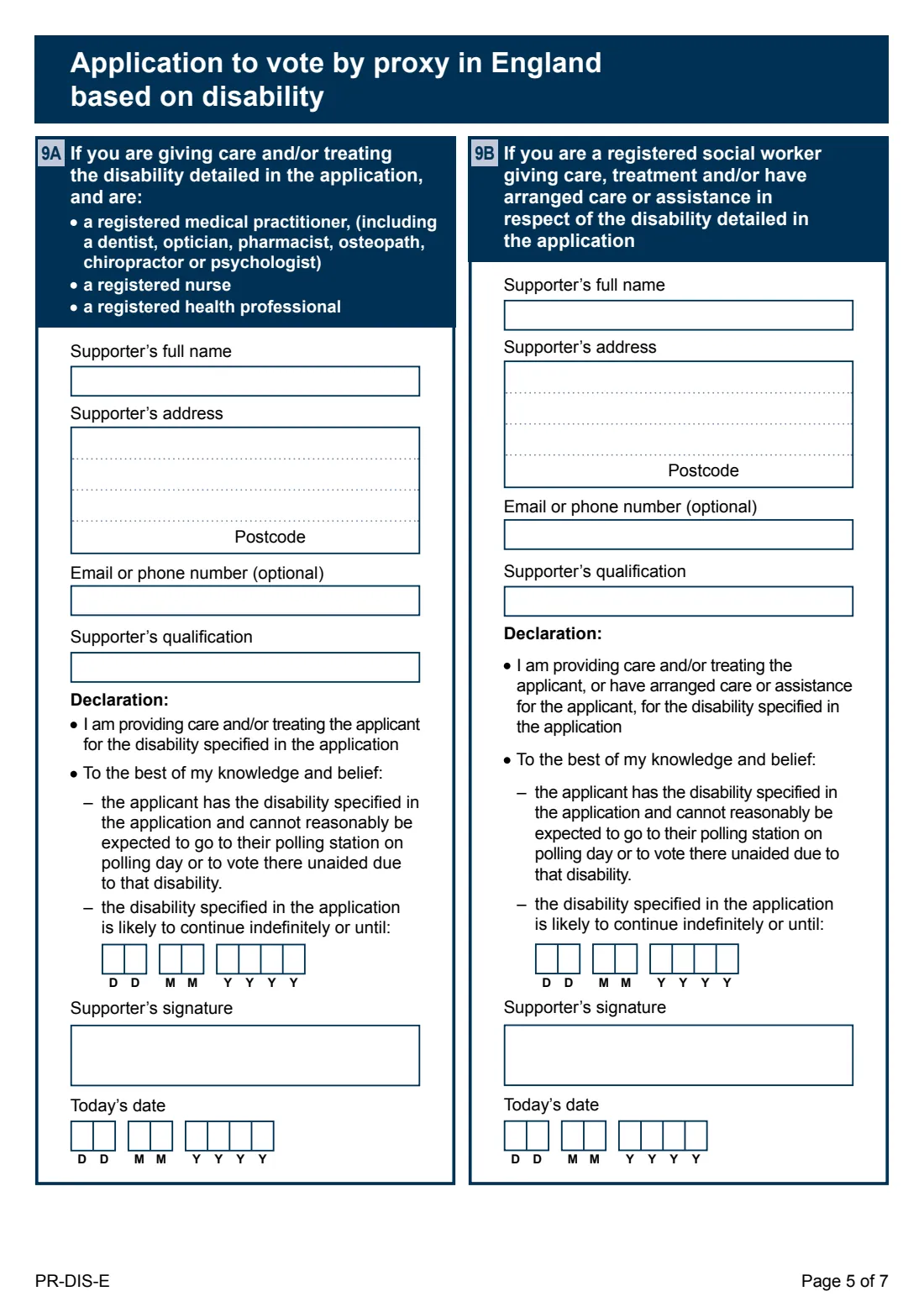
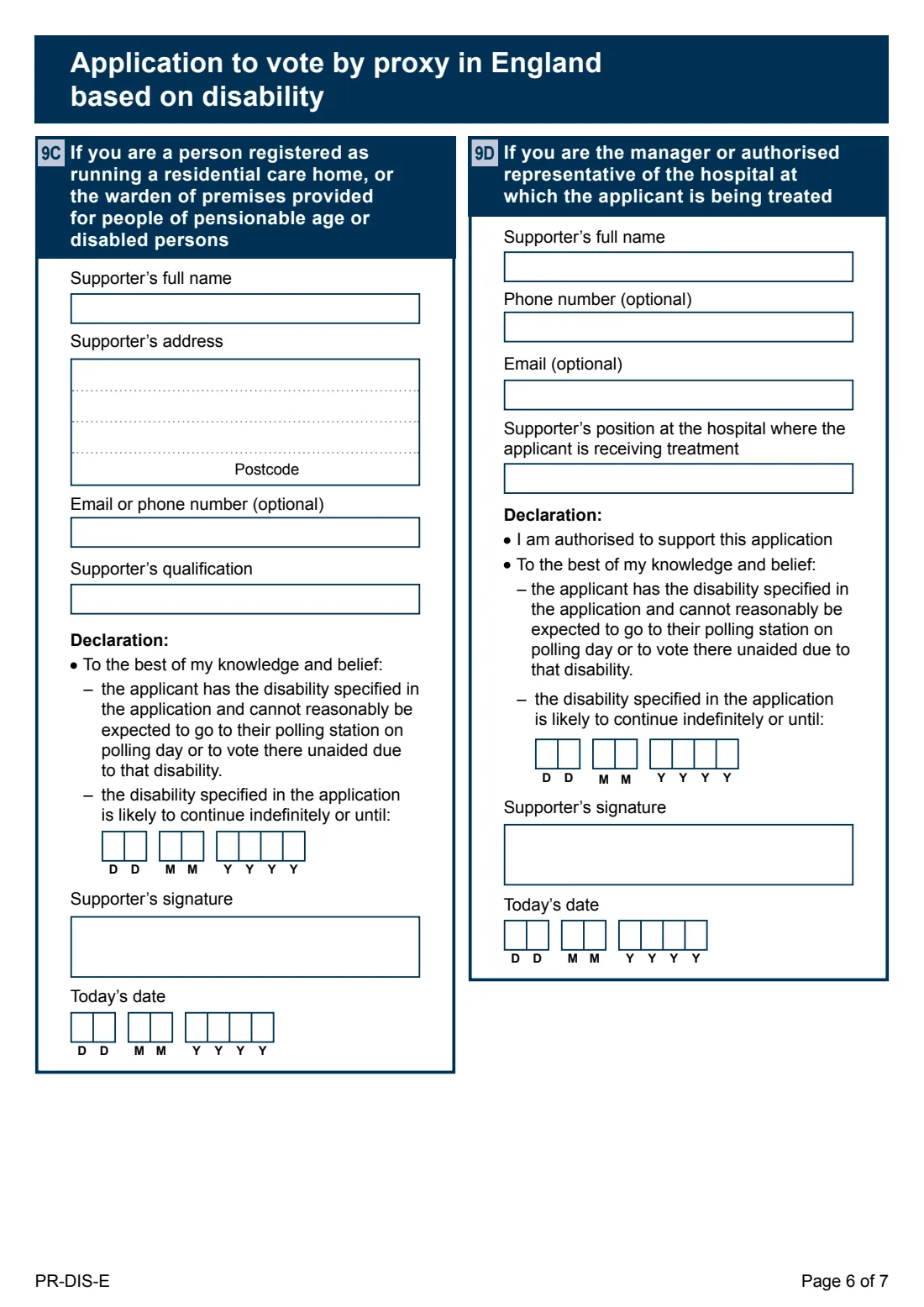
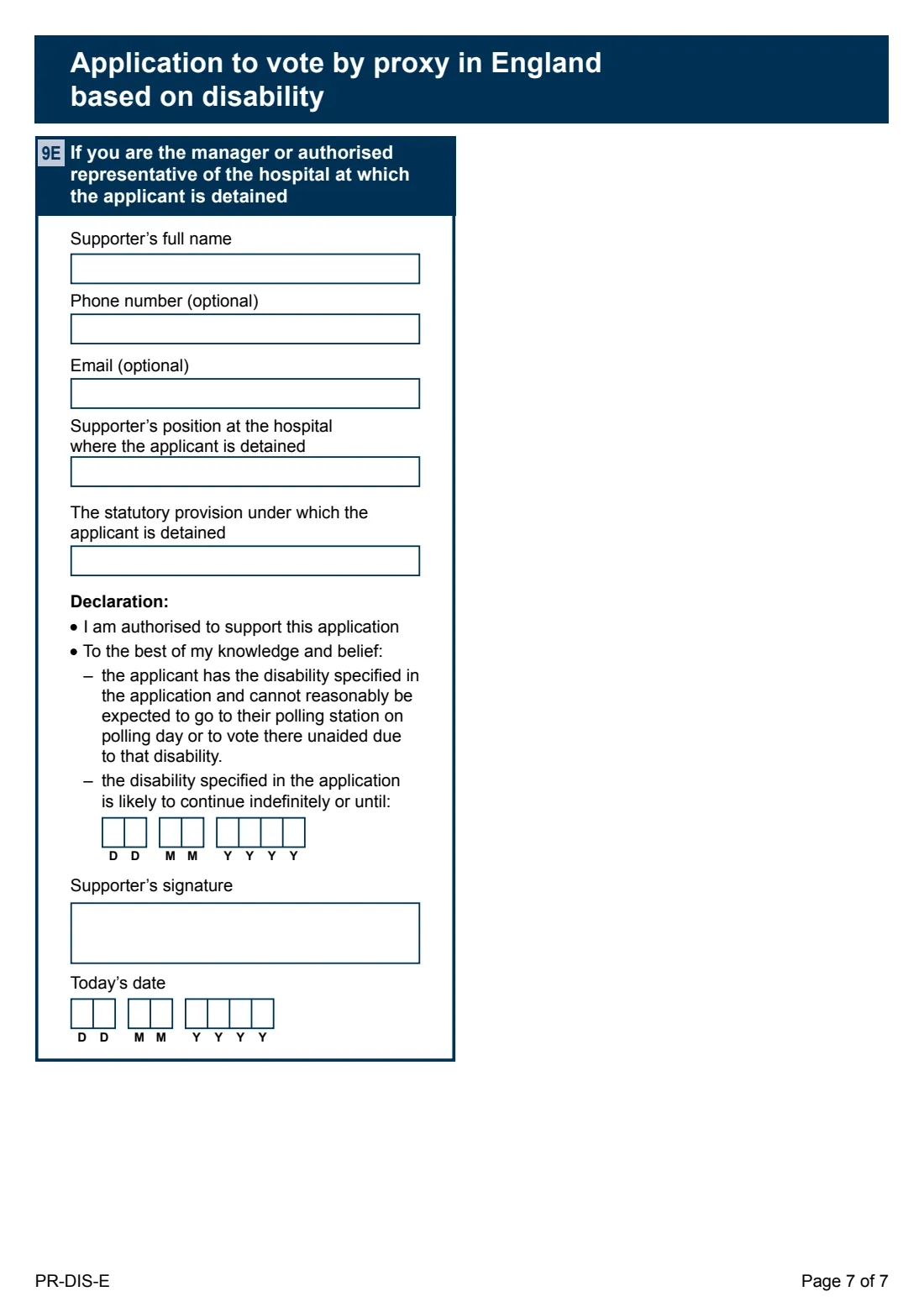
You give your details, explain why you can't vote in person (a disability, being registered blind, receiving a qualifying disability benefit, or detention in hospital), name your proxy, choose how long the arrangement lasts, and sign. In most cases a qualified person, such as a doctor, nurse, social worker, care home manager or hospital manager, supports the application in part 9. The form says no support is needed if you're registered blind (2B) or receive one of the listed benefits (2C).
FileIt asks only what applies, wraps longer answers onto the form's ruled lines in capitals, fills the National Insurance and date cells, and shows only the supporter section that matches who is supporting you. You and your supporter sign by hand, and you send the form to your local electoral registration office. FileIt never sends anything for you.
- Who fills it
- A voter in England with a disability, or detained under the Mental Health Act
- Sent to
- Your local electoral registration office
- How long
- Permanent, one election, or a set period
- Supporter
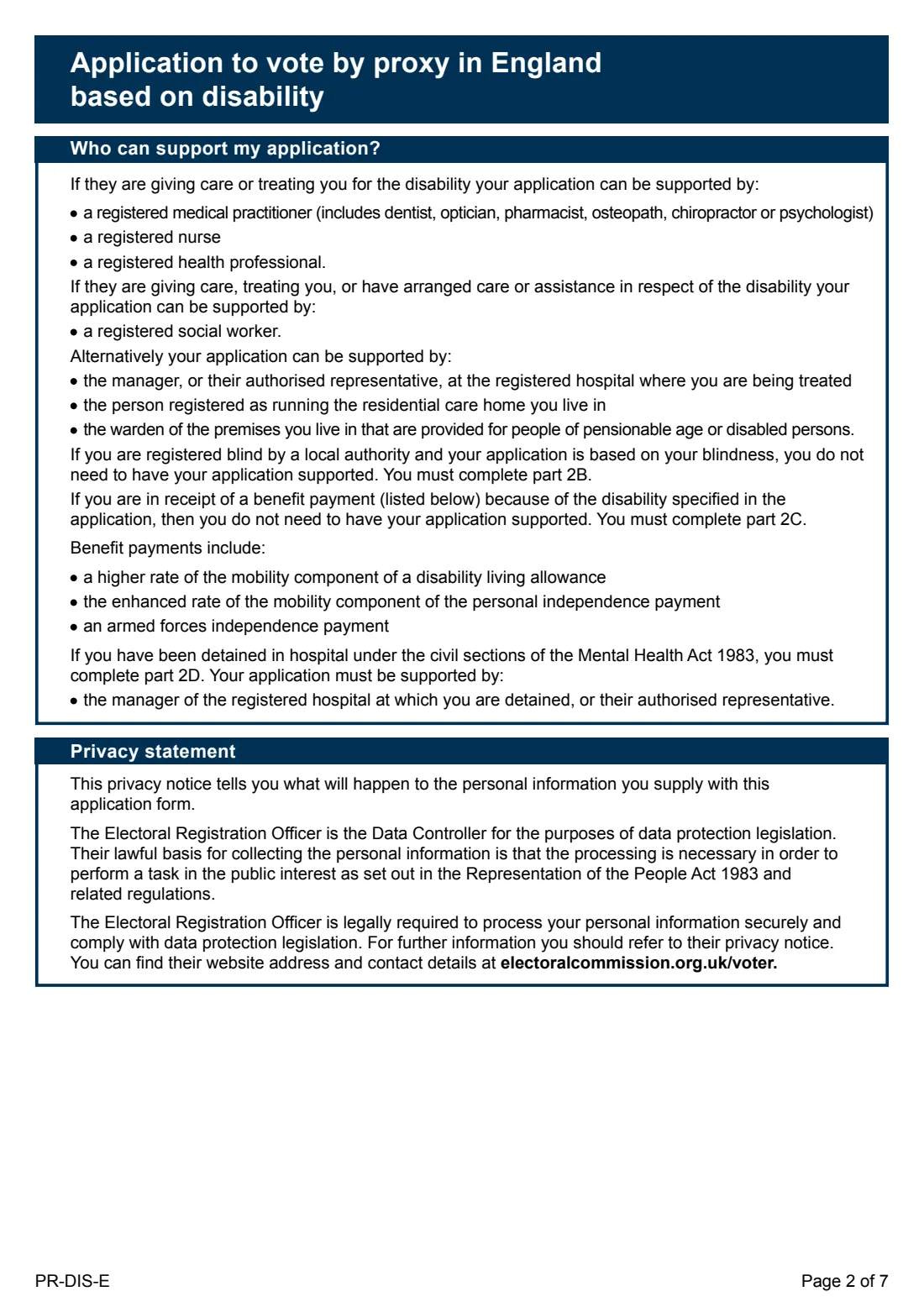
- Needed unless you're registered blind or get a listed benefit
- Deadline (new proxy)
- 5pm, 6 working days before the poll
- Signature
- By hand, in black ink, inside the grey border
Who needs to fill out PR-DIS-E Proxy vote, disability (England)?
- A voter whose disability stops them getting to the polling station or voting there unaided.
- Someone registered blind by their local authority.
- A person receiving the higher rate mobility component of disability living allowance, the enhanced rate mobility component of personal independence payment, or an armed forces independence payment because of their disability.
- Someone detained in hospital under the civil sections of the Mental Health Act 1983.
- Not for voters in Scotland or Wales, who have their own versions.
When to use PR-DIS-E Proxy vote, disability (England)
- Once you and your proxy are both registered to vote.
- In time to reach the electoral registration office by 5pm, 6 working days before the poll for a new proxy vote.
- When you need to change or cancel an existing proxy, the form says the deadline is 5pm, 11 working days before the poll.
What you need before you start
- Your name, registered address and National Insurance number (or why you can't give it).
- Details of your disability, the local authority that registered you blind, your benefit, or the hospital where you're detained.
- Your proxy's full name and address. Ask them first: you confirm they're willing and capable.
- Your date of birth.
- A supporter's details and signature, unless 2B or 2C applies.
What’s on PR-DIS-E Proxy vote, disability (England)
The 2024 edition has 7 pages. FileIt asks for it in 9 parts:
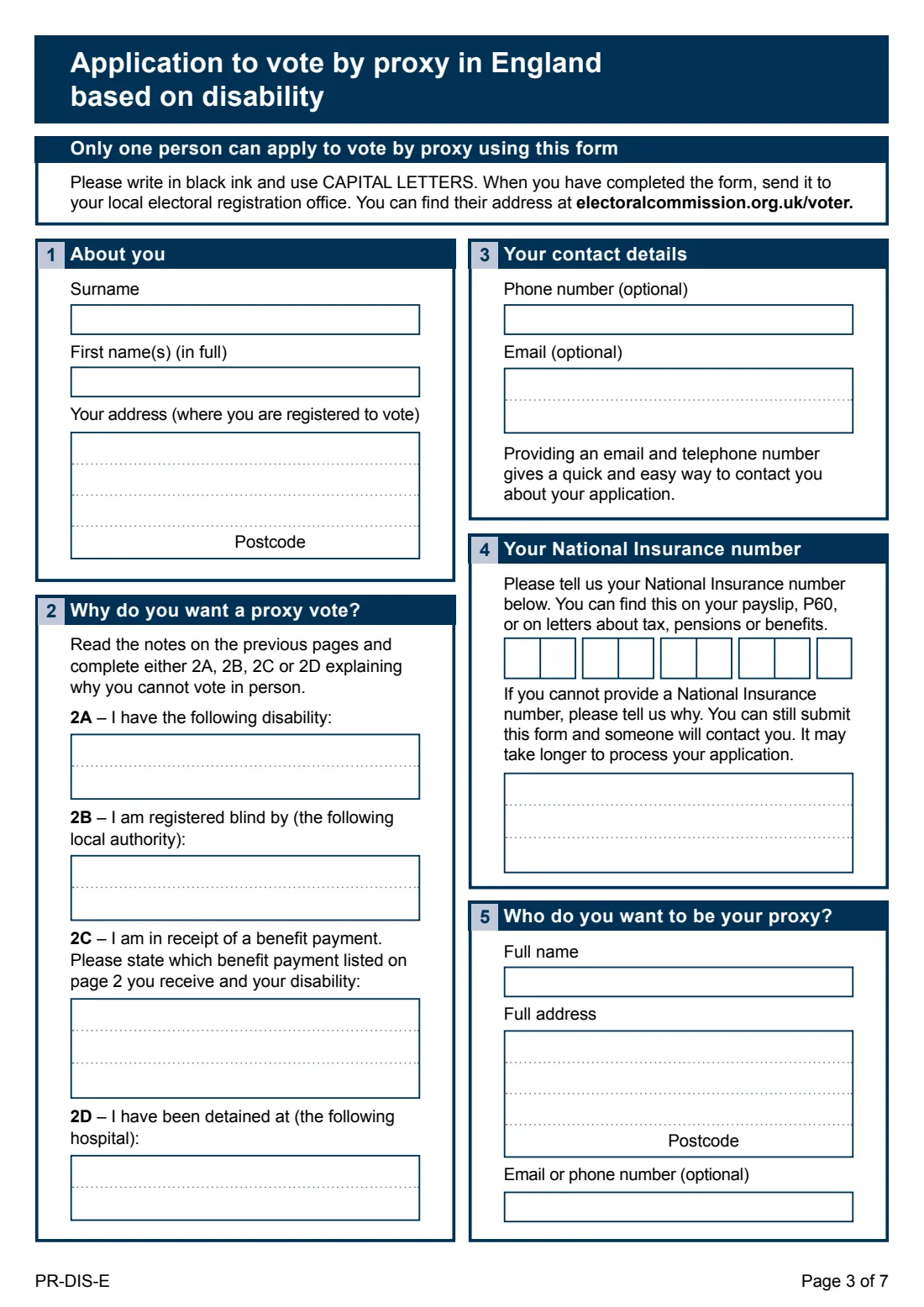
- 1. About youApplicant
- 2. Why do you want a proxy vote?Applicant
- 3. Your contact detailsApplicant
- 4. Your National Insurance numberApplicant
- 5. Who do you want to be your proxy?Applicant
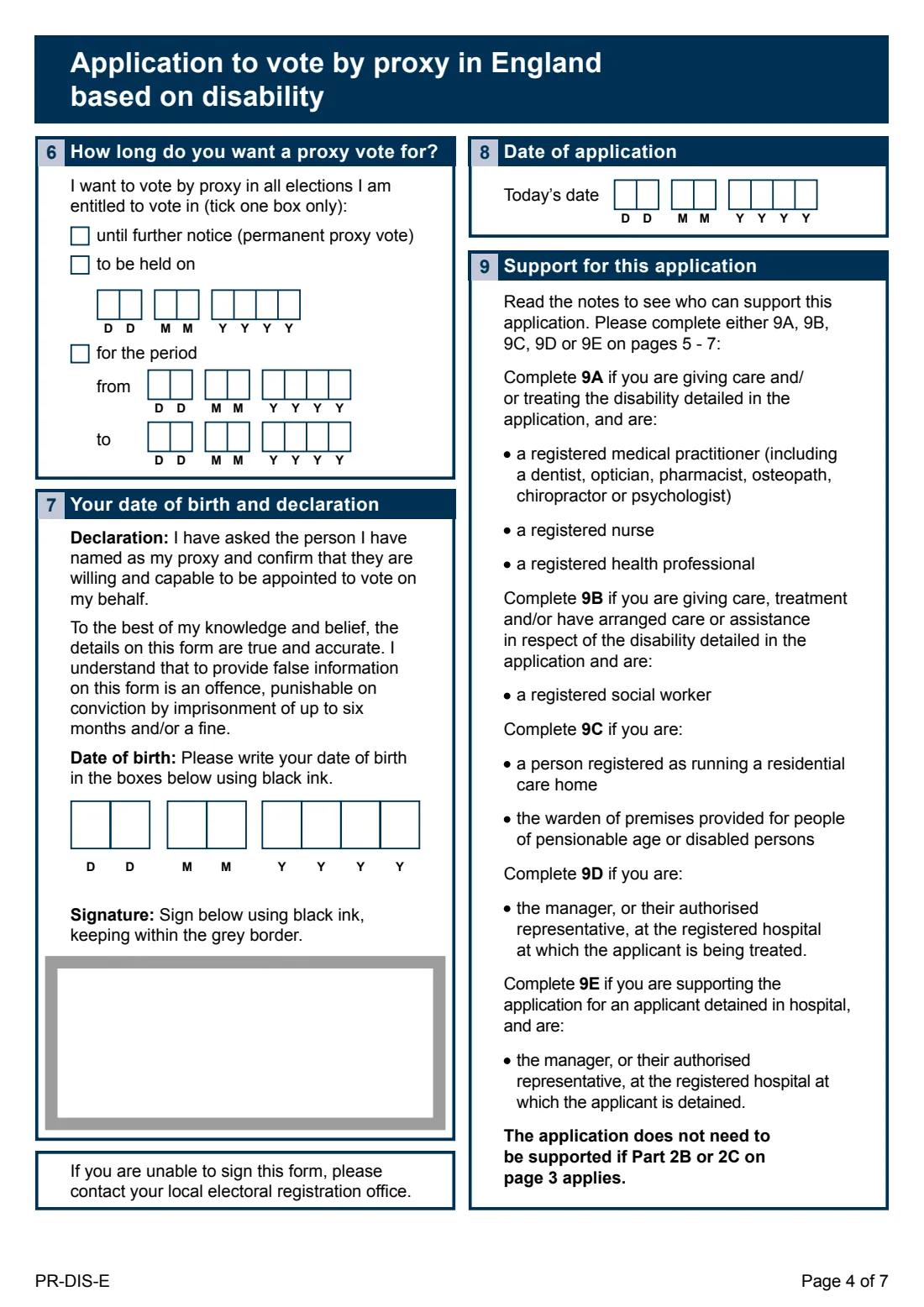
- 6. How long do you want a proxy vote for?Applicant
- 7. Your date of birth and declarationApplicant
- 8. Date of applicationApplicant
- 9. Support for this applicationSupporter
How to fill out PR-DIS-E Proxy vote, disability (England), step by step
1 1 to 4. About you
Give your name, address, optional phone and email, and your National Insurance number. If you can't give it, say why. You can still apply, but it may take longer.
2 2. Why you can't vote in person
Complete one of 2A (your disability), 2B (registered blind, and by which local authority), 2C (which listed benefit you receive, and your disability) or 2D (the hospital where you're detained).
3 5 and 6. Your proxy and how long
Name the person who'll vote for you and give their address, then choose a permanent proxy vote, a single election, or a period from one date to another.
4 7 and 8. Declaration
Confirm your proxy is willing and capable, give your date of birth, sign inside the grey border in black ink, and add today's date.
5 9. Support
Your supporter completes one part, 9A to 9E, depending on who they are, confirms what they know about your disability and how long it's likely to last, and signs.
Common mistakes to avoid
- Filling in more than one of 2A to 2D.
- Choosing a proxy without asking them, or one who isn't registered to vote.
- Leaving out the supporter's part when 2A or 2D applies.
- Signing outside the grey border, or not in black ink.
- Sending the form to the Electoral Commission rather than your local electoral registration office.
After you fill it out
Print the filled form, sign it in black ink inside the grey box, and have your supporter sign their part if needed.
Send it to your local electoral registration office. Their details are at electoralcommission.org.uk/voter. FileIt doesn't send it.
Once accepted, your proxy gets a proxy poll card. Tell them how you want them to vote. Keep a copy in your FileIt vault.
Fill out PR-DIS-E Proxy vote, disability (England) online with FileIt
- Pick the person. Choose someone from People and FileIt fills in their name, date of birth, address and other details it already knows.
- Answer plain-language questions. One part of the form at a time, with the official help text beside each question — 86 fields in all. Your answers save as you go.
- Check the live preview. Watch your answers land on the real Electoral Registration Officer (form by the UK Government and the Electoral Commission) form, and let FileIt do any worksheet arithmetic.
- Generate the official PDF. FileIt prints your answers into the agency’s own PDF and files it in that person’s folder in your vault.
FileIt fills the form — it never files or submits anything for you. Deliver the finished form to whoever asked for it, the way the form’s instructions say.
Start PR-DIS-E Proxy vote, disability (England) now — it’s freePR-DIS-E Proxy vote, disability (England): frequently asked questions
What is a proxy vote?
It's when someone you trust votes on your behalf at your polling station.
Does someone have to support my application?
Usually, yes. The form says you don't need a supporter if you're registered blind and apply on that basis (2B), or receive one of the listed benefits because of your disability (2C).
Who can be my supporter?
Depending on your situation: a registered medical practitioner, nurse or health professional treating you, a registered social worker, the person running your care home or the warden of your housing, or the manager of the hospital treating or detaining you.
How many people can a proxy vote for?
The form says a proxy can vote for up to 4 people, of whom no more than 2 can be domestic electors.
Can I still vote in person?
The form says yes, as long as your proxy hasn't already voted for you or applied to vote for you by post.
Does FileIt submit the form?
No. FileIt places your answers on the official form. You sign it and send it to your local electoral registration office.
Official sources
- Blank form (PDF), published by Electoral Registration Officer (form by the UK Government and the Electoral Commission): https://assets.publishing.service.gov.uk/media/65f85ff1efbfe40011e4dc10/PR-DIS-E_EnglandProxy_Disability2023_form_2024.pdf
- Official instructions and guidance: https://www.gov.uk/government/publications/apply-to-vote-by-proxy-due-to-a-disability
- Edition shown on this page: PR-DIS-E (2024 edition, file dated February 2024) (checked 2026-10-19).
FileIt is not affiliated with or endorsed by Electoral Registration Officer (form by the UK Government and the Electoral Commission) or any government. This page explains the form in general terms and is not legal, tax or immigration advice. Always read the official instructions, and check that you are using the edition the recipient accepts. Page last reviewed 2026-10-19.