What is COP5 acknowledgment of service?
When someone applies to the Court of Protection, for example to become a deputy for a parent who can no longer manage their money, certain people are formally served with the application or notified that it has been made. COP5 is how those people answer. It tells the court whether you agree with the application, oppose it, or want the court to make a different order or give different directions, and why.
The form also lets the person the application is about, or anyone who was only notified, ask to be joined as a party, which gives you a formal role in the case. And it asks whether you would need any help or facilities if the court asked you to attend a hearing. If you don't want to take part at all, you don't need to fill it in.
FileIt walks you through each section in plain language, prints your answers into the court's own COP5 PDF and shows you the filled form as you go. You then sign it and send it to the court yourself.
- Who fills it
- Someone served with or notified of a Court of Protection application, or their solicitor or litigation friend
- Issued by
- Court of Protection, HM Courts & Tribunals Service
- Time limit
- Return it within 14 days of being served or notified
- Evidence
- Use form COP24 (witness statement). It must reach the court within 28 days if sent later
- Edition
- COP 5 (07.15)
- Length
- 4 pages, 5 sections
Who needs to fill out COP5 acknowledgment of service?
- Family members and others who have been served with a COP1 application as a respondent.
- People notified that an application has been issued, such as close relatives of the person it concerns, who want their views heard.
- The person the application is about, if they want to respond or be joined as a party.
- Solicitors and litigation friends replying on someone's behalf.
When to use COP5 acknowledgment of service
- As soon as you receive a Court of Protection application or a notice that one has been issued, and you want to take part.
- When you agree with the application but have information you'd like the court to consider.
- When you object to the application, or think a different order or different directions would be better, for example a different deputy.
What you need before you start
- The application papers you were sent, including the full name of the person the application is about.
- Your contact details, and your solicitor's details if one is acting for you (including any DX number).
- The address where you want the court to send official documents.
- Your role in the case: the person it's about, a respondent, or someone notified.
- Your reasons, and any evidence you rely on, written up on form COP24.
- Any help you would need at a hearing, such as step-free access or an interpreter.
What’s on COP5 acknowledgment of service
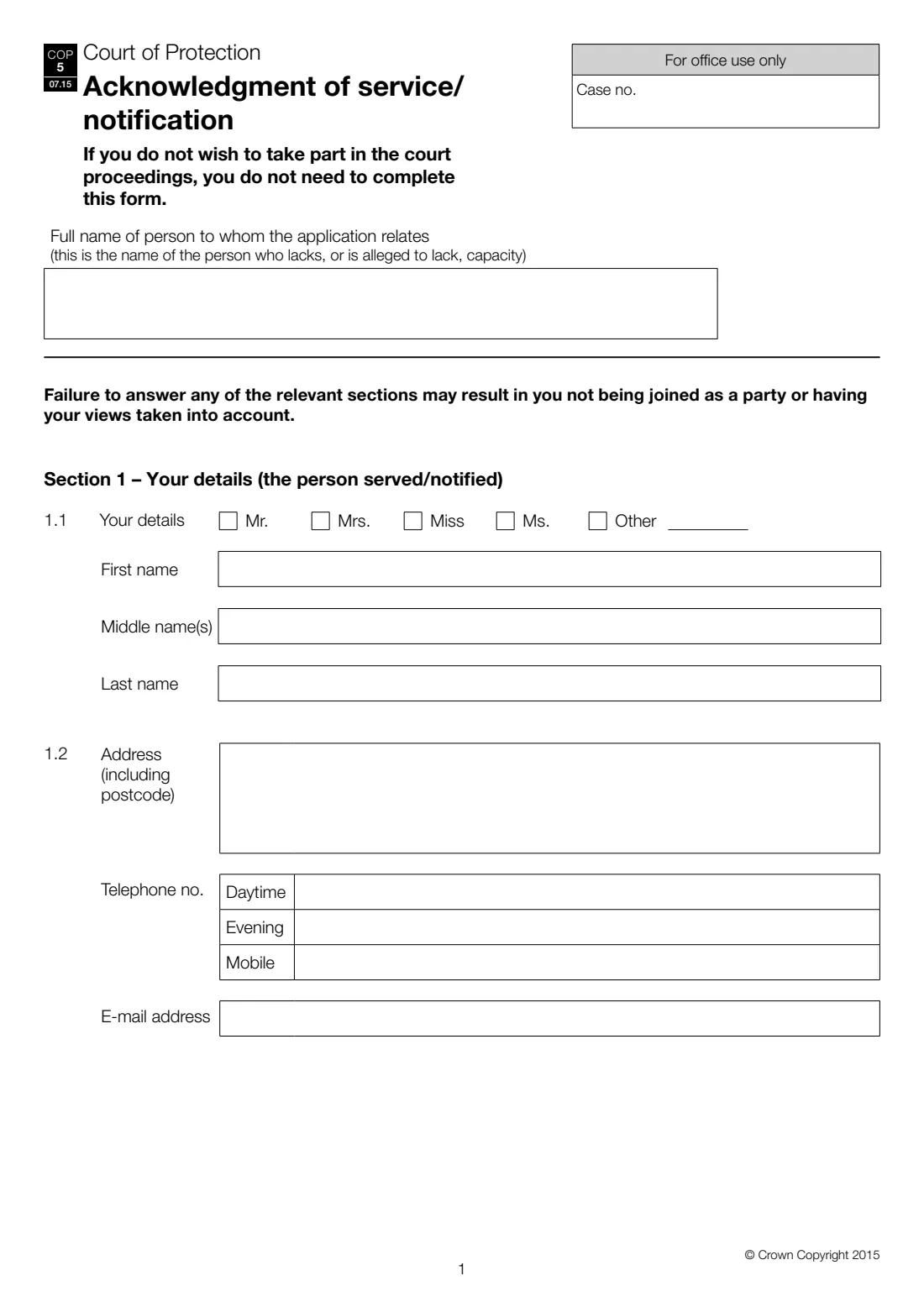
The 2015 edition has 4 pages. FileIt asks for it in 7 parts, and it is signed by Person served or notified:
- The person the application is aboutPerson served or notified
- Section 1: Your detailsPerson served or notified
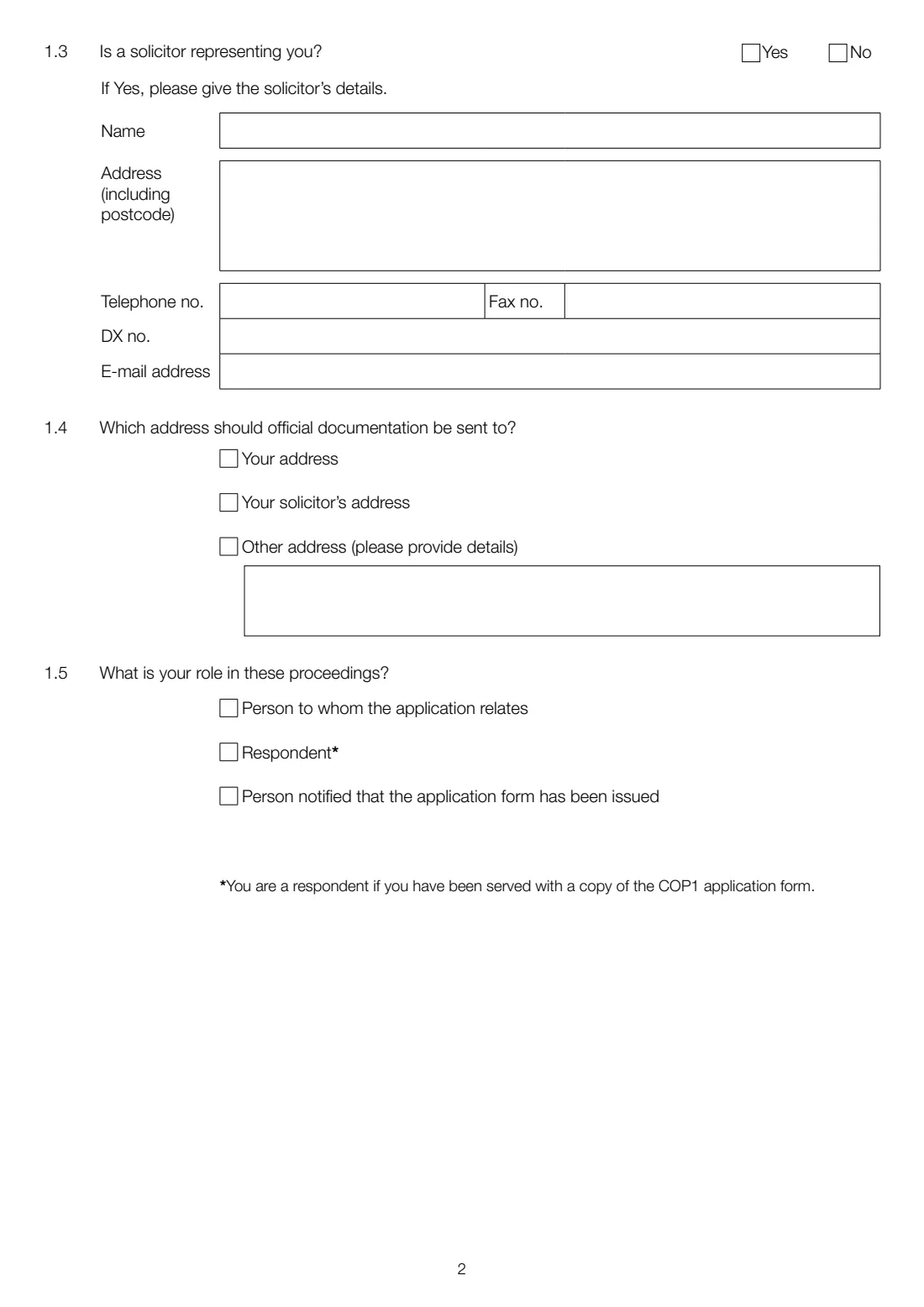
- Your solicitor, where documents go and your rolePerson served or notified
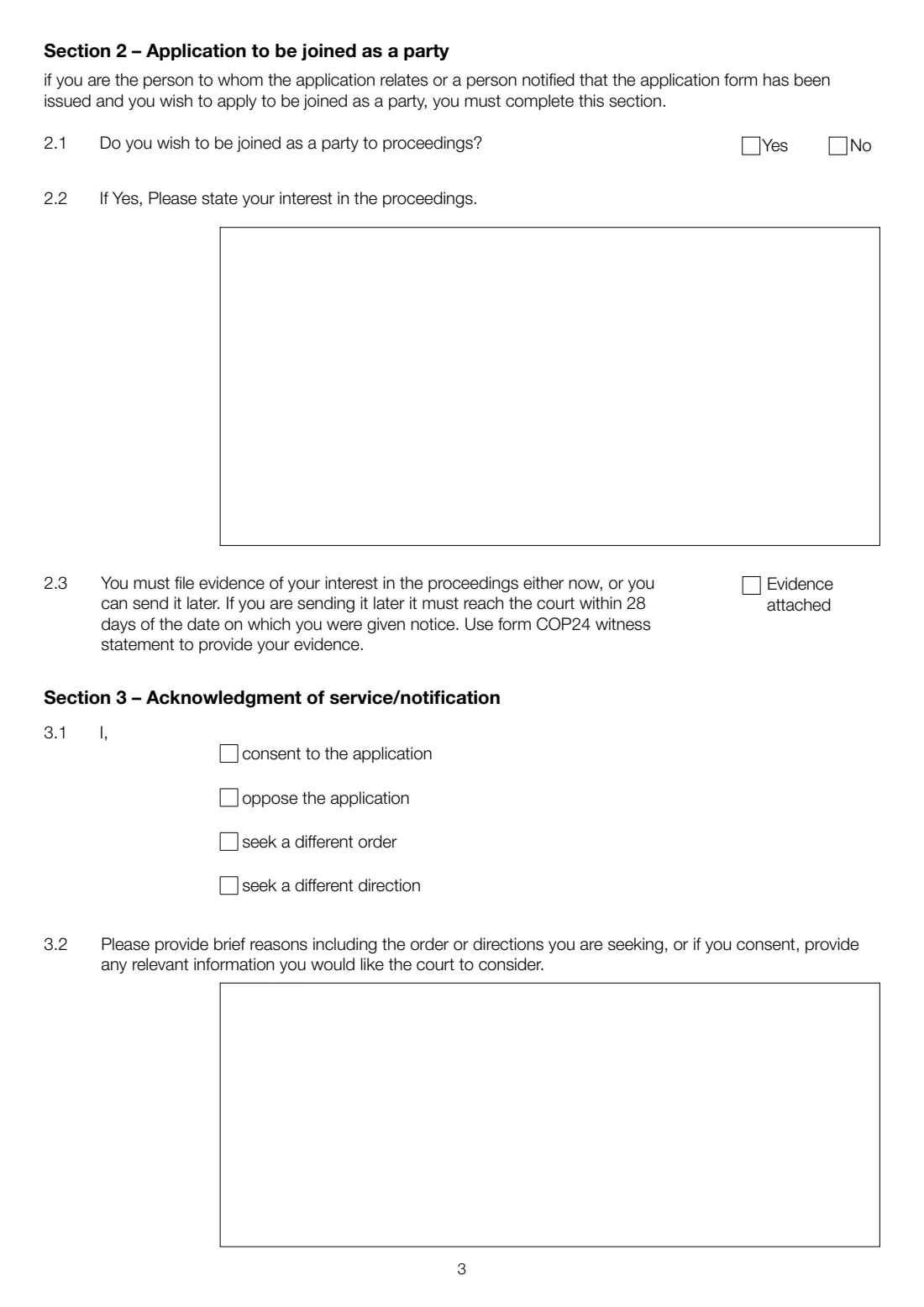
- Section 2: Applying to be joined as a partyPerson served or notified
- Section 3: Your response to the applicationPerson served or notified
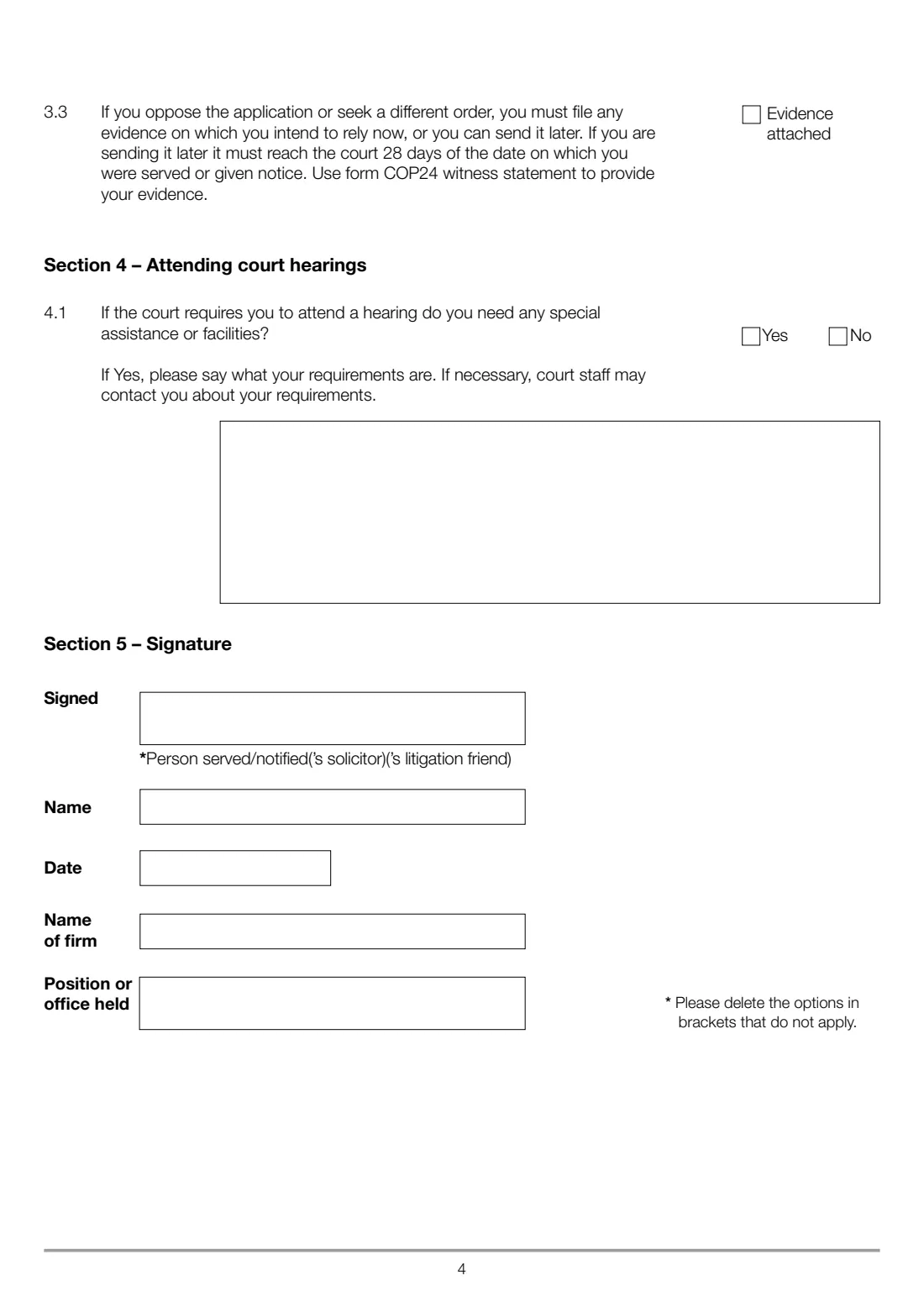
- Section 4: Attending court hearingsPerson served or notified
- Section 5: SignaturePerson served or notified
How to fill out COP5 acknowledgment of service, step by step
1 The person the application is about
Write their full name as it appears on the application. This is the person who lacks, or is said to lack, capacity.
2 Section 1: Your details
Your title, names, address, phone numbers and email, whether a solicitor is representing you, which address official documents should go to, and your role in the proceedings. FileIt can pre-fill your name and email from your FileIt profile.
3 Section 2: Being joined as a party
Only if you are the person the application is about, or someone who was notified, and you want to be a party. Explain your interest in the case and tick the box if your evidence is attached.
4 Section 3: Your response
Tick whether you consent, oppose, or want a different order or different direction, then give brief reasons. If you oppose or want something different, attach your evidence or send it within 28 days.
5 Section 4: Hearings
Say whether you would need special assistance or facilities to attend a hearing, and what they are.
6 Section 5: Signature
Your name, the date and, if a solicitor signs, the firm and position. After printing, cross out the words in brackets under the signature line that don't apply to you.
Common mistakes to avoid
- Leaving it too late. The court expects the form back within 14 days of service or notification.
- Ticking both consent and oppose. Choose the response that matches what you actually want.
- Opposing the application without any reasons or evidence. Section 3.2 and form COP24 are where you make your case.
- A respondent filling in section 2. Respondents are already parties, so section 2 is for people who were only notified.
- Forgetting to cross out the words under the signature that don't apply.
After you fill it out
Check every page in the preview, then download the filled PDF.
Sign it, cross out the bracketed words that don't apply, and send it to the Court of Protection with any COP24 evidence. FileIt doesn't send anything to the court for you.
Serve copies on the applicant and the other parties as the court's notes explain, and keep a copy in the family member's FileIt folder.
Fill out COP5 acknowledgment of service online with FileIt
- Pick the person. Choose someone from People and FileIt fills in their name, date of birth, address and other details it already knows.
- Answer plain-language questions. One part of the form at a time, with the official help text beside each question — 36 fields in all. Your answers save as you go.
- Check the live preview. Watch your answers land on the real Court of Protection (HM Courts & Tribunals Service) form, and let FileIt do any worksheet arithmetic.
- Generate the official PDF. FileIt prints your answers into the agency’s own PDF and files it in that person’s folder in your vault. Sign it, or send it for e-signature.
FileIt fills the form — it never files or submits anything for you. Deliver the finished form to whoever asked for it, the way the form’s instructions say.
Start COP5 acknowledgment of service now — it’s freeCOP5 acknowledgment of service: frequently asked questions
Do I have to fill in COP5?
No. The form itself says that if you don't wish to take part in the proceedings, you don't need to complete it. Fill it in when you want your views taken into account or want to be a party.
What's the difference between being served and being notified?
A respondent is someone who has been served with a copy of the COP1 application form, and is already a party. Others are notified that the application has been issued; they can use section 2 to ask to be joined as a party.
How do I send evidence?
Use form COP24, the Court of Protection witness statement. You can attach it to COP5 or send it later, as long as it reaches the court within 28 days of the date you were served or given notice.
Can my solicitor fill it in for me?
Yes. A solicitor or litigation friend can complete and sign it. Section 1.3 records the solicitor's details, and the signature section has spaces for the firm's name and the signer's position.
Does FileIt send the form to the court?
No. FileIt fills the official PDF so it's neat and complete. You sign it and send it to the Court of Protection yourself.
Official sources
- Blank form (PDF), published by Court of Protection (HM Courts & Tribunals Service): https://assets.publishing.service.gov.uk/media/5eb3f7b386650c278b0775e4/cop5-eng.pdf
- Official instructions and guidance: https://www.gov.uk/government/publications/apply-to-be-part-of-court-of-protection-proceedings-form-cop5
- Edition shown on this page: COP 5 (07.15) (checked 2026-10-19).
FileIt is not affiliated with or endorsed by Court of Protection (HM Courts & Tribunals Service) or any government. This page explains the form in general terms and is not legal, tax or immigration advice. Always read the official instructions, and check that you are using the edition the recipient accepts. Page last reviewed 2026-10-19.