What is Form TD1-IN?
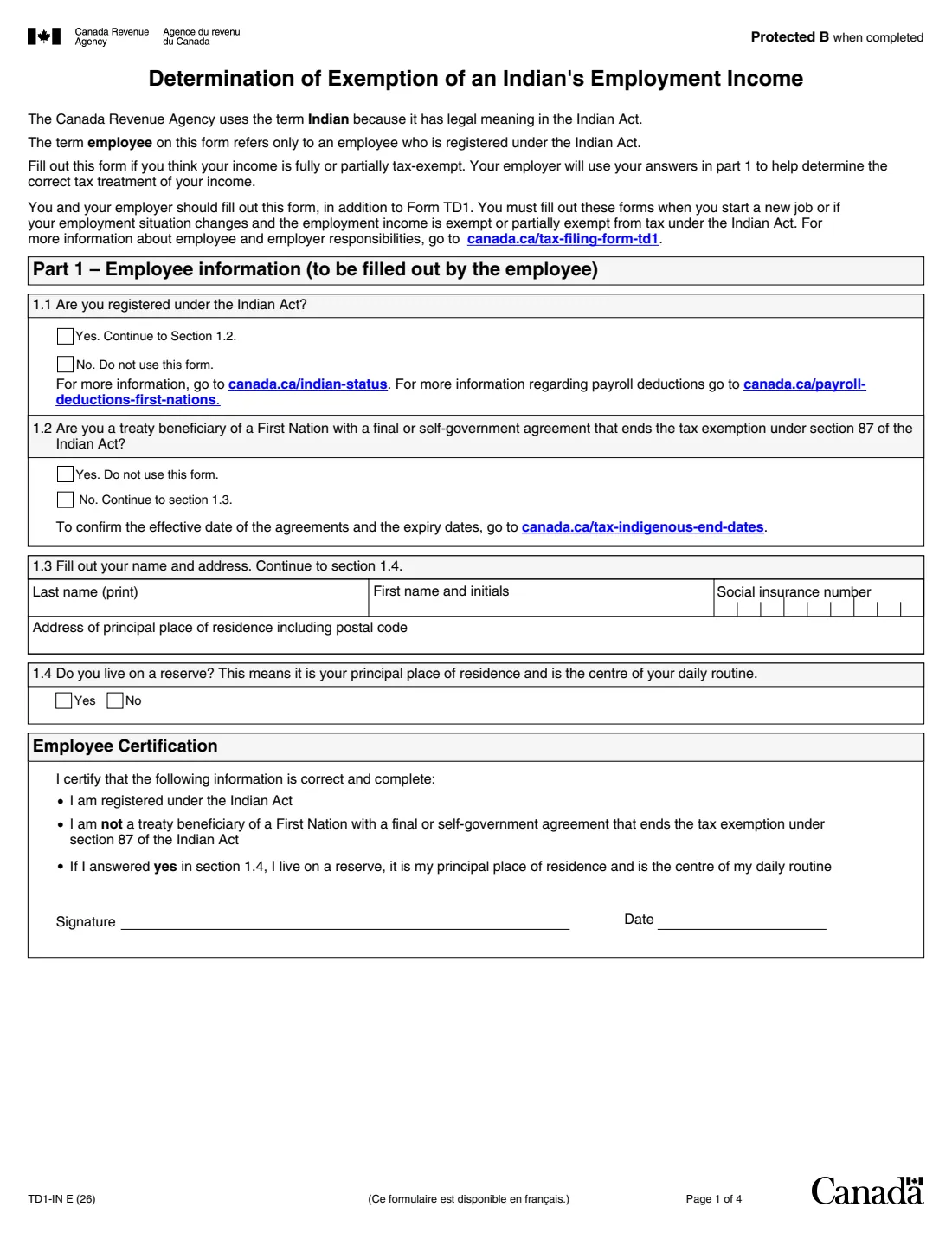
Form TD1-IN is for an employee who is registered under the Indian Act and thinks their employment income is fully or partly tax-exempt. The CRA uses the term Indian because it has legal meaning in the Indian Act. The employer uses the employee's answers in part 1 to help determine the correct tax treatment of the income. The form says you must fill it out, with Form TD1, when you start a new job or when your situation changes and your income is exempt or partly exempt.
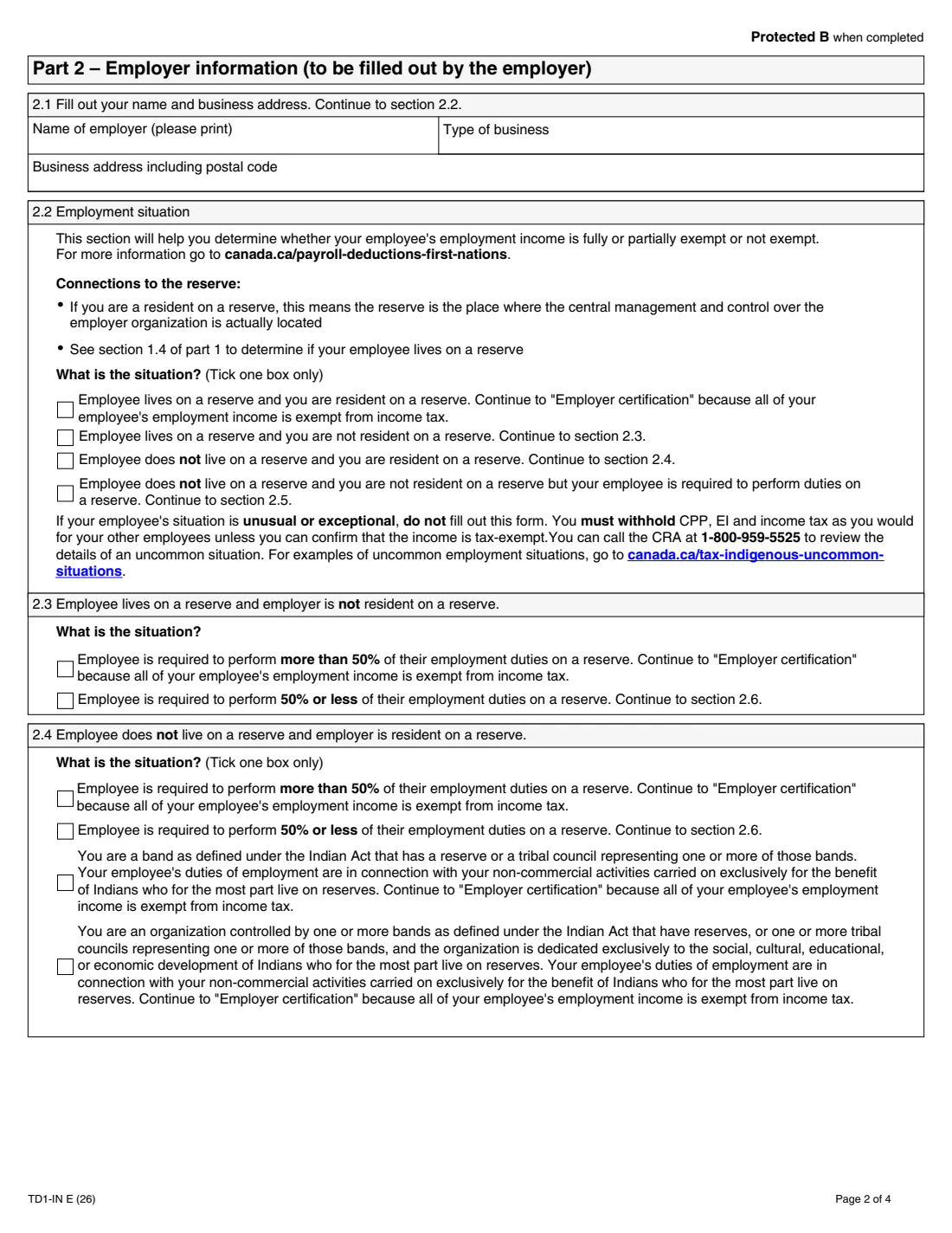
In part 1 the employee confirms they are registered under the Indian Act and are not a treaty beneficiary of a First Nation whose final or self-government agreement ends the section 87 exemption, gives their name, social insurance number and address, and says whether they live on a reserve. In part 2 the employer gives its details and picks the employment situation: whether the employee lives on a reserve, whether the employer is resident on a reserve, and how much of the employee's duties are performed on a reserve. Some situations make all of the income exempt; others lead to a prorated exemption based on the percentage of duties on the reserve.
FileIt asks the questions in plain English, shows only the follow-up sections that apply, and prints the answers onto the CRA's own PDF (edition TD1-IN E (26)). The finished PDF is saved to the employee's vault folder, and both parties can sign it with FileIt's optional e-signature or by hand. FileIt never files anything with the CRA. Filling forms is free on every plan.
- Who fills it
- The employee (part 1) and the employer (part 2)
- Kept by
- The employer, a signed copy, in case the CRA asks to see it
- Filled out with
- Form TD1, Personal Tax Credits Return
- Signatures
- The employee and the employer each sign their certification
- Edition
- TD1-IN E (26)
- Pages
- 4
Who needs to fill out Form TD1-IN?
- Employees registered under the Indian Act who think their employment income is fully or partly exempt under section 87.
- Employers, including bands, tribal councils and organizations they control, who need to decide how to withhold tax for such an employee.
When to use Form TD1-IN
- When the employee starts a new job, together with Form TD1.
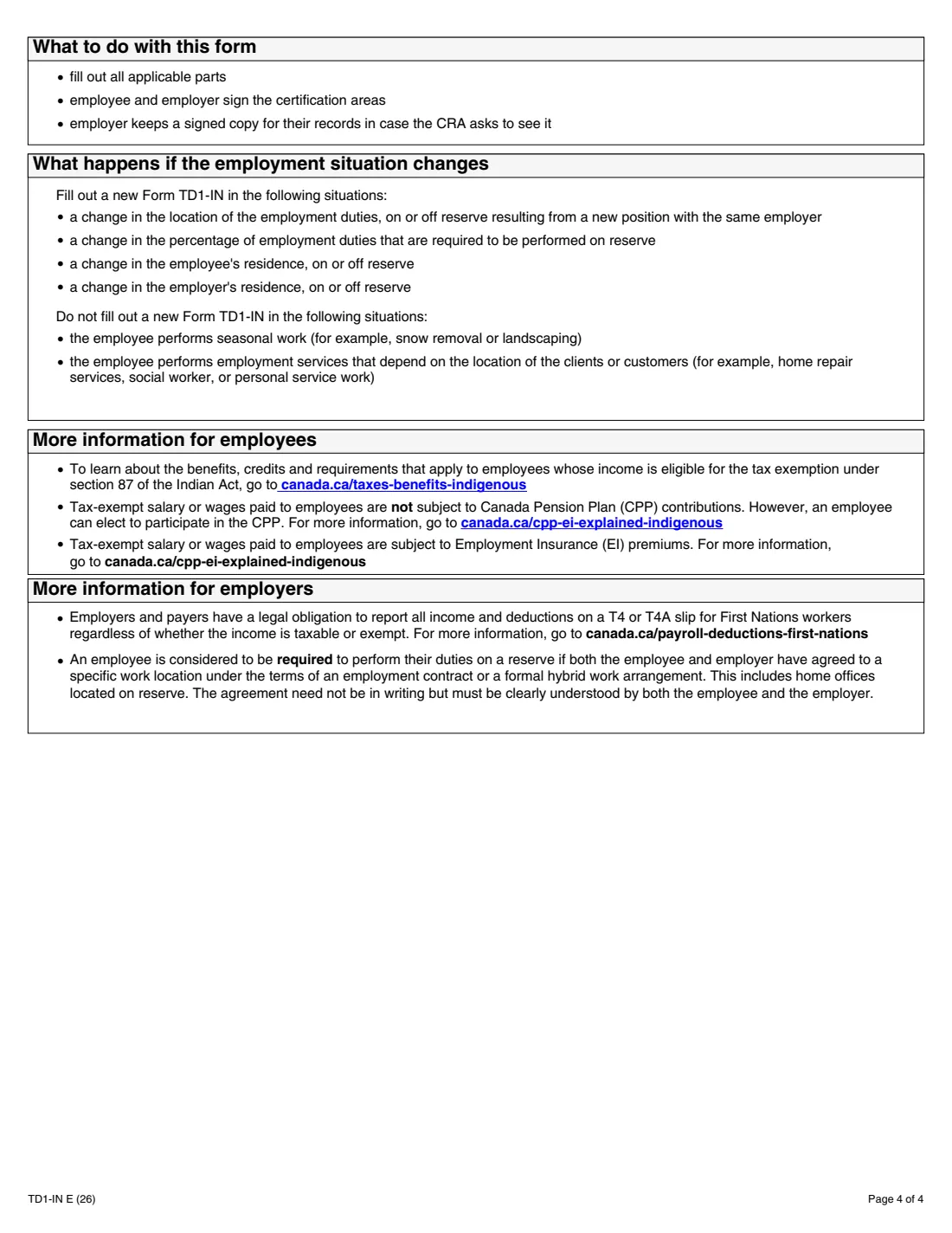
- When the location of the employment duties changes on or off reserve with a new position at the same employer.
- When the percentage of duties required to be performed on reserve changes.
- When the employee's or the employer's residence changes, on or off reserve.
- Not for seasonal work or services that depend on where the clients are: the form says not to fill out a new TD1-IN in those cases.
What you need before you start
- The employee's status under the Indian Act, and whether their First Nation has a final or self-government agreement that ends the section 87 exemption.
- The employee's name, social insurance number and the address of their principal place of residence, including postal code.
- Whether the employee lives on a reserve, which means it is their principal place of residence and the centre of their daily routine.
- The employer's name, type of business and business address, and whether its central management and control is located on a reserve.
- The percentage of the employee's duties required to be performed on a reserve, when the exemption may be prorated.
What’s on Form TD1-IN
The 2026 edition has 4 pages. FileIt asks for it in 2 parts, and it is signed by Employee and Employer:
- Part 1 – Employee informationEmployee
- Part 2 – Employer informationEmployer
How to fill out Form TD1-IN, step by step
1 1.1 and 1.2 — Status
Are you registered under the Indian Act? If not, don't use the form. Are you a treaty beneficiary of a First Nation with a final or self-government agreement that ends the tax exemption under section 87? If yes, don't use the form.
2 1.3 and 1.4 — Your details
Your last name, first name and initials, social insurance number and the address of your principal place of residence including postal code. Then whether you live on a reserve. Date and sign the employee certification.
3 2.1 and 2.2 — Employer and situation
The employer's name, type of business and address, then one of four situations, depending on whether the employee lives on a reserve and whether the employer is resident on a reserve (where its central management and control is actually located).
4 2.3 to 2.5 — The follow-up for your situation
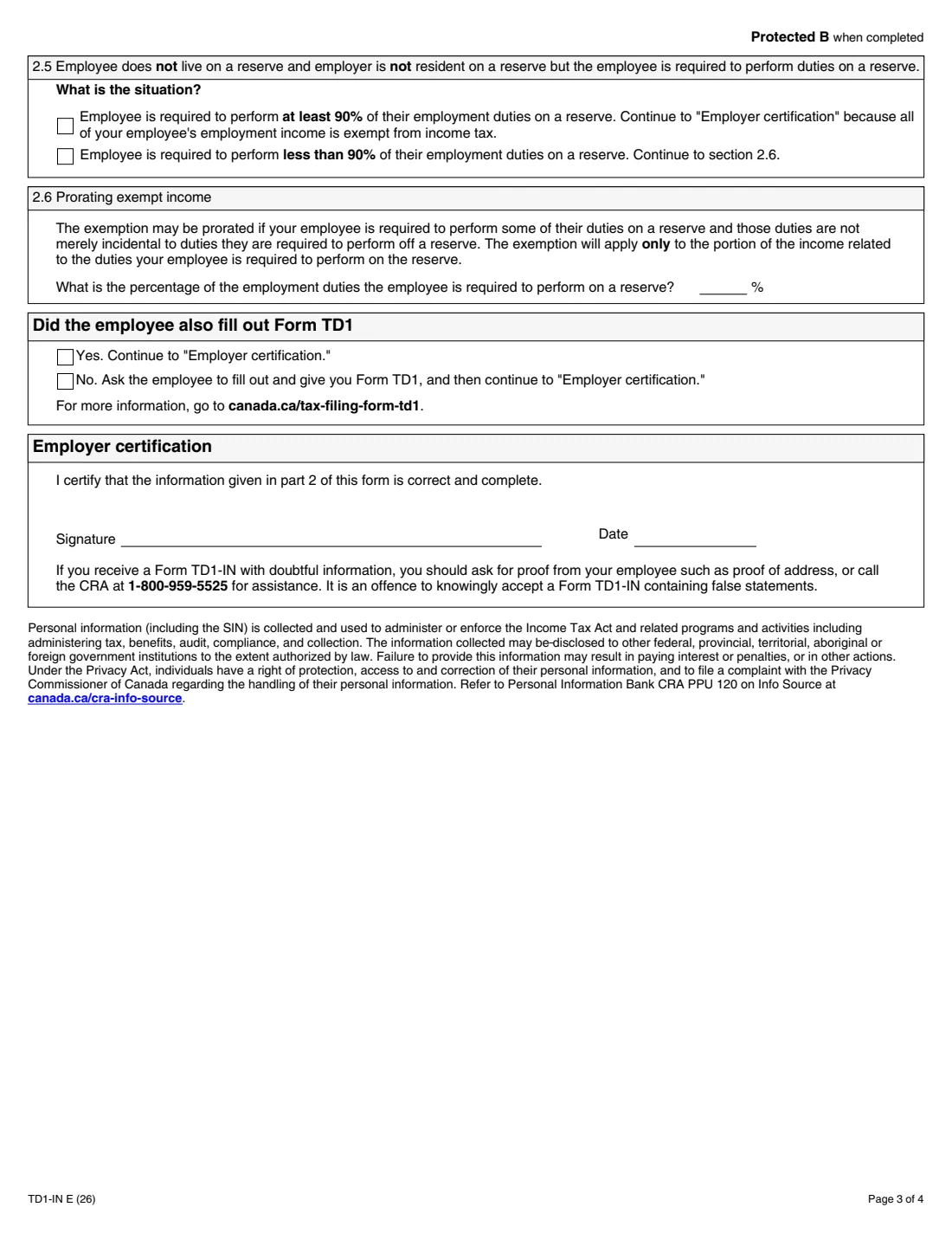
Only the one that applies: how much of the employee's duties are performed on a reserve (more than 50% or 50% or less; at least 90% or less than 90%), or, for an employer resident on a reserve, whether it is a band or tribal council, or an organization controlled by bands, carrying on non-commercial activities for the benefit of Indians who for the most part live on reserves.
5 2.6 — Prorating
If your answer sent you here, enter the percentage of the employment duties the employee is required to perform on a reserve. The exemption then applies only to that portion of the income.
6 Form TD1 and employer certification
Say whether the employee also filled out Form TD1 (if not, ask them to). The employer certifies part 2 is correct and complete, then dates and signs.
Common mistakes to avoid
- Filling out the form when the employee isn't registered under the Indian Act, or their First Nation's agreement has ended the exemption.
- Choosing a 2.2 situation that doesn't match the employee's answer in 1.4.
- Leaving out the percentage in 2.6 when a '50% or less' or 'less than 90%' answer sends you there.
- Using the form for an unusual or exceptional situation: the form says not to, and to withhold CPP, EI and income tax unless you can confirm the income is tax-exempt.
- Forgetting the employee's Form TD1.
After you fill it out
The employee and the employer sign their certifications, with FileIt's optional e-signature or by hand.
The employer keeps a signed copy for its records in case the CRA asks to see it.
The form says that if the employer receives a TD1-IN with doubtful information, it should ask for proof such as proof of address, or call the CRA at 1-800-959-5525.
A copy stays in the employee's FileIt vault folder.
Fill out Form TD1-IN online with FileIt
- Pick the person. Choose someone from People and FileIt fills in their name, date of birth, address and other details it already knows.
- Answer plain-language questions. One part of the form at a time, with the official help text beside each question — 18 fields in all. Your answers save as you go.
- Check the live preview. Watch your answers land on the real Canada Revenue Agency (CRA) form, and let FileIt do any worksheet arithmetic.
- Generate the official PDF. FileIt prints your answers into the agency’s own PDF and files it in that person’s folder in your vault. Sign it, or send it for e-signature.
FileIt fills the form — it never files or submits anything for you. Deliver the finished form to whoever asked for it, the way the form’s instructions say.
Start Form TD1-IN now — it’s freeForm TD1-IN: frequently asked questions
Can I fill out Form TD1-IN online?
Yes. FileIt guides the employee and the employer through their parts and prints the answers onto the CRA's official PDF, saved to the vault. It is free on every FileIt plan.
Does the TD1-IN replace Form TD1?
No. The form says the employee and employer fill it out in addition to Form TD1.
Is tax-exempt income still reported?
Yes. The form says employers must report all income and deductions on a T4 or T4A slip for First Nations workers, whether the income is taxable or exempt.
Are CPP and EI deducted from exempt income?
The form says tax-exempt salary or wages are not subject to CPP contributions, although the employee can elect to participate, and are subject to EI premiums.
What does 'required to perform duties on a reserve' mean?
The form says both the employee and employer have agreed to a specific work location under an employment contract or a formal hybrid work arrangement, including a home office on reserve. The agreement need not be in writing but must be clearly understood by both.
Official sources
- Blank form (PDF), published by Canada Revenue Agency (CRA): https://www.canada.ca/content/dam/cra-arc/formspubs/pbg/td1-in/td1-in-fill-26e.pdf
- Official instructions and guidance: https://www.canada.ca/en/revenue-agency/services/forms-publications/forms/td1-in.html
- Edition shown on this page: TD1-IN E (26) (checked 2026-10-25).
FileIt is not affiliated with or endorsed by Canada Revenue Agency (CRA) or any government. This page explains the form in general terms and is not legal, tax or immigration advice. Always read the official instructions, and check that you are using the edition the recipient accepts. Page last reviewed 2026-10-25.