What is Form T1172?
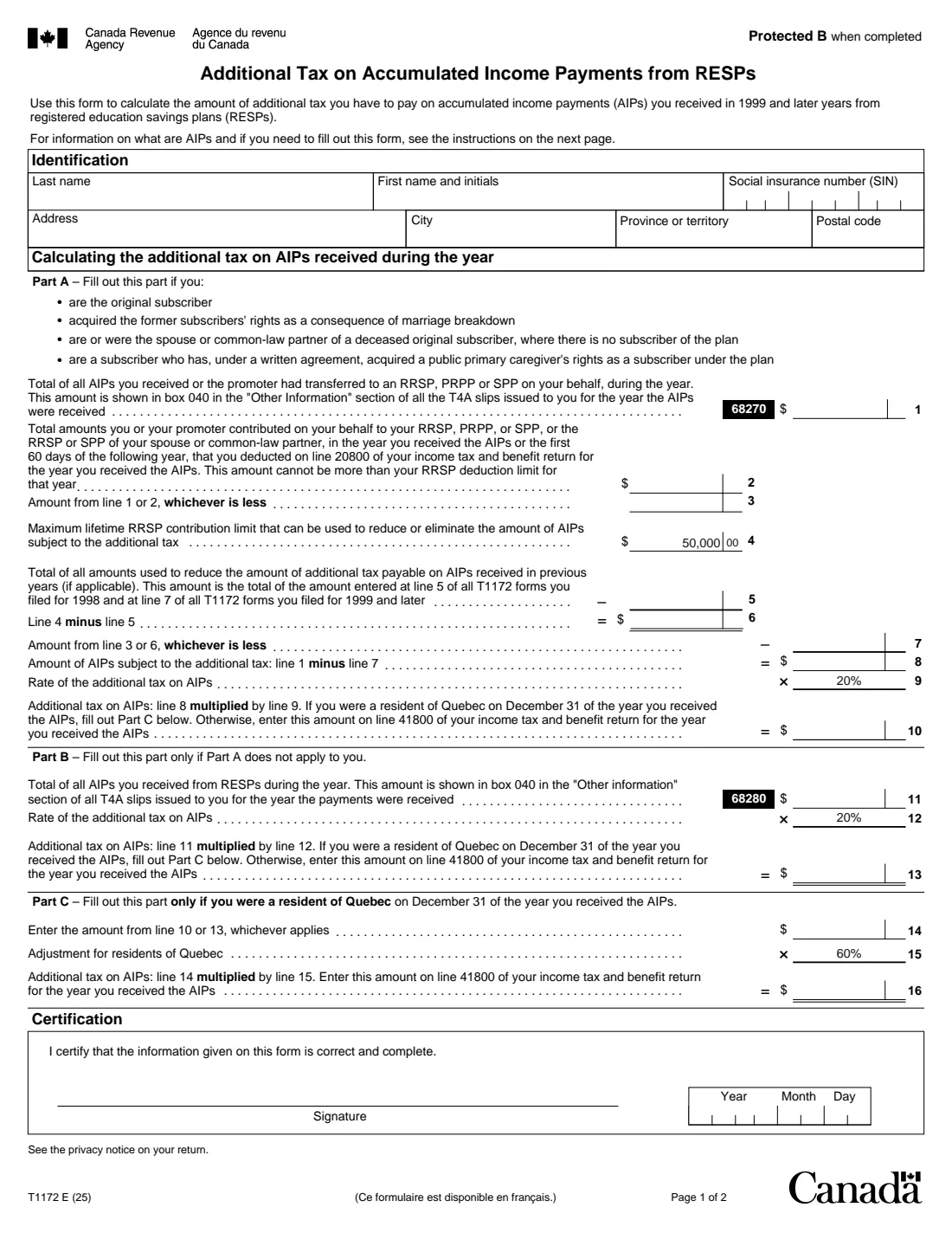
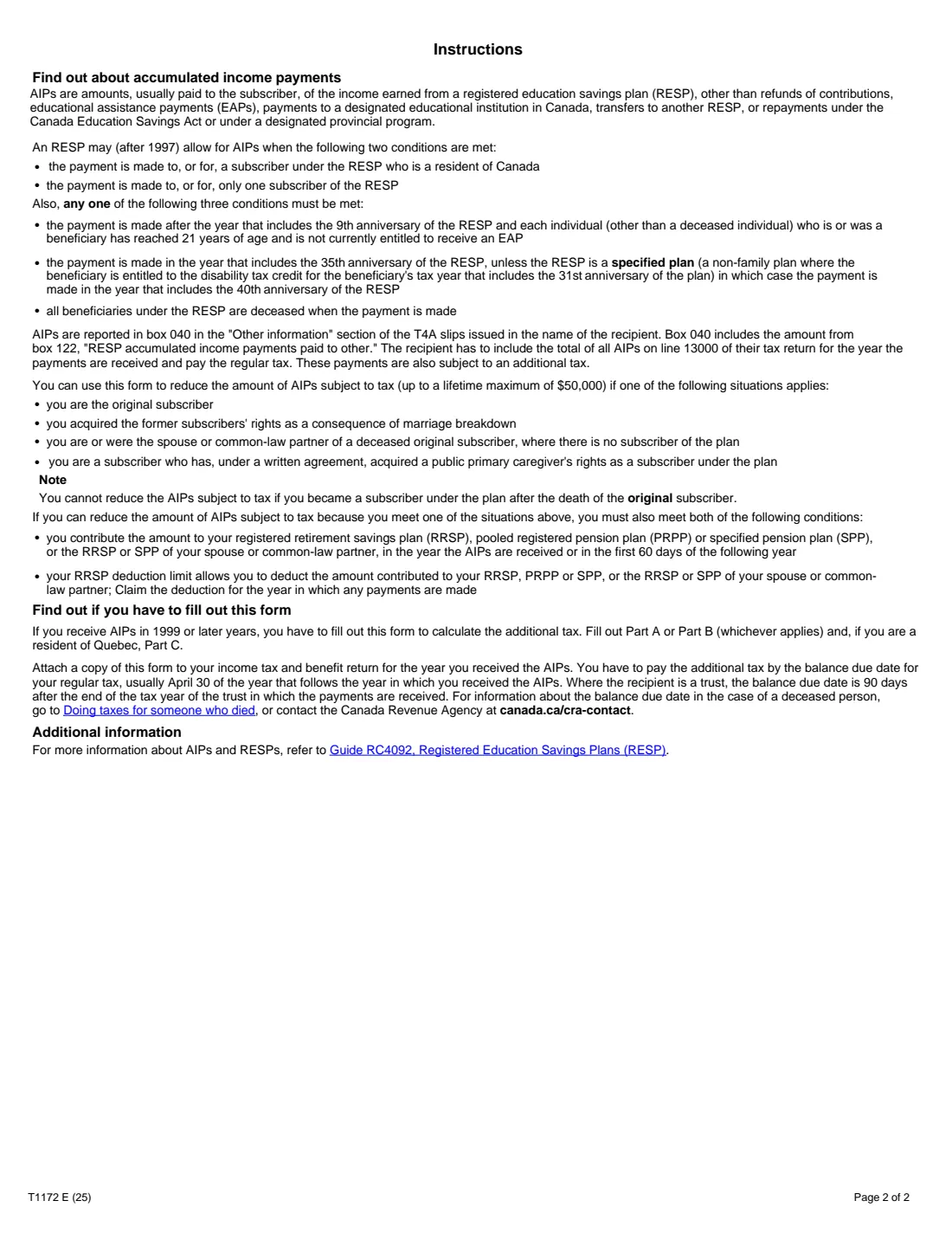
Accumulated income payments (AIPs) are the investment earnings paid out of an RESP to the subscriber when they aren't used for a beneficiary's education. They are reported in box 040 of a T4A, included in income on line 13000, and also attract an additional tax. Form T1172, Additional Tax on Accumulated Income Payments from RESPs, is how you calculate that additional tax for any year from 1999 on.
Part A is for original subscribers and people who stepped into their shoes in the situations the form lists: you can reduce the AIPs subject to the tax by RRSP, PRPP or SPP contributions you deducted, up to the $50,000 lifetime limit. Part B is for everyone else, and taxes the whole AIP. Part C applies a 60% adjustment for people who lived in Quebec on December 31 of that year.
FileIt asks which part applies and whether you lived in Quebec, takes your AIP and contribution amounts, and works out every remaining line on the CRA's own PDF (edition T1172 E (25)). The result is saved in the person's vault folder. You attach it to your return yourself; FileIt doesn't file anything.
- Who fills it
- Anyone who received AIPs from an RESP in 1999 or later
- Sent to
- Attached to your income tax and benefit return for the year you received the AIPs
- When
- With that return; the tax is due by your balance-due date, usually April 30
- Rate
- 20% of the AIPs subject to tax (60% of that for Quebec residents)
- Signatures
- Your signature and date in the certification, by hand
- Edition
- T1172 E (25)
Who needs to fill out Form T1172?
- RESP subscribers who received AIPs reported in box 040 of a T4A.
- People who took an AIP in cash, and people who had part of it transferred to an RRSP using Form T1171.
- Residents of Quebec on December 31 of the year of the AIP, who also fill out Part C.
When to use Form T1172
- When you prepare your return for the year you received the AIPs.
- After the 60-day window into the following year closes, since contributions made then can count on line 2.
- Every year you receive AIPs, keeping each year's form for the line 5 total next time.
What you need before you start
- Your SIN and address.
- Box 040 from all your T4A slips for the year.
- The RRSP, PRPP or SPP contributions you deducted on line 20800 for that year (up to your deduction limit).
- Line 5 of any T1172 you filed for 1998 and line 7 of any you filed for 1999 or later.
- Whether you lived in Quebec on December 31 of that year.
What’s on Form T1172
The 2025 edition has 2 pages. FileIt asks for it in 6 parts:
- IdentificationEmployee
- Which part applies to youEmployee
- Part A – Calculating the additional taxEmployee
- Part B – Only if Part A does not apply to youEmployee
- Part C – Residents of QuebecEmployee
- CertificationEmployee
How to fill out Form T1172, step by step
1 Choose Part A or Part B
Part A covers the original subscriber, someone who acquired the subscriber's rights on a marriage breakdown, the spouse or common-law partner of a deceased original subscriber where there's no subscriber left, and someone who acquired a public primary caregiver's rights. Everyone else uses Part B.
2 Part A – lines 1 to 10
Enter your total AIPs (line 1), the contributions you deducted (line 2) and amounts used in earlier years (line 5). FileIt takes the lesser of lines 1 and 2, limits it by what's left of $50,000, and applies 20% to the rest.
3 Part B – lines 11 to 13
Enter your total AIPs; the additional tax is 20% of the whole amount.
4 Part C – Quebec
If you lived in Quebec on December 31, the tax from line 10 or 13 is multiplied by 60%. The result goes on line 41800.
Common mistakes to avoid
- Counting contributions you didn't deduct on line 20800, or more than your deduction limit.
- Leaving out amounts used on earlier T1172 forms, which shrink the $50,000 lifetime limit.
- Using Part A when you became a subscriber after the original subscriber died.
- Forgetting Part C as a Quebec resident.
- Missing the balance-due date for the additional tax.
After you fill it out
Print the PDF from your FileIt vault, sign and date it, and attach a copy to your return for the year you received the AIPs. Enter the line 10, 13 or 16 amount on line 41800. FileIt doesn't file it for you.
Pay the additional tax by the balance-due date for your regular tax, usually April 30 of the next year (for a trust, 90 days after its year end). Keep the form in your vault: next time you'll need its line 7 for line 5.
Fill out Form T1172 online with FileIt
- Pick the person. Choose someone from People and FileIt fills in their name, date of birth, address and other details it already knows.
- Answer plain-language questions. One part of the form at a time, with the official help text beside each question — 22 fields in all. Your answers save as you go.
- Check the live preview. Watch your answers land on the real Canada Revenue Agency (CRA) form, and let FileIt do any worksheet arithmetic.
- Generate the official PDF. FileIt prints your answers into the agency’s own PDF and files it in that person’s folder in your vault.
FileIt fills the form — it never files or submits anything for you. Deliver the finished form to whoever asked for it, the way the form’s instructions say.
Start Form T1172 now — it’s freeForm T1172: frequently asked questions
What is the additional tax on AIPs?
An extra 20% tax on the AIPs that aren't sheltered by deducted RRSP, PRPP or SPP contributions, on top of the regular tax on the AIP as income.
Where does the result go?
On line 41800 of your income tax and benefit return for the year you received the AIPs.
Why does Quebec get a different amount?
Part C multiplies the tax by 60% for people who lived in Quebec on December 31 of that year, as printed on the form.
Do I still need this if the promoter transferred the AIP to my RRSP?
Yes. The T1171 only stops tax being withheld; the T1172 works out whether any additional tax is owed.
Official sources
- Blank form (PDF), published by Canada Revenue Agency (CRA): https://www.canada.ca/content/dam/cra-arc/formspubs/pbg/t1172/t1172-fill-25e.pdf
- Official instructions and guidance: https://www.canada.ca/en/revenue-agency/services/forms-publications/forms/t1172.html
- Edition shown on this page: T1172 E (25) (checked 2026-10-19).
FileIt is not affiliated with or endorsed by Canada Revenue Agency (CRA) or any government. This page explains the form in general terms and is not legal, tax or immigration advice. Always read the official instructions, and check that you are using the edition the recipient accepts. Page last reviewed 2026-10-19.