What is Form RC721?
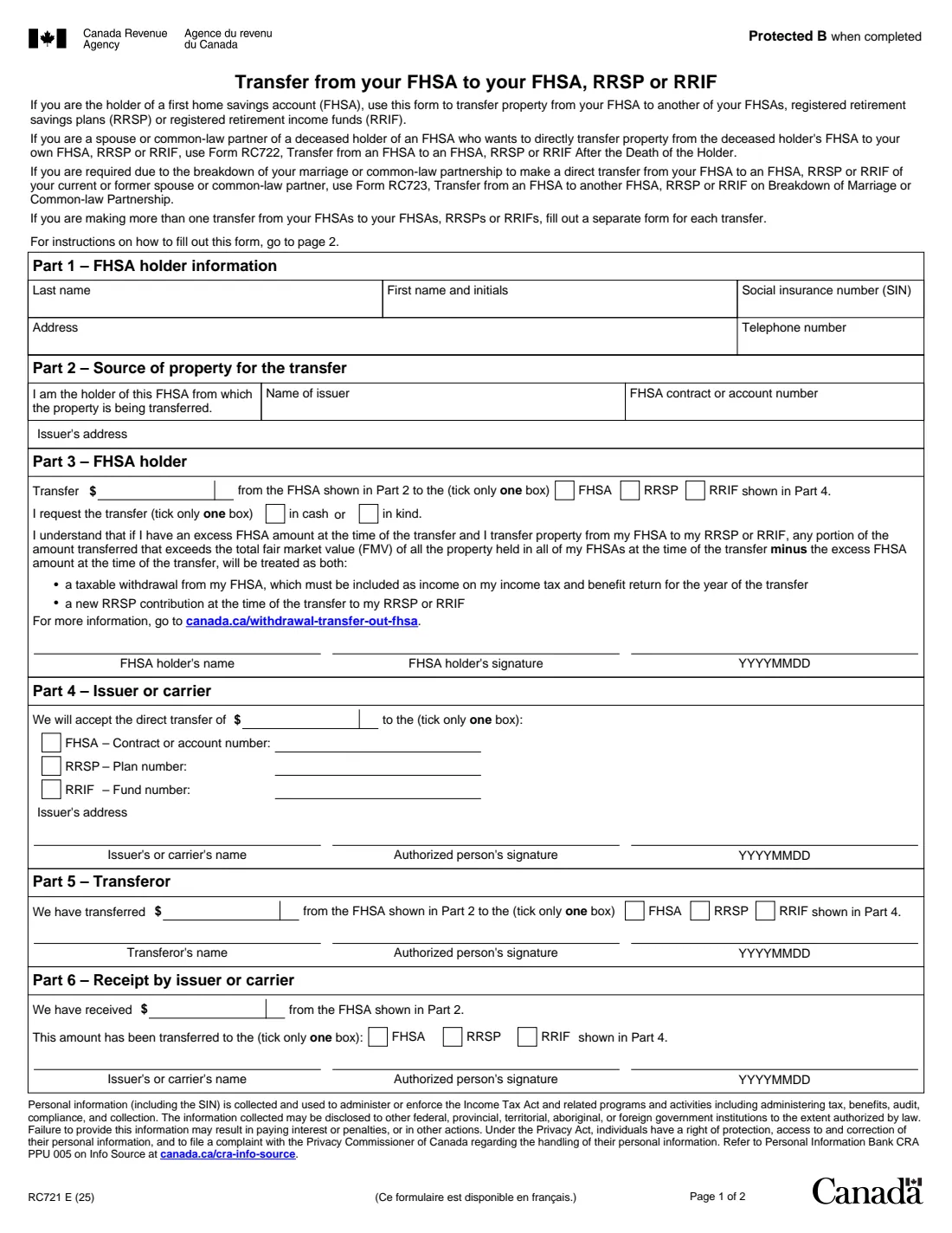
Form RC721 is the Canada Revenue Agency (CRA) form for a direct transfer from your first home savings account (FHSA) to another of your FHSAs, or to your registered retirement savings plan (RRSP) or registered retirement income fund (RRIF). The current edition is RC721 E (25).
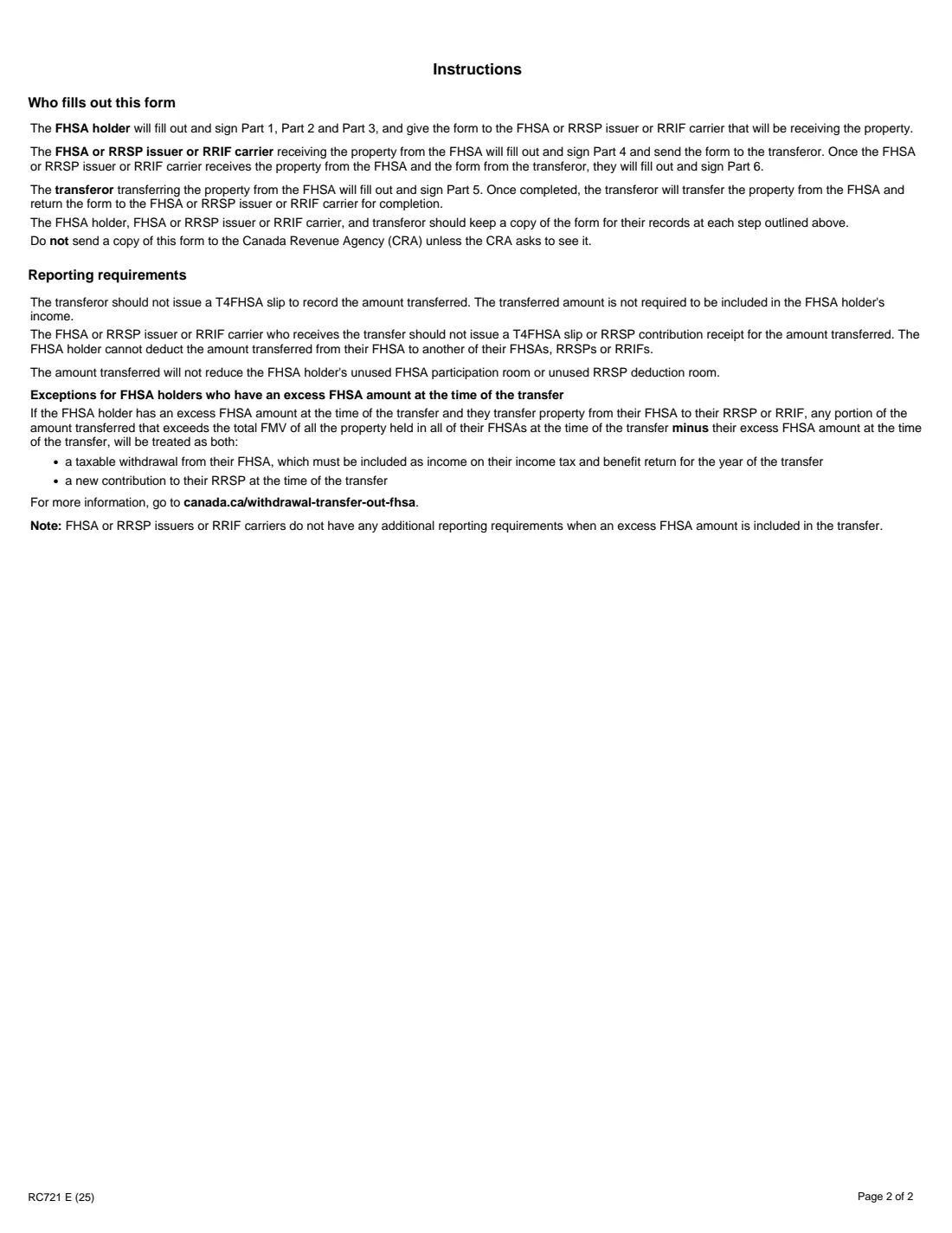
You fill out Parts 1 to 3: your details, the FHSA the property leaves, the amount, where it goes, and whether it moves in cash or in kind. You give the form to the institution receiving the property, which fills out Part 4; the transferor completes Part 5 and the receiving institution Part 6. A surviving spouse or partner uses RC722 instead, and a transfer on the breakdown of a relationship uses RC723.
FileIt guides you through your three parts, prints the amount with its cents in the form's dollars-and-cents box, and fills the CRA's official PDF. The completed form is saved in the person's vault folder, ready to print and sign or to send for signature. FileIt doesn't deliver it to any institution.
- Who fills it
- The FHSA holder; then the receiving institution and the transferor
- Given to
- The FHSA or RRSP issuer or RRIF carrier receiving the property
- Goes to the CRA?
- No, unless the CRA asks to see it
- Participation room
- Not reduced, and no unused RRSP deduction room used
- Signatures
- The holder signs Part 3
Who needs to fill out Form RC721?
- FHSA holders moving their FHSA to another financial institution.
- FHSA holders who won't buy a first home and want to move their savings into their RRSP or RRIF.
- Anyone making more than one FHSA transfer: each one needs its own form.
When to use Form RC721
- When you want the property moved directly between plans instead of withdrawing it.
- When you're consolidating FHSAs or switching providers.
- When you're closing out an FHSA into retirement savings.
What you need before you start
- Your name, social insurance number (SIN), address and telephone number.
- The name and address of the issuer of the FHSA the property leaves, and its contract or account number.
- The amount to transfer, and whether it moves in cash or in kind.
- Which kind of plan receives it: FHSA, RRSP or RRIF.
- If you have an excess FHSA amount: the fair market value of all the property in your FHSAs.
What’s on Form RC721
The 2025 edition has 2 pages. FileIt asks for it in 4 parts, and it is signed by Fhsa holder and Issuer or carrier:
- Part 1 – FHSA holder informationFhsa holder
- Part 2 – Source of property for the transferFhsa holder
- Part 3 – FHSA holderFhsa holder
- Part 4 – Issuer or carrierIssuer or carrier
How to fill out Form RC721, step by step
1 Part 1 – FHSA holder information
Your last name, first name and initials, SIN, address and telephone number.
2 Part 2 – Source of property
The issuer of the FHSA you're transferring from, its contract or account number and the issuer's address. You must be the holder of that FHSA.
3 Part 3 – FHSA holder
The amount, the kind of plan it goes to (tick only one of FHSA, RRSP or RRIF), and cash or in kind. You confirm the excess-amount rule shown on the form, then print your name, sign and date.
4 Parts 4 to 6 – The institutions
The receiving issuer or carrier gives the amount it will accept and the account, plan or fund number (Part 4), the transferor confirms what it moved (Part 5), and the receiving institution confirms receipt (Part 6). A receiving institution using FileIt can fill Part 4 as an optional part.
Common mistakes to avoid
- Using RC721 after the holder's death or on a relationship breakdown; those transfers have their own forms (RC722 and RC723).
- Ticking more than one destination, or both cash and in kind.
- Moving property to an RRSP or RRIF while you have an excess FHSA amount without reading the rule in Part 3.
- Putting two transfers on one form.
- Deducting the amount on your return; the instructions say you can't.
After you fill it out
Print the PDF from your FileIt vault, sign Part 3 and give it to the institution receiving the property. FileIt doesn't send it.
The institutions complete Parts 4 to 6 in turn; each party keeps a copy, as the instructions say.
Keep your copy in the same vault folder as your FHSA statements.
Fill out Form RC721 online with FileIt
- Pick the person. Choose someone from People and FileIt fills in their name, date of birth, address and other details it already knows.
- Answer plain-language questions. One part of the form at a time, with the official help text beside each question — 23 fields in all. Your answers save as you go.
- Check the live preview. Watch your answers land on the real Canada Revenue Agency (CRA) form, and let FileIt do any worksheet arithmetic.
- Generate the official PDF. FileIt prints your answers into the agency’s own PDF and files it in that person’s folder in your vault. Sign it, or send it for e-signature.
FileIt fills the form — it never files or submits anything for you. Deliver the finished form to whoever asked for it, the way the form’s instructions say.
Start Form RC721 now — it’s freeForm RC721: frequently asked questions
Does a transfer from my FHSA to my RRSP use RRSP room?
The instructions say the transfer doesn't reduce your unused RRSP deduction room or your unused FHSA participation room, and the receiving institution shouldn't issue a T4FHSA slip or an RRSP contribution receipt for it.
Is the transfer taxable?
Normally no: the amount isn't included in your income and you can't deduct it. The exception printed on the form is a transfer to an RRSP or RRIF while you have an excess FHSA amount, where part of it can be a taxable withdrawal and a new RRSP contribution.
Who do I give Form RC721 to?
To the FHSA or RRSP issuer or RRIF carrier that will receive the property. It isn't sent to the CRA unless the CRA asks to see it.
Can I fill out RC721 online?
Yes. FileIt guides you through Parts 1 to 3 and prints your answers on the CRA's official RC721 PDF, saved in your vault, for you to sign and hand over.
Official sources
- Blank form (PDF), published by Canada Revenue Agency (CRA): https://www.canada.ca/content/dam/cra-arc/formspubs/pbg/rc721/rc721-fill-25e.pdf
- Official instructions and guidance: https://www.canada.ca/en/revenue-agency/services/forms-publications/forms/rc721.html
- Edition shown on this page: RC721 E (25) (checked 2026-10-19).
FileIt is not affiliated with or endorsed by Canada Revenue Agency (CRA) or any government. This page explains the form in general terms and is not legal, tax or immigration advice. Always read the official instructions, and check that you are using the edition the recipient accepts. Page last reviewed 2026-10-19.