What is NSW statutory declaration?
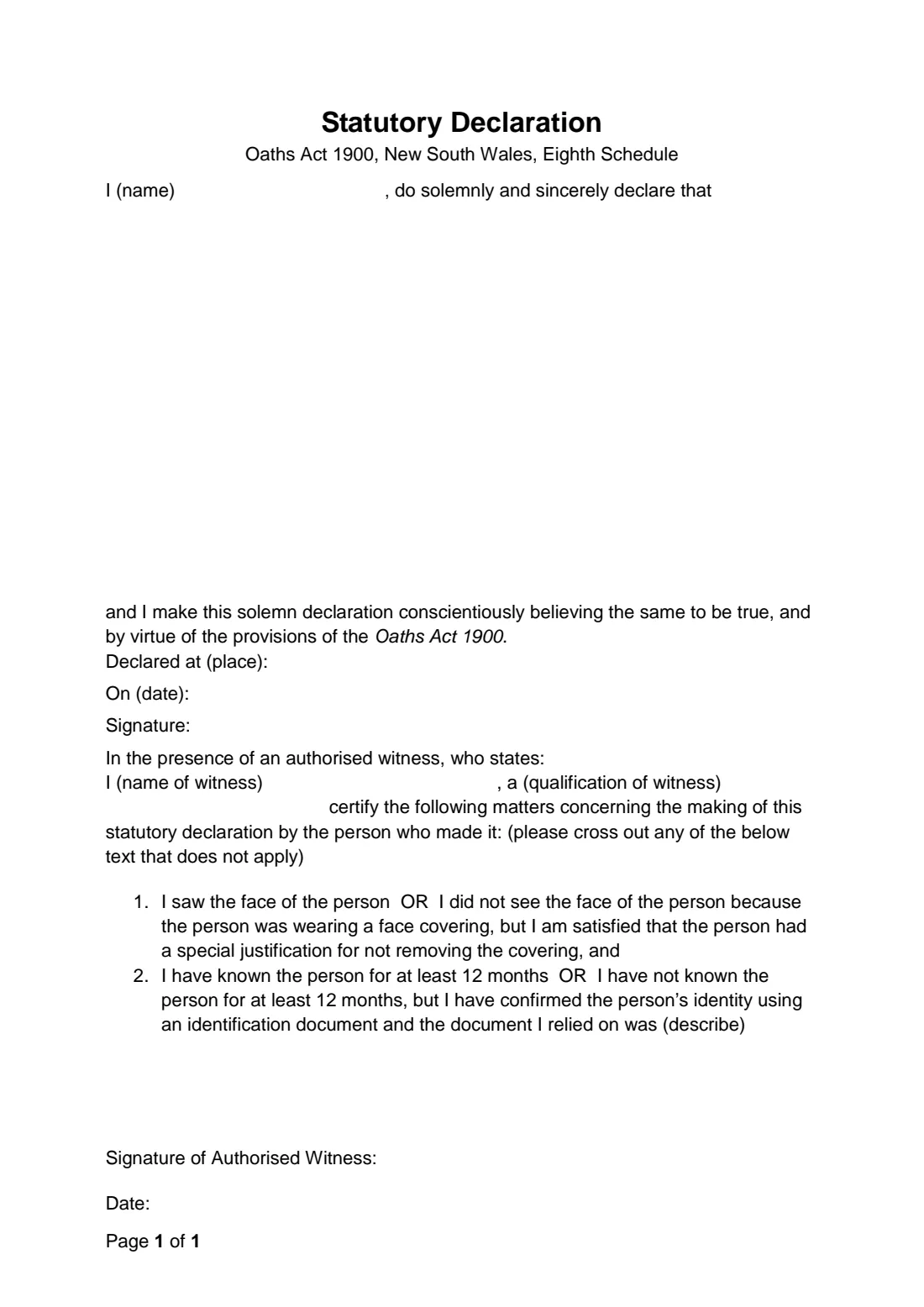
A New South Wales statutory declaration is made in the form of the Eighth Schedule to the Oaths Act 1900. It is used for NSW matters: many NSW government agencies, courts and private organisations in the state ask for it when there is no document to prove something.
The form is a single page. You write your name and your statement, then declare where and when you make it. The authorised witness completes a certificate saying they saw your face (or why not) and how they confirmed who you are, and signs.
FileIt fills in the NSW Local Court's PDF. It keeps your paragraph breaks, warns you before the statement overflows the page, and can pre-fill your witness's name and qualification. You sign in front of the witness: FileIt doesn't sign or lodge anything.
- Made under
- Oaths Act 1900 (NSW), Eighth Schedule
- Who fills it
- You, the person declaring. The witness completes their certificate
- Signatures
- You and an authorised witness, by hand
- For
- NSW matters. Commonwealth matters use the Commonwealth form
- Statement space
- About 21 typed lines
Who needs to fill out NSW statutory declaration?
- Anyone a NSW agency, court or organisation asks for a statutory declaration under the NSW Oaths Act.
- People confirming facts they can't prove with a document for a NSW matter, such as lost items, a change of circumstances or a relationship.
When to use NSW statutory declaration
- When the organisation asks for a NSW statutory declaration. For Centrelink, the ATO, Home Affairs and other Commonwealth matters, use the Commonwealth statutory declaration instead.
- Before you meet your witness: prepare it unsigned, then sign in front of them.
What you need before you start
- Your full name.
- The facts you are declaring, ideally in numbered paragraphs.
- An authorised witness, such as a Justice of the Peace or a lawyer, and their name and qualification if you want them pre-filled.
- An identification document if the witness has known you for less than 12 months.
What’s on NSW statutory declaration
The 2014 edition has 1 page. FileIt asks for it in 3 parts:
- Your declarationPerson making the declaration
- Where and when you signPerson making the declaration
- Your witnessAuthorised witness
How to fill out NSW statutory declaration, step by step
1 Your name and statement
The form reads 'I (name), do solemnly and sincerely declare that' followed by your statement. Write the facts in numbered paragraphs, keeping to what you know first-hand. FileIt prints a long name on two smaller lines so it fits the short box.
2 Declared at and on
Give the place and date where you sign in front of the witness, or leave them blank and write them in at the signing.
3 The witness's certificate
The witness writes their name and qualification and certifies that they saw your face (or were satisfied there was a special justification for a face covering) and that they have known you for at least 12 months, or confirmed your identity from a document they describe. They cross out the parts that don't apply, sign and date it.
Common mistakes to avoid
- Signing before you meet the witness.
- Using the NSW form for a Commonwealth matter, or the other way round.
- Writing more than fits: the space holds about 21 lines.
- Forgetting that the witness must cross out the parts of their certificate that don't apply.
After you fill it out
Print the PDF, take it unsigned to your authorised witness, and sign it in front of them. They complete and sign their certificate.
Give the signed declaration to the organisation that asked for it, and keep a copy in your FileIt vault.
Fill out NSW statutory declaration online with FileIt
- Pick the person. Choose someone from People and FileIt fills in their name, date of birth, address and other details it already knows.
- Answer plain-language questions. One part of the form at a time, with the official help text beside each question — 10 fields in all. Your answers save as you go.
- Check the live preview. Watch your answers land on the real NSW Department of Communities and Justice (Local Court) form, and let FileIt do any worksheet arithmetic.
- Generate the official PDF. FileIt prints your answers into the agency’s own PDF and files it in that person’s folder in your vault.
FileIt fills the form — it never files or submits anything for you. Deliver the finished form to whoever asked for it, the way the form’s instructions say.
Start NSW statutory declaration now — it’s freeNSW statutory declaration: frequently asked questions
Who can witness a NSW statutory declaration?
An authorised witness under the Oaths Act, for example a Justice of the Peace, an Australian legal practitioner or a notary public. Check with the organisation if you're unsure.
Why does the witness need to see my face?
The witness's certificate on the form says they saw your face, or did not because you wore a face covering for which they were satisfied there was a special justification.
Is this the same as the Commonwealth statutory declaration?
No. The Commonwealth form is made under the Statutory Declarations Act 1959 for Commonwealth matters. This one is for NSW matters.
Can FileIt sign it for me?
No. You and the witness sign by hand, because it must be signed in the witness's presence.
Official sources
- Blank form (PDF), published by NSW Department of Communities and Justice (Local Court): https://localcourt.nsw.gov.au/content/dam/dcj/ctsd/localcourt/documents/forms/Statutory%20Declaration%20Form.pdf
- Official instructions and guidance: https://localcourt.nsw.gov.au/content/dam/dcj/ctsd/localcourt/documents/forms/Statutory%20Declaration%20Form.pdf
- Edition shown on this page: Oaths Act 1900 (NSW), Eighth Schedule form (PDF of November 2014) (checked 2026-10-25).
FileIt is not affiliated with or endorsed by NSW Department of Communities and Justice (Local Court) or any government. This page explains the form in general terms and is not legal, tax or immigration advice. Always read the official instructions, and check that you are using the edition the recipient accepts. Page last reviewed 2026-10-25.