What is the investment risk profile form template?
Understanding how someone actually feels about investment risk takes more than a single number — it takes questions about their goals, how soon they'll need the money, what they've invested in before, and how they reacted the last time markets fell. This template walks a client through all of that online, at their own pace, before a conversation with an adviser.
An online questionnaire works better than a printed form here because branching logic keeps it relevant: someone who has seen an investment fall in value gets an extra question about how they reacted, and someone with ethical or sustainability preferences gets a box to describe them, while everyone else skips straight past. A rating scale, an agree/disagree grid and a plain-English "what would you do if your investments fell 20%" question round out the picture without turning the form into a wall of text.
Every completed questionnaire is saved as a PDF in the adviser's or firm's FileIt vault, giving a clear, dated record of what the client said at that point in time — useful context to revisit before the next review.
- Best for
- Financial advisers, wealth managers and firms opening a conversation about investment risk
- Filled in by
- The client or prospective client
- Time to complete
- About 8 minutes
- Includes
- A ratings scale, a matrix/grid question, conditional follow-ups, and a plain-language non-advice disclaimer
Who uses a investment risk profile form?
- A financial adviser gathering a new client's attitude to risk before recommending a portfolio
- A wealth management firm refreshing an existing client's risk profile ahead of an annual review
- An adviser preparing for a first meeting with a prospective client by sending the questionnaire in advance
- Recording how a client's circumstances or feelings about risk have changed after a major life event
- A firm that wants a consistent, comparable record across all clients rather than free-form notes from a call
- Capturing a client's ethical or sustainability preferences alongside their risk tolerance
Questions on this investment risk profile form
22 questions over 5 pages · includes conditional questions, multiple pages, consent checkbox, ratings.
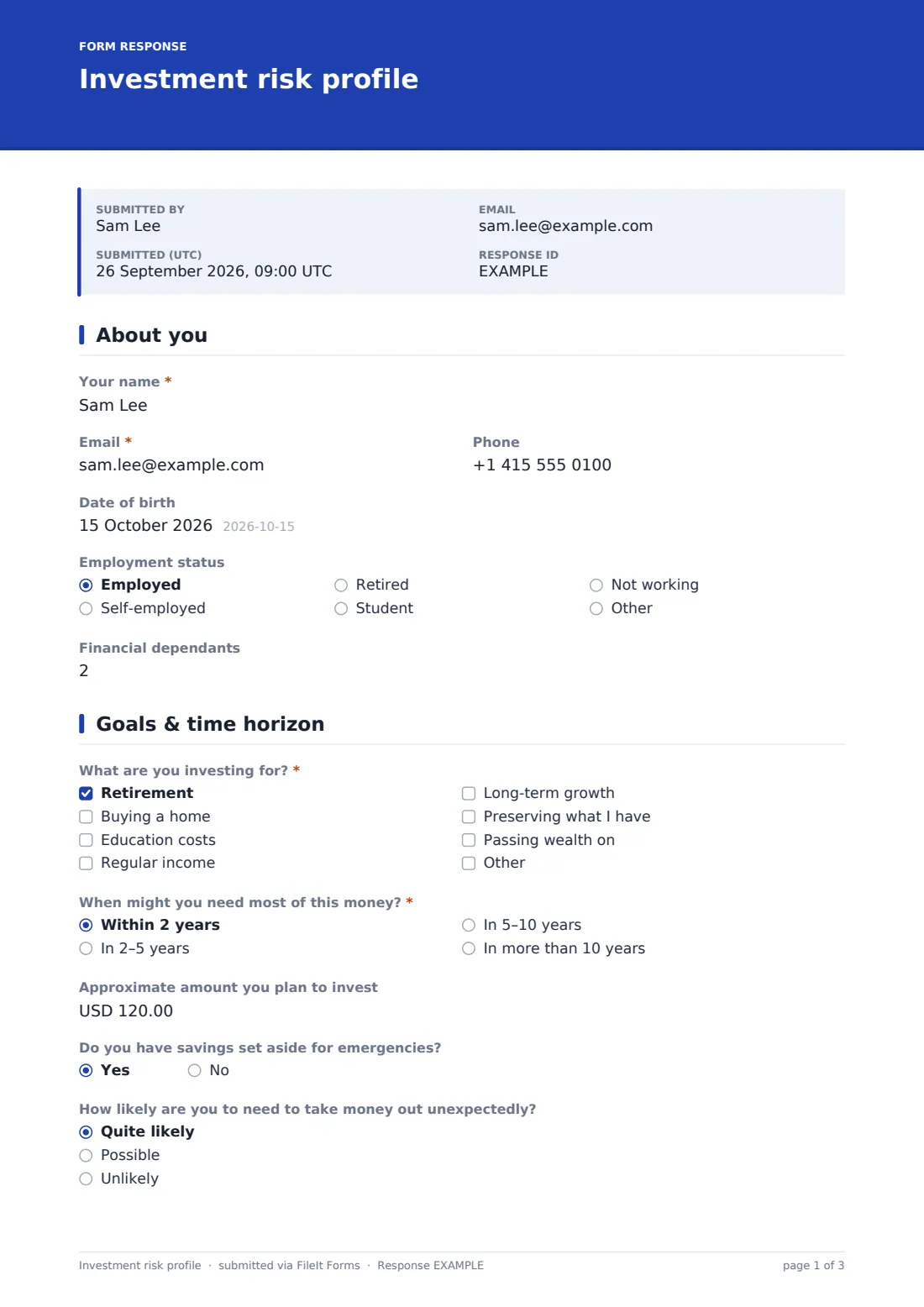
1 About you
- Your name*
- Email*
- Phone
- Date of birth
- Employment status Employed · Self-employed · Retired · Student · Not working · Other
- Financial dependants
2 Goals & time horizon
- What are you investing for?* Retirement · Buying a home · Education costs · Regular income · Long-term growth · Preserving what I have · Passing wealth on
- When might you need most of this money?* Within 2 years · In 2–5 years · In 5–10 years · In more than 10 years
- Approximate amount you plan to invest
- Do you have savings set aside for emergencies?
- How likely are you to need to take money out unexpectedly? Quite likely · Possible · Unlikely
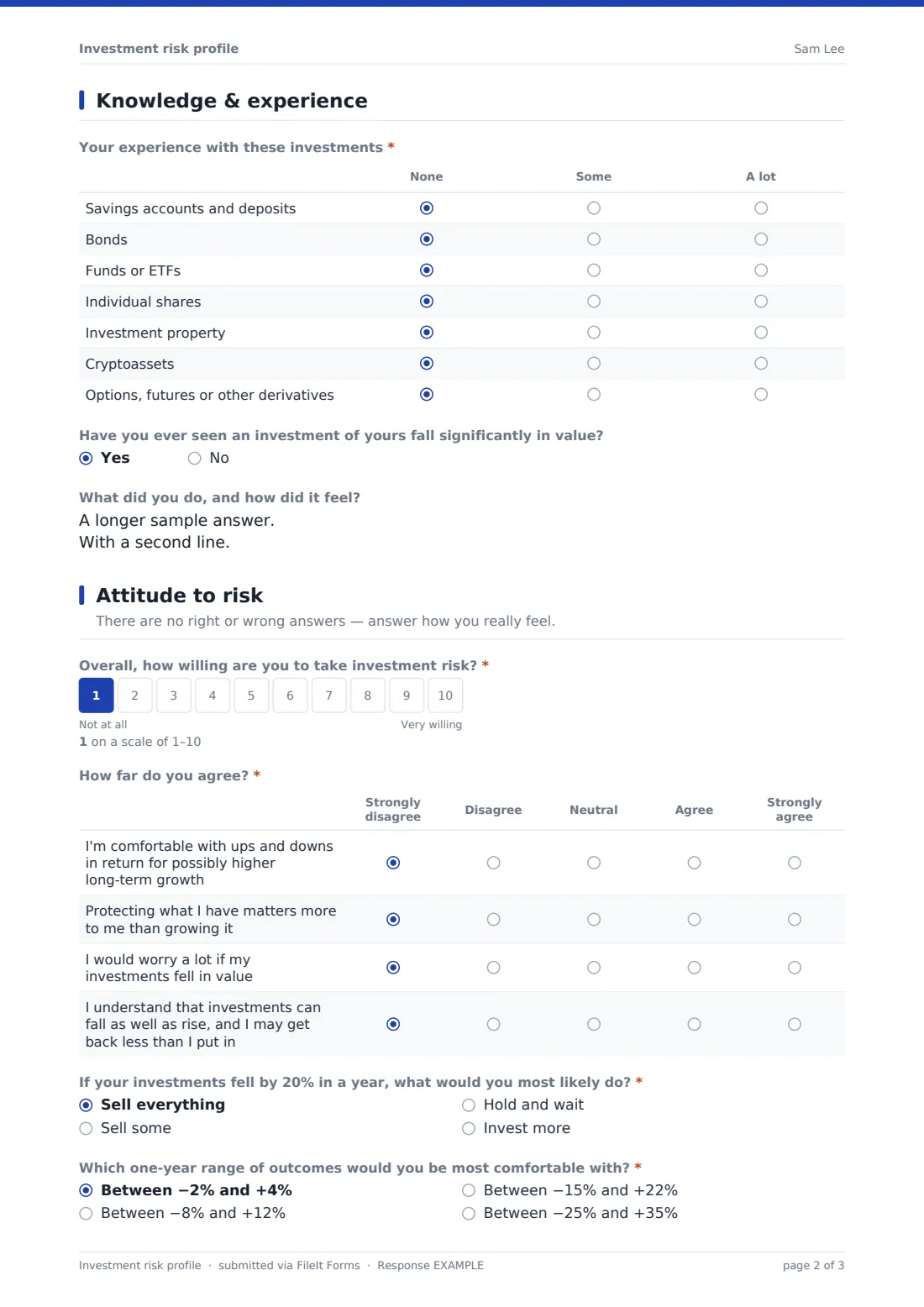
3 Knowledge & experience
- Your experience with these investments* None · Some · A lot
- Have you ever seen an investment of yours fall significantly in value?
- What did you do, and how did it feel? asked only when it applies
4 Attitude to risk
- Overall, how willing are you to take investment risk?*
- How far do you agree?* Strongly disagree · Disagree · Neutral · Agree · Strongly agree
- If your investments fell by 20% in a year, what would you most likely do?* Sell everything · Sell some · Hold and wait · Invest more
- Which one-year range of outcomes would you be most comfortable with?* Between −2% and +4% · Between −8% and +12% · Between −15% and +22% · Between −25% and +35%
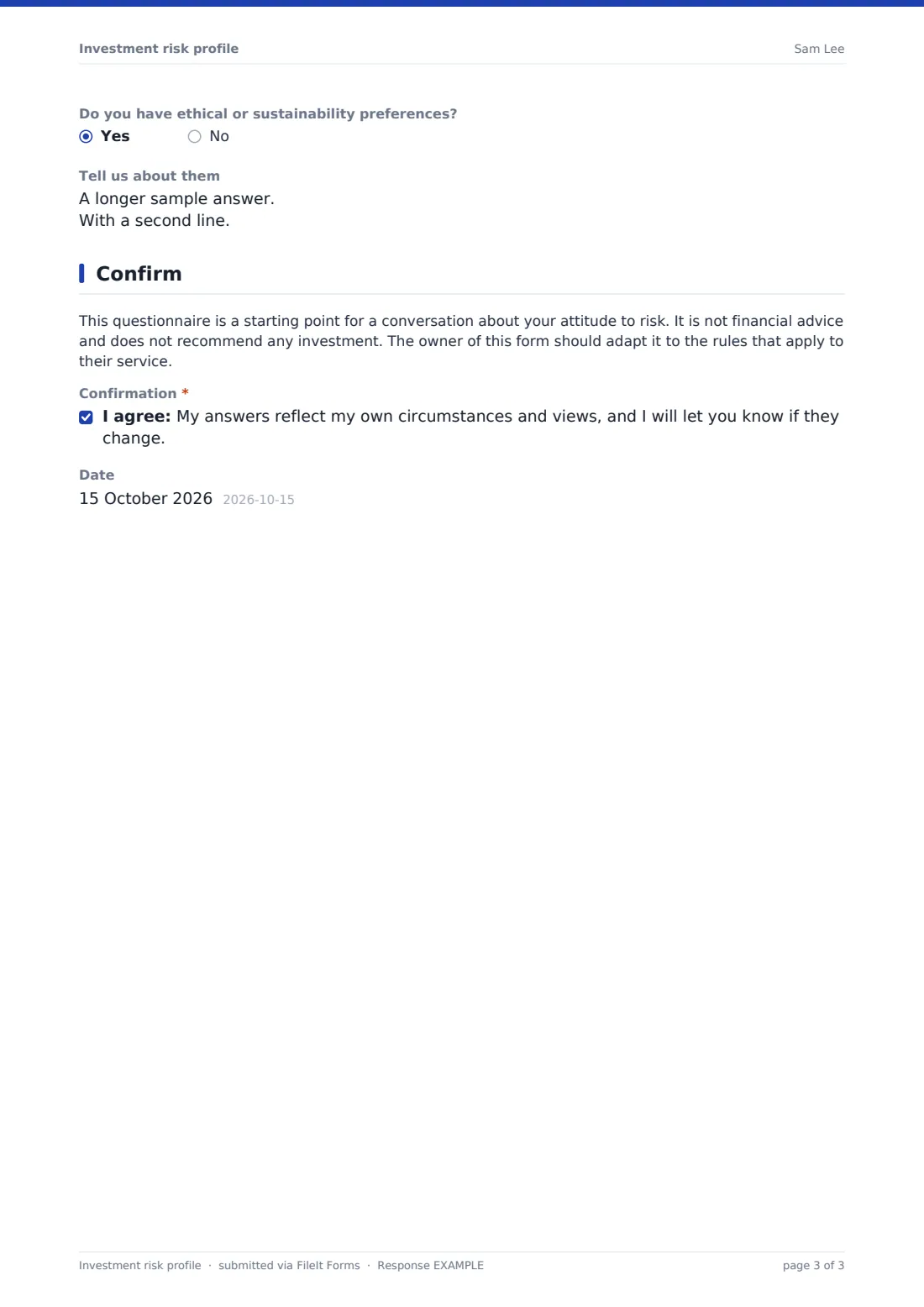
- Do you have ethical or sustainability preferences?
- Tell us about them asked only when it applies
5 Confirm
- Confirmation*
- Date
The investment risk profile form, page by page
1 About you
The form collects the client's name, email, phone, date of birth, employment status and number of financial dependants — background that shapes how much risk might be appropriate, without asking for detailed account information.
2 Goals & time horizon
A checklist lets the client pick every reason they're investing — retirement, buying a home, education costs, regular income, long-term growth, preserving what they have, or passing wealth on — followed by when they're likely to need most of the money, from within two years out to more than ten. An approximate amount they plan to invest is optional.
Two further questions round out the picture: whether they already have an emergency fund set aside, and how likely they are to need to dip into this money unexpectedly, since both affect how much risk makes sense.
3 Knowledge & experience
A grid question asks how much experience the client has with each of several investment types — savings accounts, bonds, funds or ETFs, individual shares, investment property, cryptoassets, and derivatives — rated none, some or a lot. A yes/no question then asks whether they've ever seen an investment of theirs fall significantly in value, and answering Yes opens a box asking what they did and how it felt, which often reveals more about real risk tolerance than the rating alone.
4 Attitude to risk
The page opens with the description reminding the client there are no right or wrong answers, then a 1-10 scale asks how willing they are to take investment risk overall. An agree/disagree grid covers statements like being comfortable with ups and downs for higher long-term growth, valuing protection over growth, worrying about falls in value, and understanding that investments can fall as well as rise.
Two scenario-based questions follow: what the client would most likely do if their investments fell 20% in a year (sell everything, sell some, hold, or invest more), and which illustrative one-year range of outcomes they'd be most comfortable with, from a narrow low-risk range up to a wide high-risk one. A final yes/no question and optional detail box capture any ethical or sustainability preferences.
5 Confirm
A plain-text notice states clearly that the questionnaire is a starting point for a conversation about risk, is not financial advice, and does not recommend any investment — and that the firm using it should adapt it to the rules that apply to their own service. The client then confirms their answers reflect their own circumstances and views and agrees to let the adviser know if anything changes, with an optional date field.
Make the template yours
- Add or remove investment types in the experience grid to match the products your firm actually offers
- Adjust the illustrative outcome ranges to reflect the portfolios your firm builds, rather than generic examples
- Add a field capturing which adviser or team the client is working with, for routing and filing
- Send the questionnaire ahead of a first meeting so the conversation can start from the client's answers rather than from scratch
- File completed questionnaires into a per-client vault folder alongside other onboarding documents
- Re-send the same form periodically (e.g. annually) and compare past and current answers in the Responses table
- Adapt the non-advice disclaimer and the confirmation statement to match your firm's own compliance wording
Tips for a better investment risk profile form
- Make clear to clients this is a discussion starter, not a decision — encourage honest answers rather than what they think sounds "safer" or "braver"
- Pair the scenario questions (the 20% fall, the outcome ranges) with the rating scale rather than relying on either alone — people's stated tolerance and their reaction to a real scenario often differ
- Revisit the questionnaire after major life events — a new job, retirement, a house purchase, or a market downturn — rather than treating one answer as permanent
- Keep the ethical and sustainability question genuinely optional so it doesn't feel like a compliance box-tick
- Always adapt the disclaimer and any regulatory language to what applies in your jurisdiction and to your firm's own permissions
- Use the saved PDF as a dated record to refer back to, not as the sole basis for a recommendation
Every response becomes a PDF in your vault
Once the client submits their answers, FileIt saves them as a PDF in the vault folder you've chosen, and the adviser or firm is notified by email. If an emailed copy to the respondent is turned on, the client also receives their own PDF for their records.
From there, most advisers use the answers to prepare for a follow-up conversation, referring back to the exact wording the client chose rather than relying on notes from memory. The Responses table makes it easy to track completed questionnaires across a client book, and to compare a client's current answers with an earlier profile if the form is sent again at a later review.
- Start from this template. It opens in the FileIt Forms designer — change any question, add pages, set the rules for when questions appear.
- Share it. Turn on a public link, or send it to people by email, each with their own link. They don’t need a FileIt account.
- Get the answers as PDFs. Each response is saved as a PDF in the vault folder you choose, with uploaded files attached — and listed in a Responses table you can export to CSV.
Investment risk profile form: frequently asked questions
Is this investment risk profile template free?
Yes. It's one of FileIt's ready-made templates, available on every account including the free plan, and every question can be edited.
Does the client need a FileIt account to fill it in?
No. Share the questionnaire by public link or send it directly by email — the client doesn't need a FileIt account to answer it.
Is this questionnaire financial advice?
No. It's explicitly a starting point for a conversation and does not recommend any investment. Firms should adapt the wording to the rules that apply to their own service before using it with clients.
How do I get a copy of a client's answers?
Each submission is saved automatically as a PDF in your vault, and you can also turn on an emailed PDF copy sent to the client.
Can I use this instead of my firm's own regulatory risk assessment?
This template is a conversation starter, not a substitute for whatever formal suitability or risk assessment your regulator or compliance function requires — check that separately.
Can I ask about a client's specific account balances?
The template intentionally avoids asking for detailed account numbers or balances; you can add fields for that if your process requires it, keeping in mind how sensitive that information is.
Can I send this again for a client's annual review?
Yes — send the same form periodically and use the Responses table to see how a client's answers have changed over time.