What is a utilities addendum?
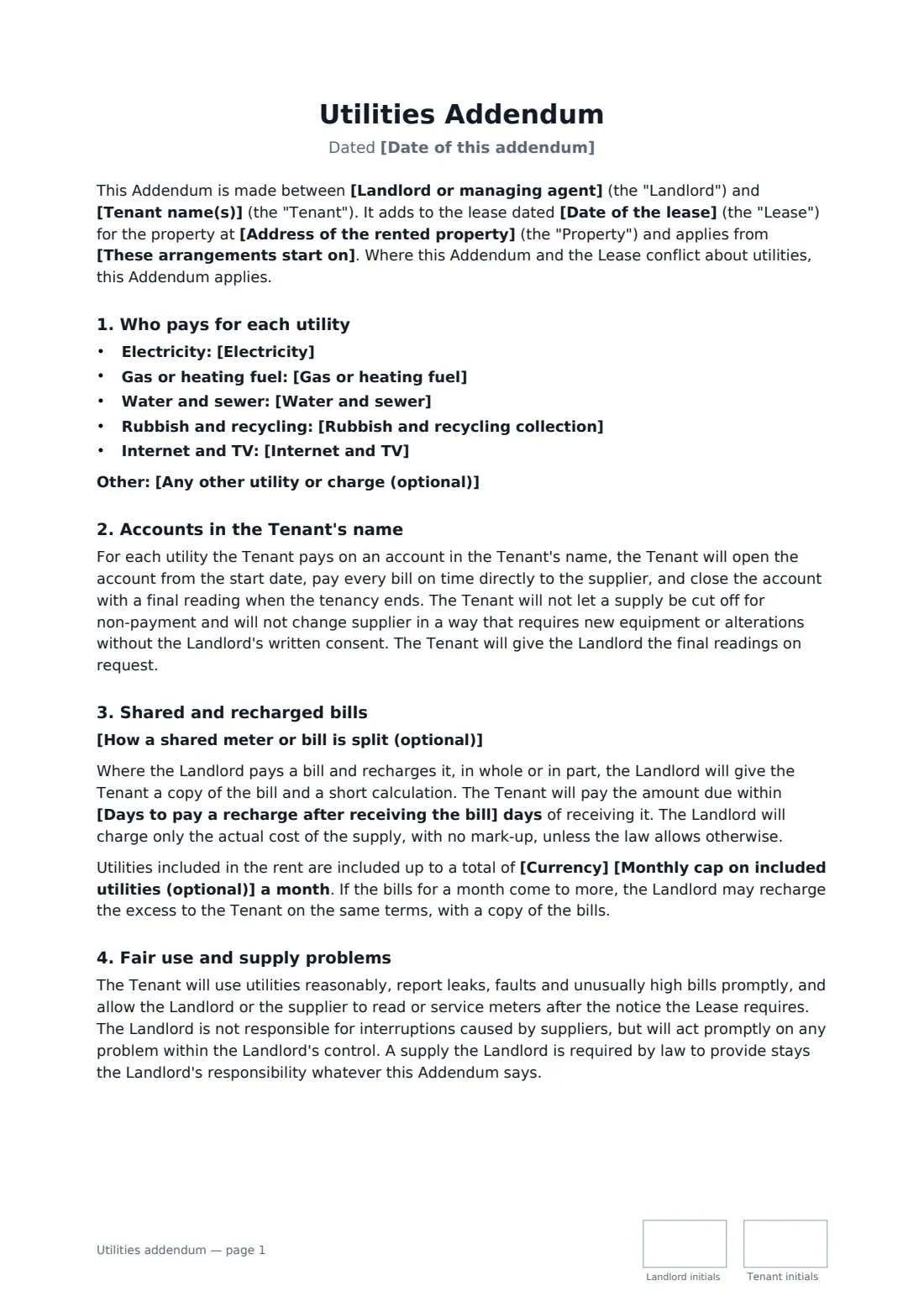
"Bills included" means different things to different people. A utilities addendum takes each supply in turn and says who pays for it, whose name the account is in and what happens when a meter is shared with another unit.
For electricity, gas, water, rubbish and internet you choose whether it is included in the rent, on the tenant's own account, paid by the landlord and recharged, shared or not supplied. You can describe how a shared bill is split and set a monthly cap for included utilities. Recharges come with a copy of the bill, at actual cost and no mark-up, payable within a set number of days.
- Best for
- Any rental where bills are mixed or some are included in the rent
- Signed by
- Landlord and tenant, initialled on every page
- Utilities covered
- Electricity, gas, water and sewer, rubbish, internet, plus one more
- Length
- 2 pages
When to use a utilities addendum
- A basement suite on the same electricity meter as the main house
- An "all bills included" let with a fair-use cap
- Moving accounts into the tenant's name at the start of a lease
- A house share where the landlord pays water and recharges it
- Clearing up confusion after a large winter heating bill
What you fill in
16 blanks, then the name and email of each person who signs: landlord, tenant.
1 The lease
- Date of this addendum*
- Landlord or managing agent*
- Tenant name(s)*
- Address of the rented property*
- Date of the lease*
- These arrangements start on*
2 Each utility
- Electricity* paid by the Tenant, on an account in the Tenant's name · included in the rent · paid by the Landlord and recharged to the Tenant · shared, as set out in section 3 · not supplied
- Gas or heating fuel* paid by the Tenant, on an account in the Tenant's name · included in the rent · paid by the Landlord and recharged to the Tenant · shared, as set out in section 3 · not supplied
- Water and sewer* included in the rent · paid by the Tenant, on an account in the Tenant's name · paid by the Landlord and recharged to the Tenant · shared, as set out in section 3 · not supplied
- Rubbish and recycling collection* included in the rent · paid by the Tenant, on an account in the Tenant's name · paid by the Landlord and recharged to the Tenant · shared, as set out in section 3 · provided by the local authority at no separate charge · not supplied
- Internet and TV* paid by the Tenant, on an account in the Tenant's name · included in the rent · paid by the Landlord and recharged to the Tenant · shared, as set out in section 3 · not supplied
- Any other utility or charge (optional)
3 Shared bills
- How a shared meter or bill is split (optional)
4 Recharges
- Currency*
- Monthly cap on included utilities (optional)
- Days to pay a recharge after receiving the bill*
5 Who signs
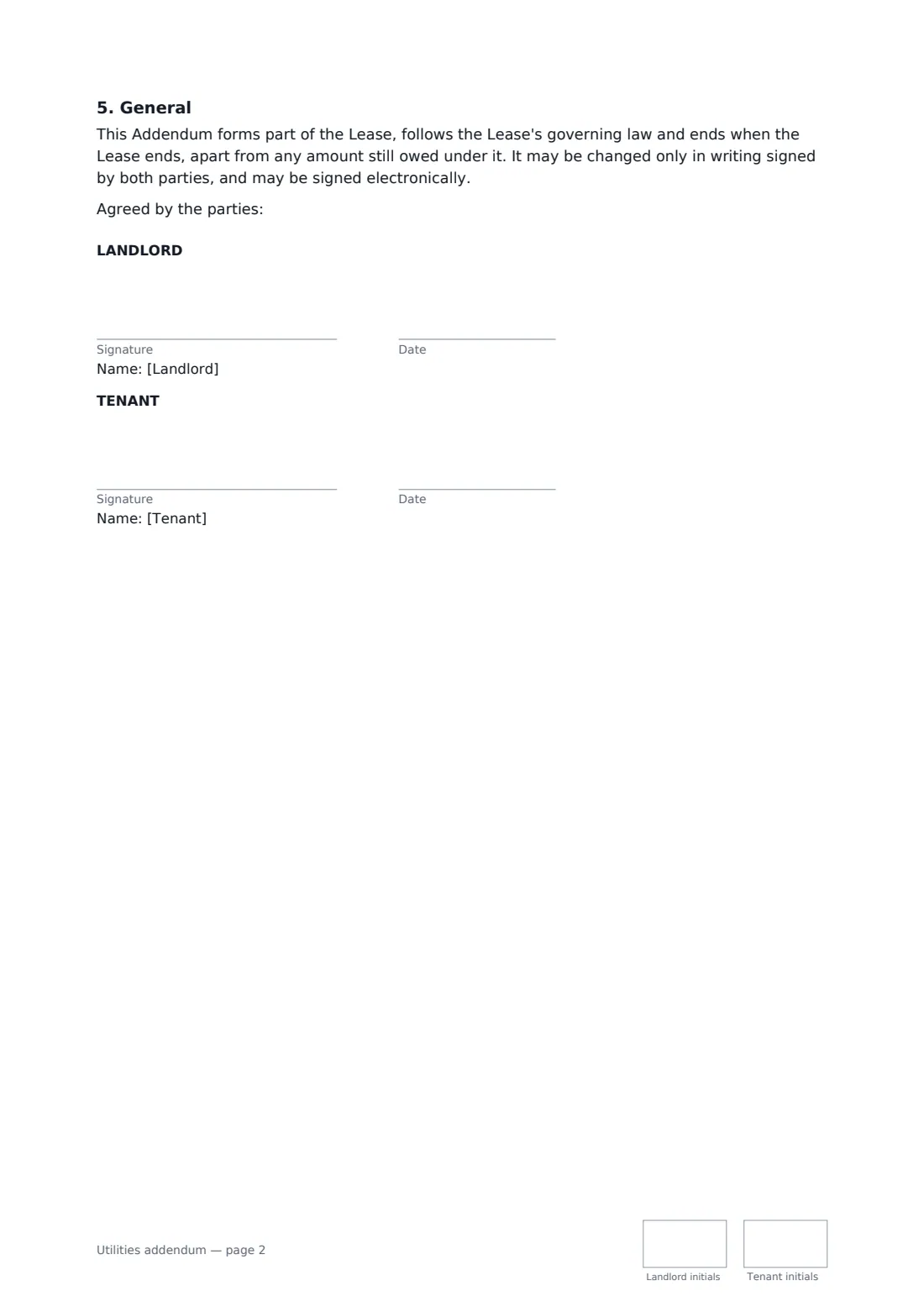
- Landlord signature and date, initials on every page · The landlord or the managing agent who signs leases for the landlord.
- Tenant signature and date, initials on every page · The tenant. If several tenants are on the lease, name them all above and have each one sign.
What the utilities addendum covers
- Who pays for each utility
- Accounts in the Tenant's name
- Shared and recharged bills
- Fair use and supply problems
- General
Using the utilities addendum, step by step
1 Link it to the lease
Enter the landlord, tenant, property and lease date, and the date these arrangements start.
2 Go through each utility
For each supply, choose who pays and how. Add any other utility, such as propane or a service charge.
3 Explain shared bills and caps
If a meter is shared, describe the split. Add a monthly cap for included utilities if you want one.
4 Set the payment period and sign
Choose how many days the tenant has to pay a recharge, check the preview and send it.
Tips before you send it
- Note the meter readings on move-in day in the move-in checklist, so the first bill is easy to split.
- Some places restrict charging tenants for a shared meter without a written method or a separate meter. Check before choosing "shared".
- Keep each recharged bill and your calculation together, so a question months later is easy to answer.
- With a cap, check the bills against it each month and send any recharge promptly, rather than one large bill when the lease ends.
Sign it online in minutes
- Fill in the blanks. Names, dates and amounts go straight into the agreement — the preview shows exactly where.
- Name who signs. Tick “This is me” for your own part. FileIt builds the PDF with every signature, date and initials box on the right line, and you can check or move anything before sending.
- Send it. Each signer gets a secure link and signs from any device — no account needed. The signed PDF, with an audit trail and a Certificate of Completion, is filed in your vault and emailed to everyone.
Utilities addendum: frequently asked questions
Can I charge more than the actual bill?
The addendum says recharges are at actual cost, with no mark-up, unless the law allows otherwise. Tenants are more likely to accept recharges when they can see the bill.
What does the cap do?
Where utilities are included in the rent, a cap lets the landlord recharge the amount by which a month's bills go over the set figure, with copies of the bills.
Who is responsible if the supplier cuts off the service?
If the account is in the tenant's name, the tenant agrees to pay on time so the supply isn't cut off. The landlord isn't responsible for supplier outages but keeps any duty the law places on them to provide a supply.
Is a utilities addendum valid if e-signed?
Yes, signing an addendum like this electronically is widely accepted, including in the US, UK, EU and Canada. FileIt adds an audit trail of every initial and signature to the finished PDF.