What is a public relations services agreement?
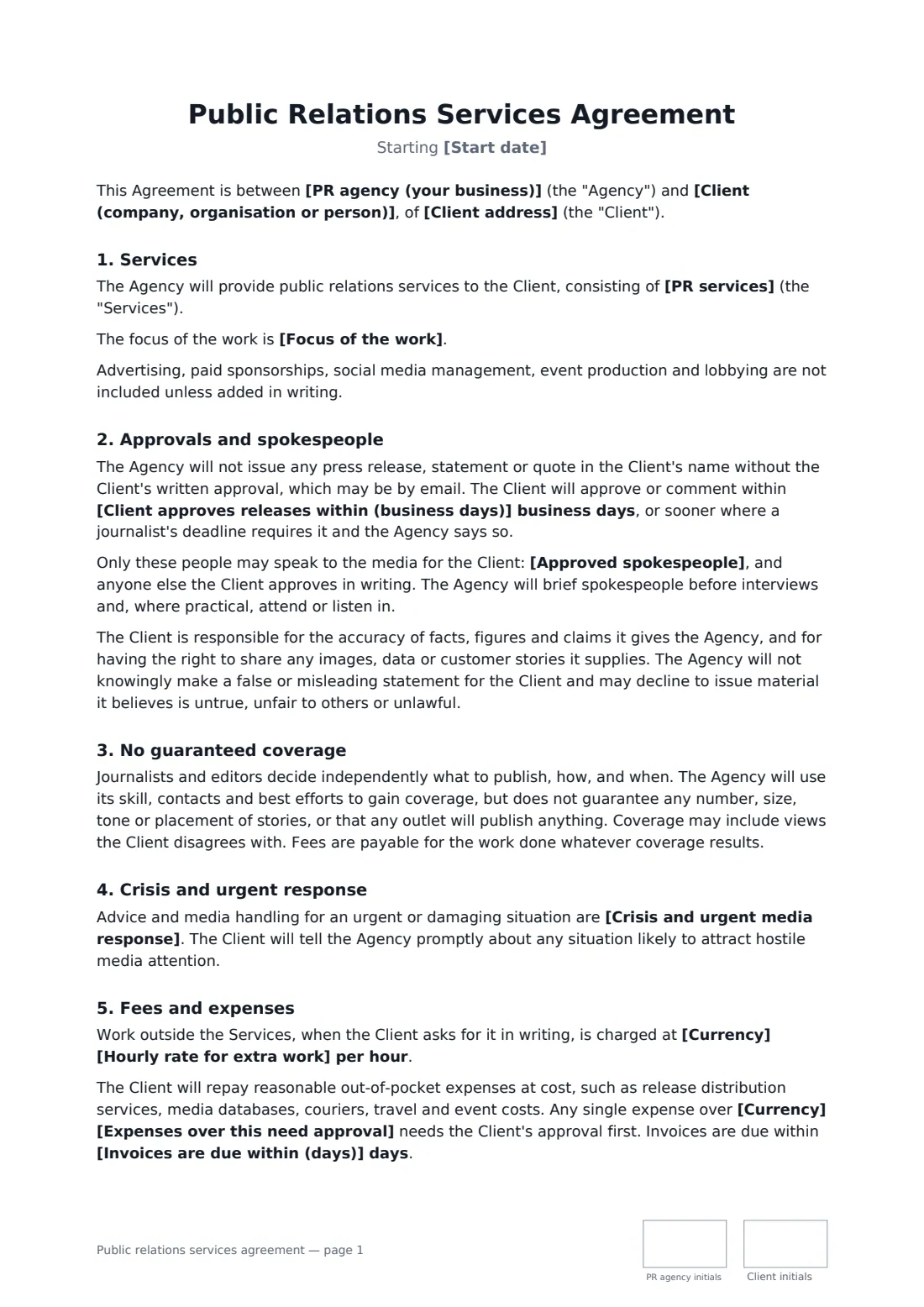
Public relations is easy to misunderstand from the client's side. They're paying every month, but the journalist decides whether a story runs, and no agency can promise the front page. A good PR agreement sets that expectation in writing on day one, alongside the practical rules that keep a client relationship calm: nothing goes out without approval, only named people speak to the press, and expenses don't appear by surprise.
This template covers the services (PR plan, press releases, pitching, interviews, monitoring) and an optional focus such as a launch, the approved spokespeople and a turnaround time for approvals. It is clear that coverage isn't guaranteed and fees are for work, not results. You choose whether crisis response is included, billed hourly or excluded; set a monthly retainer or project fee, an hourly rate for extras and an expense approval limit; and add a minimum term and notice period. Confidentiality covers embargoed news, the client owns the materials once paid for, and the agency flags any competitor it takes on.
- Best for
- PR agencies, freelance publicists and communications consultants
- Signed by
- The agency and the client, with job titles
- Fees
- Monthly retainer or fixed project fee, plus approved expenses
- Length
- About 3 pages, initialled on every page
When to use a public relations services agreement
- A start-up hiring a publicist for a product launch
- A restaurant or hotel keeping a local PR agency on a monthly retainer
- An author or artist hiring a publicist around a book or album release
- A non-profit bringing in a consultant for an awareness campaign
- A company retaining an agency for trade press and thought leadership
What you fill in
18 blanks, then the name and email of each person who signs: pr agency, client.
1 The parties
- PR agency (your business)*
- Client (company, organisation or person)*
- Client address
2 Scope
- Start date*
- PR services*
- Focus of the work
- Approved spokespeople*
- Client approves releases within (business days)*
- Crisis and urgent media response* included in the retainer · billed separately at the hourly rate below · not part of this Agreement
3 Fees
- How the agency is paid* a monthly retainer · a fixed project fee
- Currency*
- Retainer or project fee*
- Hourly rate for extra work
- Expenses over this need approval*
- Invoices are due within (days)*
4 Term
- Minimum term (months)
- Notice to end (days)*
5 Other terms
- Governing law*
6 Who signs
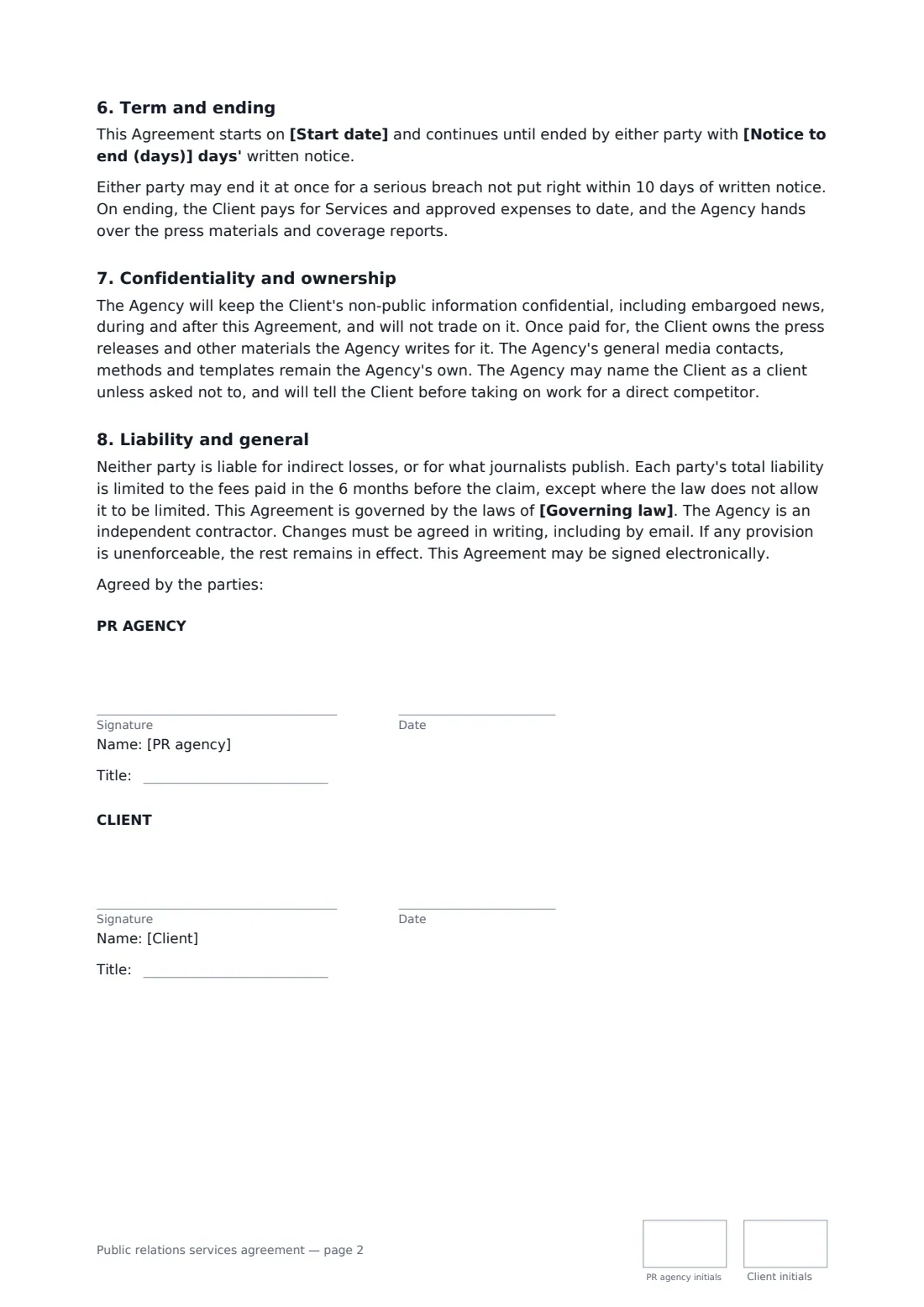
- PR agency signature and date, job title, initials on every page · The PR agency, publicist or consultant.
- Client signature and date, job title, initials on every page
What the public relations services agreement covers
- Services
- Approvals and spokespeople
- No guaranteed coverage
- Crisis and urgent response
- Fees and expenses
- Term and ending
- Confidentiality and ownership
- Liability and general
Using the public relations services agreement, step by step
1 Define the scope
Edit the list of services, add the focus of the work and name the people allowed to speak to the media. Set how quickly the client must approve releases.
2 Decide on crisis work
Choose whether urgent or damaging-story response is included in the retainer, billed separately by the hour, or left out altogether.
3 Fees and expenses
Pick a monthly retainer or a project fee, add an hourly rate for extras, and set the amount above which an expense needs the client's approval first.
4 Term and send
Set an optional minimum term and the notice period, add the governing law and send. Both sides sign with job titles and initial each page.
Tips before you send it
- Put the 'no guaranteed coverage' conversation in your first meeting, not your first report — the agreement backs you up, but expectations matter more.
- Agree a fast-track approval route for journalist deadlines, such as one named person who can say yes by text.
- Keep a running coverage log and send it with each invoice so the client sees the work behind the retainer.
- If you're asked to handle a crisis, write down what's in scope that day by email. It avoids billing disputes when things calm down.
Sign it online in minutes
- Fill in the blanks. Names, dates and amounts go straight into the agreement — the preview shows exactly where.
- Name who signs. Tick “This is me” for your own part. FileIt builds the PDF with every signature, date and initials box on the right line, and you can check or move anything before sending.
- Send it. Each signer gets a secure link and signs from any device — no account needed. The signed PDF, with an audit trail and a Certificate of Completion, is filed in your vault and emailed to everyone.
Public relations services agreement: frequently asked questions
Does a PR agency guarantee press coverage?
No. Editors and journalists decide independently what to publish. The agreement commits the agency to its best efforts and says plainly that fees are payable for the work done whatever coverage results.
Can the agency issue a press release without approval?
No. Nothing goes out in the client's name — release, statement or quote — without the client's written approval, which can be an email. The client agrees to respond within the number of business days you set.
Is there a minimum term?
You can set one for a monthly retainer, such as three months, because PR results take time to build. After that, either side can end the agreement on the notice period you choose.
Can a PR contract be signed electronically?
For an ordinary services contract like this one, electronic signatures are generally valid in the US (ESIGN Act and UETA), the UK, the EU (eIDAS) and Canada. FileIt keeps an audit trail and a Certificate of Completion with the signed PDF.
Is this template free?
Yes. It's free to use with the eSignature app in FileIt, and the client doesn't need an account to sign.