What is a neighbour agreement?
Most neighbour problems are small and repeat themselves: music late on a Saturday, a car blocking the drive, a dog that barks all afternoon, bins left out all week. They rarely need a lawyer or the council. They need a calm conversation and something both sides can point to afterwards. A neighbour agreement is that something.
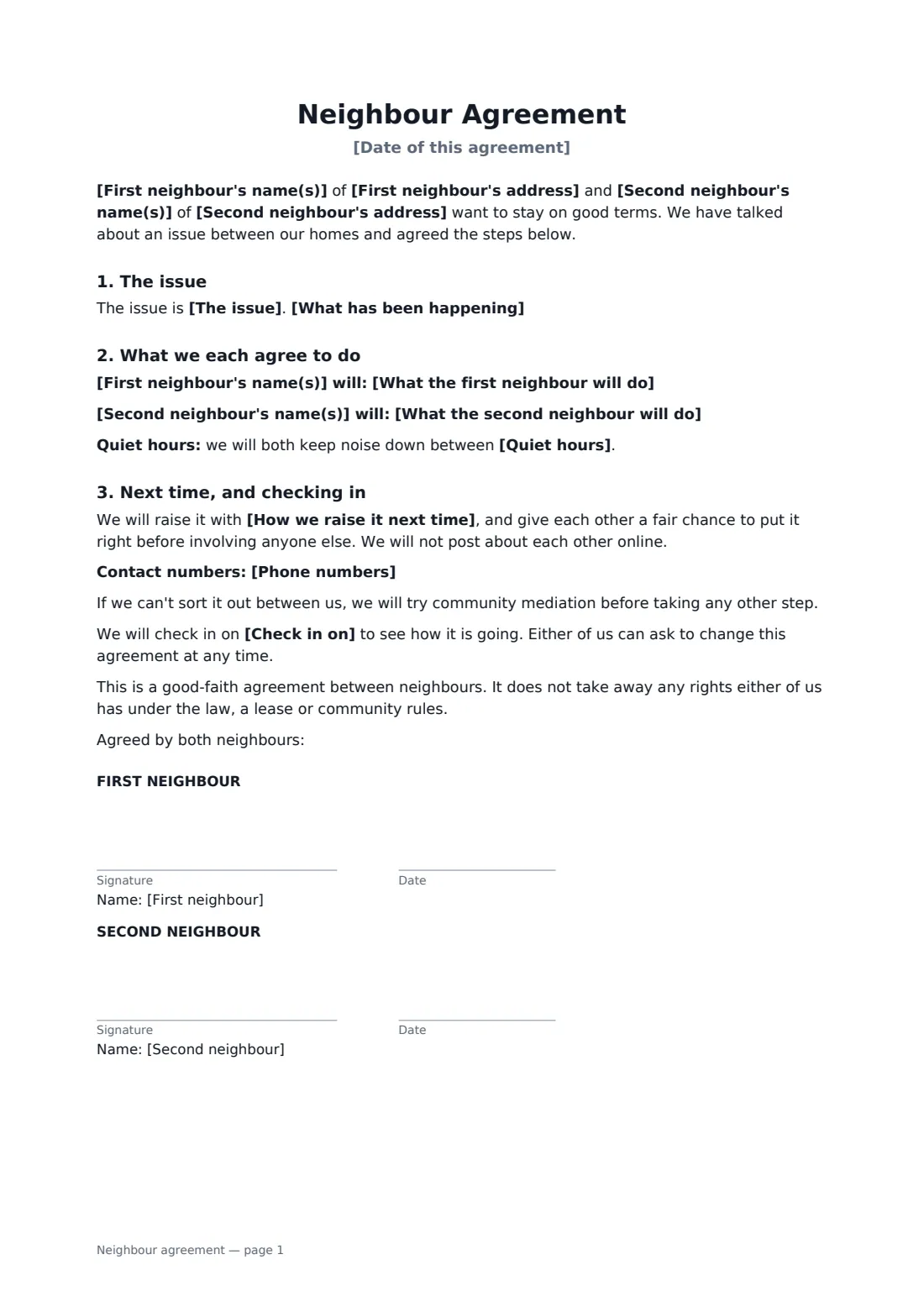
This template records both households and the date, the type of issue and what has been happening in neutral words, what each neighbour agrees to do, optional quiet hours, how you will raise it next time (a friendly text first by default), phone numbers, a promise not to post about each other online, community mediation if you can't sort it out between you, and a date to check in. It also says that neither of you gives up any rights under the law, a lease or community rules. For a shared fence or a shared driveway, FileIt has dedicated templates.
- Best for
- Noise, parking, pets, bins and other everyday issues between neighbours
- Signed by
- Both neighbours
- Includes
- What each will do, quiet hours, next steps, check-in date
- Length
- 1 page
When to use a neighbour agreement
- Agreeing quiet hours with neighbours who entertain late in the garden
- Sorting out on-street parking outside two houses
- A barking dog while the owners are at work
- Bins, recycling or rubbish left in a shared side passage
- Children's football over the fence, or barbecue smoke drifting into a window
What you fill in
13 blanks, then the name and email of each person who signs: first neighbour, second neighbour.
1 The neighbours
- First neighbour's name(s)*
- First neighbour's address*
- Second neighbour's name(s)*
- Second neighbour's address*
- Date of this agreement*
2 The issue
- The issue* noise · parking · pets · bins and rubbish · shared areas · children playing · smoke and barbecues · another everyday issue
- What has been happening*
3 What we agree
- What the first neighbour will do*
- What the second neighbour will do*
- Quiet hours
4 Next time
- How we raise it next time*
- Phone numbers
- Check in on
5 Who signs
- First neighbour signature and date
- Second neighbour signature and date
What the neighbour agreement covers
- The issue
- What we each agree to do
- Next time, and checking in
Using the neighbour agreement, step by step
1 Talk first
Have the conversation in person, then use the template to write down what you agreed. Fill it in together if you can, so the wording works for both of you.
2 Describe the issue calmly
Pick the type of issue and describe what has been happening without blame. Both of you will sign it, so neutral words matter.
3 Write what each of you will do
List what each neighbour agrees to, for example music indoors by 10:30 pm on one side and a text instead of banging on the wall on the other. Add quiet hours if noise is the issue.
4 Agree next steps and sign
Choose how you'll raise it next time, add phone numbers if you like, and set a check-in date. Tick "This is me", add your neighbour, and you both sign online. Your neighbour doesn't need a FileIt account.
Tips before you send it
- Make the agreement two-sided. Each household doing something feels fair, even if one does more.
- Be specific: times, places and numbers work better than "keep it down".
- Check in on the date you set, even if things are going well. A thank-you goes a long way.
- Local noise rules, parking restrictions and lease or HOA rules still apply. The agreement doesn't replace them.
- If things escalate, many areas have free or low-cost community mediation services.
Sign it online in minutes
- Fill in the blanks. Names, dates and amounts go straight into the agreement — the preview shows exactly where.
- Name who signs. Tick “This is me” for your own part. FileIt builds the PDF with every signature, date box on the right line, and you can check or move anything before sending.
- Send it. Each signer gets a secure link and signs from any device — no account needed. The signed PDF, with an audit trail and a Certificate of Completion, is filed in your vault and emailed to everyone.
Neighbour agreement: frequently asked questions
Is a neighbour agreement legally binding?
It is a good-faith agreement between neighbours, and it says that neither of you gives up any rights under the law, a lease or community rules. Its strength is that you both agreed to it in writing.
What if my neighbour won't sign?
The conversation is the important part. You can still write down what you agreed and send it as a friendly note. If problems continue, community mediation or your landlord, HOA or local council may be able to help.
Should I use this for a fence or tree problem?
For building or repairing a shared fence, use the neighbour fence agreement. For a shared driveway, use the shared driveway agreement. They cover costs, contractors and upkeep.
Can more than two households sign?
Yes. Add extra neighbours as signers in the editor and mention them in what each household will do.
Is this template free?
Yes. It is free with the eSignature app in FileIt.