What is a horse training agreement?
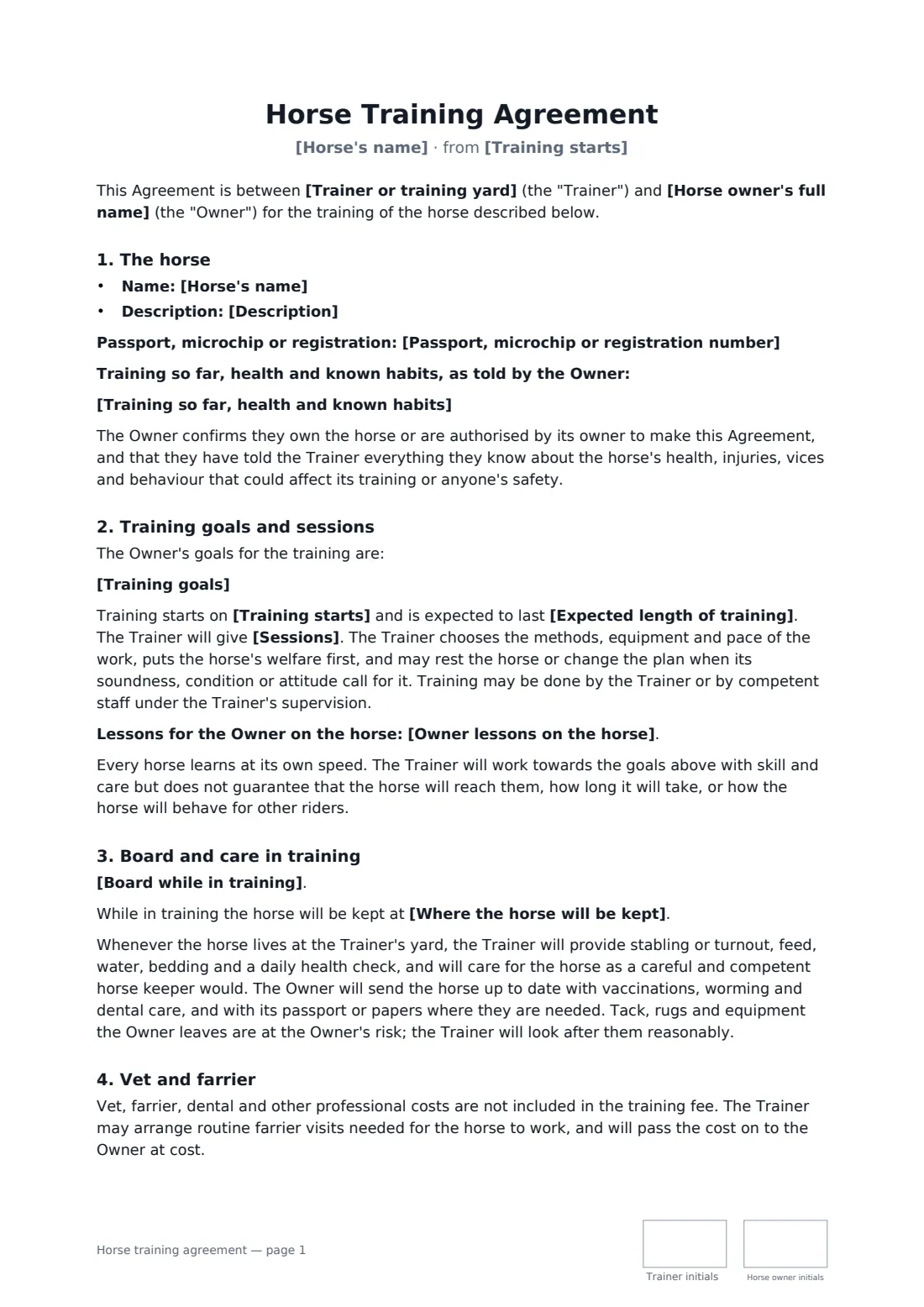
Sending a horse to a trainer means handing over an animal you care about, often for months. A horse training agreement records what the trainer is working towards, how often the horse is worked, who feeds and stables it, what the fee covers and what comes on top, and what happens if the horse goes lame or colics while the owner is out of reach. It also says plainly that no trainer can promise a result.
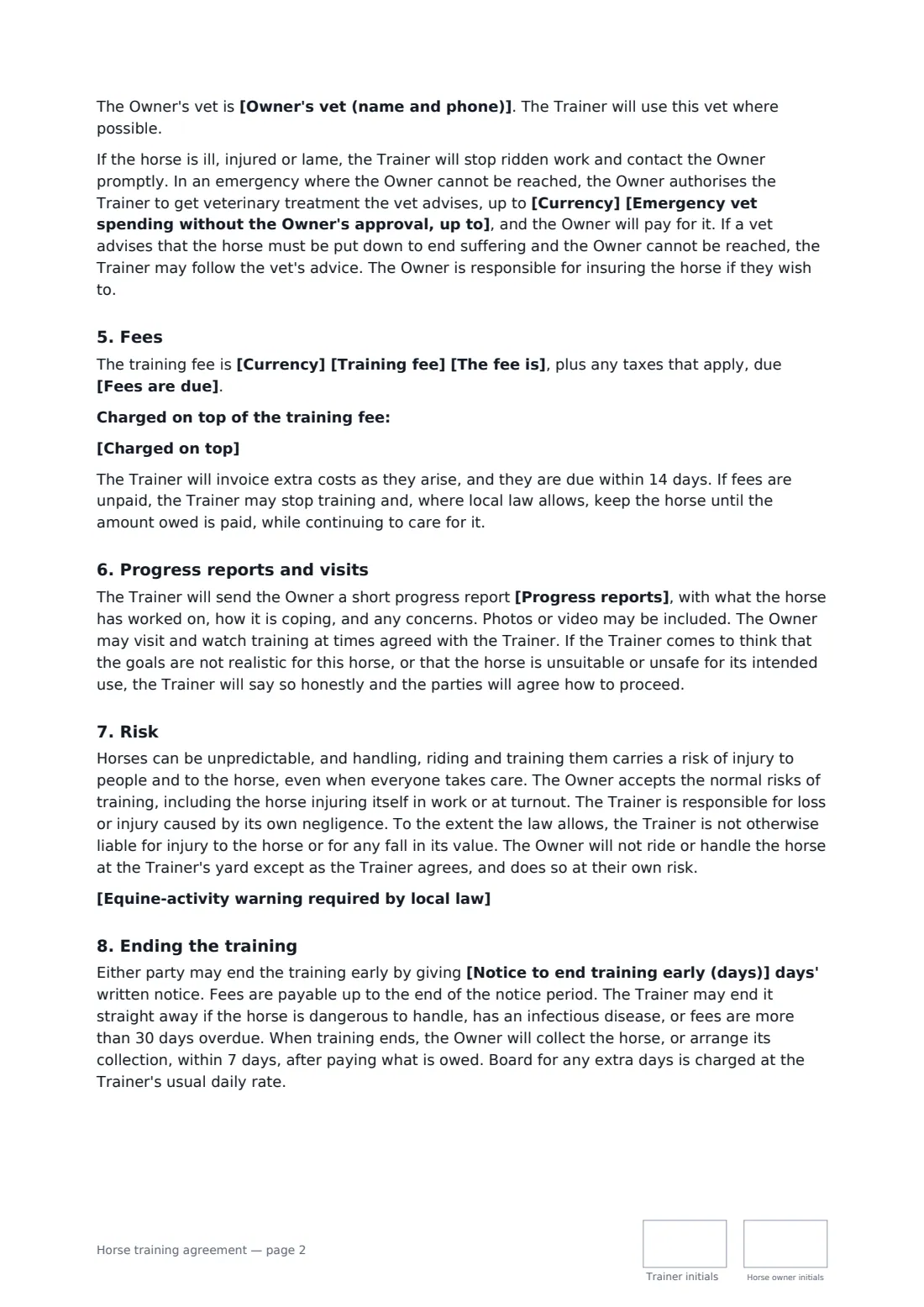
This template covers the horse's description and ID, the owner's honest account of its training so far, health and habits, the training goals, session pattern, start date and expected length, optional handover lessons for the owner, three board arrangements (board included, board charged separately, or the trainer visiting the owner's yard), care standards and what the owner sends with the horse, farrier and vet costs, an emergency vet spending limit, the training fee and extras, regular progress reports, riding risk, early ending on notice and collection. There is room for an equine-activity warning where local law asks for one.
- Best for
- Horse trainers, young-horse producers and training yards or barns
- Signed by
- The trainer, with job title, and the horse owner
- Board
- Included, charged separately, or the trainer visits the owner's yard
- Length
- About 3 pages, initialled on every page
When to use a horse training agreement
- Starting a young horse under saddle over 60 or 90 days
- Sending a horse away to fix a loading or napping problem
- Schooling a horse for dressage, jumping or showing
- A trainer riding a horse at the owner's own yard several days a week
- Producing a horse for sale with the owner's agreed goals
What you fill in
27 blanks, then the name and email of each person who signs: trainer, horse owner.
1 The parties
- Trainer or training yard*
- Where the horse will be kept*
- Horse owner's full name*
- Horse owner's phone*
- Horse owner's email
2 The horse
- Horse's name*
- Description*
- Passport, microchip or registration number
- Training so far, health and known habits*
3 The training
- Training goals*
- Sessions*
- Training starts*
- Expected length of training*
- Owner lessons on the horse
4 Board and care
- Board while in training* The horse lives at the Trainer's yard and board is included in the training fee · The horse lives at the Trainer's yard and board is charged separately · The horse stays at the Owner's own yard and the Trainer visits for sessions
- Board fee (if charged separately)
- Owner's vet (name and phone)
- Emergency vet spending without the Owner's approval, up to*
5 Fees
- Currency*
- Training fee*
- The fee is* per month · per week · per 30 days · for the whole programme
- Fees are due*
- Charged on top
6 Other terms
- Progress reports* every week · every two weeks · every month
- Notice to end training early (days)*
- Equine-activity warning required by local law
- Governing law*
7 Who signs
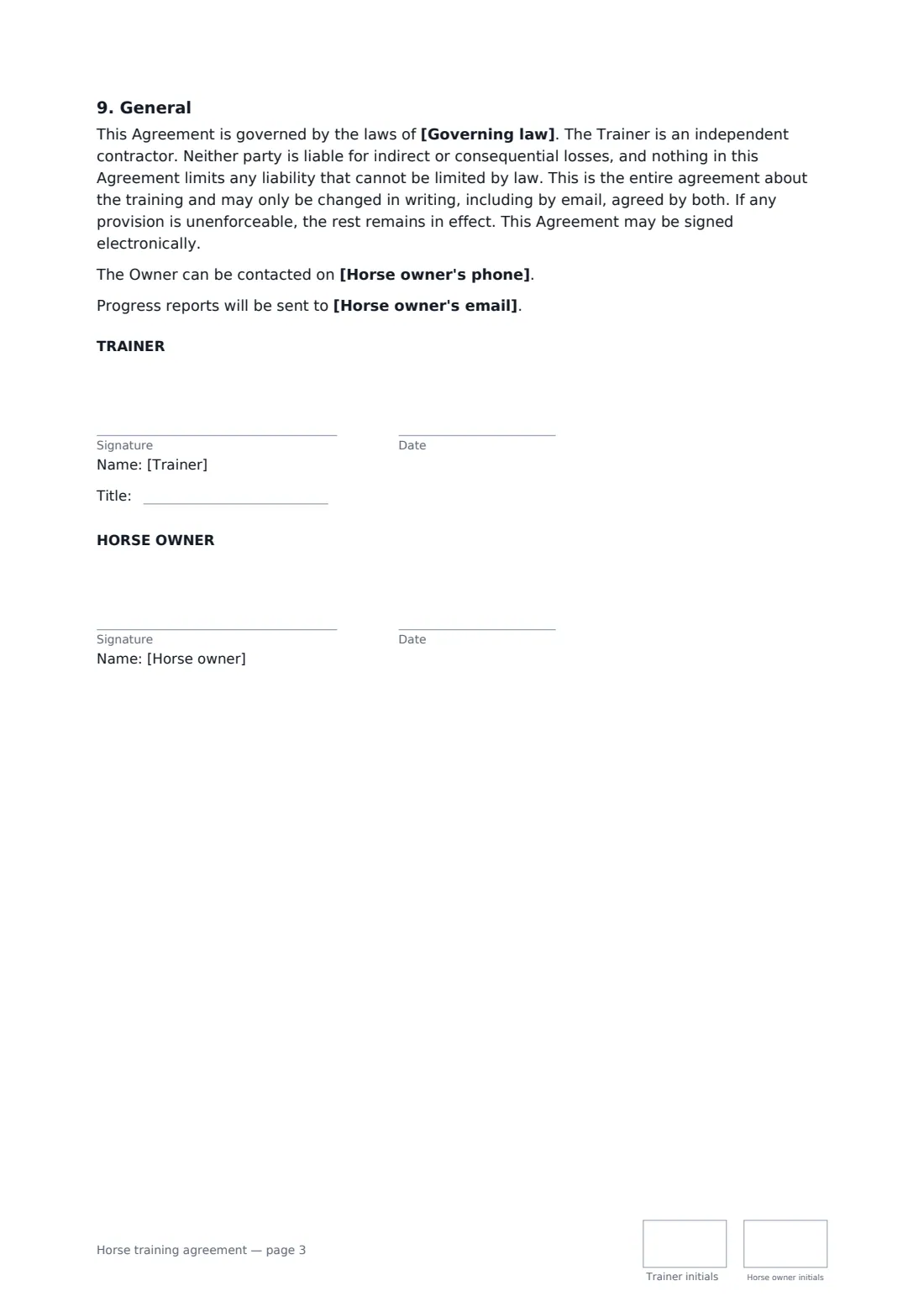
- Trainer signature and date, job title, initials on every page · The trainer, or the training yard or barn.
- Horse owner signature and date, initials on every page · The owner of the horse, or someone the owner has authorised to agree training.
What the horse training agreement covers
- The horse
- Training goals and sessions
- Board and care in training
- Vet and farrier
- Fees
- Progress reports and visits
- Risk
- Ending the training
- General
Using the horse training agreement, step by step
1 Describe the horse honestly
Enter the horse's name, description and passport or microchip number, then write down where its training stands, any health history and habits the trainer should know about — bucking, clipping, loading, past surgery.
2 Set the goals and sessions
Write the goals in plain terms, adjust the session pattern, pick the start date and the expected length, and add owner lessons if you hand horses back that way.
3 Choose the board and vet plan
Pick whether board is included, charged separately, or not needed because you visit the owner's yard. Add the owner's vet and the most you may spend on emergency treatment if they can't be reached.
4 Fees, reports and send
Enter the training fee and period, list any extras such as show entries or travel, choose how often you'll send progress reports and the notice to end early. Add the owner as a signer and send.
Tips before you send it
- Agree goals you can actually measure — "hacks out alone in walk and trot" is easier to report on than "becomes a good riding horse".
- Set the emergency vet limit with the owner while you're both calm. It's the clause that matters most on the night something goes wrong.
- Some US states and other places require a set equine-activity warning in contracts. Paste the exact wording into the warning field if yours does.
- Send short reports with a photo or a clip. Owners who can see progress rarely dispute the fee.
Sign it online in minutes
- Fill in the blanks. Names, dates and amounts go straight into the agreement — the preview shows exactly where.
- Name who signs. Tick “This is me” for your own part. FileIt builds the PDF with every signature, date and initials box on the right line, and you can check or move anything before sending.
- Send it. Each signer gets a secure link and signs from any device — no account needed. The signed PDF, with an audit trail and a Certificate of Completion, is filed in your vault and emailed to everyone.
Horse training agreement: frequently asked questions
Does the trainer guarantee the horse will reach the goals?
No. The template says the trainer works towards the goals with skill and care but doesn't guarantee they'll be reached, how long it will take, or how the horse will go for other riders. If the trainer thinks the goals aren't realistic, they say so and you agree the next step.
Who pays the vet and the farrier?
The owner. Vet, farrier and dental costs sit outside the training fee. The trainer can book routine farrier visits needed for work and pass on the cost, and in an emergency can authorise treatment up to the limit you set.
What if the owner wants the horse back early?
Either side can end the training on the notice you choose. Fees run to the end of the notice period, and the owner collects the horse within 7 days after paying what's owed.
Is a horse training contract signed online valid?
In most countries, including the US (ESIGN Act and UETA), the UK, the EU (eIDAS) and Canada, an electronic signature is generally valid for an ordinary services contract like this one. FileIt keeps an audit trail and a Certificate of Completion with the signed PDF as evidence of who signed and when.
Can I change the wording?
You fill in the blanks and choose the options on the setup page; optional clauses appear only when you fill them in. If you need different clauses, draft your own document and upload it to FileIt eSignature instead — you can still place the signature boxes in the editor.
Is this template free?
Yes. The template is free to use with the eSignature app in FileIt. The owner you send it to doesn't need a FileIt account to sign.