What is a grant writing services agreement?
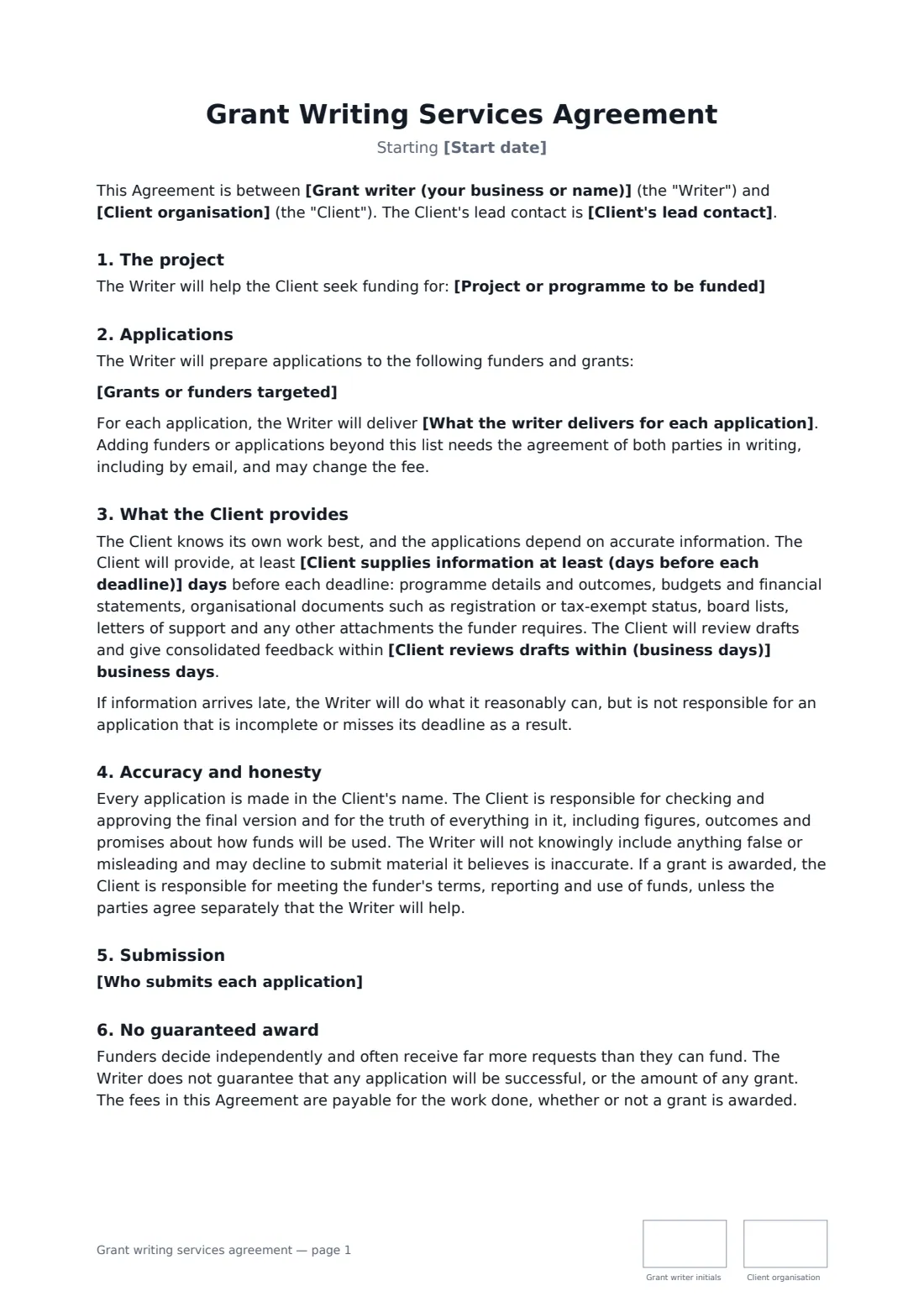
Grant writing is a partnership with an awkward shape. The writer crafts the case, but the organisation holds the facts, the figures and the funder accounts — and the funder alone decides. Most problems come from late information, a draft that sits unreviewed until the night before the deadline, or confusion about whether the writer is paid if the grant isn't won.
This agreement sorts those out. It names the project, lists each funder and deadline, and sets what the writer delivers for every application, with optional prospect research. The client commits to provide programme details, budgets and attachments a set number of days ahead and to review drafts quickly, and stays responsible for the truth of what is submitted in its name. You choose who submits through the funder portals. The fee is a flat fee per application, a project fee or an hourly rate, never a percentage of the grant, and it is payable whether or not an award is made.
- Best for
- Freelance grant writers, grant consultants and development consultancies
- Signed by
- The writer and the client organisation, with job titles
- Fees
- Flat per application, flat per project or hourly — no commission
- Length
- About 3 pages, initialled on every page
When to use a grant writing services agreement
- A small non-profit hiring a freelancer for two foundation applications
- A school or PTA preparing a state education grant
- An arts organisation applying to a council or arts fund
- A research team or small business preparing an innovation grant
- A charity retaining a consultant for a year of applications and prospect research
What you fill in
17 blanks, then the name and email of each person who signs: grant writer, client organisation.
1 The parties
- Grant writer (your business or name)*
- Client organisation*
- Client's lead contact*
2 The work
- Start date*
- Project or programme to be funded*
- Grants or funders targeted*
- Also research new funding prospects?* No · Yes, a written list of suitable prospects
- What the writer delivers for each application*
- Who submits each application* The Client submits it, through its own funder accounts. · The Writer submits it on the Client's behalf, with the Client's approval of the final version.
3 Timing
- Client supplies information at least (days before each deadline)*
- Client reviews drafts within (business days)*
4 Fees
- Fee* a flat fee per application · a flat fee for the whole project · an hourly rate
- Currency*
- Amount*
- Hours not to exceed without approval
- Payment terms*
5 Other terms
- Governing law*
6 Who signs
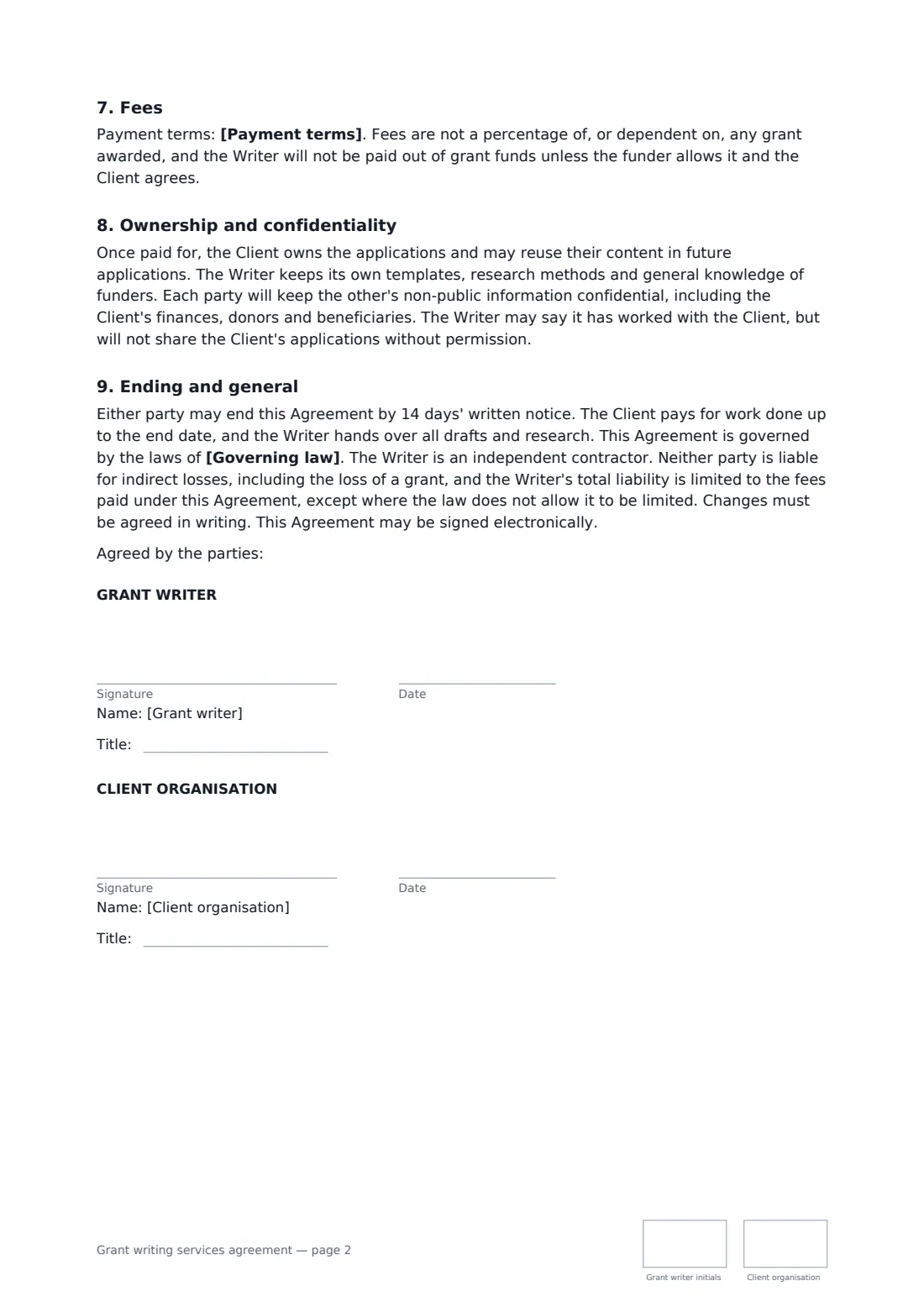
- Grant writer signature and date, job title, initials on every page · The grant writer or grant consultancy.
- Client organisation signature and date, job title, initials on every page · The non-profit, school, business or other organisation applying for grants.
What the grant writing services agreement covers
- The project
- Applications
- What the Client provides
- Accuracy and honesty
- Submission
- No guaranteed award
- Fees
- Ownership and confidentiality
- Ending and general
Using the grant writing services agreement, step by step
1 Describe the project
Enter the programme or project the money is for, then list each funder or grant with its deadline. Tick prospect research if you'll also find new funders.
2 Set deliverables and submission
Edit what you deliver for each application and choose whether the client submits through its own funder accounts or you submit for them after they approve the final version.
3 Timing
Set how many days before each deadline the client must provide information, and how many business days they have to review a draft.
4 Fee and send
Choose a flat fee per application, a project fee or an hourly rate with an optional hours cap, enter your payment terms and send it to the client's signer.
Tips before you send it
- Work backwards from each deadline and send the client a dated checklist of attachments on day one.
- Keep the client in charge of their funder portal logins. If you submit for them, ask for your own delegated access rather than their password.
- Don't take a percentage of the award, even if offered. Many funders won't pay it, and professional codes discourage it.
- Ask for last year's applications and reports first — reusing strong language saves the client money.
Sign it online in minutes
- Fill in the blanks. Names, dates and amounts go straight into the agreement — the preview shows exactly where.
- Name who signs. Tick “This is me” for your own part. FileIt builds the PDF with every signature, date and initials box on the right line, and you can check or move anything before sending.
- Send it. Each signer gets a secure link and signs from any device — no account needed. The signed PDF, with an audit trail and a Certificate of Completion, is filed in your vault and emailed to everyone.
Grant writing services agreement: frequently asked questions
Can a grant writer be paid a percentage of the grant?
This template doesn't allow it. Commission-based grant writing is discouraged by professional fundraising codes, and many funders won't allow grant money to pay it. The fee is flat or hourly and is paid for the work, whether or not a grant is won.
Who is responsible for what the application says?
The client. Every application is made in the client's name, so the client checks and approves the final version and is responsible for its facts, figures and promises. The writer won't knowingly include anything false.
What if the client sends information late?
The writer does what it reasonably can, but isn't responsible for an incomplete or late application caused by information arriving after the agreed number of days before the deadline.
Can this agreement be e-signed?
Yes, in most places. Electronic signatures are generally valid for service contracts like this in the US (ESIGN Act and UETA), the UK, the EU (eIDAS) and Canada. FileIt keeps an audit trail and a Certificate of Completion with the signed PDF.
Is this template free?
Yes. It's free to use with FileIt's eSignature app, and the client organisation signs without needing an account.