What is a exclusive negotiation agreement?
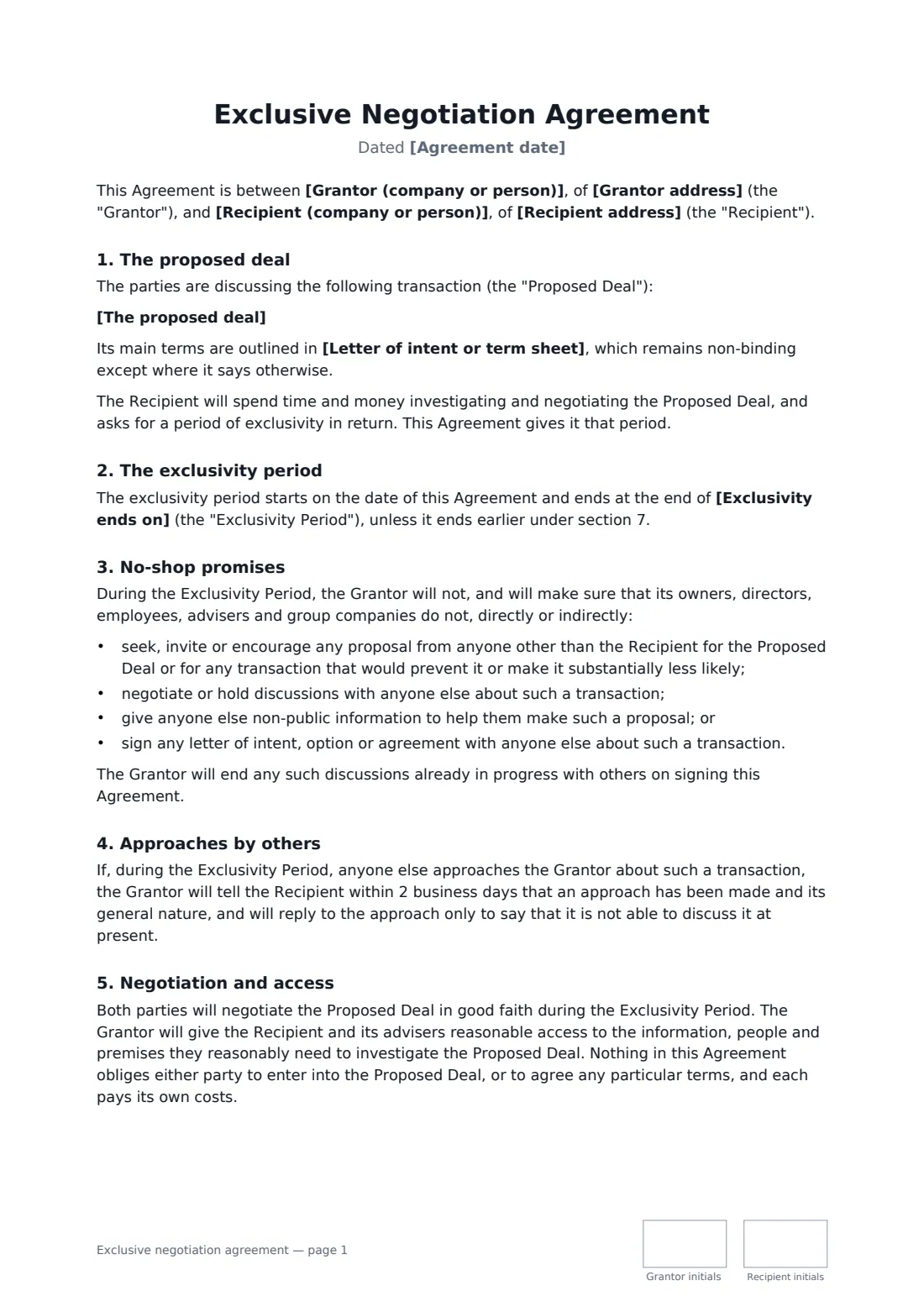
Buying a business, investing in a company or negotiating a big lease costs real money in lawyers, accountants and time. A buyer or investor doing that work usually wants a period when the other side talks to no one else — known as exclusivity, a no-shop or a lock-out. Letters of intent are often non-binding, so this protection is best set out in a short agreement that is binding on its own.
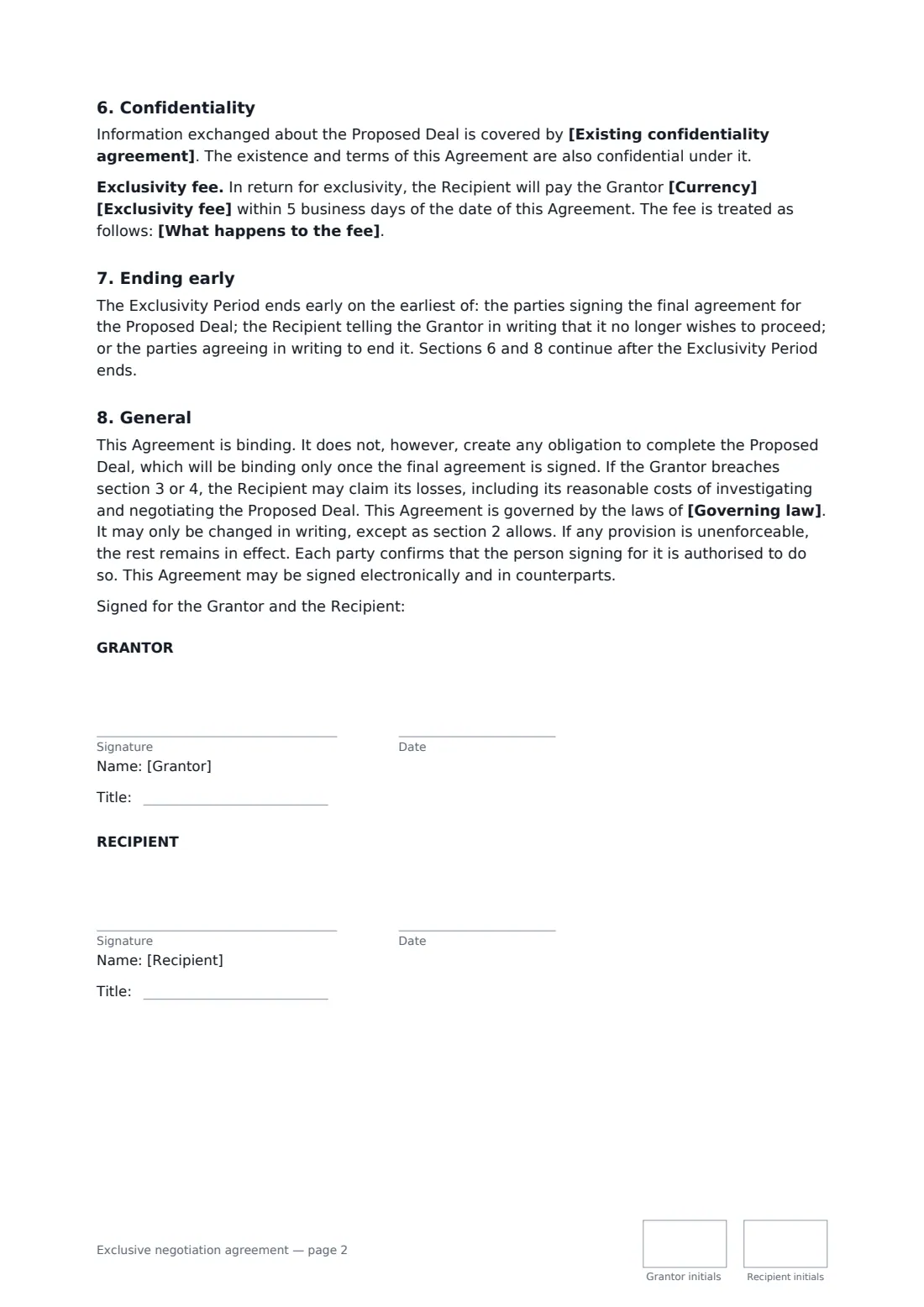
This template names the proposed deal and links to any letter of intent, sets the end of the exclusivity period with an optional automatic 14-day extension, and lists the no-shop promises: no seeking or encouraging other offers, no talks, no information to rivals and no competing agreements — including through owners, directors and advisers. It requires the grantor to report approaches, good-faith negotiation and access for due diligence, confidentiality (or a reference to your existing NDA), an optional exclusivity fee with three ways to treat it, and early ending. It's clear that neither side has to complete the deal.
- Best for
- Business sales, investments, joint ventures and major leases at the due diligence stage
- Signed by
- The party granting exclusivity and the party receiving it
- Binding?
- The exclusivity is binding; the deal itself is not until the final agreement
- Length
- 2–3 pages, initialled by both on every page
When to use a exclusive negotiation agreement
- A buyer locking up a small business for 60 days while it reviews the accounts
- An angel investor asking a startup not to take other term sheets during due diligence
- A retailer negotiating a flagship lease, asking the landlord not to talk to other tenants
- A company exploring a joint venture with a single partner
- A producer or distributor negotiating exclusive rights to a product line
What you fill in
14 blanks, then the name and email of each person who signs: grantor, recipient.
1 The parties
- Agreement date*
- Grantor (company or person)*
- Grantor address
- Recipient (company or person)*
- Recipient address
2 The deal
- The proposed deal*
- Letter of intent or term sheet
3 Exclusivity
- Exclusivity ends on*
- Extension* Only by written agreement of both parties · Automatically by 14 days if the parties are still actively negotiating
4 Exclusivity fee
- Currency
- Exclusivity fee
- What happens to the fee Credited against the price if the deal completes, otherwise kept by the Grantor · Kept by the Grantor in all cases · Refunded if the Grantor breaches this Agreement or withdraws
5 Other terms
- Existing confidentiality agreement
- Governing law*
6 Who signs
- Grantor signature and date, job title, initials on every page · The party agreeing not to talk to anyone else about the deal — often the seller, landlord or business owner.
- Recipient signature and date, job title, initials on every page · The party receiving exclusivity — often the buyer, investor or tenant doing due diligence.
What the exclusive negotiation agreement covers
- The proposed deal
- The exclusivity period
- No-shop promises
- Approaches by others
- Negotiation and access
- Confidentiality
- Ending early
- General
Using the exclusive negotiation agreement, step by step
1 Describe the deal
Write what's being negotiated precisely enough that the grantor knows what it can't discuss with others. Reference the letter of intent or term sheet if there is one.
2 Set the period
Choose the end date and whether it extends only by agreement or automatically by 14 days while you're still negotiating.
3 Decide on a fee and confidentiality
Add an exclusivity fee if one is being paid, and say whether it's credited to the price, kept, or refunded on a breach. Name your NDA if you already have one.
4 Sign before diligence starts
Send it to the grantor for signature. You'll see in FileIt when they've viewed and signed, and both of you receive the completed PDF.
Tips before you send it
- Keep the period realistic — long enough to finish due diligence and documents, short enough that the grantor will agree.
- Sign it before you start spending on advisers, not after.
- If you already have an NDA, reference it so there's only one set of confidentiality rules.
- Diary the end date. If you need more time, agree an extension in writing before it lapses.
Sign it online in minutes
- Fill in the blanks. Names, dates and amounts go straight into the agreement — the preview shows exactly where.
- Name who signs. Tick “This is me” for your own part. FileIt builds the PDF with every signature, date and initials box on the right line, and you can check or move anything before sending.
- Send it. Each signer gets a secure link and signs from any device — no account needed. The signed PDF, with an audit trail and a Certificate of Completion, is filed in your vault and emailed to everyone.
Exclusive negotiation agreement: frequently asked questions
Does this commit us to doing the deal?
No. The agreement says plainly that neither party has to enter into the deal or agree any particular terms. Only the exclusivity, confidentiality and related promises are binding.
What counts as breaking exclusivity?
Seeking or encouraging other offers, talking to other parties, giving them non-public information or signing anything with them about the same deal — by the grantor or its owners, directors, employees, advisers or group companies.
What if someone else approaches the grantor?
The grantor must tell you within two business days that there's been an approach and roughly what it is, and can only reply that it can't talk at present.
Can it be signed electronically?
In most countries, including the US (ESIGN Act and UETA), the UK, the EU (eIDAS) and Canada, an electronic signature is generally valid for an ordinary commercial contract like this one. FileIt keeps an audit trail and a Certificate of Completion with the signed PDF as evidence of who signed and when.
Is this template free?
Yes. The template is free to use with the eSignature app in FileIt, and the people you send it to don't need a FileIt account to sign.