What is a co-parenting communication agreement?
A custody order or parenting plan sets out where the children live and when. It rarely says how the parents should talk to each other — and that's where much of the day-to-day friction happens: late replies, messages at midnight, kids carrying notes between houses, surprises about school trips or new partners.
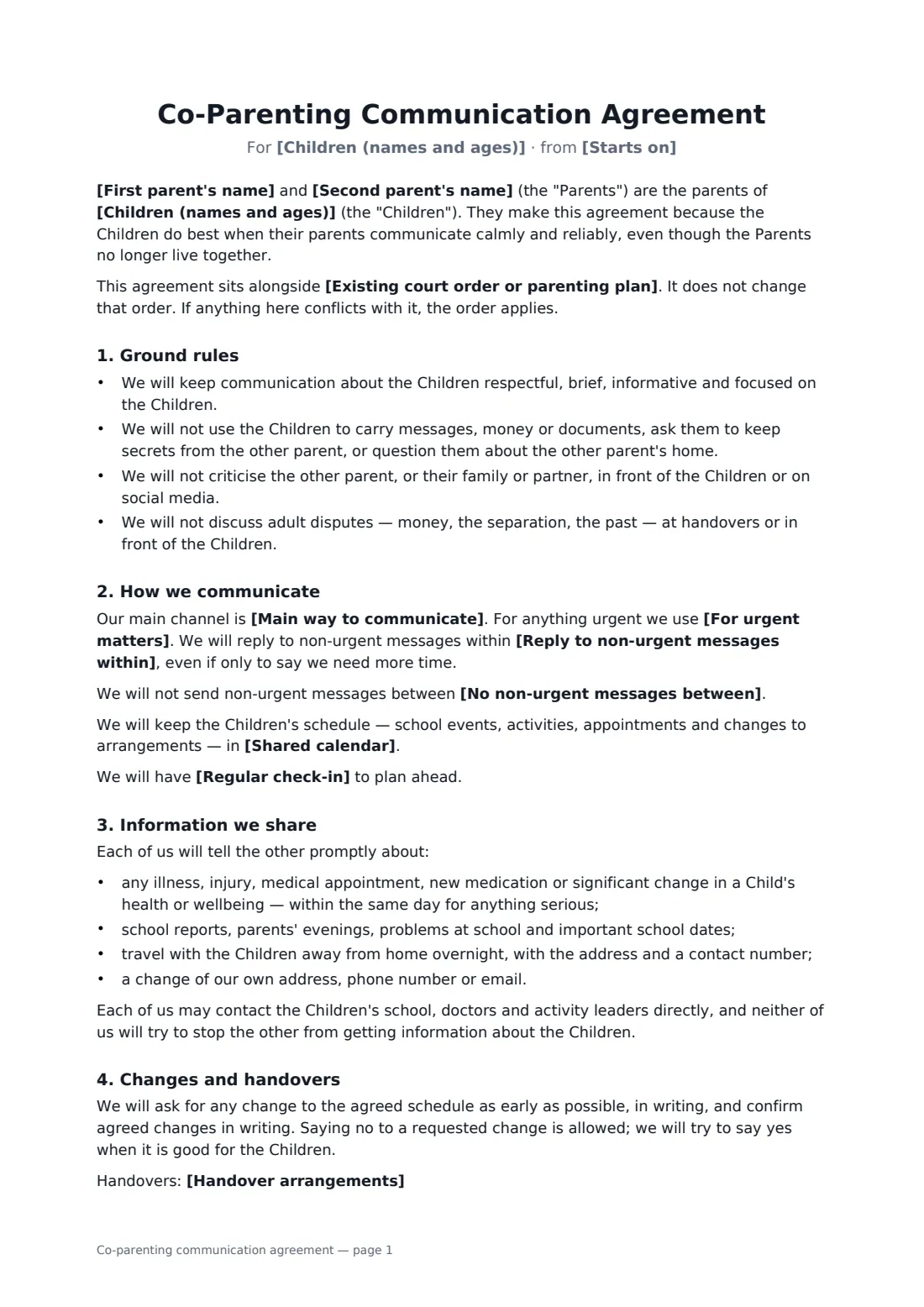
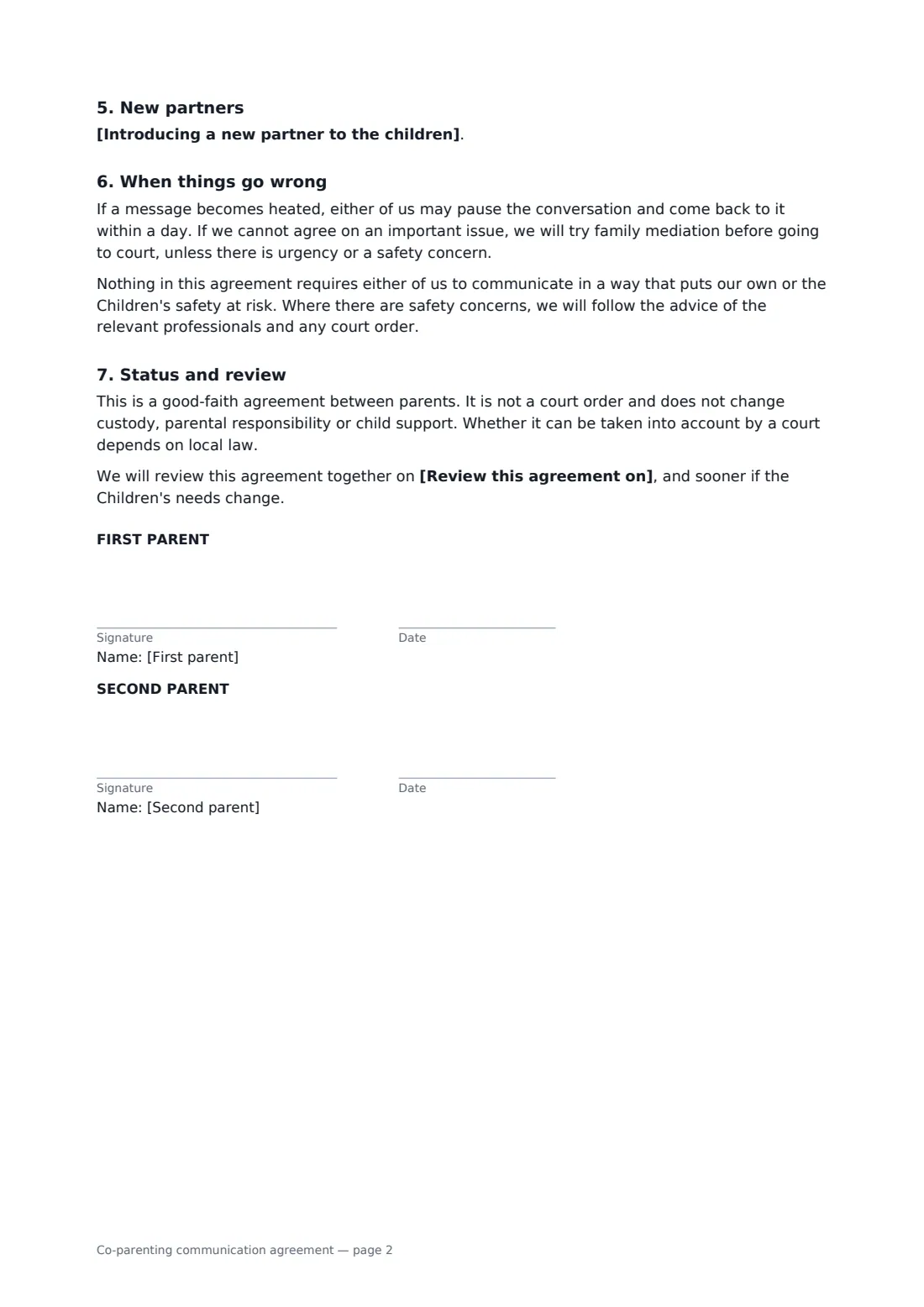
This agreement sets ground rules (keep it child-focused, don't use the children as messengers, no criticism in front of them), the main and urgent channels, a reply window, quiet hours, a shared calendar and a regular check-in. It lists what each parent shares and how fast, confirms both can talk to schools and doctors, and covers schedule changes, handovers, introducing new partners, pausing heated conversations, mediation before court, and safety. It sits alongside any court order and doesn't change custody or support.
- Best for
- Separated or divorced parents sharing care of children
- Signed by
- Both parents
- Covers
- Channels, reply times, information sharing, handovers, new partners, disputes
- Legal status
- A good-faith agreement — not a court order
- Length
- 2 pages
When to use a co-parenting communication agreement
- Parents who have just separated and want a fresh start on communication
- Adding communication rules alongside an existing parenting order
- Moving co-parenting messages onto one app or channel
- Agreeing how to handle new partners meeting the children
- A recommendation from a mediator or family counsellor
What you fill in
14 blanks, then the name and email of each person who signs: first parent, second parent.
1 The family
- First parent's name*
- Second parent's name*
- Children (names and ages)*
- Starts on*
- Existing court order or parenting plan
2 Communication
- Main way to communicate*
- For urgent matters*
- Reply to non-urgent messages within* 24 hours · 48 hours · 72 hours
- No non-urgent messages between
- Shared calendar
- Regular check-in
3 Handovers
- Handover arrangements
4 Other points
- Introducing a new partner to the children* We will tell the other parent before the Children meet a new partner · We will tell the other parent once a new relationship is serious and long-term, and before the Children meet the new partner regularly · Each of us will use good judgement and keep the Children's interests first
- Review this agreement on
5 Who signs
- First parent signature and date
- Second parent signature and date
What the co-parenting communication agreement covers
- Ground rules
- How we communicate
- Information we share
- Changes and handovers
- New partners
- When things go wrong
- Status and review
Using the co-parenting communication agreement, step by step
1 The family
Enter both parents' names, the children and the start date. If there's a court order or parenting plan, note it — the agreement says the order wins in any conflict.
2 How you'll communicate
Choose the main channel, the urgent channel, the reply window and quiet hours. Add a shared calendar and a regular check-in if you'll use them.
3 Handovers and new partners
Describe handover arrangements and choose how you'll handle introducing a new partner.
4 Sign and review
Set a review date, send it to the other parent, and both sign online. The signed PDF is filed in your FileIt vault alongside the children's documents.
Tips before you send it
- Keep messages short and factual — one topic per message helps.
- Use one channel for everything non-urgent, so nothing gets lost.
- Review the agreement as the children grow; what works for toddlers won't for teens.
- If there are safety concerns or a history of abuse, get professional advice — this agreement is not a substitute for protective arrangements.
Sign it online in minutes
- Fill in the blanks. Names, dates and amounts go straight into the agreement — the preview shows exactly where.
- Name who signs. Tick “This is me” for your own part. FileIt builds the PDF with every signature, date box on the right line, and you can check or move anything before sending.
- Send it. Each signer gets a secure link and signs from any device — no account needed. The signed PDF, with an audit trail and a Certificate of Completion, is filed in your vault and emailed to everyone.
Co-parenting communication agreement: frequently asked questions
Does this replace a parenting plan or custody order?
No. It deals only with communication and sits alongside any order. It says the order applies in any conflict, and that it doesn't change custody, parental responsibility or child support.
Is it legally binding?
It's written as a good-faith agreement between parents. Whether a court would take it into account depends on local law.
What if one parent breaks it?
The agreement suggests pausing heated conversations and trying family mediation before going to court, unless there's urgency or a safety concern.
Can we sign it without meeting?
Yes. Each parent signs online on their own device, and both get the signed PDF with an audit trail and a Certificate of Completion.
What about safety concerns?
The agreement says neither parent has to communicate in a way that puts themselves or the children at risk, and that professional advice and court orders come first.