What is a bereavement notification letter?
After a death, someone has to tell every bank, energy supplier, phone company and insurer the person dealt with. Each one asks the same questions: who died and when, which accounts, who you are, and what you want done. Writing it out once, clearly, saves repeating it on the phone while you are grieving, and gives the company everything its bereavement team needs to act.
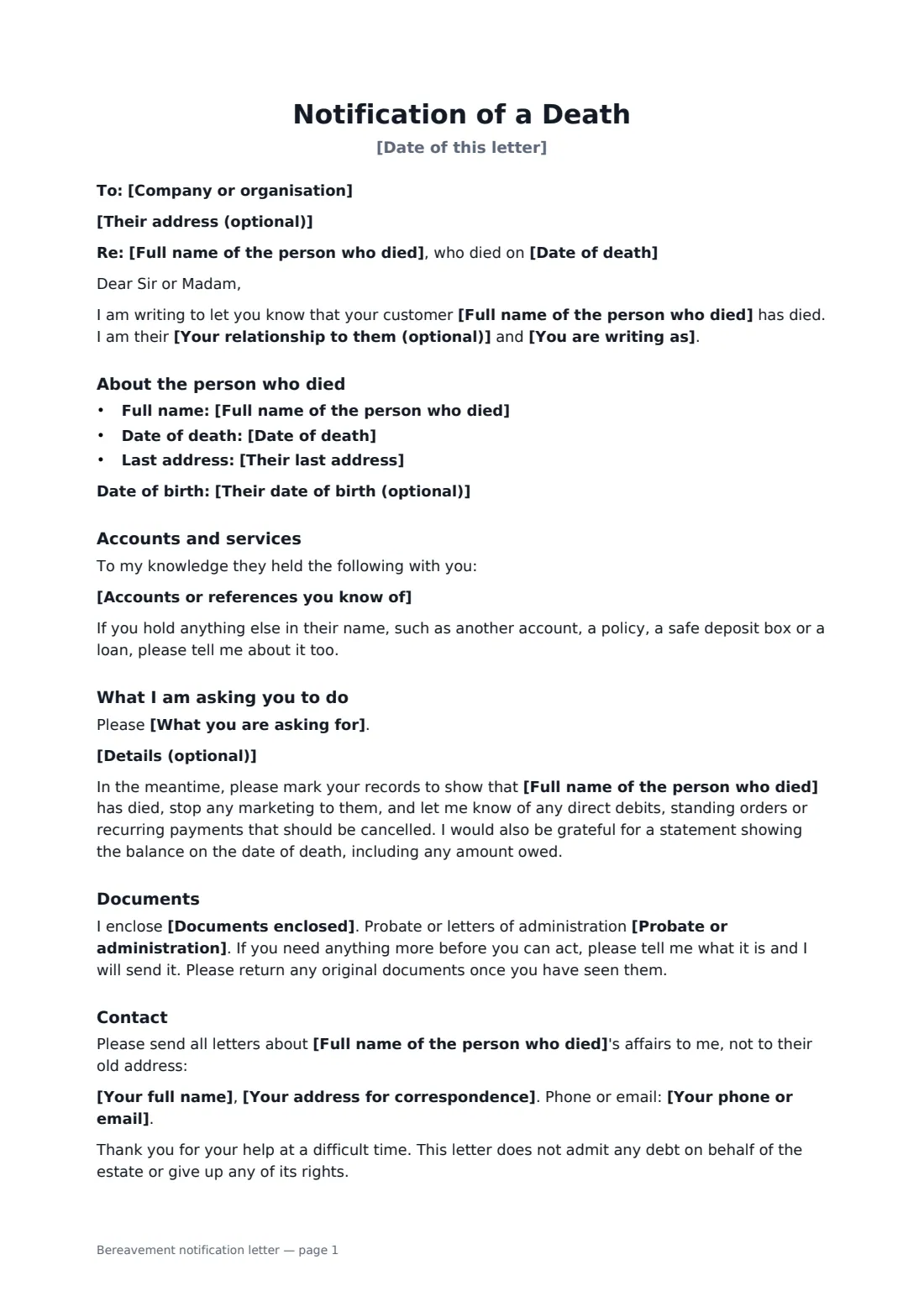
This letter gives the person's full name, date of death, last address and, if you have it, their date of birth, then lists the accounts you know of with partial numbers only. You choose what you are asking for: freeze the accounts until the estate is ready, close them with a final statement, pay the balance to the estate, or move a service into someone else's name. It asks the company to stop marketing, flag recurring payments and say what the balance was on the date of death. It records the documents you enclose, where probate or administration stands, any joint holder, and the address all future letters should go to. Someone at the company can sign to confirm the letter arrived.
- Best for
- Executors and families telling banks, utilities, insurers and other companies about a death
- Signed by
- You, plus the company's acknowledgement of receipt
- Asks to
- Freeze, close, pay the balance to the estate or transfer a service
- Length
- 2 pages
When to use a bereavement notification letter
- An executor writing to each bank where a parent held an account
- Asking an energy or water supplier to move the account into the surviving partner's name
- Closing a phone contract, streaming service or gym membership
- Telling an insurer or pension provider and asking what they need to pay out
- Stopping post and marketing addressed to someone who has died
What you fill in
19 blanks, then the name and email of each person who signs: person writing, company.
1 The letter
- Date of this letter*
- Company or organisation*
- Their address (optional)
2 About you
- Your full name*
- You are writing as* the executor named in their will · the administrator of their estate · their next of kin · a family member helping with their affairs
- Your relationship to them (optional)
- Your address for correspondence*
- Your phone or email*
3 The person who died
- Full name of the person who died*
- Their date of birth (optional)
- Date of death*
- Their last address*
4 Accounts
- Accounts or references you know of*
- What you are asking for* freeze the accounts until the estate is ready to deal with them · close the accounts and send a final statement · close the accounts and pay any balance to the estate · transfer the service into the name of the person below · as set out below
- Details (optional)
- Joint accounts* none that I know of · some of these accounts are held jointly with the person named below
- Joint holder's name (optional)
5 Documents
- Documents enclosed*
- Probate or administration* has not been applied for yet · has been applied for · has been granted and a copy is enclosed · I am told it will not be needed
6 Who signs
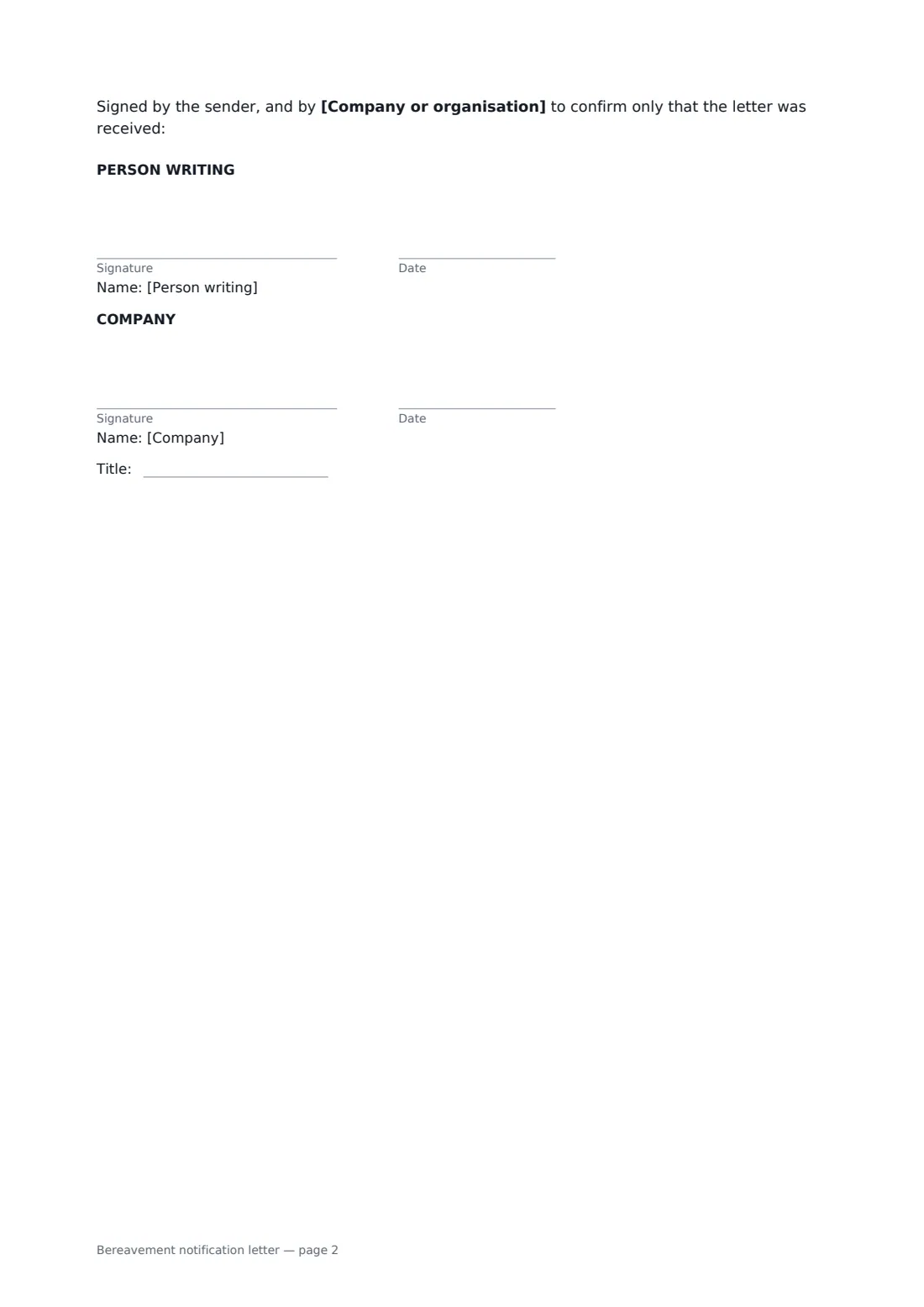
- Person writing signature and date · The executor, administrator or family member dealing with the person's affairs.
- Company signature and date, job title · Someone at the bank, utility or company, often its bereavement team. They sign only to confirm the letter arrived.
What the bereavement notification letter covers
- About the person who died
- Accounts and services
- What I am asking you to do
- Documents
- Contact
Using the bereavement notification letter, step by step
1 About you
Your name fills in from your account. Say whether you are the executor, the administrator, next of kin or a family member helping, and add the address where you want all letters sent from now on.
2 The person who died
Enter their full name as the company knows it, the date of death and their last address. A date of birth helps the company find the right record.
3 Accounts and request
List the accounts or references you know of, using only the last few digits. Pick what you want done, add details for a transfer, and name any joint holder.
4 Documents and sending
Note what you enclose, usually a copy of the death certificate, and where probate stands. Sign, then send it through FileIt and keep the signed copy with the rest of the estate papers in your vault.
Tips before you send it
- Make one copy of the letter per company. It is quicker to fill in a fresh one than to cover several companies in one letter.
- Ask the registrar for several certified copies of the death certificate. Many companies want one each.
- Some countries run a free service that tells several government offices or banks at once. Check for one before writing to each separately.
- Keep a list of who you wrote to and when, with any reference number they give you. The signed letters in your FileIt vault help with that.
Sign it online in minutes
- Fill in the blanks. Names, dates and amounts go straight into the agreement — the preview shows exactly where.
- Name who signs. Tick “This is me” for your own part. FileIt builds the PDF with every signature, date box on the right line, and you can check or move anything before sending.
- Send it. Each signer gets a secure link and signs from any device — no account needed. The signed PDF, with an audit trail and a Certificate of Completion, is filed in your vault and emailed to everyone.
Bereavement notification letter: frequently asked questions
Do I need to be the executor to send this?
No. Any family member can tell a company about a death and ask for accounts to be frozen. Closing accounts or paying out money usually needs the executor or administrator, and the company will tell you what proof it wants.
Should I send the original death certificate?
Usually a certified copy is enough, and the letter asks for any originals to be returned. Check the company's bereavement page first.
Does this letter make me responsible for the debts?
The letter says it does not admit any debt on behalf of the estate. Whether family members are liable for a debt depends on the account and local law, so ask for advice if a company says you owe it.
Why would the company sign it?
Their signature confirms only that the letter arrived, and when. If they don't sign, the FileIt audit trail still shows when it was sent and opened.
Can I send it by email instead of post?
Many bereavement teams accept letters by email or upload. If a company insists on post, print the signed PDF and post it with the enclosures.