What is Form W-4R?
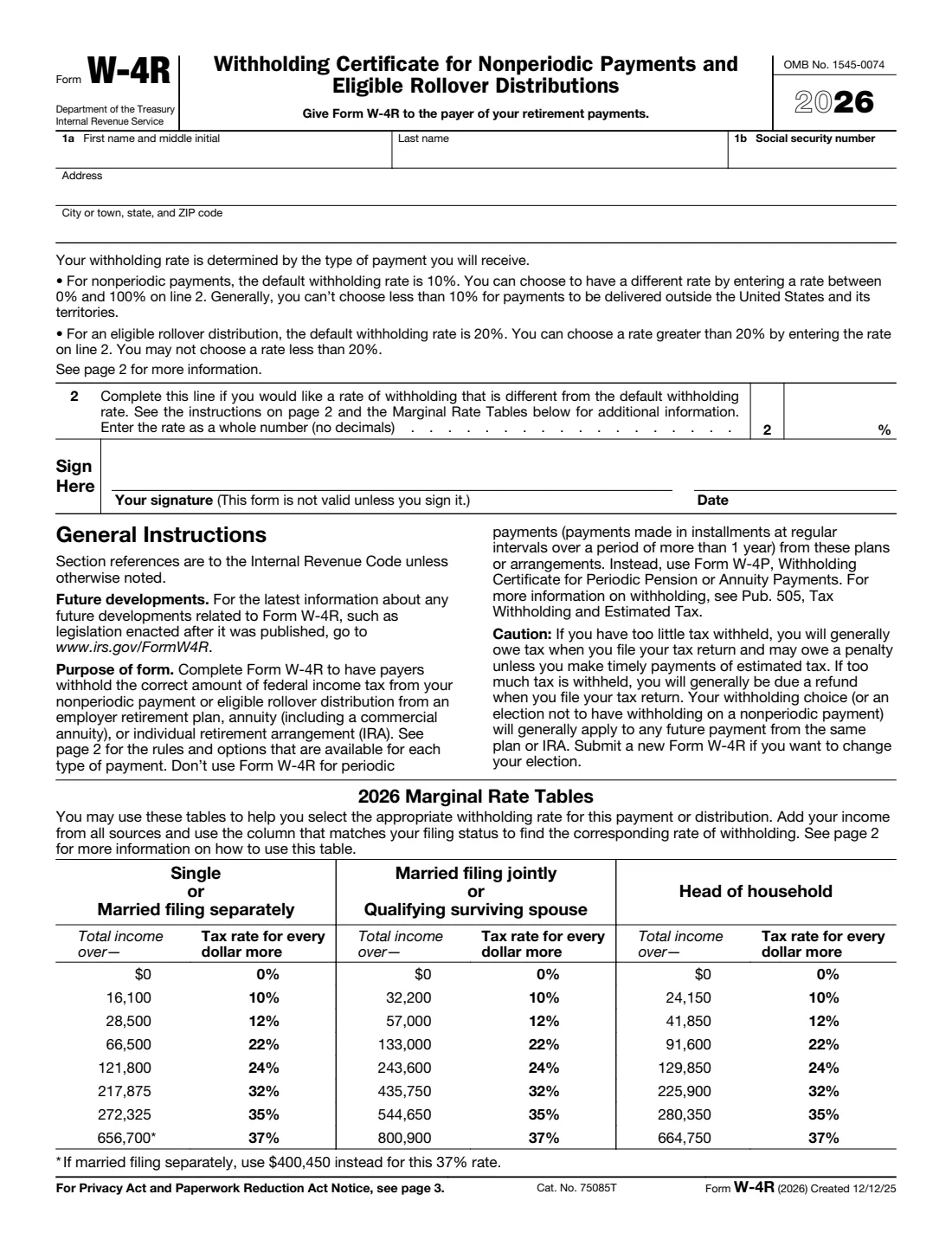
Form W-4R tells the payer of a nonperiodic retirement payment what rate of federal income tax to withhold. It covers one-time or irregular payments from an employer retirement plan, an annuity (including a commercial annuity) or an IRA, including IRA distributions payable on demand, and it covers eligible rollover distributions from plans such as 401(k)s and governmental 457(b) plans that are paid to you rather than rolled over. The form itself is short: your name, address and SSN, one line for a whole-number rate, and your signature.
The defaults matter. A nonperiodic payment is withheld at 10% unless you enter a different rate between 0% and 100%. An eligible rollover distribution is withheld at 20%, and you can only choose more, never less. The IRS notes that either default may not suit your situation, which is why page 1 carries the 2026 Marginal Rate Tables and page 2 explains how to use them to pick a rate.
FileIt asks what kind of payment you're getting, checks the rate against the form's limits, and has an optional helper that applies the 2026 Marginal Rate Tables exactly as page 2 describes: it spreads the payment across the tax brackets it falls into and rounds up to a whole percent. Your answers are printed into the IRS's own PDF, which is saved in your vault and can be sent for e-signature. You give the form to your payer yourself — FileIt never sends anything to the IRS or to the payer.
- Who fills it
- The person receiving the payment (the payee), or an estate using its EIN.
- Given to
- The payer: your plan administrator, insurer or IRA custodian. Not the IRS.
- Default rates
- 10% for nonperiodic payments; 20% for eligible rollover distributions.
- Rate range
- 0-100% for nonperiodic payments (at least 10% if delivered outside the U.S.); more than 20% for rollover distributions.
- Signatures
- You sign and date it. The form is not valid unless you sign it.
- Edition
- 2026 (created 12/12/25)
Who needs to fill out Form W-4R?
- Anyone taking a lump-sum or one-time withdrawal from a 401(k), 403(b), 457(b) or other employer retirement plan who wants a withholding rate other than the default.
- IRA owners taking withdrawals payable on demand, which count as nonperiodic payments.
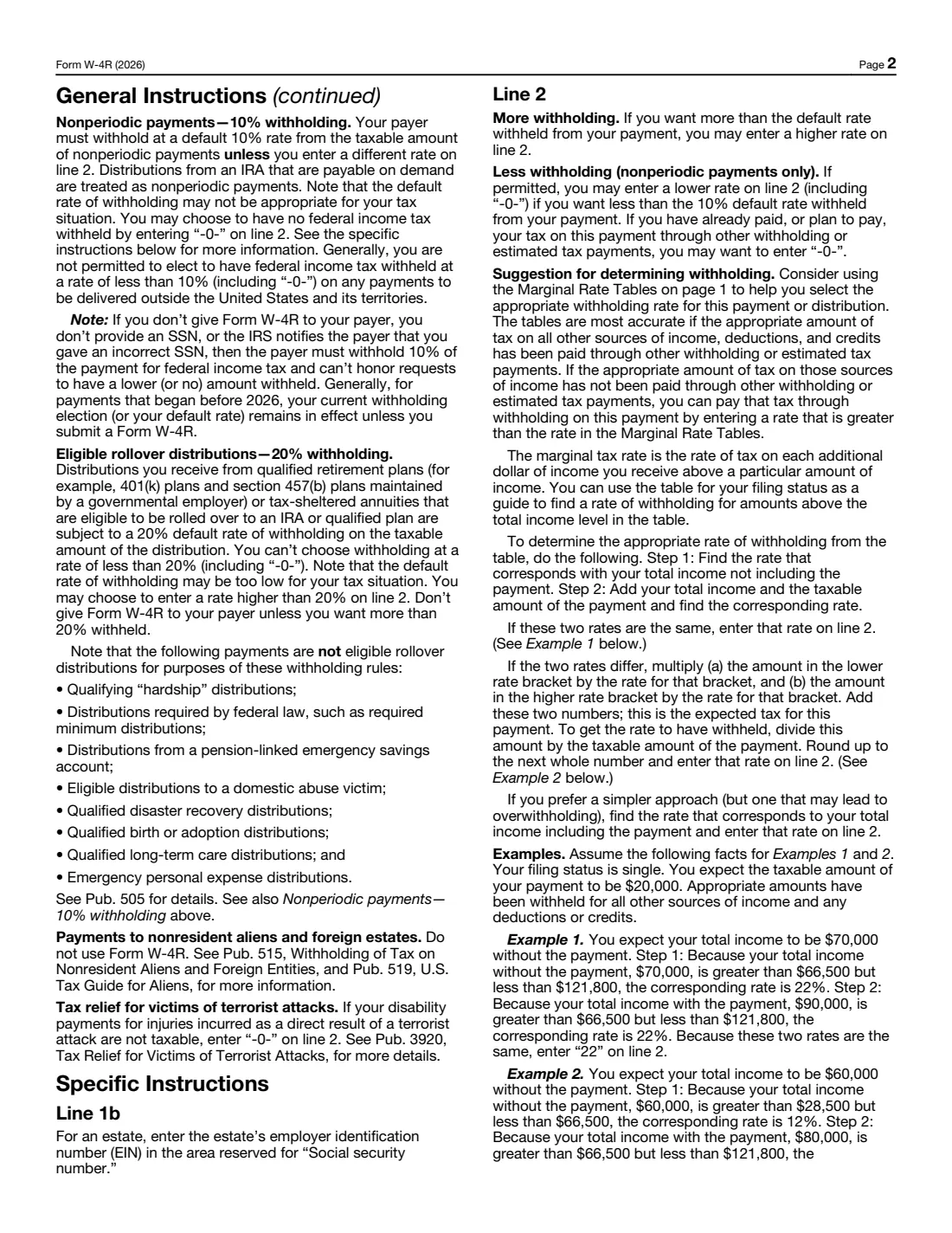
- People taking a required minimum distribution or hardship distribution (not eligible rollover distributions) who want more or less than 10% withheld.
- Anyone receiving an eligible rollover distribution paid to them who wants more than 20% withheld.
- Retirees who already cover their tax through other withholding or estimated payments and want no withholding on a nonperiodic payment.
- The executor of an estate receiving such a payment, using the estate's EIN.
When to use Form W-4R
- Before a lump-sum withdrawal, IRA distribution or rollover-eligible payout, when the payer asks how much tax to withhold.
- When the default 10% would leave you owing tax, or would take more than you need, for example because the payment pushes you into a higher bracket.
- When you want to change a previous election: your choice generally applies to future payments from the same plan or IRA until you submit a new W-4R.
- Not for periodic pension or annuity installments paid over more than a year: those use Form W-4P.
- Not for payments to nonresident aliens or foreign estates, which the form says not to use it for (see Pubs. 515 and 519).
What you need before you start
- Your full name, address and Social Security number (or the estate's name and EIN).
- Whether the payment is a nonperiodic payment or an eligible rollover distribution. Your payer's paperwork usually says.
- If you want the rate helper: your filing status, your expected 2026 income from all other sources, and the taxable amount of this payment.
- Whether the payment will be delivered outside the United States and its territories.
What’s on Form W-4R
The 2026 edition has 3 pages. FileIt asks for it in 3 parts, and it is signed by Payee (the person receiving the payment):
- Line 1: Your detailsPayee (the person receiving the payment)
- Line 2: Your withholding ratePayee (the person receiving the payment)
- Rate helper: 2026 Marginal Rate Tables (optional)Payee (the person receiving the payment)
How to fill out Form W-4R, step by step
1 Line 1: Your name, address and SSN
Enter your name, address and Social Security number. For an estate, the line 1b instructions say to put the estate's employer identification number in the SSN box.
The SSN matters: if you don't give one, or the IRS tells the payer it's wrong, the payer must withhold 10% of a nonperiodic payment and can't honor a request for less (or none).
2 Line 2: Choose your rate
Leave line 2 blank to keep the default. Otherwise enter a whole number with no decimals. For a nonperiodic payment you may choose anything from 0% to 100%; to have nothing withheld, enter zero. For an eligible rollover distribution you may only choose more than 20%, and the IRS says not to give the payer a W-4R at all unless you want more than 20%.
Generally you can't choose less than 10% on payments delivered outside the United States and its territories.
3 Using the 2026 Marginal Rate Tables
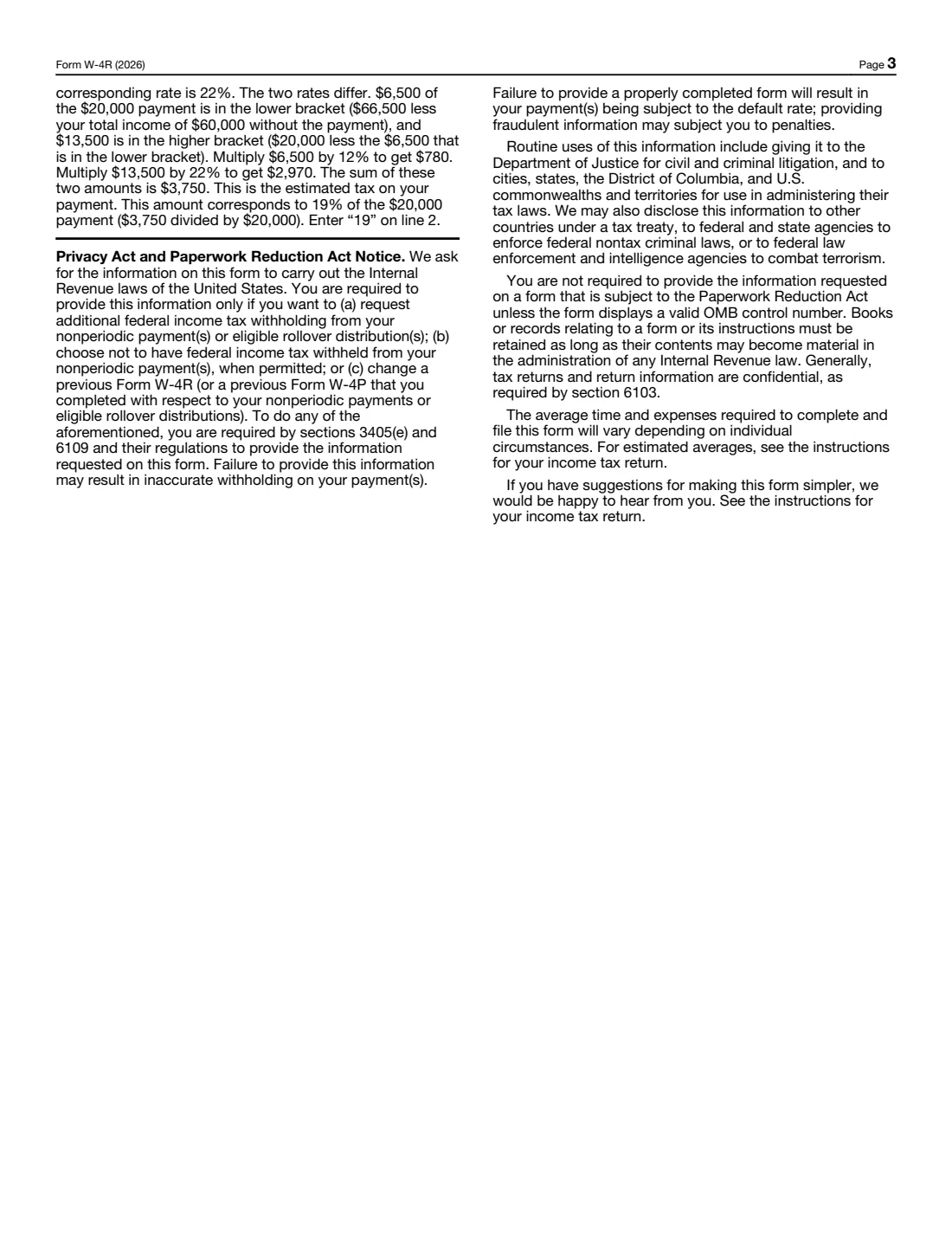
Find the rate for your total income without the payment, then with it. If both are the same, that's your rate. If they differ, multiply the part of the payment in each bracket by that bracket's rate, add the two, divide by the payment and round up to the next whole number. Page 2's example: a single filer with $60,000 of other income and a $20,000 payment gets 18.75%, rounded up to 19%.
The tables are most accurate if tax on your other income is already covered by withholding or estimated payments. FileIt's optional helper does this calculation for you for all four filing statuses, including the married filing separately threshold for the 37% rate.
4 Sign and date
Sign and date the form. It isn't valid unless you sign it.
Common mistakes to avoid
- Using W-4R for a monthly pension. Periodic payments over more than a year use Form W-4P.
- Entering less than 20% for an eligible rollover distribution. The 20% minimum can't be reduced.
- Entering a rate with decimals. The form asks for a whole number.
- Choosing 0% on a payment delivered abroad, where you generally can't go below 10%.
- Relying on the default when the payment is large. Adding a big distribution to your income can push part of it into a higher bracket than 10%.
- Sending the form to the IRS. It goes to the payer.
- Forgetting to sign.
After you fill it out
Sign and date the form, by hand or through FileIt's optional e-signature if your payer accepts it, and give it to the payer following their instructions. Many plan administrators and IRA custodians have their own upload or mailing process.
Keep the copy FileIt saves in your vault. Your election generally applies to later payments from the same plan or IRA, so it helps to know what you chose.
If too little is withheld you may owe tax and possibly a penalty when you file, unless you make timely estimated payments. If too much is withheld, you get it back as a refund. Submit a new W-4R whenever you want to change your election.
Fill out Form W-4R online with FileIt
- Pick the person. Choose someone from People and FileIt fills in their name, date of birth, address and other details it already knows.
- Answer plain-language questions. One part of the form at a time, with the official help text beside each question — 17 fields in all. Your answers save as you go.
- Check the live preview. Watch your answers land on the real Internal Revenue Service (IRS) form, and let FileIt do any worksheet arithmetic.
- Generate the official PDF. FileIt prints your answers into the agency’s own PDF and files it in that person’s folder in your vault. Sign it, or send it for e-signature.
FileIt fills the form — it never files or submits anything for you. Deliver the finished form to whoever asked for it, the way the form’s instructions say.
Start Form W-4R now — it’s freeForm W-4R: frequently asked questions
Can I fill out Form W-4R online?
Yes. FileIt walks you through it, checks your rate against the form's limits, can suggest a rate from the 2026 Marginal Rate Tables, and prints your answers into the official IRS PDF. You then sign it and give it to your payer yourself.
What's the difference between Form W-4R and Form W-4P?
W-4R is for nonperiodic payments (one-time or irregular payments, including IRA distributions payable on demand) and eligible rollover distributions. W-4P is for periodic payments made in installments at regular intervals over more than a year, like a monthly pension.
Can I have no tax withheld from my IRA withdrawal?
For a nonperiodic payment, yes: enter zero on line 2. The exceptions are payments delivered outside the U.S. and its territories (generally at least 10%) and cases where you haven't given a correct SSN, when the payer must withhold 10%.
Can I have less than 20% withheld from a 401(k) distribution?
Not from an eligible rollover distribution: 20% is the minimum. Some payments aren't eligible rollover distributions, such as hardship distributions and required minimum distributions; those follow the nonperiodic 10% rules instead. Page 2 of the form lists them.
What happens if I don't give my payer a W-4R?
The payer withholds the default: 10% of a nonperiodic payment or 20% of an eligible rollover distribution. For payments that began before 2026, your current election (or default rate) stays in effect unless you submit a new W-4R.
How do I pick the right rate?
Use the 2026 Marginal Rate Tables on page 1 as page 2 explains, or FileIt's rate helper, which does the same calculation. For a simpler approach that may over-withhold, the form says you can use the rate for your total income including the payment.
Official sources
- Blank form (PDF), published by Internal Revenue Service (IRS): https://www.irs.gov/pub/irs-pdf/fw4r.pdf
- Official instructions and guidance: https://www.irs.gov/forms-pubs/about-form-w-4-r
- Edition shown on this page: 2026 (created 12/12/25) (checked 2026-09-28).
FileIt is not affiliated with or endorsed by Internal Revenue Service (IRS) or any government. This page explains the form in general terms and is not legal, tax or immigration advice. Always read the official instructions, and check that you are using the edition the recipient accepts. Page last reviewed 2026-09-28.