What is Form TBOR 1?
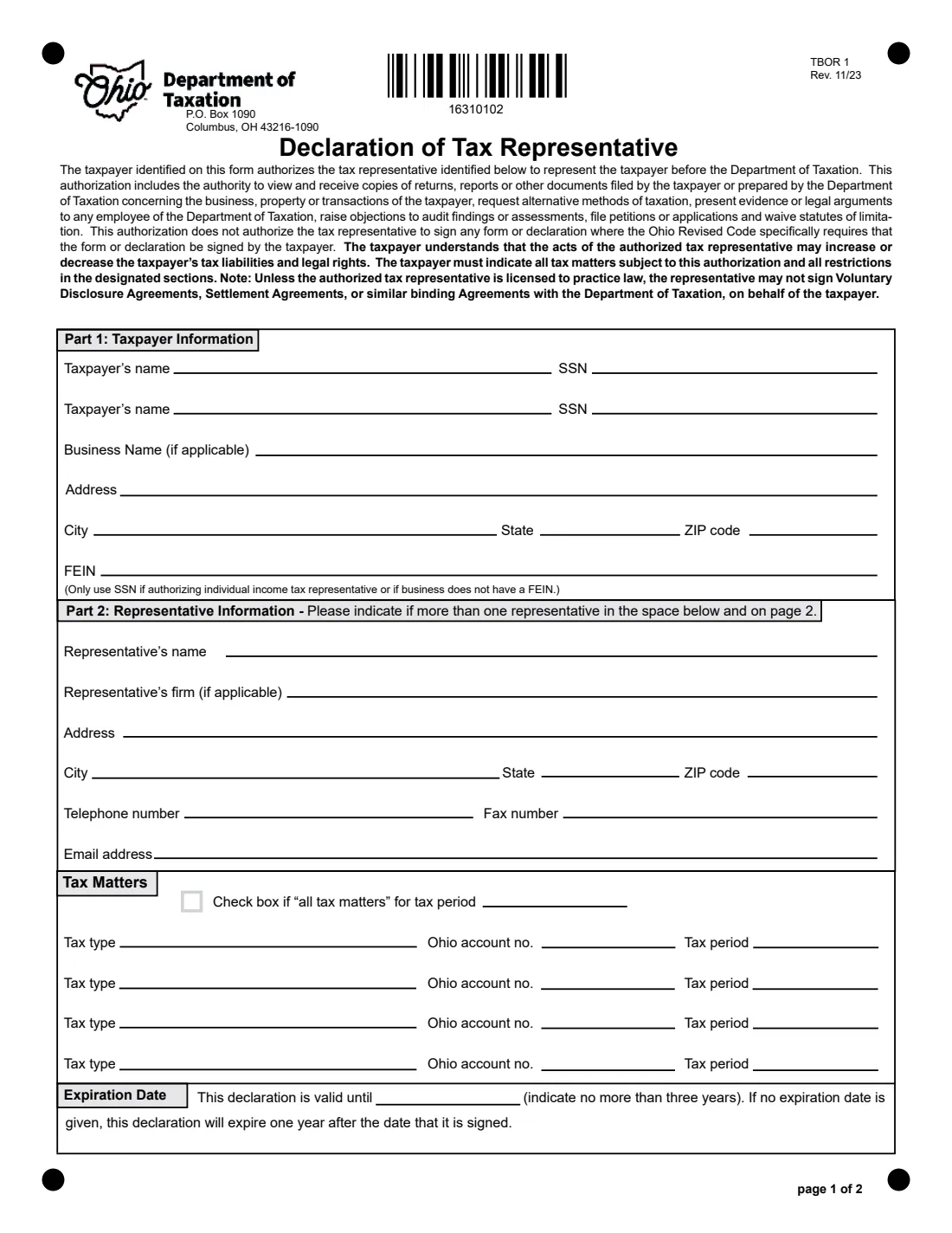
Form TBOR 1, Declaration of Tax Representative, authorizes a tax representative to represent a taxpayer before the Ohio Department of Taxation. The authority includes viewing and receiving copies of returns, reports and other documents, requesting alternative methods of taxation, presenting evidence or legal arguments, raising objections to audit findings or assessments, filing petitions or applications and waiving statutes of limitation. It doesn't let the representative sign anything Ohio law says the taxpayer must sign, and unless licensed to practice law they can't sign Voluntary Disclosure Agreements, Settlement Agreements or similar binding agreements.
You list every tax matter the authorization covers, with its Ohio account number and period, or tick all tax matters for a period, and add any restrictions. You can set an expiration date of no more than three years; without one, the declaration expires one year after it is signed. The current edition is TBOR 1 Rev. 11/23.
FileIt guides you through each part and prints your answers into the Department's own PDF. It pre-fills the taxpayer's name and email from the People records in your vault, fills the representative's designation number from their declaration, checks the expiration date, keeps the finished PDF in your vault (where you can record the expiry date to get reminders) and can send it for e-signature. You then submit it yourself: FileIt never files anything for you.
- Who fills it
- The taxpayer (or an officer, member, partner, guardian, executor or trustee for them), and the representative's declaration.
- Given to
- The Ohio Department of Taxation, through its Online Notice Response Service (tax.ohio.gov, Contact Us), gateway.ohio.gov, or by mail to P.O. Box 1090, Columbus, OH 43216-1090.
- Signatures
- The taxpayer (and spouse for a joint income tax filing) and the representative.
- Expires
- On the date you set (no more than three years), or one year after it is signed.
- Edition
- TBOR 1 Rev. 11/23
- Agency
- Ohio Department of Taxation
Who needs to fill out Form TBOR 1?
- Ohio taxpayers who want an attorney, CPA, enrolled agent or family member to deal with the Department of Taxation.
- Married couples filing jointly who want one representative for their income tax.
- Businesses letting an officer, employee or outside professional handle sales tax, withholding or other Ohio tax matters.
- Taxpayers with an audit, assessment or petition who want someone to present evidence and objections for them.
When to use Form TBOR 1
- Before a representative contacts the Department of Taxation about your returns, audits or assessments.
- When responding to a notice through a representative.
- To renew an authorization that has expired: one year after signing, or on the date you set.
- To revoke a declaration, use the same submission method you used to file it.
What you need before you start
- The taxpayer's name and SSN (and spouse's for a joint filing), business name if any, address and FEIN.
- The representative's name, firm, address, phone, fax and email.
- The tax types, Ohio account numbers and tax periods to cover, or the period for all tax matters.
- Any restrictions you want to place on the representative.
- The representative's designation (attorney, CPA, enrolled agent, officer, employee, family member or other), state and license number.
What’s on Form TBOR 1
The 2023 edition has 2 pages. FileIt asks for it in 7 parts, and it is signed by Taxpayer and Spouse and Representative:
- Part 1: Taxpayer informationTaxpayer
- Part 1: Second taxpayer (joint income tax return)Spouse
- Part 2: Representative informationRepresentative
- Tax matters and expiration dateTaxpayer
- Restrictions to this declarationTaxpayer
- Declaration of representativeRepresentative
- Taxpayer signatureTaxpayer
How to fill out Form TBOR 1, step by step
1 Part 1: Taxpayer information
Enter the taxpayer's name and SSN, a second taxpayer for a joint filing, the business name if applicable, the address and the FEIN. The form says to use an SSN only when authorizing an individual income tax representative or when a business doesn't have a FEIN.
2 Part 2: Representative information
Give the representative's name, firm, address, telephone, fax and email.
3 Tax matters
Tick the box to cover all tax matters for a tax period, or list each tax type with its Ohio account number and tax period. The taxpayer must indicate every tax matter the authorization covers.
4 Expiration date
Optionally enter the date the declaration is valid until, no more than three years ahead. With no date, it expires one year after it is signed.
5 Restrictions
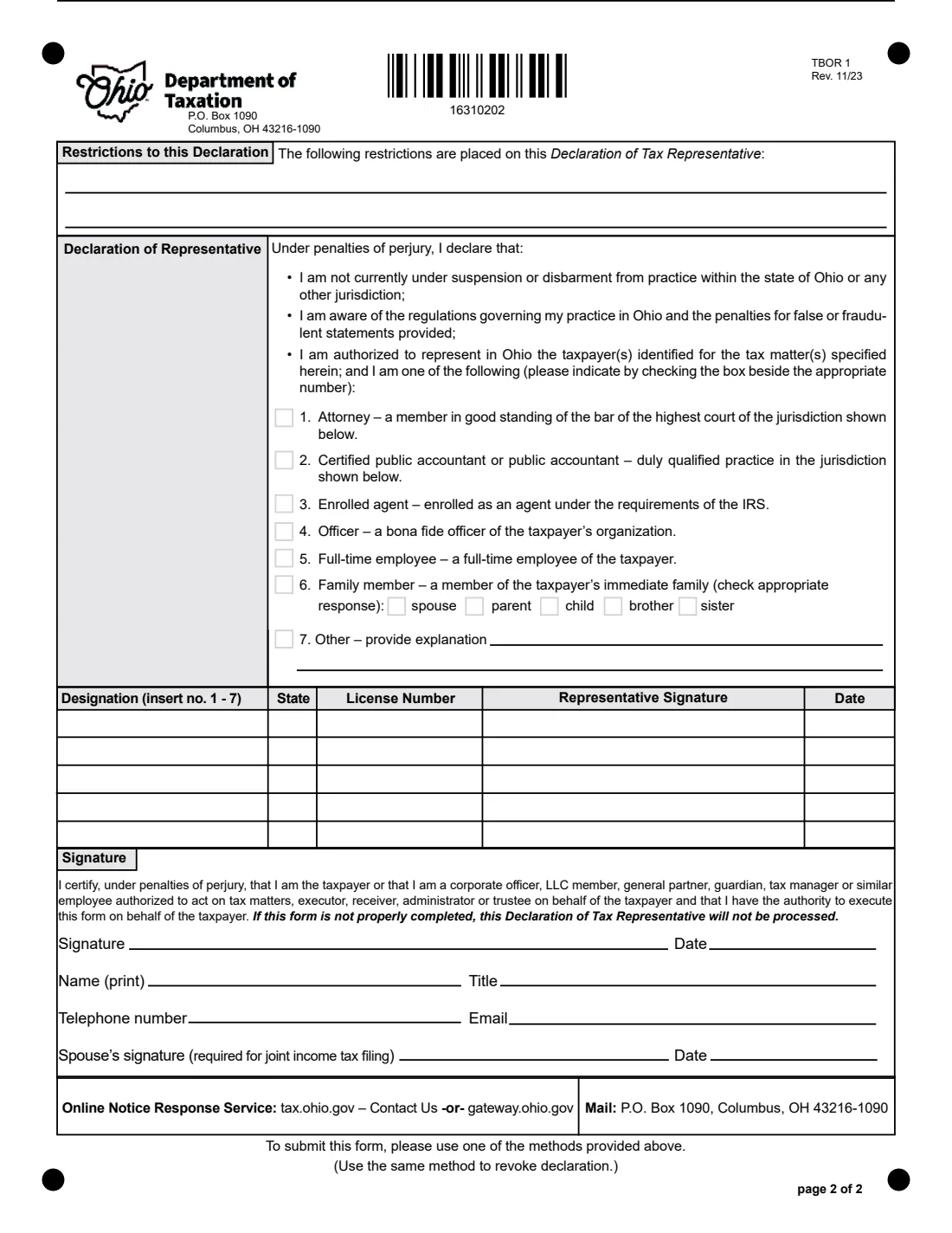
List any restrictions you place on the representative on page 2, or leave it blank.
6 Declaration of representative
The representative declares under penalties of perjury that they aren't suspended or disbarred, know the rules for practice in Ohio and are authorized for these matters, ticks their designation (1 attorney, 2 CPA or public accountant, 3 enrolled agent, 4 officer, 5 full-time employee, 6 family member, 7 other with an explanation) and completes the table with the number, state, license number, signature and date.
7 Signature
The taxpayer, or an authorized corporate officer, LLC member, general partner, guardian, tax manager, executor, receiver, administrator or trustee, signs, dates and prints their name, title, phone and email. A spouse signs for a joint income tax filing.
Common mistakes to avoid
- Leaving out tax matters. The taxpayer must list every matter the authorization covers.
- Setting an expiration date more than three years away.
- Forgetting the spouse's signature for a joint income tax filing.
- Using an SSN for a business that has a FEIN.
- Expecting a non-attorney representative to sign a Voluntary Disclosure or Settlement Agreement.
- Leaving the form incomplete. The form says an improperly completed declaration won't be processed.
After you fill it out
The taxpayer (and spouse, if joint) and the representative sign and date page 2. Sign the printed PDF by hand, or use FileIt's optional e-signature, which places each signer's signature and date boxes.
Submit it through the Online Notice Response Service (tax.ohio.gov, Contact Us) or gateway.ohio.gov, or mail it to P.O. Box 1090, Columbus, OH 43216-1090. FileIt doesn't send it.
FileIt keeps the completed PDF in your vault. Record its expiry date (the date you set, or one year after signing) to be reminded to renew it, and use the same submission method to revoke it.
Fill out Form TBOR 1 online with FileIt
- Pick the person. Choose someone from People and FileIt fills in their name, date of birth, address and other details it already knows.
- Answer plain-language questions. One part of the form at a time, with the official help text beside each question — 46 fields in all. Your answers save as you go.
- Check the live preview. Watch your answers land on the real Ohio Department of Taxation form, and let FileIt do any worksheet arithmetic.
- Generate the official PDF. FileIt prints your answers into the agency’s own PDF and files it in that person’s folder in your vault. Sign it, or send it for e-signature.
FileIt fills the form — it never files or submits anything for you. Deliver the finished form to whoever asked for it, the way the form’s instructions say.
Start Form TBOR 1 now — it’s freeForm TBOR 1: frequently asked questions
Can I fill out Ohio Form TBOR 1 online?
Yes. FileIt guides you through each part and prints your answers into the official Ohio Department of Taxation PDF, ready to sign and submit.
How long is an Ohio Declaration of Tax Representative valid?
Until the date you enter, which can be no more than three years. If you don't give one, it expires one year after the date it is signed.
How do I submit TBOR 1?
Through the Online Notice Response Service (tax.ohio.gov, Contact Us), through gateway.ohio.gov, or by mail to P.O. Box 1090, Columbus, OH 43216-1090.
How do I revoke a TBOR 1?
Use the same method you used to submit the declaration.
Can my representative sign agreements with the Department?
Only a representative licensed to practice law can sign Voluntary Disclosure Agreements, Settlement Agreements or similar binding agreements for you. No representative can sign a form Ohio law requires the taxpayer to sign.
Can a family member be my Ohio tax representative?
Yes. Designation 6 covers the taxpayer's spouse, parent, child, brother or sister.
Official sources
- Blank form (PDF), published by Ohio Department of Taxation: https://dam.assets.ohio.gov/image/upload/tax.ohio.gov/forms/miscellaneous/tbor1-fi.pdf
- Official instructions and guidance: https://dam.assets.ohio.gov/image/upload/tax.ohio.gov/forms/miscellaneous/tbor1-fi.pdf
- Edition shown on this page: TBOR 1 Rev. 11/23 (checked 2026-09-28).
FileIt is not affiliated with or endorsed by Ohio Department of Taxation or any government. This page explains the form in general terms and is not legal, tax or immigration advice. Always read the official instructions, and check that you are using the edition the recipient accepts. Page last reviewed 2026-09-28.